
Tips
ADHD Chronotype: How to Work With Your Body Clock
ADHD Chronotype: How to Work With Your Body Clock
If you have ADHD, there's a good chance your body wants to stay up until 2 a.m. and sleep until 10. It's not laziness or bad habits. The ADHD brain genuinely runs on a delayed internal clock, and fighting it head-on tends to produce exhaustion rather than productivity.
Understanding your chronotype as someone with ADHD is one of the most underrated adjustments you can make to your daily routine. It doesn't mean rearranging your entire life. It means knowing when your brain actually comes online and building your schedule around that reality rather than around what everyone else does.
This guide explains what ADHD chronotype research shows, how to identify your own peak window, and what to do with that information in practical terms.
Key Takeaways
ADHD is strongly associated with Delayed Sleep Phase Syndrome, which biologically pushes bedtimes and wake times later than average
Most ADHD adults are Wolf chronotypes (night owls), though individual variation is real and worth measuring
Scheduling your most demanding tasks during your actual peak focus window, rather than default morning hours, can produce a meaningful improvement in output and reduces task avoidance
What Is a Chronotype, and Why Does ADHD Change It
A chronotype is your body's natural preference for when to sleep and wake, determined largely by genetics and the timing of your circadian rhythm. The four main chronotype categories are Lion (early riser), Bear (aligned with the sun), Wolf (night owl), and Dolphin (light sleeper with irregular patterns).
ADHD complicates this significantly. Research consistently shows that people with ADHD have higher rates of disrupted circadian rhythms, specifically a condition called Delayed Sleep Phase Syndrome (DSPS). In DSPS, the body's internal clock runs two to four hours later than average. Your brain doesn't register sleepiness at a normal bedtime, and you don't feel alert until well after a typical morning start.
This isn't a preference or a discipline problem. It's a neurobiological reality. The dopamine system that regulates ADHD is also deeply involved in controlling the sleep-wake cycle, which is why ADHD and sleep disorders overlap so frequently. The brain that struggles to initiate tasks during the day also struggles to initiate sleep at night.
The Most Common Chronotypes in ADHD Adults
While individual variation exists, surveys and clinical data lean heavily in one direction: most adults with ADHD identify as Wolves or late Bears. The Wolf chronotype peaks mentally in the late morning to early afternoon, hits a strong second energy window in the late evening, and finds early mornings genuinely unproductive.
The Dolphin chronotype is also overrepresented in people with ADHD. Dolphins have light, fragmented sleep and tend toward anxiety-driven insomnia. They often feel most focused in mid-morning after a slow start, but their energy is inconsistent day to day.
If you've always assumed you were a night owl because you stayed up too late scrolling, consider whether the scrolling was the cause or the symptom. Many ADHD adults use stimulating content late at night because their brains aren't tired yet, not because they chose to stay up. The direction of the causal arrow matters for what you do about it.
Why ADHD Brains Resist Morning Schedules
Standard productivity advice defaults to mornings. Wake up at 5 a.m., do your most important work first, and taper into lighter tasks as the day progresses. For Lion chronotypes without ADHD, this works. For most ADHD adults, it's actively counterproductive.
The ADHD executive function system, which handles task initiation, working memory, and focus, comes online later in the day than average. Attempting deep work before your brain has reached operating temperature tends to produce avoidance, frustration, and a sense of failure that colors the rest of the day. ADHD time blindness is also at its worst in the morning, when cognitive load capacity is still low.
There's also the medication factor. For ADHD adults who take stimulant medication, the timing of the dose affects when focus peaks. Taking medication at 7 a.m. and trying to do deep work at 7:30 isn't enough time for it to reach therapeutic effect. Most people see peak benefit 60-90 minutes after taking it, which is worth building around rather than ignoring.
How to Find Your Real Peak Focus Window
The quickest way to identify your chronotype isn't a quiz. It's tracking when you actually feel mentally sharp over two weeks and looking for the pattern.
Track three things at three points in the day (morning, early afternoon, late afternoon): your energy level on a 1-5 scale, your ability to start tasks without resistance, and how well you retain information you just read. After two weeks, the clusters become obvious. Most ADHD adults find one clear peak window and one dead zone where cognitive tasks feel like moving through water.
If you use a wearable like an Oura Ring or Apple Watch, heart rate variability (HRV) data in the morning gives you a proxy for readiness. Lower HRV means your nervous system is still recovering; higher HRV typically correlates with better cognitive availability. Pairing this with your subjective tracking accelerates the process.
Finding your chronotype is a starting point, not a conclusion. Your peak window shifts based on sleep quality the night before, stress load, and whether you're in a hyperfocus period. The goal is to identify your baseline pattern and work with it while leaving room for variation.
Structuring Your Day Around Your Chronotype
Once you know your peak window, the move is simple in principle and harder in practice: protect it for cognitive work and let everything else fill in around it.
If your peak is 10 a.m. to 1 p.m., that window should hold your hardest tasks, not your email backlog. Use the hour before your peak for lower-stakes warm-up activities: reviewing your task list, answering messages, organizing. Use the hour after your peak for collaborative work, admin, or anything that doesn't require deep concentration.
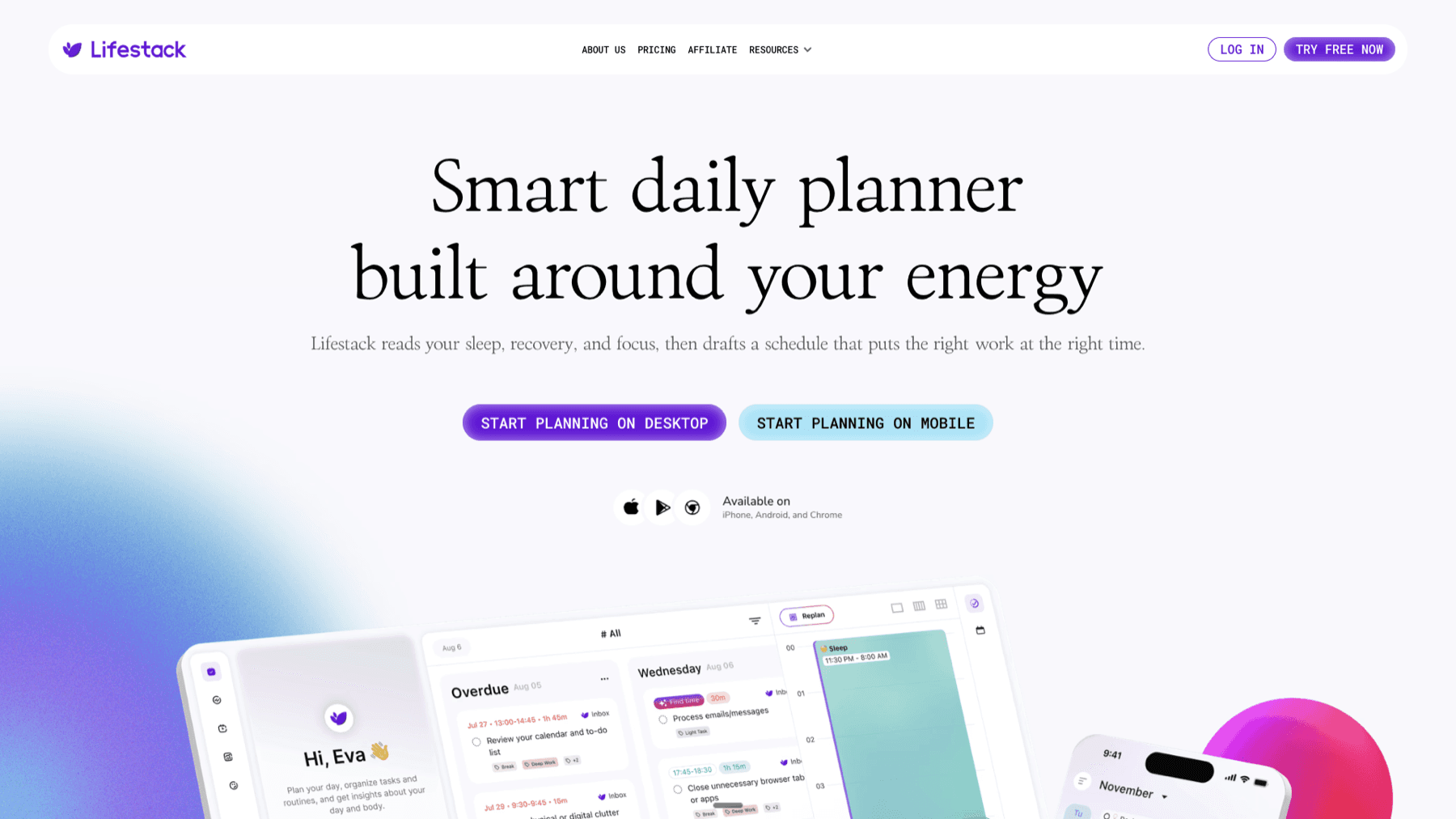
Lifestack automates this by reading your sleep and energy data and scheduling tasks in the time blocks where your focus is actually available. Rather than manually guarding your peak window each morning, the calendar adapts to your recovery and cognitive state automatically. For ADHD adults who struggle with task initiation and planning overhead, having the structure generated rather than built from scratch each day removes a significant friction point.
This approach is what energy-based scheduling looks like when applied to ADHD. You're not fighting your chronotype; you're building a system that uses it. The difference in output when hard work lands in a real focus window versus a depleted one is not subtle.
More on this: why energy-based planning beats time blocking for ADHD brains in particular.
Working With External Schedule Constraints
Not everyone can arrange their day around their chronotype. Jobs have fixed hours. Kids have school drop-off. Meetings get scheduled at 9 a.m. regardless of your sleep phase.
The goal in constrained situations isn't a perfect schedule; it's minimizing the damage. A few things that help:
Batch shallow work in the morning. If you have to be at a desk before your brain is ready, fill that time with email, Slack, and administrative tasks. Reserve deep work for after your cognitive window opens.
Protect one block of 90-120 minutes at your peak. Even if you can't restructure your entire day, having one protected deep work slot at your natural peak is worth more than multiple unfocused hours in the morning.
Use light strategically. Bright light exposure within 30 minutes of waking advances the circadian clock over time and can partially shift your peak window earlier. This takes weeks, not days.
Don't compound the problem with late-night screens. Blue light suppresses melatonin onset, which further delays your already-delayed ADHD sleep phase. ADHD sleep tips covers this in more detail.
Also worth reading: building an ADHD morning routine that accounts for slow cognitive start times, and what the research actually says about ADHD night productivity.
Frequently Asked Questions
What chronotype is most common with ADHD?
Wolf (night owl) is the most commonly reported chronotype among adults with ADHD, followed by Dolphin. This aligns with the high prevalence of Delayed Sleep Phase Syndrome in ADHD. Lion chronotypes exist in the ADHD population but are less common than in the general population.
Can you change your chronotype if you have ADHD?
You can shift it modestly over time with consistent light exposure, meal timing, and sleep schedule adherence. Shifting more than one to two hours is generally not sustainable and often rebounds. Working with your natural chronotype tends to produce better outcomes than trying to override it.
Does ADHD medication affect your chronotype?
Stimulant medication doesn't change your underlying chronotype, but it does affect the timing and duration of your focus window. Taking medication too early before your brain is ready can feel less effective. Many ADHD adults find that timing their dose 60-90 minutes before their intended deep work period works better than taking it immediately after waking.
Why do people with ADHD stay up so late?
Several factors converge: a biologically delayed internal clock (DSPS), dopamine-seeking behavior from stimulating late-night activities, difficulty transitioning away from engaging tasks, and reduced melatonin sensitivity. This is covered in more depth in the guide on ADHD and circadian rhythm.
Does sleep deprivation make ADHD worse?
Yes, significantly. Sleep deprivation impairs the prefrontal cortex, the same brain region that ADHD already taxes. A single bad night can produce symptoms that look like a medication washout: poor working memory, increased impulsivity, difficulty initiating tasks. People with ADHD often need more sleep than average, not less, to maintain baseline function.
What is the best time for an ADHD person to wake up?
The answer is individual, but the general principle is: consistent timing matters more than the specific hour. Waking at the same time daily, even on weekends, anchors your circadian rhythm and reduces the social jet lag that makes ADHD symptoms worse at the start of each week. The best time is one you can maintain consistently, ideally aligned with when you naturally feel most alert two to three hours after waking.
If you have ADHD, there's a good chance your body wants to stay up until 2 a.m. and sleep until 10. It's not laziness or bad habits. The ADHD brain genuinely runs on a delayed internal clock, and fighting it head-on tends to produce exhaustion rather than productivity.
Understanding your chronotype as someone with ADHD is one of the most underrated adjustments you can make to your daily routine. It doesn't mean rearranging your entire life. It means knowing when your brain actually comes online and building your schedule around that reality rather than around what everyone else does.
This guide explains what ADHD chronotype research shows, how to identify your own peak window, and what to do with that information in practical terms.
Key Takeaways
ADHD is strongly associated with Delayed Sleep Phase Syndrome, which biologically pushes bedtimes and wake times later than average
Most ADHD adults are Wolf chronotypes (night owls), though individual variation is real and worth measuring
Scheduling your most demanding tasks during your actual peak focus window, rather than default morning hours, can produce a meaningful improvement in output and reduces task avoidance
What Is a Chronotype, and Why Does ADHD Change It
A chronotype is your body's natural preference for when to sleep and wake, determined largely by genetics and the timing of your circadian rhythm. The four main chronotype categories are Lion (early riser), Bear (aligned with the sun), Wolf (night owl), and Dolphin (light sleeper with irregular patterns).
ADHD complicates this significantly. Research consistently shows that people with ADHD have higher rates of disrupted circadian rhythms, specifically a condition called Delayed Sleep Phase Syndrome (DSPS). In DSPS, the body's internal clock runs two to four hours later than average. Your brain doesn't register sleepiness at a normal bedtime, and you don't feel alert until well after a typical morning start.
This isn't a preference or a discipline problem. It's a neurobiological reality. The dopamine system that regulates ADHD is also deeply involved in controlling the sleep-wake cycle, which is why ADHD and sleep disorders overlap so frequently. The brain that struggles to initiate tasks during the day also struggles to initiate sleep at night.
The Most Common Chronotypes in ADHD Adults
While individual variation exists, surveys and clinical data lean heavily in one direction: most adults with ADHD identify as Wolves or late Bears. The Wolf chronotype peaks mentally in the late morning to early afternoon, hits a strong second energy window in the late evening, and finds early mornings genuinely unproductive.
The Dolphin chronotype is also overrepresented in people with ADHD. Dolphins have light, fragmented sleep and tend toward anxiety-driven insomnia. They often feel most focused in mid-morning after a slow start, but their energy is inconsistent day to day.
If you've always assumed you were a night owl because you stayed up too late scrolling, consider whether the scrolling was the cause or the symptom. Many ADHD adults use stimulating content late at night because their brains aren't tired yet, not because they chose to stay up. The direction of the causal arrow matters for what you do about it.
Why ADHD Brains Resist Morning Schedules
Standard productivity advice defaults to mornings. Wake up at 5 a.m., do your most important work first, and taper into lighter tasks as the day progresses. For Lion chronotypes without ADHD, this works. For most ADHD adults, it's actively counterproductive.
The ADHD executive function system, which handles task initiation, working memory, and focus, comes online later in the day than average. Attempting deep work before your brain has reached operating temperature tends to produce avoidance, frustration, and a sense of failure that colors the rest of the day. ADHD time blindness is also at its worst in the morning, when cognitive load capacity is still low.
There's also the medication factor. For ADHD adults who take stimulant medication, the timing of the dose affects when focus peaks. Taking medication at 7 a.m. and trying to do deep work at 7:30 isn't enough time for it to reach therapeutic effect. Most people see peak benefit 60-90 minutes after taking it, which is worth building around rather than ignoring.
How to Find Your Real Peak Focus Window
The quickest way to identify your chronotype isn't a quiz. It's tracking when you actually feel mentally sharp over two weeks and looking for the pattern.
Track three things at three points in the day (morning, early afternoon, late afternoon): your energy level on a 1-5 scale, your ability to start tasks without resistance, and how well you retain information you just read. After two weeks, the clusters become obvious. Most ADHD adults find one clear peak window and one dead zone where cognitive tasks feel like moving through water.
If you use a wearable like an Oura Ring or Apple Watch, heart rate variability (HRV) data in the morning gives you a proxy for readiness. Lower HRV means your nervous system is still recovering; higher HRV typically correlates with better cognitive availability. Pairing this with your subjective tracking accelerates the process.
Finding your chronotype is a starting point, not a conclusion. Your peak window shifts based on sleep quality the night before, stress load, and whether you're in a hyperfocus period. The goal is to identify your baseline pattern and work with it while leaving room for variation.
Structuring Your Day Around Your Chronotype
Once you know your peak window, the move is simple in principle and harder in practice: protect it for cognitive work and let everything else fill in around it.
If your peak is 10 a.m. to 1 p.m., that window should hold your hardest tasks, not your email backlog. Use the hour before your peak for lower-stakes warm-up activities: reviewing your task list, answering messages, organizing. Use the hour after your peak for collaborative work, admin, or anything that doesn't require deep concentration.
Lifestack automates this by reading your sleep and energy data and scheduling tasks in the time blocks where your focus is actually available. Rather than manually guarding your peak window each morning, the calendar adapts to your recovery and cognitive state automatically. For ADHD adults who struggle with task initiation and planning overhead, having the structure generated rather than built from scratch each day removes a significant friction point.
This approach is what energy-based scheduling looks like when applied to ADHD. You're not fighting your chronotype; you're building a system that uses it. The difference in output when hard work lands in a real focus window versus a depleted one is not subtle.
More on this: why energy-based planning beats time blocking for ADHD brains in particular.
Working With External Schedule Constraints
Not everyone can arrange their day around their chronotype. Jobs have fixed hours. Kids have school drop-off. Meetings get scheduled at 9 a.m. regardless of your sleep phase.
The goal in constrained situations isn't a perfect schedule; it's minimizing the damage. A few things that help:
Batch shallow work in the morning. If you have to be at a desk before your brain is ready, fill that time with email, Slack, and administrative tasks. Reserve deep work for after your cognitive window opens.
Protect one block of 90-120 minutes at your peak. Even if you can't restructure your entire day, having one protected deep work slot at your natural peak is worth more than multiple unfocused hours in the morning.
Use light strategically. Bright light exposure within 30 minutes of waking advances the circadian clock over time and can partially shift your peak window earlier. This takes weeks, not days.
Don't compound the problem with late-night screens. Blue light suppresses melatonin onset, which further delays your already-delayed ADHD sleep phase. ADHD sleep tips covers this in more detail.
Also worth reading: building an ADHD morning routine that accounts for slow cognitive start times, and what the research actually says about ADHD night productivity.
Frequently Asked Questions
What chronotype is most common with ADHD?
Wolf (night owl) is the most commonly reported chronotype among adults with ADHD, followed by Dolphin. This aligns with the high prevalence of Delayed Sleep Phase Syndrome in ADHD. Lion chronotypes exist in the ADHD population but are less common than in the general population.
Can you change your chronotype if you have ADHD?
You can shift it modestly over time with consistent light exposure, meal timing, and sleep schedule adherence. Shifting more than one to two hours is generally not sustainable and often rebounds. Working with your natural chronotype tends to produce better outcomes than trying to override it.
Does ADHD medication affect your chronotype?
Stimulant medication doesn't change your underlying chronotype, but it does affect the timing and duration of your focus window. Taking medication too early before your brain is ready can feel less effective. Many ADHD adults find that timing their dose 60-90 minutes before their intended deep work period works better than taking it immediately after waking.
Why do people with ADHD stay up so late?
Several factors converge: a biologically delayed internal clock (DSPS), dopamine-seeking behavior from stimulating late-night activities, difficulty transitioning away from engaging tasks, and reduced melatonin sensitivity. This is covered in more depth in the guide on ADHD and circadian rhythm.
Does sleep deprivation make ADHD worse?
Yes, significantly. Sleep deprivation impairs the prefrontal cortex, the same brain region that ADHD already taxes. A single bad night can produce symptoms that look like a medication washout: poor working memory, increased impulsivity, difficulty initiating tasks. People with ADHD often need more sleep than average, not less, to maintain baseline function.
What is the best time for an ADHD person to wake up?
The answer is individual, but the general principle is: consistent timing matters more than the specific hour. Waking at the same time daily, even on weekends, anchors your circadian rhythm and reduces the social jet lag that makes ADHD symptoms worse at the start of each week. The best time is one you can maintain consistently, ideally aligned with when you naturally feel most alert two to three hours after waking.



FOLLOW ON
FOLLOW ON
FOLLOW ON


Copyright 2026 © Lifestack. All rights reserved
Copyright 2026 © Lifestack. All rights reserved

