
App
Best Apps for Stress Relief in 2026
Best Apps for Stress Relief in 2026

Stress management apps cover a wide spectrum. Some address the mental state directly: breathing exercises, meditation, and guided relaxation. Others address the root cause: overloaded schedules, unclear priorities, and the particular dread of not knowing whether you'll get everything done. The most useful apps for stress relief tend to be specific about which type of stress they're solving.
This list covers five apps across different approaches. We focused on apps that are actively maintained, have clear evidence of effectiveness for the problem they claim to solve, and have pricing that can be verified. We skipped several well-known apps that have stalled development, shifted to B2B-only models, or had acquisition changes that affect how they work for individual users.
Key Takeaways
Lifestack addresses schedule-driven stress at the source by building a daily plan around your energy, reducing the overcommitment and task debt that cause most productivity anxiety.
Headspace and Insight Timer approach stress through mindfulness: one with structured programs, the other with the world's largest free meditation library.
Woebot and Daylio work at the cognitive and tracking level, helping you understand and interrupt the thought patterns and mood cycles that maintain stress over time.
Quick Guide: Best Stress Relief Apps
1. Lifestack: AI scheduler that eliminates overcommitment and builds your day around your actual energy
2. Headspace: Guided meditation, sleep tools, and an AI wellness companion
3. Insight Timer: World's largest free meditation library with 200,000+ tracks
4. Woebot: AI-powered cognitive behavioral therapy chatbot for daily mental support
5. Daylio: Micro-journal for mood tracking that surfaces patterns you'd otherwise miss
How We Evaluated These Apps
Clear, specific use case (not claiming to fix everything)
Active development and company behind the product
Evidence base for the core mechanism
Usability without significant onboarding friction
Verifiable pricing
1. Lifestack: Best for Schedule-Driven Stress
Reduces overwhelm at the source by building a day you can actually complete
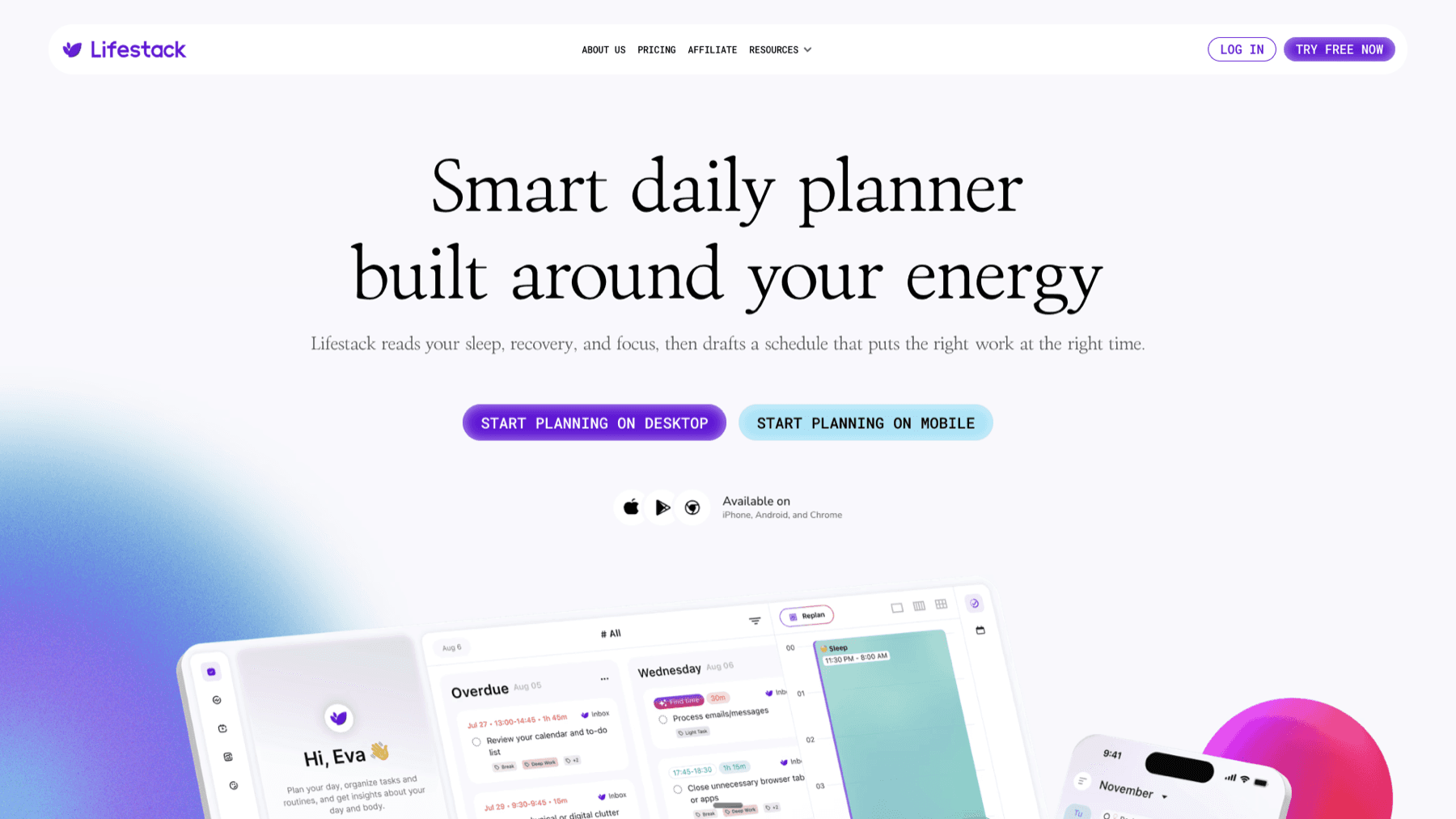
Most stress relief apps treat stress as something to manage after it arrives. Lifestack takes the other approach: prevent it from accumulating in the first place. It connects to your calendar, task list, and health data, identifies your natural energy peaks across the day, and builds a daily schedule that matches demanding work to your high-energy windows and lighter tasks to natural dips. The result is a day that's structured around what you're actually capable of rather than an optimistic list of everything you hope to finish.
This matters for stress specifically because task overload and schedule anxiety are among the most common sources of daily stress for working adults. When you start the day with more tasks than hours, or when every task feels equally urgent, stress accumulates regardless of how well you breathe or meditate. Energy-based scheduling solves that structural problem. Lifestack also adjusts automatically when things run over, rescheduling undone tasks without requiring you to manually drag and reorganize your day.
Builds a daily schedule around your energy patterns and sleep data
Auto-reschedules tasks that didn't get done without manual reorganization
Connects to Google Calendar, Apple Calendar, and health wearables
Chrome extension for fast task capture
iOS and Android apps
What Works: Addressing the source of stress rather than the symptom. If your stress is primarily driven by an overpacked schedule and the anxiety of not knowing whether you'll keep up, Lifestack is the most direct solution in this list.
Limitations: Doesn't address mood, anxiety symptoms, or cognitive patterns directly. Works alongside, not instead of, meditation or CBT tools if you're dealing with clinical anxiety.
Pricing: $7/month or $50/year (7-day free trial on annual plan). lifestack.ai
Best for: Anyone whose stress is primarily driven by a packed schedule, task overload, or not knowing whether they'll get everything done.
2. Headspace: Best Guided Meditation App
Structured programs for meditation, sleep, and stress with an AI wellness companion
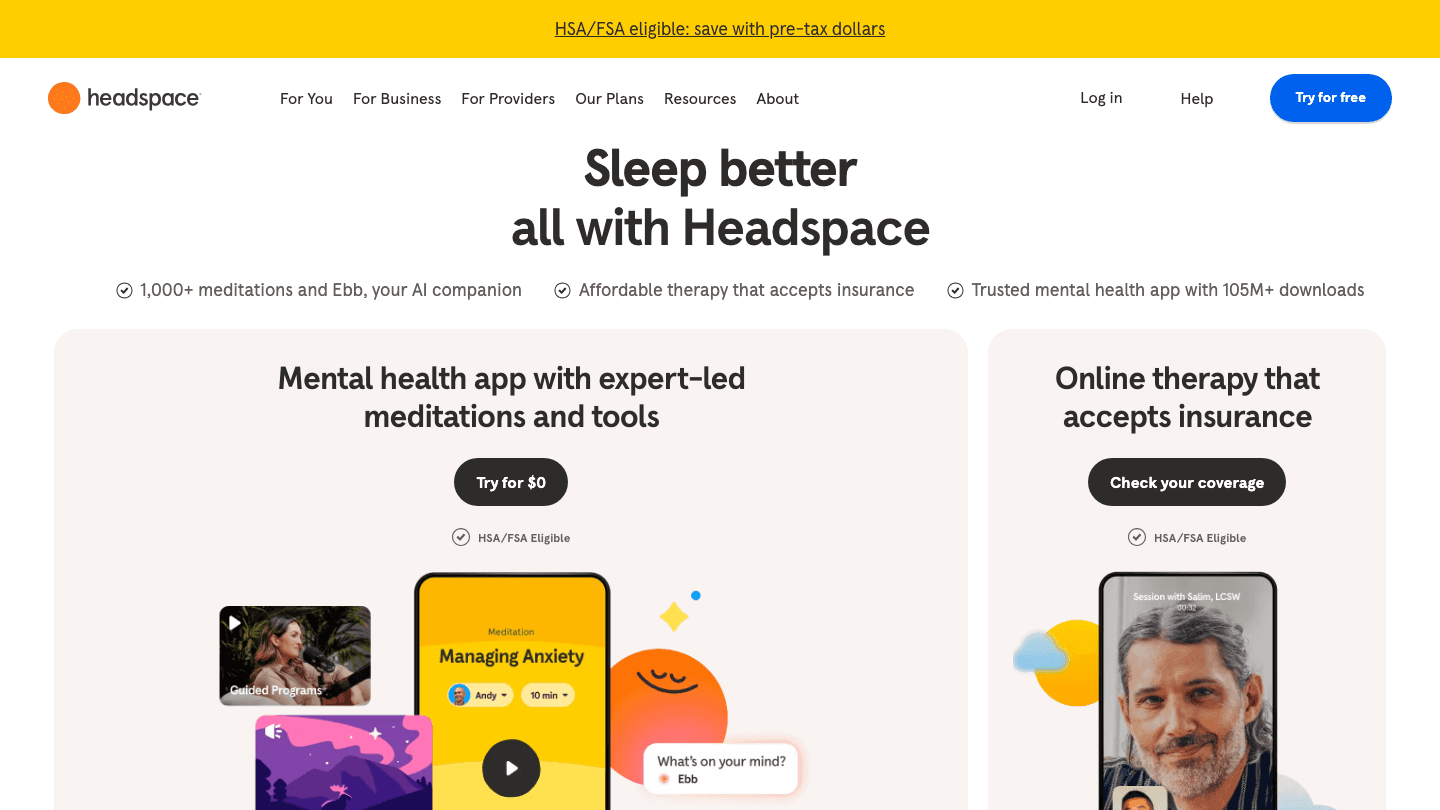
Headspace has been the most consistent guided meditation app for over a decade, and the product has matured significantly from its original ten-day beginner course. The current app includes structured programs for stress reduction, sleep improvement, focus, and emotional resilience, alongside an AI companion called Ebb that can walk you through a quick session based on how you're feeling in the moment.
The meditation quality is high across the library, with sessions ranging from 3 to 30 minutes and covering a range of styles. For stress relief specifically, the "Managing Stress" and "Stressed Out" programs are well-structured and evidence-backed: both use mindfulness-based stress reduction principles that have a solid research base. If you want to build a meditation habit with clear progression and guided support, Headspace remains the most polished option in the space.
1,000+ meditations, sleep content, and focus music
AI companion Ebb for personalized in-the-moment guidance
Structured programs for stress, sleep, focus, and resilience
HSA/FSA eligible in the US
Available on iOS, Android, and web
What Works: The structured beginner programs are the best introduction to meditation in any app. The progression from basics to more advanced techniques is clear and doesn't require prior experience.
Limitations: Premium-only for most content. The price is on the higher end for a meditation app. Some users find the narration style too uniform across the large library.
Pricing: $12.99/month or $69.99/year. headspace.com
Best for: People who want a structured, guided path into meditation with high production quality and clear progression.
3. Insight Timer: Best Free Meditation Library
200,000+ free meditations from thousands of teachers worldwide
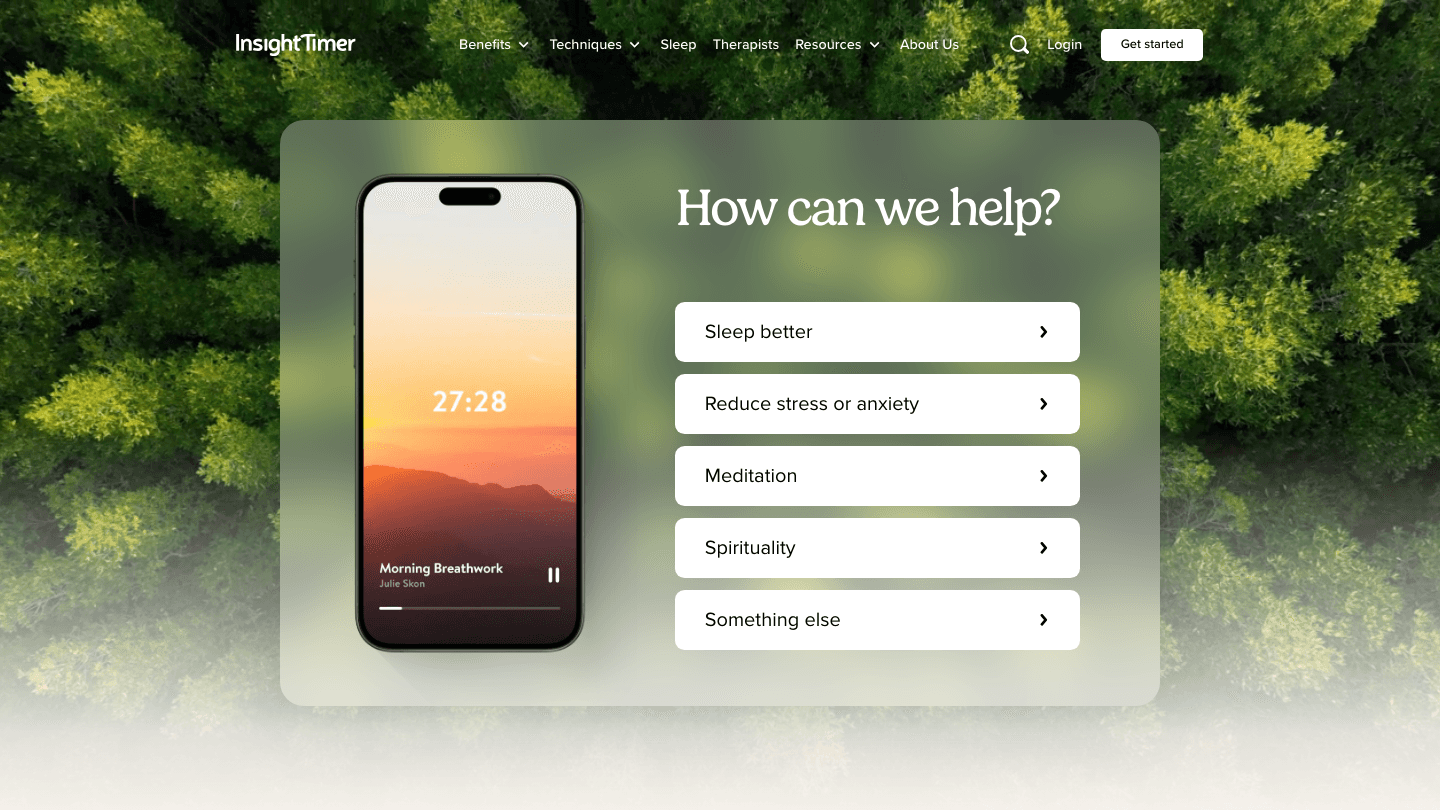
Insight Timer has the largest free meditation library of any app, with over 200,000 tracks from independent teachers, ranging from 2-minute breathing exercises to 90-minute extended sessions on specific topics. The free tier is genuinely substantial: you're not browsing a sample of what's available, you're accessing the full community library at no cost.
The variety also means you can find teachers whose style suits you rather than being locked into one voice and approach. For stress relief specifically, the library has thousands of tracks on anxiety, workplace stress, stress and fatigue, and sleep. Community groups organized by interest add a social dimension that Headspace and Calm don't offer. If cost is a barrier or you want to experiment widely before committing to one style, Insight Timer is the natural starting point.
200,000+ free guided meditations, music tracks, and courses
Timer with ambient sounds for self-guided sessions
Community groups and discussion features
Premium courses from specific teachers
Available on iOS, Android, and web
What Works: The breadth and depth of the free library is unmatched. For anyone who wants to explore meditation styles and teachers before committing to a subscription, this is the best starting point.
Limitations: The volume of content can be overwhelming without a clear starting point. Less structured than Headspace for complete beginners. Premium courses are behind a subscription paywall.
Pricing: Free (full library); Premium $9.99/month or $59.99/year for ad-free experience and offline access. insighttimer.com
Best for: People who want a large free meditation library, or anyone who wants to explore different teaching styles before committing to a paid app.
4. Woebot: Best AI Mental Health Chatbot
CBT-based conversations for daily stress, anxiety, and mood support
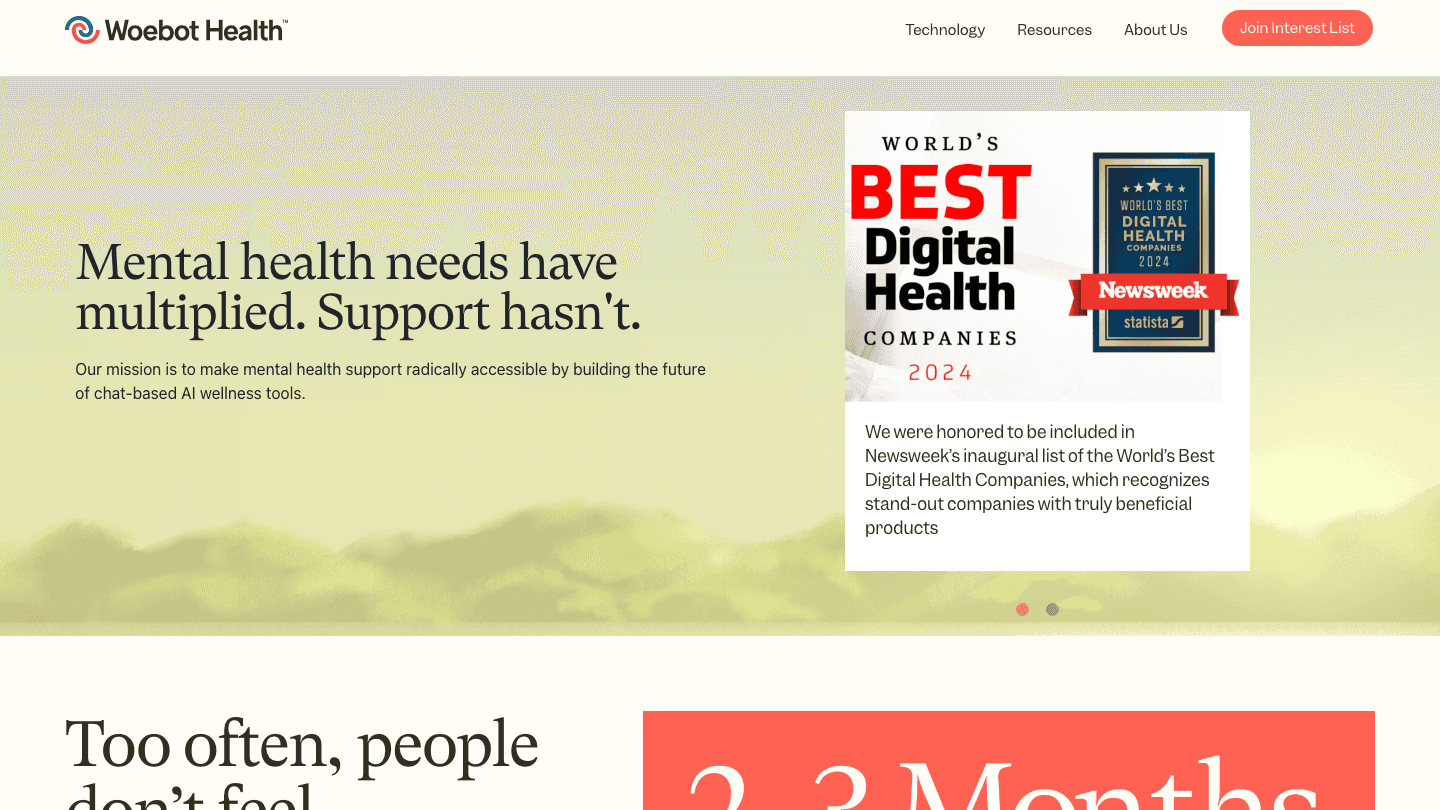
Woebot is an AI-powered chatbot trained on cognitive behavioral therapy techniques. Rather than guided meditation, it engages you in short conversations that walk through CBT exercises: identifying cognitive distortions, challenging unhelpful thought patterns, and building coping strategies for specific situations. Sessions take 5 to 15 minutes and are available any time, making it useful for stress moments that don't lend themselves to a 20-minute meditation session.
The evidence behind Woebot is among the strongest in mental health apps. Multiple studies, including a randomized controlled trial published in JMIR Mental Health, found significant reductions in anxiety and depression symptoms after using Woebot for two weeks. It's not a replacement for therapy, but it's a useful daily tool for anyone managing mild to moderate stress and anxiety between sessions, or who doesn't have access to formal mental health support. For those dealing with ADHD-related stress, the structured thought interruption techniques are particularly practical.
CBT-based daily check-ins and guided exercises
Available 24/7 for in-the-moment support
Mood tracking integrated into conversations
Evidence-based content with published research behind core methods
Accessible on iOS and web
What Works: The CBT content is genuinely useful and the conversational format makes it more engaging than a static worksheet. Available at any time, not just when you've pre-scheduled a session.
Limitations: AI chatbot, not a therapist. Not suitable as the only support for clinical anxiety or depression. Some users find the chatbot feel less engaging over time.
Pricing: Free to use for individuals. woebothealth.com
Best for: People who want CBT-style support between therapy sessions, or anyone who finds journaling too passive and wants a more interactive approach to managing stress.
5. Daylio: Best Mood Tracker
Micro-journaling that surfaces patterns in your mood, habits, and stress triggers
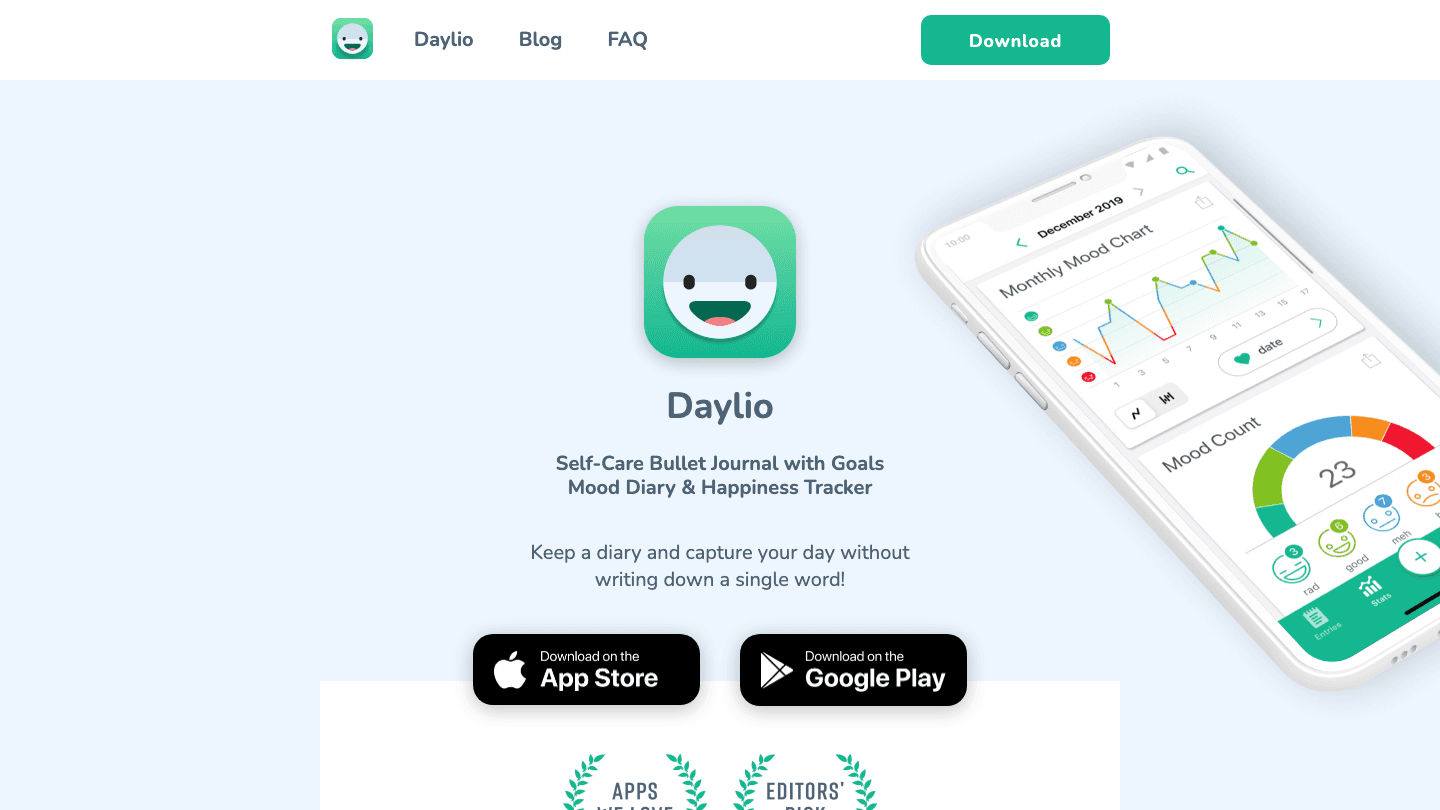
Daylio reduces journaling to its smallest possible form: tap a mood, tap one or more activities that happened today, and optionally add a note. It takes 30 seconds. Over weeks and months, that data becomes a map of what consistently correlates with your better and worse days. For stress management, the pattern recognition is the core value: you start seeing which activities, situations, and combinations reliably precede your highest-stress days.
This kind of longitudinal mood data is difficult to hold in your head, but Daylio surfaces it automatically. The monthly charts show mood trends over time. The activity correlation view shows which tracked behaviors most commonly appear on your high-mood versus low-mood days. Used alongside meditation or scheduling tools, it closes the feedback loop: you know not just how you feel today but what seems to be driving it. Mental health goals become measurable when you can see your mood trend improving over a consistent period.
30-second daily mood check-in with activity tagging
Automatic pattern analysis across moods and activities
Monthly mood charts and calendar view
Habit tracking integration with streak reminders
Available on iOS and Android
What Works: The low friction is what makes it actually work. Most people abandon journaling because it takes too long. Daylio's 30-second entry is sustainable in a way that full journal entries rarely are.
Limitations: Pattern insights take weeks to accumulate. The free tier limits older history access. Doesn't provide any therapeutic content or guidance based on the patterns it surfaces.
Pricing: Free to download; premium subscription available in-app for unlimited history and advanced features. daylio.net
Best for: Anyone who wants to understand what's actually driving their stress and mood over time without committing to full journaling.
Which Stress Relief App Is Right for You?
For schedule and overcommitment stress: Lifestack. It prevents the problem rather than treating it.
For a structured meditation program: Headspace. Best for beginners who want clear progression and guided support.
For exploring meditation without a subscription: Insight Timer. Largest free library, no credit card required.
For CBT-based thought pattern work: Woebot. Available 24/7 and free, with a genuine evidence base.
For understanding your stress triggers over time: Daylio. Low-friction mood tracking that turns into useful pattern data.
FAQ
What is the best free app for stress relief?
Insight Timer has the most extensive free content library of any stress relief app: over 200,000 guided meditations, breathing exercises, and music tracks available without a subscription. Woebot is also fully free for individuals and provides CBT-based daily support.
Do stress relief apps actually work?
The evidence varies by type. Mindfulness-based apps have the strongest research base for mild to moderate anxiety and stress. Woebot's CBT approach has randomized controlled trial evidence. Mood tracking apps like Daylio work through behavior awareness rather than direct intervention. Scheduling tools like Lifestack address structural stress rather than psychological symptoms. The best results come from matching the app to the actual type of stress you're managing.
Can a stress relief app replace therapy?
No. Apps are useful supplements and can be effective for mild to moderate stress and anxiety, but they're not a substitute for professional mental health support when symptoms are significant or persistent. Woebot is explicit about this distinction, and most clinical researchers who study mental health apps emphasize the same point.
What's the difference between a meditation app and a stress relief app?
Meditation apps (Headspace, Insight Timer) address stress primarily through mindfulness: teaching you to observe thoughts and reduce reactivity. Broader stress relief apps may include CBT tools (Woebot), mood tracking (Daylio), scheduling and prevention (Lifestack), or breathing exercises. The most effective approach usually combines multiple techniques targeting different dimensions of the stress response.
Are stress relief apps useful for ADHD?
Yes. ADHD-related stress often combines schedule overwhelm, rejection sensitivity, and difficulty regulating the nervous system. Lifestack's scheduling approach addresses the overwhelm dimension. Short meditation tracks (3-5 minutes) from Insight Timer or Headspace are more accessible than long sessions for ADHD users. See our calming activities for ADHD guide for a broader set of strategies that complement app-based tools.
How long does it take to see results from stress relief apps?
It varies by approach. Scheduling and prevention tools like Lifestack can reduce daily stress within days of use. Meditation shows measurable effects on stress markers (cortisol, HRV) within 8 weeks of consistent practice in most studies. Mood tracking apps require several weeks of data before pattern insights emerge. The common thread is consistency: a daily 5-minute practice sustained over weeks outperforms a 30-minute session you do once.
Stress management apps cover a wide spectrum. Some address the mental state directly: breathing exercises, meditation, and guided relaxation. Others address the root cause: overloaded schedules, unclear priorities, and the particular dread of not knowing whether you'll get everything done. The most useful apps for stress relief tend to be specific about which type of stress they're solving.
This list covers five apps across different approaches. We focused on apps that are actively maintained, have clear evidence of effectiveness for the problem they claim to solve, and have pricing that can be verified. We skipped several well-known apps that have stalled development, shifted to B2B-only models, or had acquisition changes that affect how they work for individual users.
Key Takeaways
Lifestack addresses schedule-driven stress at the source by building a daily plan around your energy, reducing the overcommitment and task debt that cause most productivity anxiety.
Headspace and Insight Timer approach stress through mindfulness: one with structured programs, the other with the world's largest free meditation library.
Woebot and Daylio work at the cognitive and tracking level, helping you understand and interrupt the thought patterns and mood cycles that maintain stress over time.
Quick Guide: Best Stress Relief Apps
1. Lifestack: AI scheduler that eliminates overcommitment and builds your day around your actual energy
2. Headspace: Guided meditation, sleep tools, and an AI wellness companion
3. Insight Timer: World's largest free meditation library with 200,000+ tracks
4. Woebot: AI-powered cognitive behavioral therapy chatbot for daily mental support
5. Daylio: Micro-journal for mood tracking that surfaces patterns you'd otherwise miss
How We Evaluated These Apps
Clear, specific use case (not claiming to fix everything)
Active development and company behind the product
Evidence base for the core mechanism
Usability without significant onboarding friction
Verifiable pricing
1. Lifestack: Best for Schedule-Driven Stress
Reduces overwhelm at the source by building a day you can actually complete
Most stress relief apps treat stress as something to manage after it arrives. Lifestack takes the other approach: prevent it from accumulating in the first place. It connects to your calendar, task list, and health data, identifies your natural energy peaks across the day, and builds a daily schedule that matches demanding work to your high-energy windows and lighter tasks to natural dips. The result is a day that's structured around what you're actually capable of rather than an optimistic list of everything you hope to finish.
This matters for stress specifically because task overload and schedule anxiety are among the most common sources of daily stress for working adults. When you start the day with more tasks than hours, or when every task feels equally urgent, stress accumulates regardless of how well you breathe or meditate. Energy-based scheduling solves that structural problem. Lifestack also adjusts automatically when things run over, rescheduling undone tasks without requiring you to manually drag and reorganize your day.
Builds a daily schedule around your energy patterns and sleep data
Auto-reschedules tasks that didn't get done without manual reorganization
Connects to Google Calendar, Apple Calendar, and health wearables
Chrome extension for fast task capture
iOS and Android apps
What Works: Addressing the source of stress rather than the symptom. If your stress is primarily driven by an overpacked schedule and the anxiety of not knowing whether you'll keep up, Lifestack is the most direct solution in this list.
Limitations: Doesn't address mood, anxiety symptoms, or cognitive patterns directly. Works alongside, not instead of, meditation or CBT tools if you're dealing with clinical anxiety.
Pricing: $7/month or $50/year (7-day free trial on annual plan). lifestack.ai
Best for: Anyone whose stress is primarily driven by a packed schedule, task overload, or not knowing whether they'll get everything done.
2. Headspace: Best Guided Meditation App
Structured programs for meditation, sleep, and stress with an AI wellness companion
Headspace has been the most consistent guided meditation app for over a decade, and the product has matured significantly from its original ten-day beginner course. The current app includes structured programs for stress reduction, sleep improvement, focus, and emotional resilience, alongside an AI companion called Ebb that can walk you through a quick session based on how you're feeling in the moment.
The meditation quality is high across the library, with sessions ranging from 3 to 30 minutes and covering a range of styles. For stress relief specifically, the "Managing Stress" and "Stressed Out" programs are well-structured and evidence-backed: both use mindfulness-based stress reduction principles that have a solid research base. If you want to build a meditation habit with clear progression and guided support, Headspace remains the most polished option in the space.
1,000+ meditations, sleep content, and focus music
AI companion Ebb for personalized in-the-moment guidance
Structured programs for stress, sleep, focus, and resilience
HSA/FSA eligible in the US
Available on iOS, Android, and web
What Works: The structured beginner programs are the best introduction to meditation in any app. The progression from basics to more advanced techniques is clear and doesn't require prior experience.
Limitations: Premium-only for most content. The price is on the higher end for a meditation app. Some users find the narration style too uniform across the large library.
Pricing: $12.99/month or $69.99/year. headspace.com
Best for: People who want a structured, guided path into meditation with high production quality and clear progression.
3. Insight Timer: Best Free Meditation Library
200,000+ free meditations from thousands of teachers worldwide
Insight Timer has the largest free meditation library of any app, with over 200,000 tracks from independent teachers, ranging from 2-minute breathing exercises to 90-minute extended sessions on specific topics. The free tier is genuinely substantial: you're not browsing a sample of what's available, you're accessing the full community library at no cost.
The variety also means you can find teachers whose style suits you rather than being locked into one voice and approach. For stress relief specifically, the library has thousands of tracks on anxiety, workplace stress, stress and fatigue, and sleep. Community groups organized by interest add a social dimension that Headspace and Calm don't offer. If cost is a barrier or you want to experiment widely before committing to one style, Insight Timer is the natural starting point.
200,000+ free guided meditations, music tracks, and courses
Timer with ambient sounds for self-guided sessions
Community groups and discussion features
Premium courses from specific teachers
Available on iOS, Android, and web
What Works: The breadth and depth of the free library is unmatched. For anyone who wants to explore meditation styles and teachers before committing to a subscription, this is the best starting point.
Limitations: The volume of content can be overwhelming without a clear starting point. Less structured than Headspace for complete beginners. Premium courses are behind a subscription paywall.
Pricing: Free (full library); Premium $9.99/month or $59.99/year for ad-free experience and offline access. insighttimer.com
Best for: People who want a large free meditation library, or anyone who wants to explore different teaching styles before committing to a paid app.
4. Woebot: Best AI Mental Health Chatbot
CBT-based conversations for daily stress, anxiety, and mood support
Woebot is an AI-powered chatbot trained on cognitive behavioral therapy techniques. Rather than guided meditation, it engages you in short conversations that walk through CBT exercises: identifying cognitive distortions, challenging unhelpful thought patterns, and building coping strategies for specific situations. Sessions take 5 to 15 minutes and are available any time, making it useful for stress moments that don't lend themselves to a 20-minute meditation session.
The evidence behind Woebot is among the strongest in mental health apps. Multiple studies, including a randomized controlled trial published in JMIR Mental Health, found significant reductions in anxiety and depression symptoms after using Woebot for two weeks. It's not a replacement for therapy, but it's a useful daily tool for anyone managing mild to moderate stress and anxiety between sessions, or who doesn't have access to formal mental health support. For those dealing with ADHD-related stress, the structured thought interruption techniques are particularly practical.
CBT-based daily check-ins and guided exercises
Available 24/7 for in-the-moment support
Mood tracking integrated into conversations
Evidence-based content with published research behind core methods
Accessible on iOS and web
What Works: The CBT content is genuinely useful and the conversational format makes it more engaging than a static worksheet. Available at any time, not just when you've pre-scheduled a session.
Limitations: AI chatbot, not a therapist. Not suitable as the only support for clinical anxiety or depression. Some users find the chatbot feel less engaging over time.
Pricing: Free to use for individuals. woebothealth.com
Best for: People who want CBT-style support between therapy sessions, or anyone who finds journaling too passive and wants a more interactive approach to managing stress.
5. Daylio: Best Mood Tracker
Micro-journaling that surfaces patterns in your mood, habits, and stress triggers
Daylio reduces journaling to its smallest possible form: tap a mood, tap one or more activities that happened today, and optionally add a note. It takes 30 seconds. Over weeks and months, that data becomes a map of what consistently correlates with your better and worse days. For stress management, the pattern recognition is the core value: you start seeing which activities, situations, and combinations reliably precede your highest-stress days.
This kind of longitudinal mood data is difficult to hold in your head, but Daylio surfaces it automatically. The monthly charts show mood trends over time. The activity correlation view shows which tracked behaviors most commonly appear on your high-mood versus low-mood days. Used alongside meditation or scheduling tools, it closes the feedback loop: you know not just how you feel today but what seems to be driving it. Mental health goals become measurable when you can see your mood trend improving over a consistent period.
30-second daily mood check-in with activity tagging
Automatic pattern analysis across moods and activities
Monthly mood charts and calendar view
Habit tracking integration with streak reminders
Available on iOS and Android
What Works: The low friction is what makes it actually work. Most people abandon journaling because it takes too long. Daylio's 30-second entry is sustainable in a way that full journal entries rarely are.
Limitations: Pattern insights take weeks to accumulate. The free tier limits older history access. Doesn't provide any therapeutic content or guidance based on the patterns it surfaces.
Pricing: Free to download; premium subscription available in-app for unlimited history and advanced features. daylio.net
Best for: Anyone who wants to understand what's actually driving their stress and mood over time without committing to full journaling.
Which Stress Relief App Is Right for You?
For schedule and overcommitment stress: Lifestack. It prevents the problem rather than treating it.
For a structured meditation program: Headspace. Best for beginners who want clear progression and guided support.
For exploring meditation without a subscription: Insight Timer. Largest free library, no credit card required.
For CBT-based thought pattern work: Woebot. Available 24/7 and free, with a genuine evidence base.
For understanding your stress triggers over time: Daylio. Low-friction mood tracking that turns into useful pattern data.
FAQ
What is the best free app for stress relief?
Insight Timer has the most extensive free content library of any stress relief app: over 200,000 guided meditations, breathing exercises, and music tracks available without a subscription. Woebot is also fully free for individuals and provides CBT-based daily support.
Do stress relief apps actually work?
The evidence varies by type. Mindfulness-based apps have the strongest research base for mild to moderate anxiety and stress. Woebot's CBT approach has randomized controlled trial evidence. Mood tracking apps like Daylio work through behavior awareness rather than direct intervention. Scheduling tools like Lifestack address structural stress rather than psychological symptoms. The best results come from matching the app to the actual type of stress you're managing.
Can a stress relief app replace therapy?
No. Apps are useful supplements and can be effective for mild to moderate stress and anxiety, but they're not a substitute for professional mental health support when symptoms are significant or persistent. Woebot is explicit about this distinction, and most clinical researchers who study mental health apps emphasize the same point.
What's the difference between a meditation app and a stress relief app?
Meditation apps (Headspace, Insight Timer) address stress primarily through mindfulness: teaching you to observe thoughts and reduce reactivity. Broader stress relief apps may include CBT tools (Woebot), mood tracking (Daylio), scheduling and prevention (Lifestack), or breathing exercises. The most effective approach usually combines multiple techniques targeting different dimensions of the stress response.
Are stress relief apps useful for ADHD?
Yes. ADHD-related stress often combines schedule overwhelm, rejection sensitivity, and difficulty regulating the nervous system. Lifestack's scheduling approach addresses the overwhelm dimension. Short meditation tracks (3-5 minutes) from Insight Timer or Headspace are more accessible than long sessions for ADHD users. See our calming activities for ADHD guide for a broader set of strategies that complement app-based tools.
How long does it take to see results from stress relief apps?
It varies by approach. Scheduling and prevention tools like Lifestack can reduce daily stress within days of use. Meditation shows measurable effects on stress markers (cortisol, HRV) within 8 weeks of consistent practice in most studies. Mood tracking apps require several weeks of data before pattern insights emerge. The common thread is consistency: a daily 5-minute practice sustained over weeks outperforms a 30-minute session you do once.



FOLLOW ON
FOLLOW ON
FOLLOW ON


Copyright 2026 © Lifestack. All rights reserved
Copyright 2026 © Lifestack. All rights reserved

