
Tips
Development Goals for Work: 9 Strategies That Stick
Development Goals for Work: 9 Strategies That Stick

Most development goals for work follow a familiar pattern: you write them at the start of the year, review them at your annual performance review, and forget about them in between. That's not a motivation problem. It's a design problem. Goals that live only in a document don't drive behavior.
The research on professional development points in a clear direction: people who grow fastest at work aren't necessarily working harder than their peers. They're working on the right things in a deliberate way. They build skills that compound. They seek feedback before they need it. And they use systems to make consistent effort easier than inconsistency.
This guide covers nine development goal strategies that actually stick at work, along with concrete approaches for each one. The keyword here is "strategies" rather than "goals" because the goal itself is rarely the problem. What you're doing to reach it is.
Key Takeaways
Development goals that focus on skill-building rather than task completion produce compounding returns over time.
Feedback, relationships, and energy management are underrated drivers of career growth that rarely appear on official goal templates.
A system for tracking progress matters as much as the goal itself, whether that's a weekly check-in, a planner, or an energy-aware scheduler.
1. Set Goals That Build Skills, Not Just Complete Tasks
The easiest mistake in setting development goals is framing them as deliverables. "Finish the Q4 reporting process" is a task. "Get faster and more accurate at financial modeling" is a development goal. One disappears when it's done; the other makes you better at things for years.
Good development goals have a skill at the center. Communication. Technical depth. Decision-making speed. Strategic thinking. These are capacities that build on themselves. A goal shaped around a capacity rather than a deliverable creates ongoing opportunity to practice, not just a checkbox.
When you're writing your goals, ask whether achieving them would leave you meaningfully more capable than before. If the answer is "I'd just have the thing done," the goal is probably a task in disguise.
2. Sharpen How You Communicate
Communication shows up in almost every dimension of career growth, but it rarely gets its own development goal. Most people improve their communication incidentally rather than intentionally. That's a slow path.
A targeted communication goal might look like: present one idea per week in a team meeting and request specific feedback afterward. Or: rewrite every important email twice before sending, once for content and once for clarity. Or: get better at communicating upward by learning what your manager needs to make decisions quickly.
Written communication often matters more than people expect at senior levels. The people who get promoted repeatedly are almost always the people who can write a clear proposal, synthesize a complex situation in two paragraphs, and communicate bad news without creating unnecessary alarm.
3. Develop Leadership Habits Before the Title
Waiting for a leadership role to start practicing leadership is backwards. The people who get leadership opportunities are usually the ones who have already been exhibiting leadership behaviors without the formal authority.
Leadership habits don't require direct reports. They include: taking ownership of outcomes rather than just your piece of the process. Facilitating meetings that previously felt rudderless. Mentoring a junior colleague even when it wasn't asked of you. Giving your team credit publicly and taking blame privately.
One concrete way to develop this skill: identify one project where you can volunteer to coordinate across functions, even in a limited way. The experience of managing expectations across different teams builds muscles that no number of leadership books can replace.
4. Manage Your Time Around Your Actual Energy
Time management is a standard professional development goal. Energy management is almost never on anyone's list, which is part of why standard time management advice fails so many people.
You don't have the same cognitive capacity at 3pm on a Wednesday after three back-to-back meetings as you do at 9am after a good night's sleep. If your most important development work (writing, deep thinking, learning a new skill) gets scheduled into whatever gaps are left in your calendar, it will consistently get the worst version of you.
The approach that actually works is scheduling cognitively demanding development work during your real peak hours, and protecting those windows from meetings and low-stakes tasks. This is easier said than done without a system, but it's the kind of thing you can learn to plan effectively over time. If you want a tool that does this automatically, energy-based scheduling takes your biometric data and time blocks your day around when you're actually capable of high-quality output.
5. Deepen Your Domain Expertise Intentionally
Becoming genuinely good at something makes almost everything else easier. It creates credibility that accelerates career growth, makes you a go-to person on your team, and opens doors that generalist skills don't.
The challenge is that domain expertise requires sustained attention, not just occasional effort. Cal Newport's work on deep work describes this well: the ability to focus without distraction on cognitively demanding tasks is becoming rarer and more valuable at the same time. Protecting blocks of uninterrupted time for your learning goals isn't a luxury at this point. It's the core mechanic of getting meaningfully better.
A concrete approach: commit to reading one technical or domain-specific resource per week in your area of focus, and keep a brief log of what you learned and how it connects to your work. The log is what makes the learning stick.
6. Invest in Cross-Functional Relationships
Your career will advance faster with strong relationships across functions than with strong performance in a silo. This isn't cynical advice about networking. It's about access: access to information, to opportunities, to support when things go sideways.
A practical development goal here: identify three people outside your team whose work connects to yours, and make it a point to have a substantive conversation with each of them quarterly. Learn what problems they're solving and what constraints they're working within. Share what you're working on.
Over time, these relationships make you more effective at your actual job. Cross-functional context changes how you make decisions. And when a role opens that's a good fit for you, being known by people across the organization matters more than most hiring managers will admit.
7. Make Feedback a Practice, Not a Painful Event
Most people experience feedback as something that happens to them at performance review time. The fastest-developing professionals experience it as something they actively collect throughout the year.
The difference in career trajectory over five years is significant. Waiting for your annual review means you spend twelve months getting feedback from your own assumptions. Requesting feedback monthly means you spend twelve months with actual signal about what's working and what isn't.
A simple structure: after any significant piece of work, ask one person involved for specific feedback. Not "how do you think that went?" but "what's one thing that worked and one thing I should do differently next time?" The specificity of the question drives the usefulness of the answer.
For people managing their own goal progress, building a feedback loop into the routine rather than waiting for it externally is one of the highest-return habits you can build.
8. Learn to Manage Projects, Not Just Your Own Tasks
Individual contributors often hit a ceiling not because they lack skills, but because they can only drive outcomes they personally control. The jump to broader impact requires getting good at coordinating work across people and timelines you don't directly manage.
Good project management at the development goal level isn't about mastering a methodology. It's about three habits: knowing what "done" looks like before you start, communicating proactively when something is at risk, and building checkpoints into projects so you catch problems early rather than at the deadline.
A targeted development goal might be: lead the planning process for one project this quarter, including writing the brief, identifying the stakeholders, and running the kickoff. The learning happens in the doing, not in reading about it.
9. Build a System to Track Your Own Growth
Goals without tracking are wishes. This isn't motivational advice; it's how memory works. Most people overestimate how much they'll remember about their own progress and underestimate how much they'll need the record at review time.
A tracking system doesn't need to be elaborate. A weekly five-minute log of what you worked on, what you learned, and what you'd do differently is enough. Over a year, that's fifty entries and a clear picture of your own trajectory.
The more important function of tracking is the feedback loop. When you can see that you've had three weeks in a row where your development goal didn't get touched, that's useful information. When you can see that one type of work consistently gets skipped, that's a signal about either the goal or the system. You can't see those patterns without a record.
Desktop productivity habits and tools are part of this picture. The environment you work in shapes what's easy and what gets avoided. A development goal that requires opening a separate app you never normally use will get skipped. One that's built into your existing workflow has a much better chance.
Best Tool for Development Goals at Work
The common thread across these nine strategies is that development goals require consistent effort during your best hours, not your worst ones. That's where most workplace productivity tools fall short. They manage your tasks but ignore whether you have the energy to execute them well.
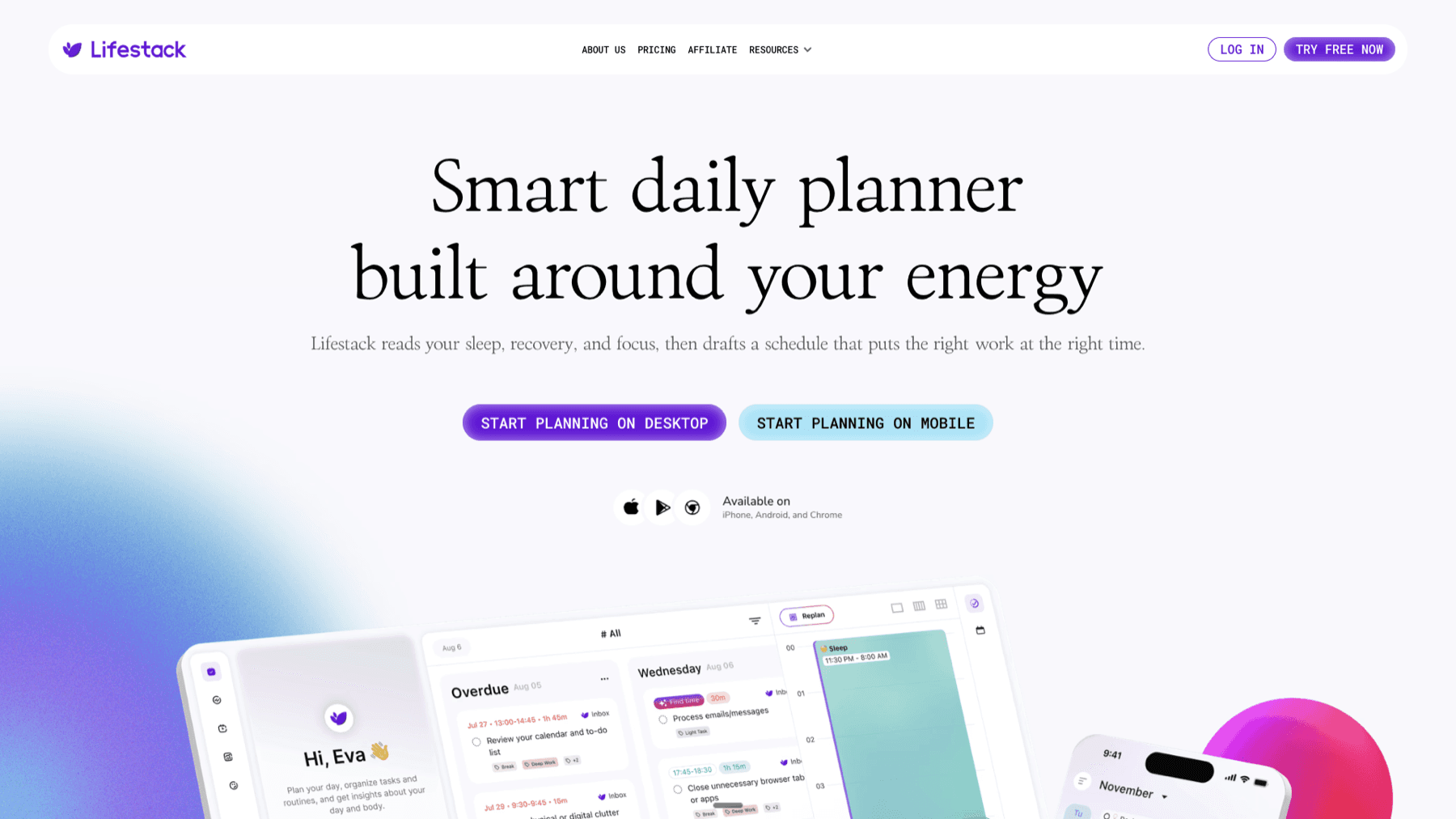
Lifestack is built around a different premise: your daily plan should adapt to how you're actually doing, not just what's on your calendar. It reads data from your wearable (Oura, WHOOP, Apple Watch) and schedules deep work and development tasks during the hours when your focus and recovery scores are highest. That means your weekly "read and learn" block or your "practice communication" session lands when you're actually capable of doing it well, not at whatever's left after a morning of meetings.
For anyone serious about making development goals a regular practice rather than a once-a-year exercise, having a tool that actively protects your best hours for that work makes a real difference. Lifestack is $7/month or $50/year, with a 7-day free trial on the annual plan. More on the underlying approach in our post on personal energy management.
Frequently Asked Questions
What are the best development goals for work?
The best development goals are skill-focused rather than task-focused. Strong examples include improving communication clarity, developing a specific technical skill, building cross-functional relationships, and learning to run more effective meetings. The most effective goals are ones where progress can be measured and where the skill built applies to more than one situation.
How do you set professional development goals for work?
Start by identifying the gap between where you are and where you want to be in 12-18 months. Then work backwards: what skill or behavior change would close that gap? Frame the goal around that skill, add a concrete practice you can do regularly, and build in a way to track progress. Check in monthly rather than waiting for the annual review.
How many development goals should you have at work?
Two to three focused goals per year tend to produce better results than a long list. More than three and attention gets diluted. The goal isn't to have a complete list of everything you want to improve. It's to make meaningful progress on a small number of things that matter most right now.
How do you write development goals for a performance review?
Frame goals around observable behavior and measurable progress rather than vague intention. Instead of "improve at communication," write "present one idea per month in team meetings and request feedback after each one." Instead of "develop leadership skills," write "lead the kickoff and coordination for one cross-functional project this quarter." Specificity makes both the goal and the assessment clearer for everyone involved.
What's the difference between performance goals and development goals?
Performance goals focus on what you deliver in your current role. Development goals focus on what capabilities you're building for future roles or to do your current role better. Both matter, but they often get conflated. A useful check: if achieving the goal makes you better at your job permanently, it's a development goal. If it just gets the work done, it's a performance goal.
How do you track development goals at work?
A simple weekly log works for most people: five minutes at the end of the week noting what you worked on toward your goals, what you learned, and what to focus on next. Beyond that, monthly check-ins against your goal criteria help you catch drift early. Tools like habit tracker planner apps can help make this practice consistent, particularly if you want a visual record of your progress over time.
Most development goals for work follow a familiar pattern: you write them at the start of the year, review them at your annual performance review, and forget about them in between. That's not a motivation problem. It's a design problem. Goals that live only in a document don't drive behavior.
The research on professional development points in a clear direction: people who grow fastest at work aren't necessarily working harder than their peers. They're working on the right things in a deliberate way. They build skills that compound. They seek feedback before they need it. And they use systems to make consistent effort easier than inconsistency.
This guide covers nine development goal strategies that actually stick at work, along with concrete approaches for each one. The keyword here is "strategies" rather than "goals" because the goal itself is rarely the problem. What you're doing to reach it is.
Key Takeaways
Development goals that focus on skill-building rather than task completion produce compounding returns over time.
Feedback, relationships, and energy management are underrated drivers of career growth that rarely appear on official goal templates.
A system for tracking progress matters as much as the goal itself, whether that's a weekly check-in, a planner, or an energy-aware scheduler.
1. Set Goals That Build Skills, Not Just Complete Tasks
The easiest mistake in setting development goals is framing them as deliverables. "Finish the Q4 reporting process" is a task. "Get faster and more accurate at financial modeling" is a development goal. One disappears when it's done; the other makes you better at things for years.
Good development goals have a skill at the center. Communication. Technical depth. Decision-making speed. Strategic thinking. These are capacities that build on themselves. A goal shaped around a capacity rather than a deliverable creates ongoing opportunity to practice, not just a checkbox.
When you're writing your goals, ask whether achieving them would leave you meaningfully more capable than before. If the answer is "I'd just have the thing done," the goal is probably a task in disguise.
2. Sharpen How You Communicate
Communication shows up in almost every dimension of career growth, but it rarely gets its own development goal. Most people improve their communication incidentally rather than intentionally. That's a slow path.
A targeted communication goal might look like: present one idea per week in a team meeting and request specific feedback afterward. Or: rewrite every important email twice before sending, once for content and once for clarity. Or: get better at communicating upward by learning what your manager needs to make decisions quickly.
Written communication often matters more than people expect at senior levels. The people who get promoted repeatedly are almost always the people who can write a clear proposal, synthesize a complex situation in two paragraphs, and communicate bad news without creating unnecessary alarm.
3. Develop Leadership Habits Before the Title
Waiting for a leadership role to start practicing leadership is backwards. The people who get leadership opportunities are usually the ones who have already been exhibiting leadership behaviors without the formal authority.
Leadership habits don't require direct reports. They include: taking ownership of outcomes rather than just your piece of the process. Facilitating meetings that previously felt rudderless. Mentoring a junior colleague even when it wasn't asked of you. Giving your team credit publicly and taking blame privately.
One concrete way to develop this skill: identify one project where you can volunteer to coordinate across functions, even in a limited way. The experience of managing expectations across different teams builds muscles that no number of leadership books can replace.
4. Manage Your Time Around Your Actual Energy
Time management is a standard professional development goal. Energy management is almost never on anyone's list, which is part of why standard time management advice fails so many people.
You don't have the same cognitive capacity at 3pm on a Wednesday after three back-to-back meetings as you do at 9am after a good night's sleep. If your most important development work (writing, deep thinking, learning a new skill) gets scheduled into whatever gaps are left in your calendar, it will consistently get the worst version of you.
The approach that actually works is scheduling cognitively demanding development work during your real peak hours, and protecting those windows from meetings and low-stakes tasks. This is easier said than done without a system, but it's the kind of thing you can learn to plan effectively over time. If you want a tool that does this automatically, energy-based scheduling takes your biometric data and time blocks your day around when you're actually capable of high-quality output.
5. Deepen Your Domain Expertise Intentionally
Becoming genuinely good at something makes almost everything else easier. It creates credibility that accelerates career growth, makes you a go-to person on your team, and opens doors that generalist skills don't.
The challenge is that domain expertise requires sustained attention, not just occasional effort. Cal Newport's work on deep work describes this well: the ability to focus without distraction on cognitively demanding tasks is becoming rarer and more valuable at the same time. Protecting blocks of uninterrupted time for your learning goals isn't a luxury at this point. It's the core mechanic of getting meaningfully better.
A concrete approach: commit to reading one technical or domain-specific resource per week in your area of focus, and keep a brief log of what you learned and how it connects to your work. The log is what makes the learning stick.
6. Invest in Cross-Functional Relationships
Your career will advance faster with strong relationships across functions than with strong performance in a silo. This isn't cynical advice about networking. It's about access: access to information, to opportunities, to support when things go sideways.
A practical development goal here: identify three people outside your team whose work connects to yours, and make it a point to have a substantive conversation with each of them quarterly. Learn what problems they're solving and what constraints they're working within. Share what you're working on.
Over time, these relationships make you more effective at your actual job. Cross-functional context changes how you make decisions. And when a role opens that's a good fit for you, being known by people across the organization matters more than most hiring managers will admit.
7. Make Feedback a Practice, Not a Painful Event
Most people experience feedback as something that happens to them at performance review time. The fastest-developing professionals experience it as something they actively collect throughout the year.
The difference in career trajectory over five years is significant. Waiting for your annual review means you spend twelve months getting feedback from your own assumptions. Requesting feedback monthly means you spend twelve months with actual signal about what's working and what isn't.
A simple structure: after any significant piece of work, ask one person involved for specific feedback. Not "how do you think that went?" but "what's one thing that worked and one thing I should do differently next time?" The specificity of the question drives the usefulness of the answer.
For people managing their own goal progress, building a feedback loop into the routine rather than waiting for it externally is one of the highest-return habits you can build.
8. Learn to Manage Projects, Not Just Your Own Tasks
Individual contributors often hit a ceiling not because they lack skills, but because they can only drive outcomes they personally control. The jump to broader impact requires getting good at coordinating work across people and timelines you don't directly manage.
Good project management at the development goal level isn't about mastering a methodology. It's about three habits: knowing what "done" looks like before you start, communicating proactively when something is at risk, and building checkpoints into projects so you catch problems early rather than at the deadline.
A targeted development goal might be: lead the planning process for one project this quarter, including writing the brief, identifying the stakeholders, and running the kickoff. The learning happens in the doing, not in reading about it.
9. Build a System to Track Your Own Growth
Goals without tracking are wishes. This isn't motivational advice; it's how memory works. Most people overestimate how much they'll remember about their own progress and underestimate how much they'll need the record at review time.
A tracking system doesn't need to be elaborate. A weekly five-minute log of what you worked on, what you learned, and what you'd do differently is enough. Over a year, that's fifty entries and a clear picture of your own trajectory.
The more important function of tracking is the feedback loop. When you can see that you've had three weeks in a row where your development goal didn't get touched, that's useful information. When you can see that one type of work consistently gets skipped, that's a signal about either the goal or the system. You can't see those patterns without a record.
Desktop productivity habits and tools are part of this picture. The environment you work in shapes what's easy and what gets avoided. A development goal that requires opening a separate app you never normally use will get skipped. One that's built into your existing workflow has a much better chance.
Best Tool for Development Goals at Work
The common thread across these nine strategies is that development goals require consistent effort during your best hours, not your worst ones. That's where most workplace productivity tools fall short. They manage your tasks but ignore whether you have the energy to execute them well.
Lifestack is built around a different premise: your daily plan should adapt to how you're actually doing, not just what's on your calendar. It reads data from your wearable (Oura, WHOOP, Apple Watch) and schedules deep work and development tasks during the hours when your focus and recovery scores are highest. That means your weekly "read and learn" block or your "practice communication" session lands when you're actually capable of doing it well, not at whatever's left after a morning of meetings.
For anyone serious about making development goals a regular practice rather than a once-a-year exercise, having a tool that actively protects your best hours for that work makes a real difference. Lifestack is $7/month or $50/year, with a 7-day free trial on the annual plan. More on the underlying approach in our post on personal energy management.
Frequently Asked Questions
What are the best development goals for work?
The best development goals are skill-focused rather than task-focused. Strong examples include improving communication clarity, developing a specific technical skill, building cross-functional relationships, and learning to run more effective meetings. The most effective goals are ones where progress can be measured and where the skill built applies to more than one situation.
How do you set professional development goals for work?
Start by identifying the gap between where you are and where you want to be in 12-18 months. Then work backwards: what skill or behavior change would close that gap? Frame the goal around that skill, add a concrete practice you can do regularly, and build in a way to track progress. Check in monthly rather than waiting for the annual review.
How many development goals should you have at work?
Two to three focused goals per year tend to produce better results than a long list. More than three and attention gets diluted. The goal isn't to have a complete list of everything you want to improve. It's to make meaningful progress on a small number of things that matter most right now.
How do you write development goals for a performance review?
Frame goals around observable behavior and measurable progress rather than vague intention. Instead of "improve at communication," write "present one idea per month in team meetings and request feedback after each one." Instead of "develop leadership skills," write "lead the kickoff and coordination for one cross-functional project this quarter." Specificity makes both the goal and the assessment clearer for everyone involved.
What's the difference between performance goals and development goals?
Performance goals focus on what you deliver in your current role. Development goals focus on what capabilities you're building for future roles or to do your current role better. Both matter, but they often get conflated. A useful check: if achieving the goal makes you better at your job permanently, it's a development goal. If it just gets the work done, it's a performance goal.
How do you track development goals at work?
A simple weekly log works for most people: five minutes at the end of the week noting what you worked on toward your goals, what you learned, and what to focus on next. Beyond that, monthly check-ins against your goal criteria help you catch drift early. Tools like habit tracker planner apps can help make this practice consistent, particularly if you want a visual record of your progress over time.



FOLLOW ON
FOLLOW ON
FOLLOW ON


Copyright 2026 © Lifestack. All rights reserved
Copyright 2026 © Lifestack. All rights reserved

