
Device
Herz P1 Smart Ring Review: Budget Ring, Real Results?
Herz P1 Smart Ring Review: Budget Ring, Real Results?

The Herz P1 targets the growing segment of buyers who want a smart ring without paying $299 for an Oura Ring or signing up for a subscription. At $59.99 with a one-time purchase and a free companion app, it is aggressively positioned as the budget entry point into ring-based health tracking.
Whether it actually delivers on the "20+ biometrics" promise or leans on inflated marketing is the question this review answers. The short version: the sleep tracking is genuinely useful, the heart rate data during exercise is mediocre, and the app does the job without being impressive. For casual sleep and recovery tracking without ongoing fees, it is a reasonable buy. For athletes or anyone who needs accurate workout data, it is not.
Key Takeaways
At $59.99 with no subscription, the Herz P1 is one of the most affordable smart rings available in 2026
Sleep tracking is the strongest feature; workout heart rate accuracy is inconsistent compared to chest strap benchmarks
The QRing companion app works but lacks the depth and polish of the Oura, RingConn, or Ultrahuman apps
Herz P1 Specs
Material: Titanium alloy with stainless steel inner band
Sizes: 6 through 13
Battery life: Up to 6 days on a full charge
Charging: Magnetic dock, under 1 hour to full
Water resistance: IP68, rated to 50m depth
Sensors: Optical heart rate (PPG), accelerometer, skin temperature, SpO2
App: QRing (free, iOS and Android)
Price: $59.99 single ring; bundles available at lower per-unit cost
Subscription: None
Design and Build Quality
The Herz P1 is a thin, unbranded band available in black, silver, and gold finishes. It passes the basic build quality test: no sharp edges, a smooth inner surface that sits comfortably overnight, and an IP68 waterproof rating that covers swimming and showering. The titanium construction feels solid for the price.
Sizing is the biggest practical challenge. Like most smart rings, the Herz P1 requires an accurate ring size for the sensors to maintain consistent contact with your skin. The company offers a free sizing kit, but getting the wrong size means less accurate readings. If you are between sizes, go smaller rather than larger for better sensor contact.
There is no charging indicator light on the ring itself; you track battery level through the app. Charging takes roughly 45-60 minutes via the magnetic dock, which snaps on securely.
Sleep Tracking
Sleep tracking is where the Herz P1 performs best relative to its price. Sleep duration accuracy is solid for an optical ring sensor, and the app's morning sleep summary breaks down light, deep, and REM time alongside a simple sleep score. The temperature sensor adds overnight body temperature tracking, which helps flag illness and menstrual cycle phases.
Blood oxygen monitoring during sleep is included and works passively throughout the night. Readings are directionally accurate, useful for spotting irregular dips, though not calibrated to clinical standards. For users primarily interested in sleep quality trends rather than precise stage classification, the tracking holds up well over weeks of use.
The weakness is granularity. The QRing app lacks the detailed HRV analysis, readiness scoring, and sleep coaching features found in premium sleep-tracking rings. You get the basics, not the depth.
Heart Rate and Activity Tracking
Resting heart rate monitoring is reliable. During low-intensity activity like walking, heart rate readings track reasonably closely to a reference chest strap. During high-intensity intervals, sprints, or fast-paced cycling, readings lag and miss peaks. This is a common limitation of finger-based PPG sensors at budget price points, and the Herz P1 is no exception.
Step counting works adequately for daily movement totals. The accelerometer classification for workouts is coarse: it detects general activity but does not reliably distinguish between run types, lifting, or cycling without manual tagging in the app. If workout tracking accuracy matters to you, the Herz P1 is not the right tool.
Stress monitoring uses heart rate variability estimation to flag high-stress periods. The readings are plausible as daily trend data but should not be treated as precise HRV measurements.
The QRing App
The companion app covers the basics: sleep history, daily activity summary, heart rate trends, stress levels, and cycle tracking for women. Data syncs over Bluetooth and the app stores up to seven days of data offline on the ring itself.
The interface is functional but dated. There is no web dashboard, no API for third-party integrations, and no sharing features. For users who want to pipe their data into other health platforms or productivity apps, the QRing ecosystem is a dead end. This is a meaningful limitation compared to rings like the Oura or RingConn, which offer open data exports and third-party app connections.
Herz P1 vs RingConn vs Oura Ring
These three represent the main tiers in the subscription-free smart ring market:
Herz P1 ($59.99): Entry-level sleep and recovery tracking. Best for casual users who want basic data without recurring fees. Limited app ecosystem.
RingConn Gen 2 (~$179): Meaningfully better app, more accurate HRV tracking, and no subscription fee. A stronger buy if you want to invest a bit more without committing to Oura pricing.
Oura Ring 4 (~$299 + $5.99/month): The gold standard for ring-based health tracking. Better sensor accuracy, a polished app with readiness scoring, and an open API for third-party integrations. Worth the price if tracking depth matters.
The Herz P1 competes well at its price point against other ultra-budget trackers. It does not compete with RingConn or Oura on data quality or app experience. For a broader look at no-subscription options, see the best smart rings without subscription fees.
Who Should Buy the Herz P1?
The Herz P1 makes the most sense for someone who is new to smart ring tracking and wants to try the form factor without a $300 commitment. Sleep duration, resting heart rate, and basic recovery trends are genuinely useful at any price point, and the Herz P1 delivers those without any monthly fees.
Skip it if you are an athlete who needs accurate workout heart rate data, if you want HRV-based readiness scoring, or if you plan to connect ring data to other apps. At that point, spending the extra $120 on a RingConn Gen 2 is the smarter move. For a full comparison of Oura alternatives, the alternatives to Oura Ring guide covers the full field.
Pair Your Ring Data With a Smarter Daily Plan
Smart ring data is most useful when it actually changes what you do in a day. Lifestack connects with health data from wearables to schedule your day around your actual energy and recovery state, not just your task list. On mornings when your sleep score is low, it shifts demanding work to better windows. On high-recovery days, it front-loads focus blocks.
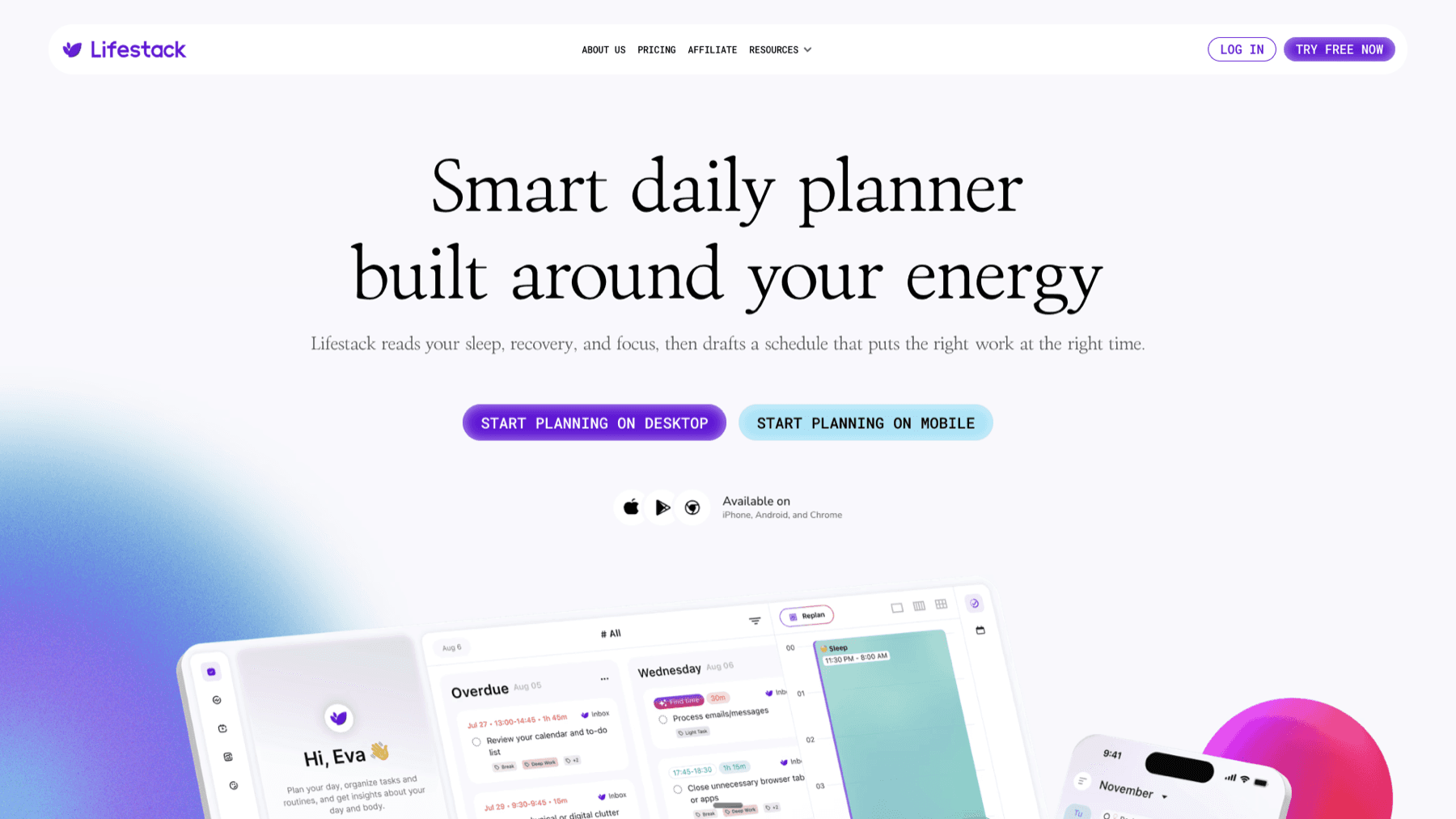
It is a small step that makes passive health data actionable. Learn how energy-based scheduling works. Lifestack is $49.99/year with a 7-day free trial, or $120 as a lifetime purchase.
Frequently Asked Questions
Is the Herz P1 smart ring worth it?
For casual sleep and recovery tracking with no monthly fees, yes. The $59.99 price and zero subscription cost make it an accessible entry point. For athletes or users who need precise workout data or a deep app ecosystem, it falls short.
Does the Herz P1 require a subscription?
No. The QRing companion app is free, and there are no recurring fees after the initial purchase. All features are included with the one-time hardware cost.
How accurate is the Herz P1 heart rate tracking?
Resting heart rate is reasonably accurate. During high-intensity exercise, readings lag and undercount peaks. It is adequate for daily trend monitoring but not for training-specific heart rate zones.
How long does the Herz P1 battery last?
Up to 6 days on a full charge with continuous overnight sleep tracking active. The magnetic charging dock refills it in under an hour.
Is the Herz P1 waterproof?
Yes. The IP68 rating covers swimming, showering, and submersion up to 50 meters. It is safe for everyday water exposure without removal.
How does the Herz P1 compare to Oura Ring?
The Oura Ring offers significantly better sensor accuracy, a polished app with readiness scoring, and an open API for integrations. It costs $299 plus a $5.99/month subscription. The Herz P1 covers the basics at a fraction of the cost but is not a like-for-like alternative for serious health tracking.
The Herz P1 targets the growing segment of buyers who want a smart ring without paying $299 for an Oura Ring or signing up for a subscription. At $59.99 with a one-time purchase and a free companion app, it is aggressively positioned as the budget entry point into ring-based health tracking.
Whether it actually delivers on the "20+ biometrics" promise or leans on inflated marketing is the question this review answers. The short version: the sleep tracking is genuinely useful, the heart rate data during exercise is mediocre, and the app does the job without being impressive. For casual sleep and recovery tracking without ongoing fees, it is a reasonable buy. For athletes or anyone who needs accurate workout data, it is not.
Key Takeaways
At $59.99 with no subscription, the Herz P1 is one of the most affordable smart rings available in 2026
Sleep tracking is the strongest feature; workout heart rate accuracy is inconsistent compared to chest strap benchmarks
The QRing companion app works but lacks the depth and polish of the Oura, RingConn, or Ultrahuman apps
Herz P1 Specs
Material: Titanium alloy with stainless steel inner band
Sizes: 6 through 13
Battery life: Up to 6 days on a full charge
Charging: Magnetic dock, under 1 hour to full
Water resistance: IP68, rated to 50m depth
Sensors: Optical heart rate (PPG), accelerometer, skin temperature, SpO2
App: QRing (free, iOS and Android)
Price: $59.99 single ring; bundles available at lower per-unit cost
Subscription: None
Design and Build Quality
The Herz P1 is a thin, unbranded band available in black, silver, and gold finishes. It passes the basic build quality test: no sharp edges, a smooth inner surface that sits comfortably overnight, and an IP68 waterproof rating that covers swimming and showering. The titanium construction feels solid for the price.
Sizing is the biggest practical challenge. Like most smart rings, the Herz P1 requires an accurate ring size for the sensors to maintain consistent contact with your skin. The company offers a free sizing kit, but getting the wrong size means less accurate readings. If you are between sizes, go smaller rather than larger for better sensor contact.
There is no charging indicator light on the ring itself; you track battery level through the app. Charging takes roughly 45-60 minutes via the magnetic dock, which snaps on securely.
Sleep Tracking
Sleep tracking is where the Herz P1 performs best relative to its price. Sleep duration accuracy is solid for an optical ring sensor, and the app's morning sleep summary breaks down light, deep, and REM time alongside a simple sleep score. The temperature sensor adds overnight body temperature tracking, which helps flag illness and menstrual cycle phases.
Blood oxygen monitoring during sleep is included and works passively throughout the night. Readings are directionally accurate, useful for spotting irregular dips, though not calibrated to clinical standards. For users primarily interested in sleep quality trends rather than precise stage classification, the tracking holds up well over weeks of use.
The weakness is granularity. The QRing app lacks the detailed HRV analysis, readiness scoring, and sleep coaching features found in premium sleep-tracking rings. You get the basics, not the depth.
Heart Rate and Activity Tracking
Resting heart rate monitoring is reliable. During low-intensity activity like walking, heart rate readings track reasonably closely to a reference chest strap. During high-intensity intervals, sprints, or fast-paced cycling, readings lag and miss peaks. This is a common limitation of finger-based PPG sensors at budget price points, and the Herz P1 is no exception.
Step counting works adequately for daily movement totals. The accelerometer classification for workouts is coarse: it detects general activity but does not reliably distinguish between run types, lifting, or cycling without manual tagging in the app. If workout tracking accuracy matters to you, the Herz P1 is not the right tool.
Stress monitoring uses heart rate variability estimation to flag high-stress periods. The readings are plausible as daily trend data but should not be treated as precise HRV measurements.
The QRing App
The companion app covers the basics: sleep history, daily activity summary, heart rate trends, stress levels, and cycle tracking for women. Data syncs over Bluetooth and the app stores up to seven days of data offline on the ring itself.
The interface is functional but dated. There is no web dashboard, no API for third-party integrations, and no sharing features. For users who want to pipe their data into other health platforms or productivity apps, the QRing ecosystem is a dead end. This is a meaningful limitation compared to rings like the Oura or RingConn, which offer open data exports and third-party app connections.
Herz P1 vs RingConn vs Oura Ring
These three represent the main tiers in the subscription-free smart ring market:
Herz P1 ($59.99): Entry-level sleep and recovery tracking. Best for casual users who want basic data without recurring fees. Limited app ecosystem.
RingConn Gen 2 (~$179): Meaningfully better app, more accurate HRV tracking, and no subscription fee. A stronger buy if you want to invest a bit more without committing to Oura pricing.
Oura Ring 4 (~$299 + $5.99/month): The gold standard for ring-based health tracking. Better sensor accuracy, a polished app with readiness scoring, and an open API for third-party integrations. Worth the price if tracking depth matters.
The Herz P1 competes well at its price point against other ultra-budget trackers. It does not compete with RingConn or Oura on data quality or app experience. For a broader look at no-subscription options, see the best smart rings without subscription fees.
Who Should Buy the Herz P1?
The Herz P1 makes the most sense for someone who is new to smart ring tracking and wants to try the form factor without a $300 commitment. Sleep duration, resting heart rate, and basic recovery trends are genuinely useful at any price point, and the Herz P1 delivers those without any monthly fees.
Skip it if you are an athlete who needs accurate workout heart rate data, if you want HRV-based readiness scoring, or if you plan to connect ring data to other apps. At that point, spending the extra $120 on a RingConn Gen 2 is the smarter move. For a full comparison of Oura alternatives, the alternatives to Oura Ring guide covers the full field.
Pair Your Ring Data With a Smarter Daily Plan
Smart ring data is most useful when it actually changes what you do in a day. Lifestack connects with health data from wearables to schedule your day around your actual energy and recovery state, not just your task list. On mornings when your sleep score is low, it shifts demanding work to better windows. On high-recovery days, it front-loads focus blocks.
It is a small step that makes passive health data actionable. Learn how energy-based scheduling works. Lifestack is $49.99/year with a 7-day free trial, or $120 as a lifetime purchase.
Frequently Asked Questions
Is the Herz P1 smart ring worth it?
For casual sleep and recovery tracking with no monthly fees, yes. The $59.99 price and zero subscription cost make it an accessible entry point. For athletes or users who need precise workout data or a deep app ecosystem, it falls short.
Does the Herz P1 require a subscription?
No. The QRing companion app is free, and there are no recurring fees after the initial purchase. All features are included with the one-time hardware cost.
How accurate is the Herz P1 heart rate tracking?
Resting heart rate is reasonably accurate. During high-intensity exercise, readings lag and undercount peaks. It is adequate for daily trend monitoring but not for training-specific heart rate zones.
How long does the Herz P1 battery last?
Up to 6 days on a full charge with continuous overnight sleep tracking active. The magnetic charging dock refills it in under an hour.
Is the Herz P1 waterproof?
Yes. The IP68 rating covers swimming, showering, and submersion up to 50 meters. It is safe for everyday water exposure without removal.
How does the Herz P1 compare to Oura Ring?
The Oura Ring offers significantly better sensor accuracy, a polished app with readiness scoring, and an open API for integrations. It costs $299 plus a $5.99/month subscription. The Herz P1 covers the basics at a fraction of the cost but is not a like-for-like alternative for serious health tracking.



FOLLOW ON
FOLLOW ON
FOLLOW ON


Copyright 2026 © Lifestack. All rights reserved
Copyright 2026 © Lifestack. All rights reserved

