
Tips
How to Get Motivated: 8 Strategies That Actually Work
How to Get Motivated: 8 Strategies That Actually Work

Motivation is one of those things that feels like it should be effortless, but rarely is. You know what you need to do. You have the time. Yet you sit there, scrolling, reorganizing your desk, doing anything but the actual work. This is not a character flaw. It is a design problem, and like most design problems, it has solutions.
The truth is that motivation does not come before action. It comes after. Most people wait to feel ready before they start, but that feeling almost never arrives on its own. Research is clear on this: action generates motivation, not the other way around. Small wins create momentum, and momentum makes the next step feel easier.
This guide covers eight concrete strategies for how to get motivated when you are stuck. Some are psychological, some are structural, and some are about building the right conditions for your brain to do its best work. None of them require willpower. They require a different setup.
Whether you are dealing with a single project you keep avoiding or a longer pattern of struggling to start anything, these strategies give you something to actually try. Pick one. See what moves.
Key Takeaways
Motivation follows action. Start smaller than you think you need to, and momentum builds on its own.
Your energy level matters more than your time slot. Scheduling hard tasks during peak energy hours changes everything.
Environment and accountability are powerful triggers. Use them deliberately, rather than leaving motivation to chance.
1. Start Smaller Than You Think You Need To
The biggest obstacle to getting motivated is usually the first step. Not the whole project, but the act of beginning. Your brain is wired to protect you from tasks that feel uncertain or overwhelming, which is exactly what a large, vague goal looks like from the outside.
The fix is to shrink the entry point. Instead of "write the report," try "open the document and type one sentence." Instead of "go to the gym," try "put on workout clothes and walk outside." The two-minute rule works because it bypasses the brain's resistance by making the task feel trivial. Once you are in motion, you usually keep going.
This is not a trick to fool yourself. It is how momentum actually works. Starting is the hard part. Everything after that is easier.
2. Connect Your Work to a Reason You Actually Care About
Motivation tends to collapse when work feels arbitrary. When you can draw a direct line between what you are doing right now and something you genuinely want, the work gets easier to approach.
This is the difference between extrinsic and intrinsic motivation. External rewards like pay, grades, or approval can get you started, but they rarely sustain effort over time. Internal reasons, whether it is curiosity, mastery, meaningful contribution, or personal growth, are far more durable.
Take five minutes to write down why the task actually matters to you. Not why it is on your to-do list. Why it connects to something you care about. That small act of reflection shifts the frame from obligation to choice, and choice is where motivation tends to live.
If you consistently cannot connect tasks to anything meaningful, that is worth paying attention to. It may be a signal that the task, the role, or the goal needs to change. Not your work ethic.
3. Schedule Tasks Around Your Energy, Not the Clock
Most productivity advice treats every hour of the day as equal. Your calendar has 9am and 3pm in the same font, with the same block sizes, as if your brain performs identically throughout the day. It does not.
Everyone has a natural rhythm. Some people hit their cognitive peak in the morning. Others warm up slowly and do their sharpest work in the afternoon. Working against your natural rhythm means spending your best hours on low-stakes tasks and saving your hard work for the moments when you have the least capacity. Everything feels harder than it should, and motivation suffers.
Energy-based scheduling flips this around. You map your natural energy peaks across the day and protect those windows for cognitively demanding work. Low-energy periods go to admin, emails, and tasks that do not require deep thinking. For a deeper look at why this outperforms traditional approaches, see the post on why energy-based planning beats time blocking.
The challenge is that most calendar tools are not built for this. They help you schedule, but they do not know when you should be working on what. That is the gap Lifestack fills directly.
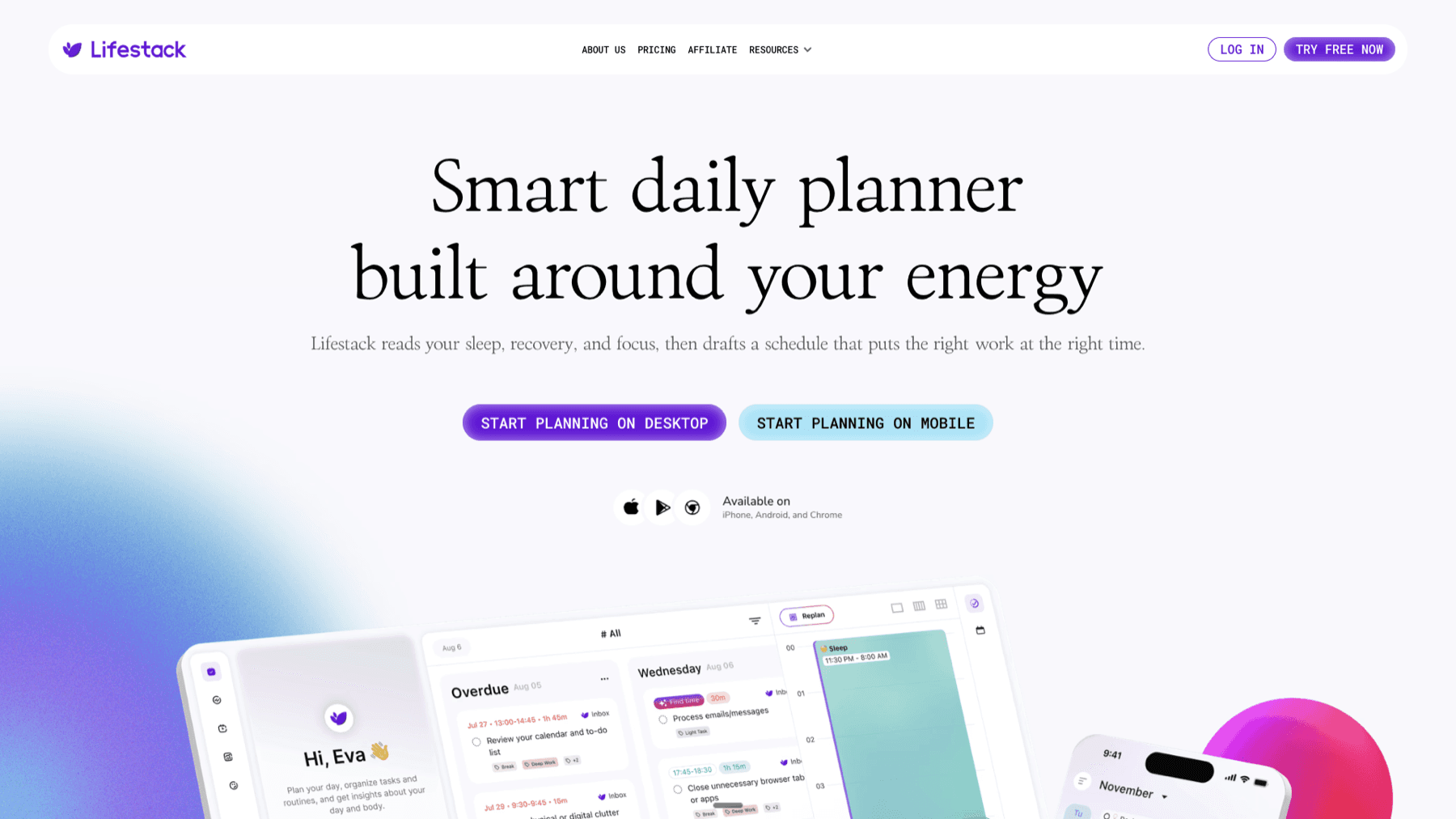
Lifestack reads your sleep data, recovery metrics, and focus patterns to build a daily schedule around your actual energy levels. Instead of blocking tasks at arbitrary times, it places high-focus work during your natural peak windows and lighter tasks when your energy is lower. The result is a day that works with your biology rather than against it, which makes staying motivated far less of a struggle. Learn more about how Lifestack works here.
4. Use the Pomodoro Technique to Build Momentum
The Pomodoro technique is straightforward: 25 minutes of focused work, then a five-minute break. Repeat four times, then take a longer break. What makes it useful is not the timer itself. It is the fact that committing to a 25-minute block is much easier than committing to "finishing the project."
The starting problem, the one that keeps most people stuck, disappears when the commitment is small enough. You are not trying to complete anything. You are just doing 25 minutes and then stopping. Except that once you are in it, you often find the task was not as difficult as it looked from the outside.
There is also something to be said for permission to stop. Knowing a break is coming makes it easier to fully commit during the work interval. You can customize the intervals to match different kinds of work; some people prefer 50-minute blocks for deep tasks, while shorter sprints work better for tasks that drain attention quickly.
5. Eliminate Multitasking and Protect Single Focus
Multitasking feels productive. You are doing two things at once, so you must be getting twice as much done. In reality, the brain does not multitask. It switches between tasks rapidly, and each switch carries a cognitive cost. Researchers call it attention residue: part of your attention stays on the previous task even after you have moved on.
Over a day of constant context-switching, this adds up to significant lost capacity and the persistent feeling that you got a lot done but finished nothing. Motivation drops because there is no sense of progress. Just noise.
The fix is single-tasking. Close the tabs you do not need. Turn off notifications. Do one thing until it is done or until a scheduled break arrives. Protecting focus is an active choice, not a passive outcome. For practical tactics on how to focus at work, including environment design and digital distraction management, that post goes into detail.
6. Fight Procrastination by Lowering the Activation Energy
Procrastination is not laziness. It is an emotional response, usually to uncertainty, boredom, or a vague fear of doing something wrong. The brain seeks relief from that discomfort by doing something easier. Checking email. Tidying your desk. Anything that is not the thing.
The fix is not pushing through the discomfort with more willpower. It is reducing the discomfort itself by making starting easier. One reliable method: set up your next session before you stop working. Leave a file open, write a one-line note about exactly where you are picking up, or leave a sentence unfinished. When you return, there is no blank-page problem. The on-ramp is already built.
Another approach is making the task environment more appealing. A comfortable chair, a cup of coffee, a playlist you like. These are not rewards for later. They are real factors that affect how your brain perceives the task ahead. The post on how to stop procrastinating covers the psychology behind this in depth, including why willpower-based approaches tend to fail.
7. Build Accountability Into Your Routine
Motivation is easier to maintain when someone else knows you are working. This is not about social pressure as a punishment. It is about the fact that having a witness to your effort genuinely changes how you show up, even when the other person is not watching closely.
Body doubling, the practice of working alongside another person even silently and on separate tasks, is one of the most practical tools for this. It is used widely by people with ADHD, but it works across the board. Having another person present changes the ambient conditions in a way that makes focus easier to access.
You can also use habit stacking to attach accountability to something you already do reliably. Pair your work session with a regular anchor event: the morning coffee, the end of lunch, the first thing after the commute. When the cue is automatic, the work session that follows gets much easier to start.
Sharing a specific commitment adds another layer. Not "I am going to work on the report today," but "I will send you the first section by 4pm." Specific commitments are harder to walk away from, and that difficulty is the point.
8. Protect the Basics: Sleep, Movement, and Recovery
No strategy helps if your body is depleted. Sleep is not optional for cognition. Movement is not optional for mood. These are the substrate everything else runs on, and treating them as negotiable is a fast way to make every other strategy feel like it is not working.
Chronic sleep deprivation reduces working memory, lowers impulse control, and makes it significantly harder to start tasks you do not feel like doing. A single bad night has measurable effects on motivation and decision-making. Regular poor sleep does not just cause fatigue; it changes how the prefrontal cortex functions, which is the part of the brain responsible for planning, initiating tasks, and regulating the emotional responses that drive procrastination.
Exercise has a direct effect on motivation as well. Even a 20-minute walk raises dopamine and norepinephrine, two of the neurotransmitters most associated with drive and initiation. You do not need a gym or a long session. You need regular movement. The post on personal energy management covers how sleep, exercise, and recovery connect to your daily capacity in practical terms.
Recovery is the third piece. Working hard without deliberate rest is not discipline. It is just drawing down a resource without refilling it. Breaks, real ones with genuine disengagement from work, are part of the system. Not a reward for finishing.
Best Tool for Getting Motivated: Lifestack
The eight strategies above work best when your daily structure actively supports them. That is where Lifestack becomes a practical companion rather than just another app.
Lifestack is a smart daily planner that reads your sleep data, recovery metrics, and focus patterns to build a schedule around your actual energy levels. It places high-focus tasks during your natural peak windows and reserves low-energy periods for lighter work, which means you are not fighting your own biology just to get started. The connection between energy awareness and motivation is direct: when your schedule is aligned with how you actually feel, tasks feel more approachable and procrastination has less grip.
For anyone who struggles with motivation as a recurring pattern rather than an occasional bad day, the energy-first approach that Lifestack is built on is worth trying. You can read more on the Lifestack overview or explore the research behind the approach in the post on energy-based planning.
Pricing: $7/month (monthly), $50/year with a 7-day free trial, or $120 as a one-time lifetime purchase.
Frequently Asked Questions
Why do I have no motivation?
Low motivation usually comes from one of a few sources: the task feels too large or vague to start, it does not connect to anything you care about, your energy is depleted from sleep loss or stress, or the emotional discomfort of uncertainty is triggering avoidance. Identifying which factor is at play tells you which strategy to try first.
How do I get motivated when I'm depressed?
Depression specifically affects the brain circuits responsible for initiation and reward, which is why waiting to feel motivated before starting almost never works. The most reliable approach is behavioral activation: doing small, low-stakes actions regardless of how you feel, and letting the feeling of progress slowly rebuild from there. If motivation problems are severe or persistent, speaking with a mental health professional is worth prioritizing.
What is the fastest way to get motivated?
Start something. Anything. The fastest path to motivation is action, not preparation or planning. Set a timer for two minutes and do the smallest possible version of the task. Most of the time, you will keep going after the timer ends. If you do not, you still did something, and tomorrow is easier to approach.
How do I stay motivated long-term?
Long-term motivation comes from systems, not willpower. Build a daily structure that removes friction from starting (low activation energy), protects your peak energy windows for your most important work, and includes genuine recovery. Combine that with meaningful goals and regular small wins, and motivation stops being something you have to manufacture.
Does exercise help with motivation?
Yes. Physical movement directly raises the neurotransmitters associated with drive, focus, and mood. Even a short walk makes a measurable difference. This is not a productivity cliche; it is a neurological effect that is well documented. Making movement a non-negotiable part of your routine is one of the highest-impact changes you can make for sustained motivation.
Can my daily schedule affect my motivation?
Significantly. Scheduling demanding work during your natural low-energy periods makes everything feel harder than it is. When you align your schedule with your energy rhythm, tasks become more approachable without any other change. This is one of the most underrated factors in sustained motivation, and it is exactly what motivation research consistently points toward as a structural fix rather than a mindset one.
Motivation is one of those things that feels like it should be effortless, but rarely is. You know what you need to do. You have the time. Yet you sit there, scrolling, reorganizing your desk, doing anything but the actual work. This is not a character flaw. It is a design problem, and like most design problems, it has solutions.
The truth is that motivation does not come before action. It comes after. Most people wait to feel ready before they start, but that feeling almost never arrives on its own. Research is clear on this: action generates motivation, not the other way around. Small wins create momentum, and momentum makes the next step feel easier.
This guide covers eight concrete strategies for how to get motivated when you are stuck. Some are psychological, some are structural, and some are about building the right conditions for your brain to do its best work. None of them require willpower. They require a different setup.
Whether you are dealing with a single project you keep avoiding or a longer pattern of struggling to start anything, these strategies give you something to actually try. Pick one. See what moves.
Key Takeaways
Motivation follows action. Start smaller than you think you need to, and momentum builds on its own.
Your energy level matters more than your time slot. Scheduling hard tasks during peak energy hours changes everything.
Environment and accountability are powerful triggers. Use them deliberately, rather than leaving motivation to chance.
1. Start Smaller Than You Think You Need To
The biggest obstacle to getting motivated is usually the first step. Not the whole project, but the act of beginning. Your brain is wired to protect you from tasks that feel uncertain or overwhelming, which is exactly what a large, vague goal looks like from the outside.
The fix is to shrink the entry point. Instead of "write the report," try "open the document and type one sentence." Instead of "go to the gym," try "put on workout clothes and walk outside." The two-minute rule works because it bypasses the brain's resistance by making the task feel trivial. Once you are in motion, you usually keep going.
This is not a trick to fool yourself. It is how momentum actually works. Starting is the hard part. Everything after that is easier.
2. Connect Your Work to a Reason You Actually Care About
Motivation tends to collapse when work feels arbitrary. When you can draw a direct line between what you are doing right now and something you genuinely want, the work gets easier to approach.
This is the difference between extrinsic and intrinsic motivation. External rewards like pay, grades, or approval can get you started, but they rarely sustain effort over time. Internal reasons, whether it is curiosity, mastery, meaningful contribution, or personal growth, are far more durable.
Take five minutes to write down why the task actually matters to you. Not why it is on your to-do list. Why it connects to something you care about. That small act of reflection shifts the frame from obligation to choice, and choice is where motivation tends to live.
If you consistently cannot connect tasks to anything meaningful, that is worth paying attention to. It may be a signal that the task, the role, or the goal needs to change. Not your work ethic.
3. Schedule Tasks Around Your Energy, Not the Clock
Most productivity advice treats every hour of the day as equal. Your calendar has 9am and 3pm in the same font, with the same block sizes, as if your brain performs identically throughout the day. It does not.
Everyone has a natural rhythm. Some people hit their cognitive peak in the morning. Others warm up slowly and do their sharpest work in the afternoon. Working against your natural rhythm means spending your best hours on low-stakes tasks and saving your hard work for the moments when you have the least capacity. Everything feels harder than it should, and motivation suffers.
Energy-based scheduling flips this around. You map your natural energy peaks across the day and protect those windows for cognitively demanding work. Low-energy periods go to admin, emails, and tasks that do not require deep thinking. For a deeper look at why this outperforms traditional approaches, see the post on why energy-based planning beats time blocking.
The challenge is that most calendar tools are not built for this. They help you schedule, but they do not know when you should be working on what. That is the gap Lifestack fills directly.
Lifestack reads your sleep data, recovery metrics, and focus patterns to build a daily schedule around your actual energy levels. Instead of blocking tasks at arbitrary times, it places high-focus work during your natural peak windows and lighter tasks when your energy is lower. The result is a day that works with your biology rather than against it, which makes staying motivated far less of a struggle. Learn more about how Lifestack works here.
4. Use the Pomodoro Technique to Build Momentum
The Pomodoro technique is straightforward: 25 minutes of focused work, then a five-minute break. Repeat four times, then take a longer break. What makes it useful is not the timer itself. It is the fact that committing to a 25-minute block is much easier than committing to "finishing the project."
The starting problem, the one that keeps most people stuck, disappears when the commitment is small enough. You are not trying to complete anything. You are just doing 25 minutes and then stopping. Except that once you are in it, you often find the task was not as difficult as it looked from the outside.
There is also something to be said for permission to stop. Knowing a break is coming makes it easier to fully commit during the work interval. You can customize the intervals to match different kinds of work; some people prefer 50-minute blocks for deep tasks, while shorter sprints work better for tasks that drain attention quickly.
5. Eliminate Multitasking and Protect Single Focus
Multitasking feels productive. You are doing two things at once, so you must be getting twice as much done. In reality, the brain does not multitask. It switches between tasks rapidly, and each switch carries a cognitive cost. Researchers call it attention residue: part of your attention stays on the previous task even after you have moved on.
Over a day of constant context-switching, this adds up to significant lost capacity and the persistent feeling that you got a lot done but finished nothing. Motivation drops because there is no sense of progress. Just noise.
The fix is single-tasking. Close the tabs you do not need. Turn off notifications. Do one thing until it is done or until a scheduled break arrives. Protecting focus is an active choice, not a passive outcome. For practical tactics on how to focus at work, including environment design and digital distraction management, that post goes into detail.
6. Fight Procrastination by Lowering the Activation Energy
Procrastination is not laziness. It is an emotional response, usually to uncertainty, boredom, or a vague fear of doing something wrong. The brain seeks relief from that discomfort by doing something easier. Checking email. Tidying your desk. Anything that is not the thing.
The fix is not pushing through the discomfort with more willpower. It is reducing the discomfort itself by making starting easier. One reliable method: set up your next session before you stop working. Leave a file open, write a one-line note about exactly where you are picking up, or leave a sentence unfinished. When you return, there is no blank-page problem. The on-ramp is already built.
Another approach is making the task environment more appealing. A comfortable chair, a cup of coffee, a playlist you like. These are not rewards for later. They are real factors that affect how your brain perceives the task ahead. The post on how to stop procrastinating covers the psychology behind this in depth, including why willpower-based approaches tend to fail.
7. Build Accountability Into Your Routine
Motivation is easier to maintain when someone else knows you are working. This is not about social pressure as a punishment. It is about the fact that having a witness to your effort genuinely changes how you show up, even when the other person is not watching closely.
Body doubling, the practice of working alongside another person even silently and on separate tasks, is one of the most practical tools for this. It is used widely by people with ADHD, but it works across the board. Having another person present changes the ambient conditions in a way that makes focus easier to access.
You can also use habit stacking to attach accountability to something you already do reliably. Pair your work session with a regular anchor event: the morning coffee, the end of lunch, the first thing after the commute. When the cue is automatic, the work session that follows gets much easier to start.
Sharing a specific commitment adds another layer. Not "I am going to work on the report today," but "I will send you the first section by 4pm." Specific commitments are harder to walk away from, and that difficulty is the point.
8. Protect the Basics: Sleep, Movement, and Recovery
No strategy helps if your body is depleted. Sleep is not optional for cognition. Movement is not optional for mood. These are the substrate everything else runs on, and treating them as negotiable is a fast way to make every other strategy feel like it is not working.
Chronic sleep deprivation reduces working memory, lowers impulse control, and makes it significantly harder to start tasks you do not feel like doing. A single bad night has measurable effects on motivation and decision-making. Regular poor sleep does not just cause fatigue; it changes how the prefrontal cortex functions, which is the part of the brain responsible for planning, initiating tasks, and regulating the emotional responses that drive procrastination.
Exercise has a direct effect on motivation as well. Even a 20-minute walk raises dopamine and norepinephrine, two of the neurotransmitters most associated with drive and initiation. You do not need a gym or a long session. You need regular movement. The post on personal energy management covers how sleep, exercise, and recovery connect to your daily capacity in practical terms.
Recovery is the third piece. Working hard without deliberate rest is not discipline. It is just drawing down a resource without refilling it. Breaks, real ones with genuine disengagement from work, are part of the system. Not a reward for finishing.
Best Tool for Getting Motivated: Lifestack
The eight strategies above work best when your daily structure actively supports them. That is where Lifestack becomes a practical companion rather than just another app.
Lifestack is a smart daily planner that reads your sleep data, recovery metrics, and focus patterns to build a schedule around your actual energy levels. It places high-focus tasks during your natural peak windows and reserves low-energy periods for lighter work, which means you are not fighting your own biology just to get started. The connection between energy awareness and motivation is direct: when your schedule is aligned with how you actually feel, tasks feel more approachable and procrastination has less grip.
For anyone who struggles with motivation as a recurring pattern rather than an occasional bad day, the energy-first approach that Lifestack is built on is worth trying. You can read more on the Lifestack overview or explore the research behind the approach in the post on energy-based planning.
Pricing: $7/month (monthly), $50/year with a 7-day free trial, or $120 as a one-time lifetime purchase.
Frequently Asked Questions
Why do I have no motivation?
Low motivation usually comes from one of a few sources: the task feels too large or vague to start, it does not connect to anything you care about, your energy is depleted from sleep loss or stress, or the emotional discomfort of uncertainty is triggering avoidance. Identifying which factor is at play tells you which strategy to try first.
How do I get motivated when I'm depressed?
Depression specifically affects the brain circuits responsible for initiation and reward, which is why waiting to feel motivated before starting almost never works. The most reliable approach is behavioral activation: doing small, low-stakes actions regardless of how you feel, and letting the feeling of progress slowly rebuild from there. If motivation problems are severe or persistent, speaking with a mental health professional is worth prioritizing.
What is the fastest way to get motivated?
Start something. Anything. The fastest path to motivation is action, not preparation or planning. Set a timer for two minutes and do the smallest possible version of the task. Most of the time, you will keep going after the timer ends. If you do not, you still did something, and tomorrow is easier to approach.
How do I stay motivated long-term?
Long-term motivation comes from systems, not willpower. Build a daily structure that removes friction from starting (low activation energy), protects your peak energy windows for your most important work, and includes genuine recovery. Combine that with meaningful goals and regular small wins, and motivation stops being something you have to manufacture.
Does exercise help with motivation?
Yes. Physical movement directly raises the neurotransmitters associated with drive, focus, and mood. Even a short walk makes a measurable difference. This is not a productivity cliche; it is a neurological effect that is well documented. Making movement a non-negotiable part of your routine is one of the highest-impact changes you can make for sustained motivation.
Can my daily schedule affect my motivation?
Significantly. Scheduling demanding work during your natural low-energy periods makes everything feel harder than it is. When you align your schedule with your energy rhythm, tasks become more approachable without any other change. This is one of the most underrated factors in sustained motivation, and it is exactly what motivation research consistently points toward as a structural fix rather than a mindset one.



FOLLOW ON
FOLLOW ON
FOLLOW ON


Copyright 2026 © Lifestack. All rights reserved
Copyright 2026 © Lifestack. All rights reserved

