
Tips
How to Improve Attention Span: 7 Techniques
How to Improve Attention Span: 7 Techniques

Attention span is trainable. The popular claim that the average human attention span is now shorter than a goldfish's is not based on real science. It comes from a 2015 Microsoft marketing report that was never peer-reviewed. What is real is that modern environments make sustained attention harder to practice, and unpracticed attention degrades. The difference matters because it means the fix is behavioral, not biological.
Most people who struggle with focus have been living in an environment optimized to fragment attention: notifications, short-form content, rapid context switching, and always-on communication all train the brain to expect and seek interruption. The antidote is deliberate practice in the opposite direction, along with structural changes that reduce the interruption load in the first place.
These seven techniques target different components of the attention problem. Some address the environment. Others address biology. The most effective approach combines several of them rather than relying on any single one.
Key Takeaways
Attention span improves with deliberate practice in sustained focus, not with tips or hacks. The underlying mechanism is the same as building any cognitive skill
Sleep quality has the single largest short-term effect on attention capacity. No technique compensates well for consistent sleep deficit
Scheduling your most demanding work during your actual energy peak produces more usable focused time than any amount of effort applied at the wrong hour
1. Protect Sleep as the Foundation
Before any behavioral technique matters, sleep matters more. Research on sleep deprivation consistently shows that losing one to two hours of sleep per night for several nights produces cognitive impairment comparable to two full nights without sleep. Critically, most sleep-deprived people dramatically underestimate how impaired they are. Attention capacity, working memory, and impulse control are among the first functions to degrade.
The practical implication is that improving attention span by working on focus techniques while carrying a sleep debt is like trying to improve your run time with a broken shoe. Fix the shoe first. Consistent sleep of seven to nine hours per night, good sleep hygiene, and protection of sleep schedule consistency are the highest-impact interventions available before anything else in this list takes effect.
2. Practice Single-Tasking Deliberately
Sustained attention is a skill that degrades with disuse and improves with practice. The practice is simple: pick one task, remove competing inputs, and do it without switching for a set period. The duration matters less than the consistency of the practice. Starting with 20-minute single-task sessions and extending gradually is more effective than attempting long sessions from the start and abandoning them when focus breaks.
The key is that this must be deliberate. Watching TV while checking your phone is not rest. It is context switching. The brain needs periods of genuine single-threaded processing, not just periods without work. Reading a physical book, writing by hand, or doing a focused physical activity like cooking or exercise without screens all count as attention-building practice.
3. Reduce the Ambient Notification Load
Every notification is a small demand on attentional resources. Studies on attention residue show that even seeing a notification you choose not to act on occupies cognitive processing, because the brain begins preparing a response whether or not you follow through on it. The aggregate effect of dozens of daily notifications is a constant low-level fragmentation of attention that makes sustained focus harder even during intentional focus sessions.
The practical fix involves reducing the number of apps with notification permissions, setting specific times to check messages rather than responding to each one as it arrives, and using phone-free periods for the hours where you most need focused work. These changes feel significant in the first week and become invisible within two weeks as the new baseline normalizes.
4. Use Structured Focus Intervals
The Pomodoro Technique and its variants work by creating a defined commitment window that is short enough to feel manageable. Starting a 25-minute session is psychologically easier than starting a 3-hour work block, which lowers the activation energy for beginning. The timer also provides a clear endpoint that makes sustained focus feel finite rather than open-ended.
For tasks requiring deeper immersion, longer intervals of 50 minutes with 10-minute breaks often produce better results than the shorter standard intervals. The optimal length is the one where you consistently reach a genuine focused state before the break arrives. If you find the timer always interrupting you just as you get going, extend the interval. See our guide to the 50/10 Pomodoro method for when longer blocks work better.
5. Exercise Consistently
Aerobic exercise has one of the strongest evidence bases of any intervention for improving attention and cognitive function. A single session of moderate-intensity exercise produces immediate improvements in attention and working memory that last two to three hours post-exercise. Regular exercise over weeks and months produces structural changes in the prefrontal cortex, the brain region most responsible for sustained attention and executive control.
The mechanism involves increased levels of BDNF (brain-derived neurotrophic factor), dopamine, and norepinephrine, all of which support attentional systems. Even 20-30 minutes of brisk walking three to five times per week is enough to produce measurable cognitive benefits. The effect is dose-dependent but does not require intense training to be meaningful.
6. Minimize Passive Consumption of Short-Form Content
Short-form video, social media feeds, and news apps are designed to deliver reward signals at a rate that conditions the brain to expect frequent novelty. After sustained exposure to this type of content, longer tasks that do not deliver the same reward frequency feel more difficult and less engaging by comparison, even if they are inherently more satisfying.
This is not a moral argument against short-form content. It is a practical observation about attentional conditioning. Replacing some scroll time with longer-form content (reading, podcasts, long videos) re-acclimates the brain to tolerating and enjoying longer spans between reward signals. The transition is uncomfortable for the first week and significantly easier after two.
Best Tool for Scheduling Your Sharpest Hours
All of the techniques above improve your attention capacity. But capacity and performance diverge sharply depending on when you use it. Applying your best focus techniques during your cognitive trough produces worse results than ordinary effort during your peak. Most people schedule demanding work based on calendar availability, not on actual cognitive readiness.
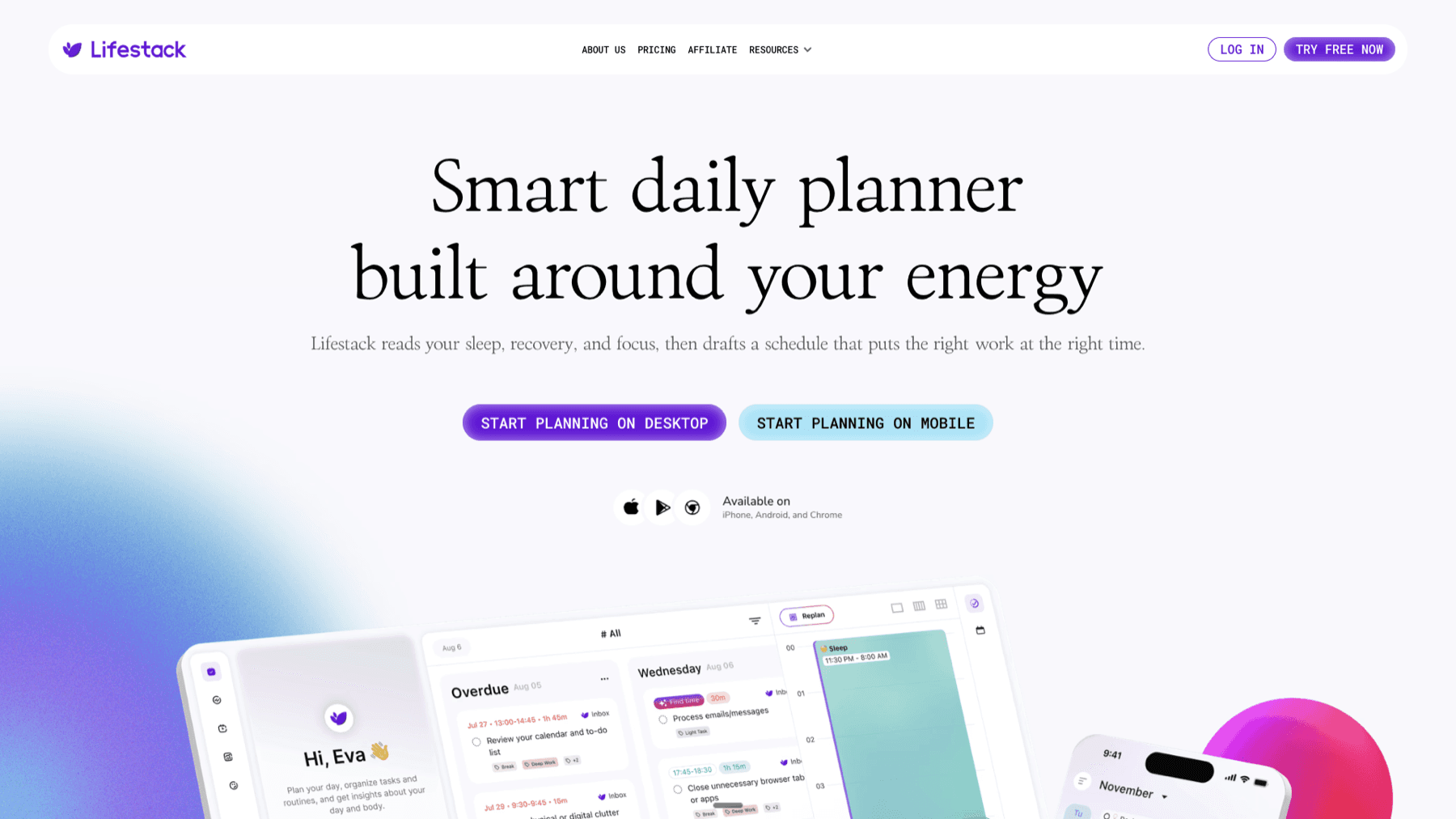
Lifestack connects to your wearable device, reads your sleep score and HRV data, and uses that information to schedule your most cognitively demanding tasks during the windows where your brain is performing at its highest. It closes the gap between having better attention and using it at the right time. The result is not just more focus time on the calendar. It is focus time placed where it produces the best work. Combined with the techniques above, this energy-based scheduling approach turns attention improvement from a project into a system. It costs $7/month or $50/year, with a 7-day free trial on the annual plan.
Frequently Asked Questions
Can you actually improve your attention span?
Yes. Attention is a cognitive skill that responds to practice and environmental conditions. Research on mindfulness, single-tasking practice, and exercise all show measurable improvements in attentional capacity over time. The mechanism is partly structural: regular attentional practice produces changes in the prefrontal cortex that support better sustained focus. The key is that the practice must be deliberate and consistent, not occasional.
How long does it take to improve attention span?
Meaningful improvement in subjective focus quality tends to become apparent within two to four weeks of consistent practice. Structural changes in the brain associated with sustained attention practice have been measured at 8 weeks in mindfulness research. The most immediate improvements come from reducing notification load and improving sleep consistency, which can produce noticeable changes within days. Longer-term capacity improvements from regular exercise and deliberate single-tasking practice take weeks to months.
Why is my attention span getting worse?
The most common causes are insufficient sleep, high notification load, increasing exposure to short-form content that conditions the brain for rapid reward cycling, and insufficient practice with sustained focus tasks. Stress and anxiety also significantly impair attentional control, as does inadequate physical activity. In most cases, addressing sleep and notification load first produces the most visible and rapid improvement before adding other interventions.
Does ADHD make it impossible to improve attention span?
No, but ADHD presents a different attentional profile that responds differently to standard interventions. The attentional challenges in ADHD involve difficulty with self-regulation of attention rather than a fixed capacity limit. Many people with ADHD achieve strong sustained focus on tasks that engage their interest intensely (hyperfocus) while struggling with tasks that do not. Treatment approaches that combine behavioral strategies with appropriate support (medication, accommodation, structured environments) are effective. See our guide on why you can't focus for more on the different causes of attention difficulties.
What is the fastest way to improve focus right now?
The fastest immediate intervention is to remove competing inputs: put the phone in another room, close unnecessary browser tabs, use noise-canceling headphones or move to a quieter space, and commit to a single task for 20 minutes without switching. This combination of environmental change and defined commitment window produces noticeable focus improvement within a single session. The effect is not permanent. It is the result of a better environment, not a trained capacity. Building the capacity takes longer and requires consistent practice.
Attention span is trainable. The popular claim that the average human attention span is now shorter than a goldfish's is not based on real science. It comes from a 2015 Microsoft marketing report that was never peer-reviewed. What is real is that modern environments make sustained attention harder to practice, and unpracticed attention degrades. The difference matters because it means the fix is behavioral, not biological.
Most people who struggle with focus have been living in an environment optimized to fragment attention: notifications, short-form content, rapid context switching, and always-on communication all train the brain to expect and seek interruption. The antidote is deliberate practice in the opposite direction, along with structural changes that reduce the interruption load in the first place.
These seven techniques target different components of the attention problem. Some address the environment. Others address biology. The most effective approach combines several of them rather than relying on any single one.
Key Takeaways
Attention span improves with deliberate practice in sustained focus, not with tips or hacks. The underlying mechanism is the same as building any cognitive skill
Sleep quality has the single largest short-term effect on attention capacity. No technique compensates well for consistent sleep deficit
Scheduling your most demanding work during your actual energy peak produces more usable focused time than any amount of effort applied at the wrong hour
1. Protect Sleep as the Foundation
Before any behavioral technique matters, sleep matters more. Research on sleep deprivation consistently shows that losing one to two hours of sleep per night for several nights produces cognitive impairment comparable to two full nights without sleep. Critically, most sleep-deprived people dramatically underestimate how impaired they are. Attention capacity, working memory, and impulse control are among the first functions to degrade.
The practical implication is that improving attention span by working on focus techniques while carrying a sleep debt is like trying to improve your run time with a broken shoe. Fix the shoe first. Consistent sleep of seven to nine hours per night, good sleep hygiene, and protection of sleep schedule consistency are the highest-impact interventions available before anything else in this list takes effect.
2. Practice Single-Tasking Deliberately
Sustained attention is a skill that degrades with disuse and improves with practice. The practice is simple: pick one task, remove competing inputs, and do it without switching for a set period. The duration matters less than the consistency of the practice. Starting with 20-minute single-task sessions and extending gradually is more effective than attempting long sessions from the start and abandoning them when focus breaks.
The key is that this must be deliberate. Watching TV while checking your phone is not rest. It is context switching. The brain needs periods of genuine single-threaded processing, not just periods without work. Reading a physical book, writing by hand, or doing a focused physical activity like cooking or exercise without screens all count as attention-building practice.
3. Reduce the Ambient Notification Load
Every notification is a small demand on attentional resources. Studies on attention residue show that even seeing a notification you choose not to act on occupies cognitive processing, because the brain begins preparing a response whether or not you follow through on it. The aggregate effect of dozens of daily notifications is a constant low-level fragmentation of attention that makes sustained focus harder even during intentional focus sessions.
The practical fix involves reducing the number of apps with notification permissions, setting specific times to check messages rather than responding to each one as it arrives, and using phone-free periods for the hours where you most need focused work. These changes feel significant in the first week and become invisible within two weeks as the new baseline normalizes.
4. Use Structured Focus Intervals
The Pomodoro Technique and its variants work by creating a defined commitment window that is short enough to feel manageable. Starting a 25-minute session is psychologically easier than starting a 3-hour work block, which lowers the activation energy for beginning. The timer also provides a clear endpoint that makes sustained focus feel finite rather than open-ended.
For tasks requiring deeper immersion, longer intervals of 50 minutes with 10-minute breaks often produce better results than the shorter standard intervals. The optimal length is the one where you consistently reach a genuine focused state before the break arrives. If you find the timer always interrupting you just as you get going, extend the interval. See our guide to the 50/10 Pomodoro method for when longer blocks work better.
5. Exercise Consistently
Aerobic exercise has one of the strongest evidence bases of any intervention for improving attention and cognitive function. A single session of moderate-intensity exercise produces immediate improvements in attention and working memory that last two to three hours post-exercise. Regular exercise over weeks and months produces structural changes in the prefrontal cortex, the brain region most responsible for sustained attention and executive control.
The mechanism involves increased levels of BDNF (brain-derived neurotrophic factor), dopamine, and norepinephrine, all of which support attentional systems. Even 20-30 minutes of brisk walking three to five times per week is enough to produce measurable cognitive benefits. The effect is dose-dependent but does not require intense training to be meaningful.
6. Minimize Passive Consumption of Short-Form Content
Short-form video, social media feeds, and news apps are designed to deliver reward signals at a rate that conditions the brain to expect frequent novelty. After sustained exposure to this type of content, longer tasks that do not deliver the same reward frequency feel more difficult and less engaging by comparison, even if they are inherently more satisfying.
This is not a moral argument against short-form content. It is a practical observation about attentional conditioning. Replacing some scroll time with longer-form content (reading, podcasts, long videos) re-acclimates the brain to tolerating and enjoying longer spans between reward signals. The transition is uncomfortable for the first week and significantly easier after two.
Best Tool for Scheduling Your Sharpest Hours
All of the techniques above improve your attention capacity. But capacity and performance diverge sharply depending on when you use it. Applying your best focus techniques during your cognitive trough produces worse results than ordinary effort during your peak. Most people schedule demanding work based on calendar availability, not on actual cognitive readiness.
Lifestack connects to your wearable device, reads your sleep score and HRV data, and uses that information to schedule your most cognitively demanding tasks during the windows where your brain is performing at its highest. It closes the gap between having better attention and using it at the right time. The result is not just more focus time on the calendar. It is focus time placed where it produces the best work. Combined with the techniques above, this energy-based scheduling approach turns attention improvement from a project into a system. It costs $7/month or $50/year, with a 7-day free trial on the annual plan.
Frequently Asked Questions
Can you actually improve your attention span?
Yes. Attention is a cognitive skill that responds to practice and environmental conditions. Research on mindfulness, single-tasking practice, and exercise all show measurable improvements in attentional capacity over time. The mechanism is partly structural: regular attentional practice produces changes in the prefrontal cortex that support better sustained focus. The key is that the practice must be deliberate and consistent, not occasional.
How long does it take to improve attention span?
Meaningful improvement in subjective focus quality tends to become apparent within two to four weeks of consistent practice. Structural changes in the brain associated with sustained attention practice have been measured at 8 weeks in mindfulness research. The most immediate improvements come from reducing notification load and improving sleep consistency, which can produce noticeable changes within days. Longer-term capacity improvements from regular exercise and deliberate single-tasking practice take weeks to months.
Why is my attention span getting worse?
The most common causes are insufficient sleep, high notification load, increasing exposure to short-form content that conditions the brain for rapid reward cycling, and insufficient practice with sustained focus tasks. Stress and anxiety also significantly impair attentional control, as does inadequate physical activity. In most cases, addressing sleep and notification load first produces the most visible and rapid improvement before adding other interventions.
Does ADHD make it impossible to improve attention span?
No, but ADHD presents a different attentional profile that responds differently to standard interventions. The attentional challenges in ADHD involve difficulty with self-regulation of attention rather than a fixed capacity limit. Many people with ADHD achieve strong sustained focus on tasks that engage their interest intensely (hyperfocus) while struggling with tasks that do not. Treatment approaches that combine behavioral strategies with appropriate support (medication, accommodation, structured environments) are effective. See our guide on why you can't focus for more on the different causes of attention difficulties.
What is the fastest way to improve focus right now?
The fastest immediate intervention is to remove competing inputs: put the phone in another room, close unnecessary browser tabs, use noise-canceling headphones or move to a quieter space, and commit to a single task for 20 minutes without switching. This combination of environmental change and defined commitment window produces noticeable focus improvement within a single session. The effect is not permanent. It is the result of a better environment, not a trained capacity. Building the capacity takes longer and requires consistent practice.



FOLLOW ON
FOLLOW ON
FOLLOW ON


Copyright 2026 © Lifestack. All rights reserved
Copyright 2026 © Lifestack. All rights reserved

