
Tips
How to Sleep Better at Night: 10 Proven Tips
How to Sleep Better at Night: 10 Proven Tips

Sleep quality degrades for predictable reasons, and most of them are behavioral. The core biology of sleep, the circadian rhythm that drives your sleep-wake cycle, hasn't changed, but the habits that interfere with it have multiplied. Late-night screen exposure, caffeine consumed past noon, irregular bedtimes, and high cortisol from evening work are the main culprits for most people.
These ten strategies address the most common causes of poor sleep with specific, actionable steps. They're ranked roughly by impact for the average person, though individual variation matters: some people are sensitive to caffeine timing but fine with late-night screens, and vice versa.
Key Takeaways
Caffeine timing, consistent wake time, and cool room temperature are the three most impactful changes for most people
Sleep quantity matters less than sleep architecture: 7 hours of quality deep and REM sleep beats 9 hours of fragmented light sleep
Most sleep problems respond to behavioral changes without medication or supplements
1. Set a Consistent Wake Time (Not Just a Bedtime)
Circadian rhythms are anchored by light exposure and consistent wake times, not by when you go to bed. The most effective single change for most people is picking a wake time and holding it every day, including weekends. This anchors your circadian rhythm and naturally adjusts your sleep drive to match.
Varying your wake time by more than 90 minutes between weekdays and weekends creates social jetlag: the same disorientation as crossing time zones, recurring every weekend. If you go to bed late on weekends and sleep in to compensate, you're resetting your rhythm twice a week. Hold the wake time and let your sleep drive adjust the bedtime organically.
2. Cut Caffeine Earlier Than You Think
Caffeine has a half-life of 5-7 hours in most adults. A coffee at 2pm means roughly half the caffeine is still active at 9pm. It doesn't feel like it because adenosine tolerance builds over the course of a day, but the drug is still blocking the adenosine receptors that drive sleep pressure.
The practical cutoff for most people is noon, or at the latest 1pm for a 10pm bedtime. The 10-3-2-1-0 sleep rule structures this as a 10-hour cutoff: no caffeine 10 hours before bed. For a midnight bedtime, that's a 2pm cap. For a 10pm bedtime, it's noon.
3. Keep Your Room Cool
Sleep onset requires a drop in core body temperature of 1-2 degrees. A warm room slows or prevents this drop. The optimal bedroom temperature for sleep is 65-68°F (18-20°C) for most adults. If your room is significantly warmer, the fix is mechanical: air conditioning, a fan, cooling mattress pad, or breathable bedding.
The body temperature drop is part of the reason a warm bath 90 minutes before bed counterintuitively helps sleep: the bath heats the skin, dilates blood vessels, and accelerates heat loss once you get out, dropping core temperature faster than it would drop passively.
4. Stop Screens an Hour Before Bed
Blue-wavelength light from phones, tablets, and laptops suppresses melatonin production in the pineal gland. The suppression starts with 20-30 minutes of exposure and can delay melatonin onset by 1-2 hours for heavy users. Melatonin doesn't put you to sleep, but it signals the brain that darkness has arrived, initiating the physiological preparation for sleep.
Blue light glasses reduce the suppression effect but don't eliminate it. See our review of blue light glasses and sleep for how much they actually help. The more reliable fix is avoidance: a one-hour screen-free window before bed is more effective than any filter.
5. Build a Wind-Down Routine
The 60-90 minutes before bed should be a consistent, low-stimulation sequence. The specifics matter less than the consistency: the routine itself becomes a conditioned cue that your brain learns to associate with sleep onset. Reading physical books, light stretching, journaling, and slow breathing all work. What matters is doing the same things in the same order.
Work email is specifically problematic in this window. Even reading a stressful email without responding produces anticipatory cortisol that keeps the prefrontal cortex active. A clean stopping point for work-related information is as important as the routine itself. See our complete night routine guide for detailed structure.
6. Get Morning Light Exposure
Bright light exposure in the first 30-60 minutes after waking sets your circadian clock. This isn't about mood; it's about the photoreceptors in your eyes signaling the suprachiasmatic nucleus (the brain's master clock) to begin the countdown to that night's sleep. Without this morning signal, the clock drifts, pushing sleep and wake times progressively later.
Natural outdoor light is roughly 10,000-50,000 lux. Indoor lighting is 100-500 lux. This is a 100x difference that artificial light can't compensate for, which is why a few minutes outside in the morning has a larger effect on circadian timing than leaving indoor lights on all day.
7. Stop Working at Least 2 Hours Before Bed
Work activates the prefrontal cortex and raises cortisol. Cortisol follows a natural diurnal curve: high in the morning to drive alertness, dropping through the evening to allow sleep onset. Work done late in the evening interrupts this curve. The cortisol-sleep relationship explains why even mildly stressful work before bed delays sleep onset significantly more than passive entertainment does.
The 2-hour buffer gives cortisol time to drop to baseline. If your schedule makes this genuinely impossible, even a 60-minute buffer is better than working until your head hits the pillow.
8. Use Melatonin Correctly (or Not at All)
Melatonin is a timing signal, not a sedative. A low dose (0.5-1mg) taken 90-120 minutes before the desired sleep time helps shift the circadian clock earlier, which is useful for delayed sleep phase or jet lag. High doses (5-10mg) are common but pharmacologically unnecessary; they may cause morning grogginess without improving sleep quality.
For people with normal circadian timing who sleep at a consistent time, melatonin provides minimal benefit. Where it helps most is for shift workers, frequent travelers, or anyone trying to adjust sleep timing. See our comparison of melatonin vs magnesium for sleep for how they differ in mechanism and use case.
9. Keep the Bedroom for Sleep Only
Stimulus control is a core technique in cognitive behavioral therapy for insomnia. The bedroom should be associated exclusively with sleep (and sex); activities like working in bed, watching TV in bed, or lying awake scrolling your phone train the brain to associate the bedroom with wakefulness rather than sleep. The conditioned association works in both directions.
If you're lying awake for more than 20 minutes, the most effective CBT-I response is to get out of bed and do something quiet in low light until you feel genuinely sleepy. Lying in bed frustrated, waiting for sleep, strengthens the association between bed and wakefulness.
10. Track Your Sleep to Find Your Pattern
Sleep tracking with a wearable gives you objective data about which nights are actually restorative versus which ones feel fine but show low deep sleep. Patterns become visible over weeks: late alcohol, late meals, or irregular schedules all show up clearly in sleep score trends. See our guide on how to improve your sleep score for how to interpret wearable sleep data and act on it.
Best Tool for Sleep-Aware Scheduling
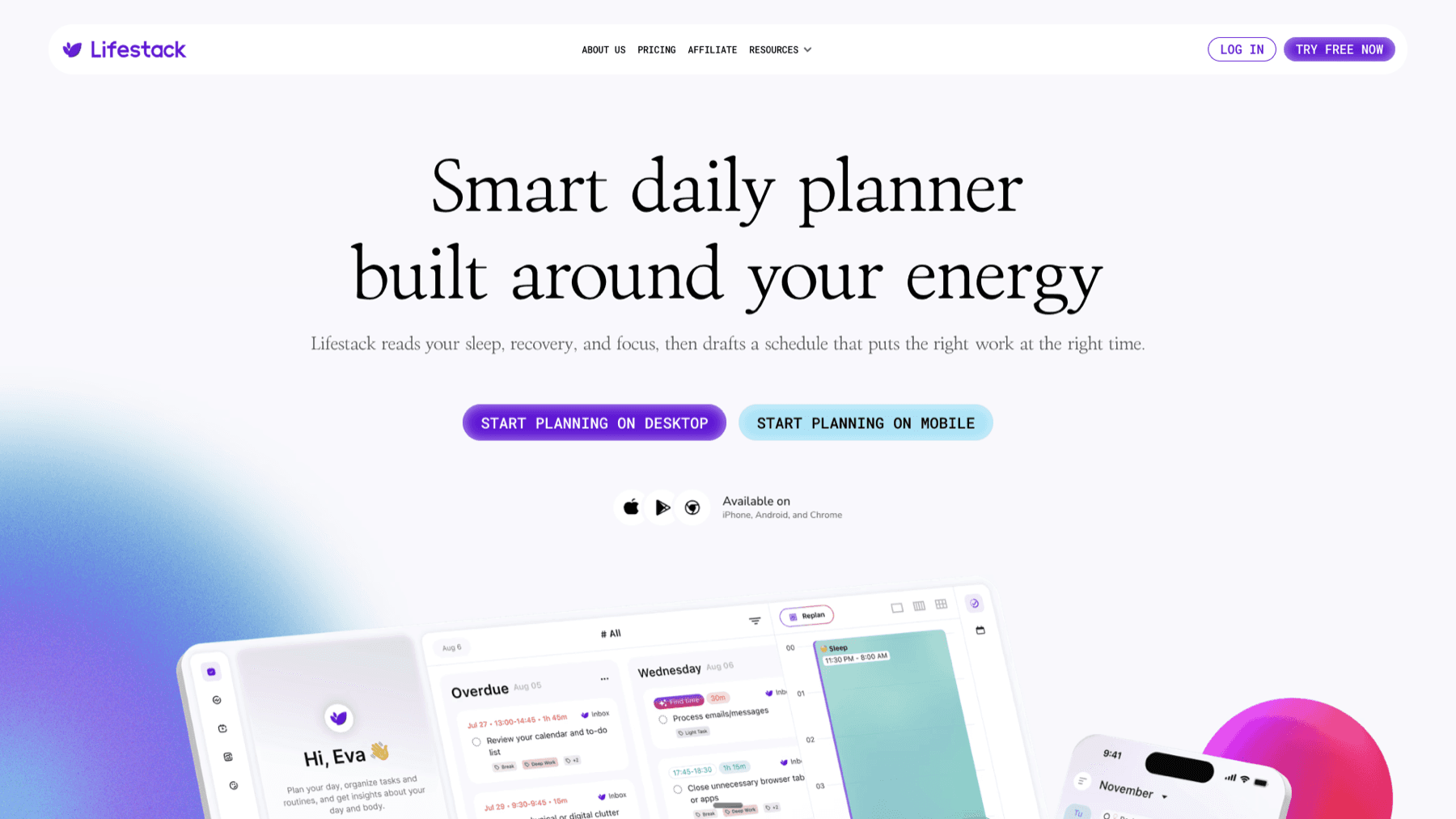
Sleep quality directly affects what you're capable of the following day. Lifestack reads your overnight sleep data from wearables like Oura Ring, Apple Watch, WHOOP, or Garmin and uses it to schedule your day accordingly. High-priority, cognitively demanding tasks get placed in windows when your sleep score and HRV say you're at your best. When sleep was poor, the schedule adjusts to protect focus blocks rather than stacking them when you can't use them.
Lifestack starts at $9.99/month or $49.99/year with a 7-day free trial on the annual plan.
Frequently Asked Questions
How can I fall asleep faster at night?
The most effective immediate strategies are cooling your room to 65-68°F, turning off screens an hour before bed, and doing a consistent wind-down routine. For falling asleep faster specifically, the 4-7-8 breathing technique (inhale for 4 seconds, hold for 7, exhale for 8) activates the parasympathetic nervous system and reliably reduces time to sleep onset for most people.
What is the best time to sleep at night?
The best bedtime is the one that allows 7-9 hours of sleep before your required wake time, occurring at a consistent hour each night. For most adults, that's between 10pm and midnight. The specific time matters less than the consistency: sleeping and waking at the same time every day is more restorative than sleeping longer on irregular schedules.
Does alcohol help you sleep?
Alcohol is a sedative that shortens time to sleep onset, but it degrades sleep architecture significantly. As alcohol metabolizes in the second half of the night, it produces a rebound effect: lighter sleep, more waking, and suppressed REM. The net result is usually more time in bed but less restorative sleep. Regular alcohol use as a sleep aid also builds tolerance quickly.
How many hours of sleep do I need?
The National Sleep Foundation recommends 7-9 hours for adults aged 18-64. Individual needs vary within this range; some people function optimally on 7 hours while others need closer to 9. Sleep quality matters as much as quantity: 7 hours with solid deep and REM sleep is more restorative than 9 hours of fragmented light sleep. See our comparison of 7 vs 8 hours of sleep for more on this.
What should I do if I can't sleep at night?
If you're lying awake after 20 minutes, get out of bed. Do something quiet in low light, such as reading a physical book or doing light stretching, until you feel genuinely sleepy. This breaks the association between your bed and wakefulness. Avoid checking your phone: the light exposure and stimulating content both work against sleep onset. Return to bed only when you feel the specific physical sensation of drowsiness.
Sleep quality degrades for predictable reasons, and most of them are behavioral. The core biology of sleep, the circadian rhythm that drives your sleep-wake cycle, hasn't changed, but the habits that interfere with it have multiplied. Late-night screen exposure, caffeine consumed past noon, irregular bedtimes, and high cortisol from evening work are the main culprits for most people.
These ten strategies address the most common causes of poor sleep with specific, actionable steps. They're ranked roughly by impact for the average person, though individual variation matters: some people are sensitive to caffeine timing but fine with late-night screens, and vice versa.
Key Takeaways
Caffeine timing, consistent wake time, and cool room temperature are the three most impactful changes for most people
Sleep quantity matters less than sleep architecture: 7 hours of quality deep and REM sleep beats 9 hours of fragmented light sleep
Most sleep problems respond to behavioral changes without medication or supplements
1. Set a Consistent Wake Time (Not Just a Bedtime)
Circadian rhythms are anchored by light exposure and consistent wake times, not by when you go to bed. The most effective single change for most people is picking a wake time and holding it every day, including weekends. This anchors your circadian rhythm and naturally adjusts your sleep drive to match.
Varying your wake time by more than 90 minutes between weekdays and weekends creates social jetlag: the same disorientation as crossing time zones, recurring every weekend. If you go to bed late on weekends and sleep in to compensate, you're resetting your rhythm twice a week. Hold the wake time and let your sleep drive adjust the bedtime organically.
2. Cut Caffeine Earlier Than You Think
Caffeine has a half-life of 5-7 hours in most adults. A coffee at 2pm means roughly half the caffeine is still active at 9pm. It doesn't feel like it because adenosine tolerance builds over the course of a day, but the drug is still blocking the adenosine receptors that drive sleep pressure.
The practical cutoff for most people is noon, or at the latest 1pm for a 10pm bedtime. The 10-3-2-1-0 sleep rule structures this as a 10-hour cutoff: no caffeine 10 hours before bed. For a midnight bedtime, that's a 2pm cap. For a 10pm bedtime, it's noon.
3. Keep Your Room Cool
Sleep onset requires a drop in core body temperature of 1-2 degrees. A warm room slows or prevents this drop. The optimal bedroom temperature for sleep is 65-68°F (18-20°C) for most adults. If your room is significantly warmer, the fix is mechanical: air conditioning, a fan, cooling mattress pad, or breathable bedding.
The body temperature drop is part of the reason a warm bath 90 minutes before bed counterintuitively helps sleep: the bath heats the skin, dilates blood vessels, and accelerates heat loss once you get out, dropping core temperature faster than it would drop passively.
4. Stop Screens an Hour Before Bed
Blue-wavelength light from phones, tablets, and laptops suppresses melatonin production in the pineal gland. The suppression starts with 20-30 minutes of exposure and can delay melatonin onset by 1-2 hours for heavy users. Melatonin doesn't put you to sleep, but it signals the brain that darkness has arrived, initiating the physiological preparation for sleep.
Blue light glasses reduce the suppression effect but don't eliminate it. See our review of blue light glasses and sleep for how much they actually help. The more reliable fix is avoidance: a one-hour screen-free window before bed is more effective than any filter.
5. Build a Wind-Down Routine
The 60-90 minutes before bed should be a consistent, low-stimulation sequence. The specifics matter less than the consistency: the routine itself becomes a conditioned cue that your brain learns to associate with sleep onset. Reading physical books, light stretching, journaling, and slow breathing all work. What matters is doing the same things in the same order.
Work email is specifically problematic in this window. Even reading a stressful email without responding produces anticipatory cortisol that keeps the prefrontal cortex active. A clean stopping point for work-related information is as important as the routine itself. See our complete night routine guide for detailed structure.
6. Get Morning Light Exposure
Bright light exposure in the first 30-60 minutes after waking sets your circadian clock. This isn't about mood; it's about the photoreceptors in your eyes signaling the suprachiasmatic nucleus (the brain's master clock) to begin the countdown to that night's sleep. Without this morning signal, the clock drifts, pushing sleep and wake times progressively later.
Natural outdoor light is roughly 10,000-50,000 lux. Indoor lighting is 100-500 lux. This is a 100x difference that artificial light can't compensate for, which is why a few minutes outside in the morning has a larger effect on circadian timing than leaving indoor lights on all day.
7. Stop Working at Least 2 Hours Before Bed
Work activates the prefrontal cortex and raises cortisol. Cortisol follows a natural diurnal curve: high in the morning to drive alertness, dropping through the evening to allow sleep onset. Work done late in the evening interrupts this curve. The cortisol-sleep relationship explains why even mildly stressful work before bed delays sleep onset significantly more than passive entertainment does.
The 2-hour buffer gives cortisol time to drop to baseline. If your schedule makes this genuinely impossible, even a 60-minute buffer is better than working until your head hits the pillow.
8. Use Melatonin Correctly (or Not at All)
Melatonin is a timing signal, not a sedative. A low dose (0.5-1mg) taken 90-120 minutes before the desired sleep time helps shift the circadian clock earlier, which is useful for delayed sleep phase or jet lag. High doses (5-10mg) are common but pharmacologically unnecessary; they may cause morning grogginess without improving sleep quality.
For people with normal circadian timing who sleep at a consistent time, melatonin provides minimal benefit. Where it helps most is for shift workers, frequent travelers, or anyone trying to adjust sleep timing. See our comparison of melatonin vs magnesium for sleep for how they differ in mechanism and use case.
9. Keep the Bedroom for Sleep Only
Stimulus control is a core technique in cognitive behavioral therapy for insomnia. The bedroom should be associated exclusively with sleep (and sex); activities like working in bed, watching TV in bed, or lying awake scrolling your phone train the brain to associate the bedroom with wakefulness rather than sleep. The conditioned association works in both directions.
If you're lying awake for more than 20 minutes, the most effective CBT-I response is to get out of bed and do something quiet in low light until you feel genuinely sleepy. Lying in bed frustrated, waiting for sleep, strengthens the association between bed and wakefulness.
10. Track Your Sleep to Find Your Pattern
Sleep tracking with a wearable gives you objective data about which nights are actually restorative versus which ones feel fine but show low deep sleep. Patterns become visible over weeks: late alcohol, late meals, or irregular schedules all show up clearly in sleep score trends. See our guide on how to improve your sleep score for how to interpret wearable sleep data and act on it.
Best Tool for Sleep-Aware Scheduling
Sleep quality directly affects what you're capable of the following day. Lifestack reads your overnight sleep data from wearables like Oura Ring, Apple Watch, WHOOP, or Garmin and uses it to schedule your day accordingly. High-priority, cognitively demanding tasks get placed in windows when your sleep score and HRV say you're at your best. When sleep was poor, the schedule adjusts to protect focus blocks rather than stacking them when you can't use them.
Lifestack starts at $9.99/month or $49.99/year with a 7-day free trial on the annual plan.
Frequently Asked Questions
How can I fall asleep faster at night?
The most effective immediate strategies are cooling your room to 65-68°F, turning off screens an hour before bed, and doing a consistent wind-down routine. For falling asleep faster specifically, the 4-7-8 breathing technique (inhale for 4 seconds, hold for 7, exhale for 8) activates the parasympathetic nervous system and reliably reduces time to sleep onset for most people.
What is the best time to sleep at night?
The best bedtime is the one that allows 7-9 hours of sleep before your required wake time, occurring at a consistent hour each night. For most adults, that's between 10pm and midnight. The specific time matters less than the consistency: sleeping and waking at the same time every day is more restorative than sleeping longer on irregular schedules.
Does alcohol help you sleep?
Alcohol is a sedative that shortens time to sleep onset, but it degrades sleep architecture significantly. As alcohol metabolizes in the second half of the night, it produces a rebound effect: lighter sleep, more waking, and suppressed REM. The net result is usually more time in bed but less restorative sleep. Regular alcohol use as a sleep aid also builds tolerance quickly.
How many hours of sleep do I need?
The National Sleep Foundation recommends 7-9 hours for adults aged 18-64. Individual needs vary within this range; some people function optimally on 7 hours while others need closer to 9. Sleep quality matters as much as quantity: 7 hours with solid deep and REM sleep is more restorative than 9 hours of fragmented light sleep. See our comparison of 7 vs 8 hours of sleep for more on this.
What should I do if I can't sleep at night?
If you're lying awake after 20 minutes, get out of bed. Do something quiet in low light, such as reading a physical book or doing light stretching, until you feel genuinely sleepy. This breaks the association between your bed and wakefulness. Avoid checking your phone: the light exposure and stimulating content both work against sleep onset. Return to bed only when you feel the specific physical sensation of drowsiness.



FOLLOW ON
FOLLOW ON
FOLLOW ON



Copyright 2026 © Lifestack. All rights reserved
Copyright 2026 © Lifestack. All rights reserved

