
Tips
Is Sleeping 5 Hours Enough?
Is Sleeping 5 Hours Enough?

Five hours. If you pull that regularly, you probably know the feeling: a vague, low-grade fog that becomes your baseline, a coffee habit that feels mandatory, a creeping sense that you should be sharper than you are. Yet a lot of people quietly normalize it. The question is whether the body actually adapts or just gets worse at noticing how tired it is.
The research on this is pretty unambiguous. For roughly 99% of adults, sleeping five hours is not enough. The one percent exception is a real genetic variant, but the odds that you have it are extremely low, and most people who think they're fine on five hours are simply running a cognitive debt they can no longer accurately perceive.
Here's what's actually happening in your brain and body during those missing hours, what the long-term stakes look like, and what to do when life genuinely doesn't leave you more than five hours to sleep.
Key Takeaways
The CDC and sleep researchers consistently recommend 7 to 9 hours for adults. Five hours falls well below this threshold for virtually all adults.
Short-term cognitive impairment from five hours of sleep is measurable and accumulates day over day, even when you stop feeling tired.
The short sleeper gene (BHLHE41) affects fewer than 1% of people. If you haven't tested positive, you almost certainly don't have it.
What the Research Actually Says
The National Sleep Foundation and the Centers for Disease Control both recommend 7 to 9 hours of sleep per night for adults aged 18 to 64. Adults 65 and older are recommended 7 to 8 hours. These aren't conservative, cushioned estimates. They reflect the range at which most adults show optimal cognitive performance, immune function, metabolic regulation, and emotional stability in controlled studies.
Five hours sits almost two full hours below the minimum threshold. Research from the University of Pennsylvania found that people who slept six hours a night for two weeks performed as poorly on cognitive tests as people who had gone completely without sleep for 24 hours straight. Five hours produces a steeper deficit faster. What's striking is that most people in these studies felt only "slightly sleepy" despite being severely impaired. The subjective sense of tiredness adapts; the objective impairment does not.
For comparison with the 8-hour question, see our post on whether 8 hours of sleep is actually enough.
What Five Hours Cuts Short in Your Sleep Architecture
Sleep doesn't happen in one uniform block. It cycles through distinct stages roughly every 90 minutes, with the ratio of those stages shifting over the course of the night. The full picture of how sleep stages work matters here because cutting the night short affects some stages far more than others.
Deep sleep (slow-wave sleep) concentrates in the first half of the night. REM sleep, the stage associated with memory consolidation, emotional processing, and creativity, concentrates in the last few hours. A five-hour window usually captures most of your deep sleep but cuts into REM significantly.
The difference between deep sleep and REM sleep matters for what you lose. Deep sleep is when growth hormone releases and physical repair happens. REM is when the brain files and integrates what it learned during the day. Consistently truncating REM means impaired memory formation, worse emotional regulation, reduced creative problem-solving, and slower learning. You can read about how much deep sleep you actually need for a fuller breakdown.
What Happens to Your Body on Five Hours
The short-term effects start within 24 hours and stack across days. After one five-hour night, reaction time, working memory, and decision quality all drop measurably. After a week, the impairment mirrors being mildly intoxicated, according to research from the Walter Reed Army Institute. That's the cognitive state many people are operating in permanently.
Appetite hormones are also affected. Ghrelin (the hunger signal) goes up; leptin (the satiety signal) goes down. You eat more, particularly high-carbohydrate foods, because sleep-deprived brains seek quick energy. The immune system produces fewer cytokines during sleep, meaning five-hour sleepers are statistically more likely to get sick after virus exposure. Cortisol, the stress hormone, releases at higher levels the morning after short sleep.
Sleep's relationship to daily energy levels runs deeper than most people realize. It's not just that you feel tired. Every system that regulates your capacity to focus, move, and make good decisions is running at reduced capacity.
The Long-Term Picture
Chronically short sleep (consistently under six hours) is associated with significantly increased risk for several serious conditions: cardiovascular disease, type 2 diabetes, obesity, depression, and cognitive decline. A 2021 study published in Nature Communications followed over 7,000 participants for 25 years and found that consistently sleeping six hours or fewer at age 50 was associated with a 30% higher risk of developing dementia later in life.
None of this means a bad week of five-hour nights will cause permanent damage. The body is resilient and recovery is possible. But it does mean treating five hours as a sustainable baseline has real consequences that show up on long timescales. Sleep hygiene practices exist precisely because small, consistent improvements to sleep duration and quality compound over time.
The Short Sleeper Gene: Are You the Exception?
True short sleepers exist. A mutation in the BHLHE41 gene (and several related genes identified in subsequent research) allows a small fraction of people to function normally on six hours or fewer, with no measurable cognitive deficit, no higher disease risk, and no accumulated sleep debt. These individuals wake naturally after five or six hours feeling genuinely rested, not just awake.
The catch: this affects roughly 1 in 100 people, possibly fewer. Most people who believe they're fine on five hours have simply adapted to feeling impaired. Decades of sleep research consistently find that self-reported tolerance for short sleep doesn't correlate with objective performance. If you've never had a genetic test confirming the variant, the statistical probability that you're a natural short sleeper is very low. Most people who feel fine are just poor judges of their own impairment.
How Sleep Debt Compounds
Every night you sleep fewer than your personal requirement, you add to a deficit. How to calculate sleep debt involves tracking your target sleep duration versus actual sleep across days. The problem is that debt doesn't just clear on a good night. Research suggests it can take several days of adequate sleep to recover from a week of restriction, and some cognitive effects (particularly those tied to REM deprivation) may take longer.
The subjective experience of recovery is also misleading. After a long sleep, you often feel much better quickly, which makes it easy to underestimate how much residual debt remains. The limits of sleep deprivation show how far the body can be pushed, but short-term resilience isn't the same as long-term sustainability.
What to Do When Five Hours Is Unavoidable
Sometimes life doesn't cooperate. A newborn, a deadline, an illness in the family, a red-eye flight. If you're working with five hours for a stretch, a few principles help minimize the damage.
Prioritize sleep debt repayment as soon as the constraint lifts. Don't treat the first normal night as optional. Protect whatever sleep window you have by making it dark, cool, and consistent. Even within a five-hour window, sleep quality varies. Avoiding alcohol and heavy food close to sleep improves the depth of the sleep you do get. A short nap (10 to 20 minutes) in the early afternoon can partially offset cognitive impairment from a short night, though it doesn't address the underlying debt. And watch for sleep inertia, the grogginess that follows an alarm during deep sleep, which hits harder on short-sleep nights.
How Sleep-Aware Scheduling Helps You Recover
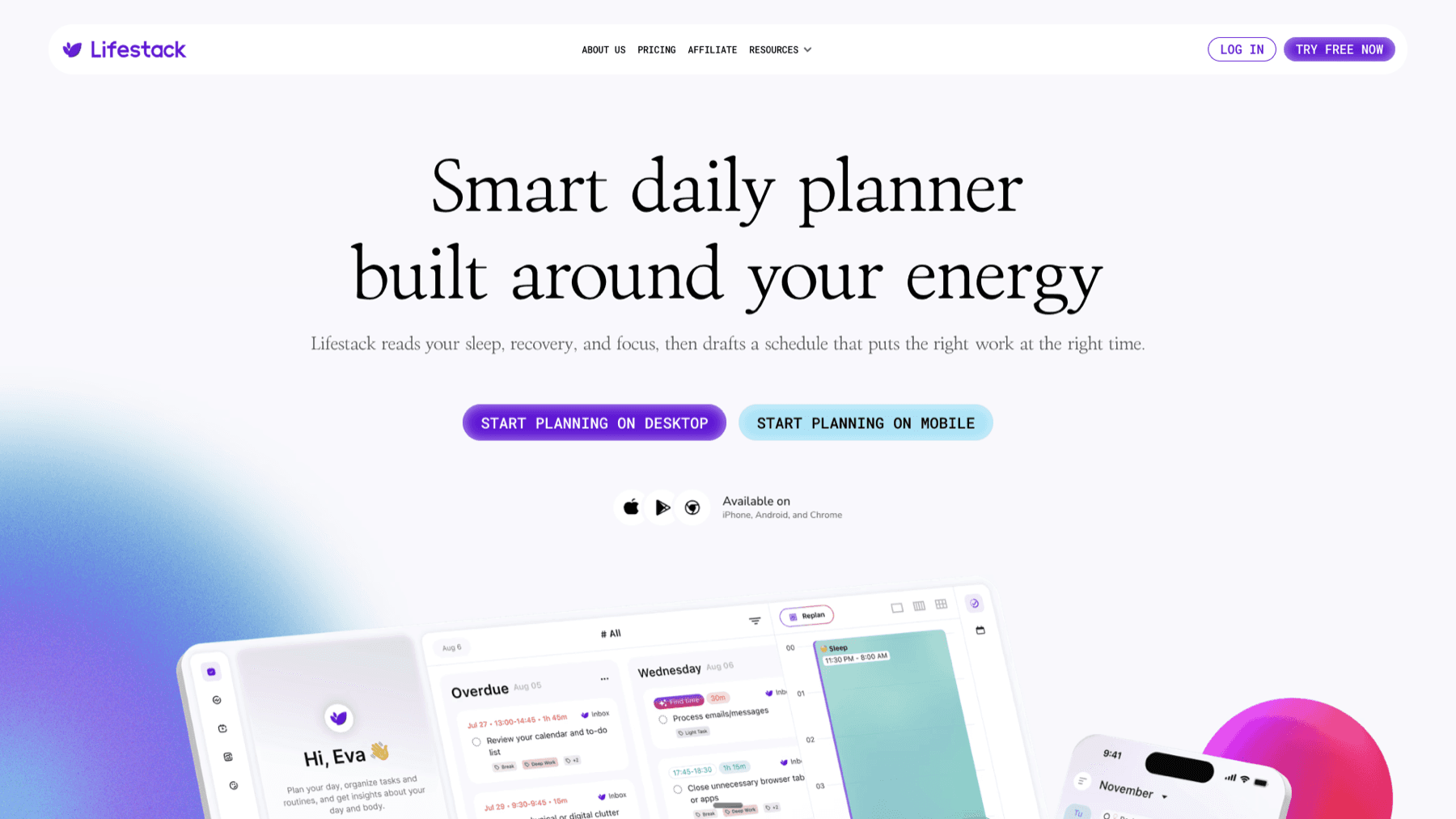
One underrated recovery tool is planning your day around your actual energy state rather than your intended schedule. After a short night, your cognitive resources are lower, your reaction time is longer, and your decision quality drops. Scheduling your most demanding tasks as if you've had a full night means you're likely to underperform on them and over-rely on willpower to compensate.
Lifestack connects to your wearable data (Oura, Whoop, Garmin, Apple Health, Fitbit) and reads your recovery metrics, including HRV, sleep score, and readiness, before planning your day. When your metrics are low because of a short or poor-quality night, Lifestack shifts demanding tasks to later windows, protects lighter periods in the morning, and gives you a realistic picture of what the day can actually hold. It doesn't add sleep to your schedule. But it does stop you from building a day that a sleep-deprived version of you can't execute. See the broader approach in our guide to energy-based scheduling. Lifestack is $10/month or $50/year, with a 7-day free trial on the annual plan.
Frequently Asked Questions
Is sleeping 5 hours enough for adults?
For approximately 99% of adults, no. The recommended range is 7 to 9 hours. Five hours is associated with measurable cognitive impairment, immune suppression, hormonal disruption, and increased long-term health risk. The exception is a small genetic minority who carry the BHLHE41 short-sleeper mutation.
Can you function on 5 hours of sleep?
You can function, in the sense that you'll be awake and able to complete basic tasks. But research consistently shows that objective performance on cognitive tests drops significantly after even one five-hour night, and subjective sleepiness stops being a reliable indicator of impairment after several days. Most people functioning on five hours are performing worse than they realize.
What happens to your brain on 5 hours of sleep?
Reaction time slows, working memory capacity shrinks, decision quality declines, and emotional regulation weakens. After several days, the effect is roughly equivalent to moderate alcohol intoxication in terms of measured performance, according to research from the Walter Reed Army Institute of Research.
Is it okay to sleep 5 hours if you feel fine?
Feeling fine is not a reliable indicator. Studies show that people who sleep less than 7 hours consistently underestimate their own impairment. The subjective sense of being "used to it" is real, but it reflects adaptation to the feeling of impairment, not recovery from it. The objective performance deficit remains.
Can you catch up on sleep after a week of 5-hour nights?
Partially. Research suggests that acute cognitive deficits from short sleep do recover with several nights of adequate sleep, though full recovery takes longer than most people expect. REM-related effects, such as memory consolidation and emotional processing, may take multiple recovery nights. Long-term health risks associated with chronic short sleep cannot be "repaid" all at once.
How much sleep do I actually need?
The standard recommendation is 7 to 9 hours for adults. Individual need varies within that range and is partly genetic. The most reliable way to determine your personal requirement is to sleep without an alarm for a week when you have no sleep debt and see where you naturally land. Most people find it's between 7.5 and 8.5 hours.
Five hours. If you pull that regularly, you probably know the feeling: a vague, low-grade fog that becomes your baseline, a coffee habit that feels mandatory, a creeping sense that you should be sharper than you are. Yet a lot of people quietly normalize it. The question is whether the body actually adapts or just gets worse at noticing how tired it is.
The research on this is pretty unambiguous. For roughly 99% of adults, sleeping five hours is not enough. The one percent exception is a real genetic variant, but the odds that you have it are extremely low, and most people who think they're fine on five hours are simply running a cognitive debt they can no longer accurately perceive.
Here's what's actually happening in your brain and body during those missing hours, what the long-term stakes look like, and what to do when life genuinely doesn't leave you more than five hours to sleep.
Key Takeaways
The CDC and sleep researchers consistently recommend 7 to 9 hours for adults. Five hours falls well below this threshold for virtually all adults.
Short-term cognitive impairment from five hours of sleep is measurable and accumulates day over day, even when you stop feeling tired.
The short sleeper gene (BHLHE41) affects fewer than 1% of people. If you haven't tested positive, you almost certainly don't have it.
What the Research Actually Says
The National Sleep Foundation and the Centers for Disease Control both recommend 7 to 9 hours of sleep per night for adults aged 18 to 64. Adults 65 and older are recommended 7 to 8 hours. These aren't conservative, cushioned estimates. They reflect the range at which most adults show optimal cognitive performance, immune function, metabolic regulation, and emotional stability in controlled studies.
Five hours sits almost two full hours below the minimum threshold. Research from the University of Pennsylvania found that people who slept six hours a night for two weeks performed as poorly on cognitive tests as people who had gone completely without sleep for 24 hours straight. Five hours produces a steeper deficit faster. What's striking is that most people in these studies felt only "slightly sleepy" despite being severely impaired. The subjective sense of tiredness adapts; the objective impairment does not.
For comparison with the 8-hour question, see our post on whether 8 hours of sleep is actually enough.
What Five Hours Cuts Short in Your Sleep Architecture
Sleep doesn't happen in one uniform block. It cycles through distinct stages roughly every 90 minutes, with the ratio of those stages shifting over the course of the night. The full picture of how sleep stages work matters here because cutting the night short affects some stages far more than others.
Deep sleep (slow-wave sleep) concentrates in the first half of the night. REM sleep, the stage associated with memory consolidation, emotional processing, and creativity, concentrates in the last few hours. A five-hour window usually captures most of your deep sleep but cuts into REM significantly.
The difference between deep sleep and REM sleep matters for what you lose. Deep sleep is when growth hormone releases and physical repair happens. REM is when the brain files and integrates what it learned during the day. Consistently truncating REM means impaired memory formation, worse emotional regulation, reduced creative problem-solving, and slower learning. You can read about how much deep sleep you actually need for a fuller breakdown.
What Happens to Your Body on Five Hours
The short-term effects start within 24 hours and stack across days. After one five-hour night, reaction time, working memory, and decision quality all drop measurably. After a week, the impairment mirrors being mildly intoxicated, according to research from the Walter Reed Army Institute. That's the cognitive state many people are operating in permanently.
Appetite hormones are also affected. Ghrelin (the hunger signal) goes up; leptin (the satiety signal) goes down. You eat more, particularly high-carbohydrate foods, because sleep-deprived brains seek quick energy. The immune system produces fewer cytokines during sleep, meaning five-hour sleepers are statistically more likely to get sick after virus exposure. Cortisol, the stress hormone, releases at higher levels the morning after short sleep.
Sleep's relationship to daily energy levels runs deeper than most people realize. It's not just that you feel tired. Every system that regulates your capacity to focus, move, and make good decisions is running at reduced capacity.
The Long-Term Picture
Chronically short sleep (consistently under six hours) is associated with significantly increased risk for several serious conditions: cardiovascular disease, type 2 diabetes, obesity, depression, and cognitive decline. A 2021 study published in Nature Communications followed over 7,000 participants for 25 years and found that consistently sleeping six hours or fewer at age 50 was associated with a 30% higher risk of developing dementia later in life.
None of this means a bad week of five-hour nights will cause permanent damage. The body is resilient and recovery is possible. But it does mean treating five hours as a sustainable baseline has real consequences that show up on long timescales. Sleep hygiene practices exist precisely because small, consistent improvements to sleep duration and quality compound over time.
The Short Sleeper Gene: Are You the Exception?
True short sleepers exist. A mutation in the BHLHE41 gene (and several related genes identified in subsequent research) allows a small fraction of people to function normally on six hours or fewer, with no measurable cognitive deficit, no higher disease risk, and no accumulated sleep debt. These individuals wake naturally after five or six hours feeling genuinely rested, not just awake.
The catch: this affects roughly 1 in 100 people, possibly fewer. Most people who believe they're fine on five hours have simply adapted to feeling impaired. Decades of sleep research consistently find that self-reported tolerance for short sleep doesn't correlate with objective performance. If you've never had a genetic test confirming the variant, the statistical probability that you're a natural short sleeper is very low. Most people who feel fine are just poor judges of their own impairment.
How Sleep Debt Compounds
Every night you sleep fewer than your personal requirement, you add to a deficit. How to calculate sleep debt involves tracking your target sleep duration versus actual sleep across days. The problem is that debt doesn't just clear on a good night. Research suggests it can take several days of adequate sleep to recover from a week of restriction, and some cognitive effects (particularly those tied to REM deprivation) may take longer.
The subjective experience of recovery is also misleading. After a long sleep, you often feel much better quickly, which makes it easy to underestimate how much residual debt remains. The limits of sleep deprivation show how far the body can be pushed, but short-term resilience isn't the same as long-term sustainability.
What to Do When Five Hours Is Unavoidable
Sometimes life doesn't cooperate. A newborn, a deadline, an illness in the family, a red-eye flight. If you're working with five hours for a stretch, a few principles help minimize the damage.
Prioritize sleep debt repayment as soon as the constraint lifts. Don't treat the first normal night as optional. Protect whatever sleep window you have by making it dark, cool, and consistent. Even within a five-hour window, sleep quality varies. Avoiding alcohol and heavy food close to sleep improves the depth of the sleep you do get. A short nap (10 to 20 minutes) in the early afternoon can partially offset cognitive impairment from a short night, though it doesn't address the underlying debt. And watch for sleep inertia, the grogginess that follows an alarm during deep sleep, which hits harder on short-sleep nights.
How Sleep-Aware Scheduling Helps You Recover
One underrated recovery tool is planning your day around your actual energy state rather than your intended schedule. After a short night, your cognitive resources are lower, your reaction time is longer, and your decision quality drops. Scheduling your most demanding tasks as if you've had a full night means you're likely to underperform on them and over-rely on willpower to compensate.
Lifestack connects to your wearable data (Oura, Whoop, Garmin, Apple Health, Fitbit) and reads your recovery metrics, including HRV, sleep score, and readiness, before planning your day. When your metrics are low because of a short or poor-quality night, Lifestack shifts demanding tasks to later windows, protects lighter periods in the morning, and gives you a realistic picture of what the day can actually hold. It doesn't add sleep to your schedule. But it does stop you from building a day that a sleep-deprived version of you can't execute. See the broader approach in our guide to energy-based scheduling. Lifestack is $10/month or $50/year, with a 7-day free trial on the annual plan.
Frequently Asked Questions
Is sleeping 5 hours enough for adults?
For approximately 99% of adults, no. The recommended range is 7 to 9 hours. Five hours is associated with measurable cognitive impairment, immune suppression, hormonal disruption, and increased long-term health risk. The exception is a small genetic minority who carry the BHLHE41 short-sleeper mutation.
Can you function on 5 hours of sleep?
You can function, in the sense that you'll be awake and able to complete basic tasks. But research consistently shows that objective performance on cognitive tests drops significantly after even one five-hour night, and subjective sleepiness stops being a reliable indicator of impairment after several days. Most people functioning on five hours are performing worse than they realize.
What happens to your brain on 5 hours of sleep?
Reaction time slows, working memory capacity shrinks, decision quality declines, and emotional regulation weakens. After several days, the effect is roughly equivalent to moderate alcohol intoxication in terms of measured performance, according to research from the Walter Reed Army Institute of Research.
Is it okay to sleep 5 hours if you feel fine?
Feeling fine is not a reliable indicator. Studies show that people who sleep less than 7 hours consistently underestimate their own impairment. The subjective sense of being "used to it" is real, but it reflects adaptation to the feeling of impairment, not recovery from it. The objective performance deficit remains.
Can you catch up on sleep after a week of 5-hour nights?
Partially. Research suggests that acute cognitive deficits from short sleep do recover with several nights of adequate sleep, though full recovery takes longer than most people expect. REM-related effects, such as memory consolidation and emotional processing, may take multiple recovery nights. Long-term health risks associated with chronic short sleep cannot be "repaid" all at once.
How much sleep do I actually need?
The standard recommendation is 7 to 9 hours for adults. Individual need varies within that range and is partly genetic. The most reliable way to determine your personal requirement is to sleep without an alarm for a week when you have no sleep debt and see where you naturally land. Most people find it's between 7.5 and 8.5 hours.



FOLLOW ON
FOLLOW ON
FOLLOW ON


Copyright 2026 © Lifestack. All rights reserved
Copyright 2026 © Lifestack. All rights reserved

