
Tips
Light Therapy for Jet Lag: Does It Actually Work?
Light Therapy for Jet Lag: Does It Actually Work?

Jet lag is a real physiological disruption, not just tiredness from a long flight. When you cross multiple time zones quickly, your internal circadian clock stays set to your departure timezone while the external environment (sunlight, meal times, social cues) operates on the destination timezone. The mismatch produces sleep problems, cognitive fog, digestive issues, and mood disruption that can last several days.
Light therapy - specifically, timed exposure to bright light - is one of the most effective and well-researched interventions for resetting the circadian clock faster. The science is solid: light is the primary external signal that sets your internal clock. Use it at the right time, and you can shift your rhythm by one to two hours per day, dramatically shortening recovery time compared to waiting it out.
The challenge is that timing matters enormously. Light exposure at the wrong time of day doesn't just fail to help - it can actively delay your recovery by pushing your clock further in the wrong direction. This guide covers how to use light therapy correctly, what devices to use, and how to combine it with other jet lag strategies.
Key Takeaways
Bright light exposure is the most powerful signal for resetting your circadian rhythm - morning light advances your clock (useful for eastward travel), evening light delays it (useful for westward travel).
Timing is everything: light at the wrong phase of your existing sleep cycle can make jet lag worse, not better. The standard rule is morning light at the destination for westward flights, afternoon/evening light for eastward flights.
Light therapy devices that deliver 10,000 lux are the standard clinical dose - they work significantly faster than relying on ambient indoor lighting.
How Light Controls Your Circadian Rhythm
Your circadian rhythm is regulated by a structure in the brain called the suprachiasmatic nucleus (SCN), which acts as the master clock. The SCN is directly wired to the retina via a dedicated neural pathway. When bright light hits photosensitive cells in your retina - especially in the morning - the signal travels directly to the SCN and tells it what time it is.
This system evolved before artificial lighting. In the natural world, sunrise is unambiguous: it happens once per day at a specific time and delivers intense, full-spectrum light. The SCN uses this signal to synchronize itself every day. Modern indoor lighting (typically 200-500 lux) is too dim to send a strong synchronization signal - it doesn't trigger the same neural pathway that bright outdoor light does.
Jet lag is what happens when your SCN is synchronized to one timezone while your body is operating in another. The question isn't whether light resets the clock - it does - but how to use it strategically to speed up the resynchronization process. More context on how the circadian system works is in the jet lag explainer and the circadian rhythm and lighting guide.
Light Therapy Devices: What to Use
The clinical standard for light therapy is 10,000 lux delivered at a distance of about 16-24 inches from your face. At this intensity, a 20-30 minute session in the morning produces measurable circadian phase shifts. Standard indoor lighting typically delivers 100-500 lux, which is insufficient.
Most light therapy lamps sold for seasonal affective disorder (SAD) work well for jet lag too - both applications use the same mechanism. When shopping for a light box, look for: 10,000 lux rating (not just "bright"), UV-filtered output, a large enough panel that you don't need to stare directly at it, and a stable stand or mount. You shouldn't need to look into the light - position it at eye level slightly to the side while you eat breakfast or read.
Wearable light therapy devices (glasses-style, like Luminette) exist and have the advantage of portability - useful for travel. The tradeoff is that they deliver lower total lux than a full lamp panel, so sessions may need to be longer. For most people, a desk lamp used at home before or after travel is a practical starting point.
Timing Light Therapy for Jet Lag: Eastward vs Westward
Direction of travel determines everything. Eastward travel (e.g., New York to London) requires advancing your clock - making your body feel that "morning" is earlier. Westward travel (e.g., London to New York) requires delaying your clock - making your body feel that morning comes later. These require opposite light timing strategies.
Eastward flights (advancing your clock)
Use bright light in the early morning at your destination. The goal is to tell your SCN that dawn is happening earlier than your internal clock expects. Aim for 20-30 minutes of 10,000 lux light within the first hour of waking at your destination timezone, ideally starting before local sunrise or immediately after. Avoid bright light in the evening, since evening light delays the clock, which is the opposite of what you want when traveling east.
In practice: bring or rent a light lamp, or find morning outdoor sunlight. If your destination is overcast, a lamp is more reliable. Start light therapy on day 1 and repeat each morning until you feel synchronized. For a 6-hour time difference, most people need 3-4 days of consistent morning light therapy to feel fully adjusted.
Westward flights (delaying your clock)
Use bright light in the evening at your destination. This tells your SCN that sunset is happening later than it expects, which delays the clock to match the new timezone. Aim for 20-30 minutes of bright light exposure in the late afternoon or early evening (not right before bed, as that can interfere with sleep). Avoid morning bright light for the first day or two, since it would advance the clock in the wrong direction.
Westward travel is generally easier to recover from because most people find it easier to stay up late than to fall asleep early. Light therapy accelerates the adjustment but the natural tendency already works in your favor. The jet lag recovery calculator can estimate how many days your specific flight direction and time zone difference will take.
How Long and How Bright
The standard protocol is 20-30 minutes at 10,000 lux. Longer sessions provide diminishing returns rather than linear benefit - an hour of light therapy doesn't produce twice the phase shift of 30 minutes. Shorter sessions (10 minutes) at 10,000 lux do produce smaller but meaningful shifts and can be useful when time is limited.
Don't stare directly at the lamp. The therapeutic effect comes from ambient light entering the periphery of the visual field, not from direct eye contact with the light source. Position the lamp at eye level and slightly to the side while you read, eat, or work. Closing your eyes blocks the effect.
Consistency across days matters more than any single session. One morning of light therapy produces a modest phase shift. Three mornings in a row produces a cumulative shift that significantly reduces jet lag duration. Skipping sessions slows the process considerably. The relationship between light exposure and sleep quality is covered in the sleep and energy guide.
Combining Light Therapy with Other Strategies
Light therapy works best as part of a broader jet lag protocol, not in isolation. The main supporting strategies are melatonin (taken at bedtime in the new timezone to reinforce the sleep signal), meal timing (eating at destination meal times signals circadian alignment through the digestive system), exercise timing (morning exercise reinforces phase advance), and avoiding caffeine within 8 hours of your target bedtime.
Avoid alcohol on the flight and during the first day or two of recovery. Alcohol suppresses REM sleep, which is already disrupted by jet lag, and compounds the cognitive fog. Hydration on long-haul flights matters for how functional you feel on day one, though it doesn't directly accelerate circadian resynchronization.
Blue-light blocking glasses are useful in the evening at your destination to avoid inadvertently advancing your clock when you're trying to delay it (westward travel) or to avoid light when you need to wind down. The blue light glasses guide covers the evidence on those. Social jet lag from irregular schedules is a related issue covered in the social jet lag guide.
Rebuilding Your Schedule After Jet Lag
The circadian recovery process doesn't just affect sleep - it disrupts your cognitive performance windows. The mental clarity peak that you're used to having at 10am may shift, temporarily, to a time you don't expect. High-stakes work scheduled for the first few days after international travel often goes worse than expected, not because of sleep quantity but because the timing of your alertness window has shifted.
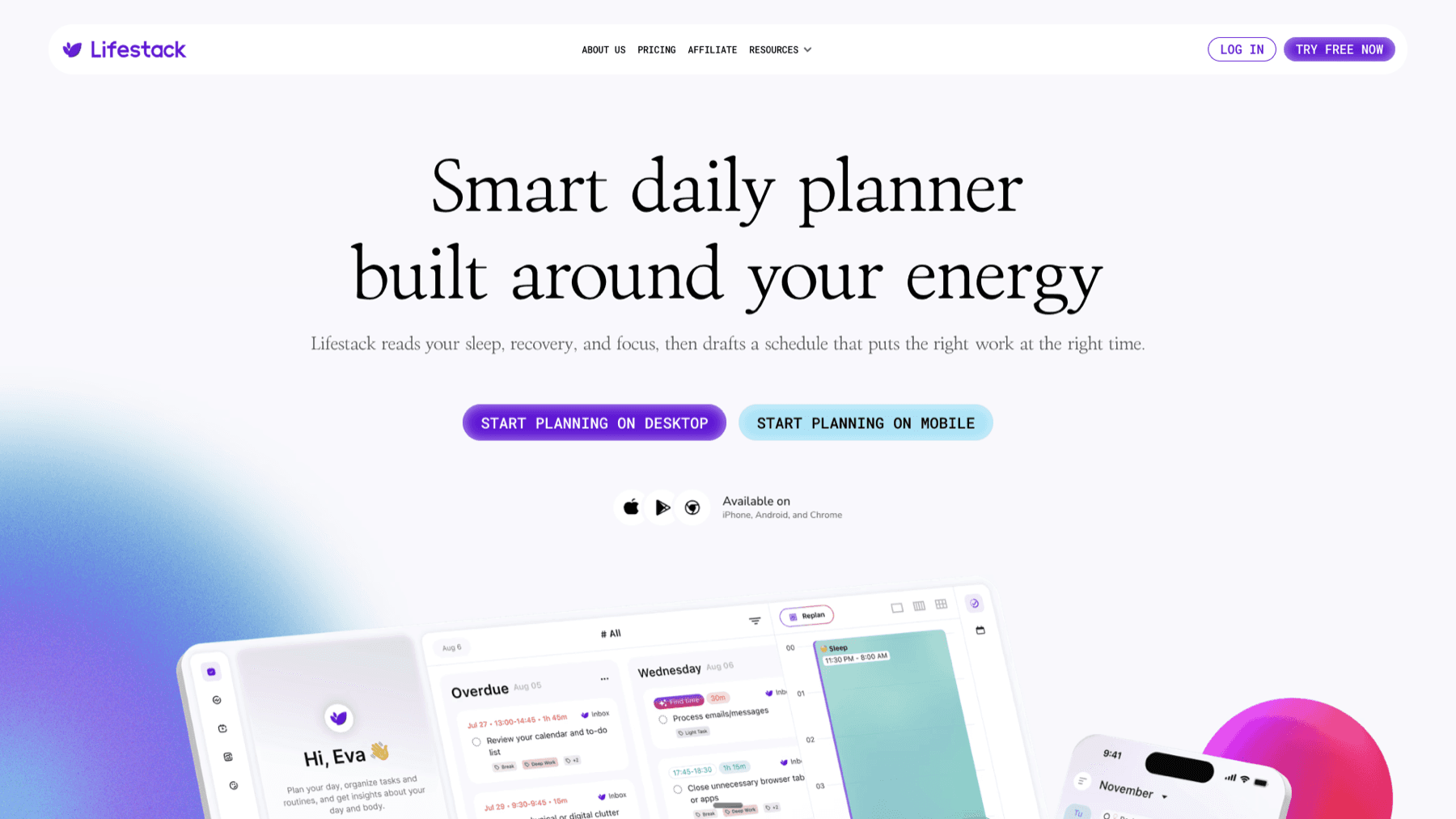
Lifestack tracks your energy patterns and adjusts your work schedule around when you're genuinely alert, not just when your calendar happens to be free. During jet lag recovery, this means your high-focus tasks get scheduled during your actual alertness peaks rather than during time blocks that worked pre-travel. The energy-based scheduling guide explains how this works in practice, and the sleep schedule reset guide covers the broader recovery process.
Lifestack costs $9.99/month or $49.99/year (7-day free trial on the annual plan). If your work is affected by travel frequently and you're losing productive time to disoriented scheduling post-flight, it's worth trying alongside your light therapy protocol.
Frequently Asked Questions
How long should I use a light therapy lamp for jet lag?
20-30 minutes per session at 10,000 lux is the standard protocol. Use it once per day, at the correct time for your travel direction (morning for eastward, evening for westward). Continue for 3-5 days or until you feel synchronized with the new timezone.
Can I use my phone screen or computer for light therapy?
No. Screens typically deliver 200-400 lux at normal viewing distance - far below the 10,000 lux threshold needed for meaningful circadian phase shifting. Screen light affects your sleep by suppressing melatonin, but it doesn't deliver the intensity required for intentional clock resetting. A dedicated light therapy lamp is necessary for the full effect.
What if I get the timing wrong?
Light exposure at the wrong phase can delay your recovery. If you're not sure of the correct timing, err on the side of natural outdoor light during the day at your destination and dim conditions after sunset - this produces a milder, slower correction that won't make things worse. The directional guidelines (morning light east, evening light west) are well established enough to follow, but the exact window varies by individual and can be refined with apps like Timeshifter, which calculate personalized protocols based on your itinerary.
Does light therapy work for mild jet lag (1-2 time zones)?
For 1-2 time zones, your body typically adjusts within a day or two naturally, and light therapy offers a modest benefit that may not be worth the setup. Light therapy is most useful for longer-haul travel (4+ time zones) where natural adjustment takes a week or more. The recovery time calculator gives estimates by flight direction and distance.
Can children use light therapy for jet lag?
Light therapy is generally considered safe for children, and bright morning light is part of normal healthy childhood routines anyway. For mild jet lag in children, prioritizing outdoor play at the destination in the correct morning hours often achieves the same effect as a clinical lamp setup. Consult a pediatrician before using a clinical lamp with young children.
Does sunlight work as well as a lamp?
Outdoor sunlight on a clear day delivers 50,000-100,000 lux, far exceeding any lamp. When outdoor sunlight is available at the right time, it's more effective than any device. The challenge is that at your destination, the sun may not be available at the correct time (winter destinations, overcast weather, early departures) and you may not be able to get outside immediately upon waking. A lamp provides a controllable, reliable dose when natural sunlight isn't accessible at the right phase.
Jet lag is a real physiological disruption, not just tiredness from a long flight. When you cross multiple time zones quickly, your internal circadian clock stays set to your departure timezone while the external environment (sunlight, meal times, social cues) operates on the destination timezone. The mismatch produces sleep problems, cognitive fog, digestive issues, and mood disruption that can last several days.
Light therapy - specifically, timed exposure to bright light - is one of the most effective and well-researched interventions for resetting the circadian clock faster. The science is solid: light is the primary external signal that sets your internal clock. Use it at the right time, and you can shift your rhythm by one to two hours per day, dramatically shortening recovery time compared to waiting it out.
The challenge is that timing matters enormously. Light exposure at the wrong time of day doesn't just fail to help - it can actively delay your recovery by pushing your clock further in the wrong direction. This guide covers how to use light therapy correctly, what devices to use, and how to combine it with other jet lag strategies.
Key Takeaways
Bright light exposure is the most powerful signal for resetting your circadian rhythm - morning light advances your clock (useful for eastward travel), evening light delays it (useful for westward travel).
Timing is everything: light at the wrong phase of your existing sleep cycle can make jet lag worse, not better. The standard rule is morning light at the destination for westward flights, afternoon/evening light for eastward flights.
Light therapy devices that deliver 10,000 lux are the standard clinical dose - they work significantly faster than relying on ambient indoor lighting.
How Light Controls Your Circadian Rhythm
Your circadian rhythm is regulated by a structure in the brain called the suprachiasmatic nucleus (SCN), which acts as the master clock. The SCN is directly wired to the retina via a dedicated neural pathway. When bright light hits photosensitive cells in your retina - especially in the morning - the signal travels directly to the SCN and tells it what time it is.
This system evolved before artificial lighting. In the natural world, sunrise is unambiguous: it happens once per day at a specific time and delivers intense, full-spectrum light. The SCN uses this signal to synchronize itself every day. Modern indoor lighting (typically 200-500 lux) is too dim to send a strong synchronization signal - it doesn't trigger the same neural pathway that bright outdoor light does.
Jet lag is what happens when your SCN is synchronized to one timezone while your body is operating in another. The question isn't whether light resets the clock - it does - but how to use it strategically to speed up the resynchronization process. More context on how the circadian system works is in the jet lag explainer and the circadian rhythm and lighting guide.
Light Therapy Devices: What to Use
The clinical standard for light therapy is 10,000 lux delivered at a distance of about 16-24 inches from your face. At this intensity, a 20-30 minute session in the morning produces measurable circadian phase shifts. Standard indoor lighting typically delivers 100-500 lux, which is insufficient.
Most light therapy lamps sold for seasonal affective disorder (SAD) work well for jet lag too - both applications use the same mechanism. When shopping for a light box, look for: 10,000 lux rating (not just "bright"), UV-filtered output, a large enough panel that you don't need to stare directly at it, and a stable stand or mount. You shouldn't need to look into the light - position it at eye level slightly to the side while you eat breakfast or read.
Wearable light therapy devices (glasses-style, like Luminette) exist and have the advantage of portability - useful for travel. The tradeoff is that they deliver lower total lux than a full lamp panel, so sessions may need to be longer. For most people, a desk lamp used at home before or after travel is a practical starting point.
Timing Light Therapy for Jet Lag: Eastward vs Westward
Direction of travel determines everything. Eastward travel (e.g., New York to London) requires advancing your clock - making your body feel that "morning" is earlier. Westward travel (e.g., London to New York) requires delaying your clock - making your body feel that morning comes later. These require opposite light timing strategies.
Eastward flights (advancing your clock)
Use bright light in the early morning at your destination. The goal is to tell your SCN that dawn is happening earlier than your internal clock expects. Aim for 20-30 minutes of 10,000 lux light within the first hour of waking at your destination timezone, ideally starting before local sunrise or immediately after. Avoid bright light in the evening, since evening light delays the clock, which is the opposite of what you want when traveling east.
In practice: bring or rent a light lamp, or find morning outdoor sunlight. If your destination is overcast, a lamp is more reliable. Start light therapy on day 1 and repeat each morning until you feel synchronized. For a 6-hour time difference, most people need 3-4 days of consistent morning light therapy to feel fully adjusted.
Westward flights (delaying your clock)
Use bright light in the evening at your destination. This tells your SCN that sunset is happening later than it expects, which delays the clock to match the new timezone. Aim for 20-30 minutes of bright light exposure in the late afternoon or early evening (not right before bed, as that can interfere with sleep). Avoid morning bright light for the first day or two, since it would advance the clock in the wrong direction.
Westward travel is generally easier to recover from because most people find it easier to stay up late than to fall asleep early. Light therapy accelerates the adjustment but the natural tendency already works in your favor. The jet lag recovery calculator can estimate how many days your specific flight direction and time zone difference will take.
How Long and How Bright
The standard protocol is 20-30 minutes at 10,000 lux. Longer sessions provide diminishing returns rather than linear benefit - an hour of light therapy doesn't produce twice the phase shift of 30 minutes. Shorter sessions (10 minutes) at 10,000 lux do produce smaller but meaningful shifts and can be useful when time is limited.
Don't stare directly at the lamp. The therapeutic effect comes from ambient light entering the periphery of the visual field, not from direct eye contact with the light source. Position the lamp at eye level and slightly to the side while you read, eat, or work. Closing your eyes blocks the effect.
Consistency across days matters more than any single session. One morning of light therapy produces a modest phase shift. Three mornings in a row produces a cumulative shift that significantly reduces jet lag duration. Skipping sessions slows the process considerably. The relationship between light exposure and sleep quality is covered in the sleep and energy guide.
Combining Light Therapy with Other Strategies
Light therapy works best as part of a broader jet lag protocol, not in isolation. The main supporting strategies are melatonin (taken at bedtime in the new timezone to reinforce the sleep signal), meal timing (eating at destination meal times signals circadian alignment through the digestive system), exercise timing (morning exercise reinforces phase advance), and avoiding caffeine within 8 hours of your target bedtime.
Avoid alcohol on the flight and during the first day or two of recovery. Alcohol suppresses REM sleep, which is already disrupted by jet lag, and compounds the cognitive fog. Hydration on long-haul flights matters for how functional you feel on day one, though it doesn't directly accelerate circadian resynchronization.
Blue-light blocking glasses are useful in the evening at your destination to avoid inadvertently advancing your clock when you're trying to delay it (westward travel) or to avoid light when you need to wind down. The blue light glasses guide covers the evidence on those. Social jet lag from irregular schedules is a related issue covered in the social jet lag guide.
Rebuilding Your Schedule After Jet Lag
The circadian recovery process doesn't just affect sleep - it disrupts your cognitive performance windows. The mental clarity peak that you're used to having at 10am may shift, temporarily, to a time you don't expect. High-stakes work scheduled for the first few days after international travel often goes worse than expected, not because of sleep quantity but because the timing of your alertness window has shifted.
Lifestack tracks your energy patterns and adjusts your work schedule around when you're genuinely alert, not just when your calendar happens to be free. During jet lag recovery, this means your high-focus tasks get scheduled during your actual alertness peaks rather than during time blocks that worked pre-travel. The energy-based scheduling guide explains how this works in practice, and the sleep schedule reset guide covers the broader recovery process.
Lifestack costs $9.99/month or $49.99/year (7-day free trial on the annual plan). If your work is affected by travel frequently and you're losing productive time to disoriented scheduling post-flight, it's worth trying alongside your light therapy protocol.
Frequently Asked Questions
How long should I use a light therapy lamp for jet lag?
20-30 minutes per session at 10,000 lux is the standard protocol. Use it once per day, at the correct time for your travel direction (morning for eastward, evening for westward). Continue for 3-5 days or until you feel synchronized with the new timezone.
Can I use my phone screen or computer for light therapy?
No. Screens typically deliver 200-400 lux at normal viewing distance - far below the 10,000 lux threshold needed for meaningful circadian phase shifting. Screen light affects your sleep by suppressing melatonin, but it doesn't deliver the intensity required for intentional clock resetting. A dedicated light therapy lamp is necessary for the full effect.
What if I get the timing wrong?
Light exposure at the wrong phase can delay your recovery. If you're not sure of the correct timing, err on the side of natural outdoor light during the day at your destination and dim conditions after sunset - this produces a milder, slower correction that won't make things worse. The directional guidelines (morning light east, evening light west) are well established enough to follow, but the exact window varies by individual and can be refined with apps like Timeshifter, which calculate personalized protocols based on your itinerary.
Does light therapy work for mild jet lag (1-2 time zones)?
For 1-2 time zones, your body typically adjusts within a day or two naturally, and light therapy offers a modest benefit that may not be worth the setup. Light therapy is most useful for longer-haul travel (4+ time zones) where natural adjustment takes a week or more. The recovery time calculator gives estimates by flight direction and distance.
Can children use light therapy for jet lag?
Light therapy is generally considered safe for children, and bright morning light is part of normal healthy childhood routines anyway. For mild jet lag in children, prioritizing outdoor play at the destination in the correct morning hours often achieves the same effect as a clinical lamp setup. Consult a pediatrician before using a clinical lamp with young children.
Does sunlight work as well as a lamp?
Outdoor sunlight on a clear day delivers 50,000-100,000 lux, far exceeding any lamp. When outdoor sunlight is available at the right time, it's more effective than any device. The challenge is that at your destination, the sun may not be available at the correct time (winter destinations, overcast weather, early departures) and you may not be able to get outside immediately upon waking. A lamp provides a controllable, reliable dose when natural sunlight isn't accessible at the right phase.



FOLLOW ON
FOLLOW ON
FOLLOW ON



Copyright 2026 © Lifestack. All rights reserved
Copyright 2026 © Lifestack. All rights reserved

