
Tips
Normal Resting Heart Rate and the 5 Training Zones
Normal Resting Heart Rate and the 5 Training Zones
Your resting heart rate is one of the most accessible windows into your cardiovascular health. It requires no equipment to measure, and the trends it reveals over time are genuinely useful. For most adults, a normal resting heart rate falls between 60 and 100 beats per minute. Fit individuals and endurance athletes often sit between 40 and 60.
Heart rate zones describe where your heart rate lands during exercise relative to your maximum effort. Understanding both resting HR and training zones gives you a picture of your cardiovascular system at rest and under load.
This guide covers what counts as normal for each, how the 5 training zones work, how to calculate yours, and what the data actually tells you about your fitness and recovery.
Key Takeaways
A normal resting heart rate for adults is 60 to 100 BPM; trained athletes often fall between 40 and 60 BPM
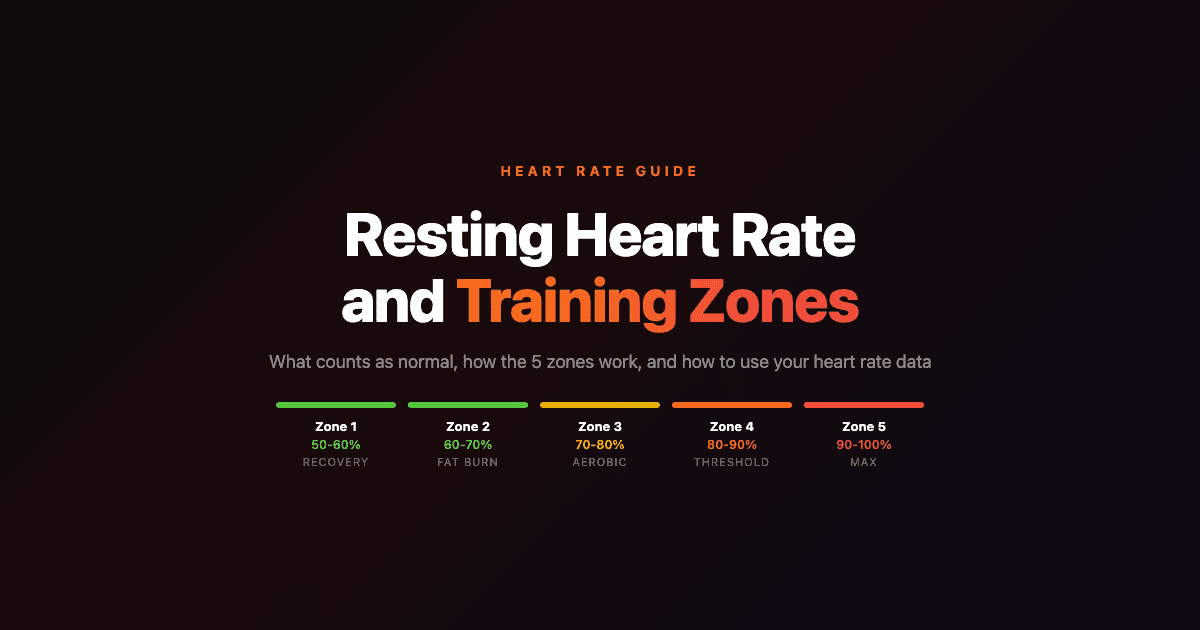
The 5 heart rate zones range from recovery effort (50-60% of max HR) to maximum intensity (90-100%)
Tracking resting HR trends over weeks is more informative than any single reading
What Is a Normal Resting Heart Rate?
The American Heart Association defines a normal resting heart rate for adults as 60 to 100 beats per minute. This is measured when you are at complete rest, ideally first thing in the morning before getting out of bed.
The range is intentionally wide because cardiovascular fitness has a significant influence on resting HR. Endurance athletes and people who exercise regularly often have resting heart rates in the 40s or 50s. A resting HR of 45 BPM in a well-trained runner signals excellent cardiovascular efficiency. The same number in someone sedentary might warrant a medical conversation.
What matters most is your personal baseline and the direction it moves over time. A resting HR that drops 5 to 10 BPM over a few months of consistent aerobic exercise is a reliable sign of cardiovascular improvement. A resting HR that climbs noticeably without explanation can indicate illness, poor recovery, high stress, or overtraining. Tracking this with a wearable, as covered in our guide to building a consistent health tracking system, is how you catch these patterns early.
Factors That Affect Resting Heart Rate
Cardiovascular fitness: higher fitness generally means a lower resting HR
Age: resting HR tends to rise slightly with age for sedentary individuals
Sleep quality: poor sleep and disrupted sleep stages raise resting HR
Stress: chronic stress keeps resting HR above baseline
Hydration: dehydration causes HR to rise to compensate for lower blood volume
Caffeine and alcohol: both can temporarily raise resting HR
Medications: beta-blockers lower resting HR; stimulants raise it
The 5 Heart Rate Training Zones
Heart rate zones divide your working intensity range into five segments based on a percentage of your maximum heart rate. Each zone delivers different physiological benefits and is appropriate for different training goals.
Zone 1: Recovery (50-60% of Max HR)
Light activity: easy walking, gentle cycling, warm-ups. You can hold a full conversation comfortably. Your body primarily burns fat as fuel. Zone 1 is used for active recovery between harder training days and is appropriate for beginners building a base level of activity.
Zone 2: Fat Burn (60-70% of Max HR)
Brisk walking, light jogging, easy cycling. Still conversational but slightly more challenging than Zone 1. Zone 2 has the highest proportion of fat oxidation relative to carbohydrate use. Sustained Zone 2 training (45 to 90 minutes) builds aerobic base and metabolic efficiency. It is the zone most associated with healthy walking heart rate targets for general fitness.
Zone 3: Aerobic (70-80% of Max HR)
Moderate running, tempo cycling, sustained swimming. Conversation requires more effort. Both fat and carbohydrates are used as fuel. Zone 3 builds aerobic capacity and cardiovascular efficiency. Most moderate-intensity exercise falls here.
Zone 4: Threshold (80-90% of Max HR)
Hard, sustained effort: running at a pace you can hold for 30 to 60 minutes but not much longer. Lactate threshold training. Zone 4 builds speed endurance and improves your ability to sustain hard efforts without accumulating fatigue too quickly.
Zone 5: Maximum (90-100% of Max HR)
Short, maximal bursts: sprints, HIIT intervals, track repeats. Cannot be sustained for more than a few minutes. Zone 5 builds peak power, VO2 max, and anaerobic capacity. High recovery demand; not appropriate for daily training.
How to Calculate Your Heart Rate Zones
Step 1: Estimate your maximum heart rate. The more accurate modern formula is: 208 minus (0.7 times your age). This outperforms the older 220-minus-age formula, particularly for adults over 40.
For a 40-year-old: 208 - (0.7 x 40) = 208 - 28 = 180 BPM maximum heart rate.
Step 2: Apply the zone percentages to that number. Using 180 BPM max HR as the example:
Zone 1 (50-60%): 90-108 BPM
Zone 2 (60-70%): 108-126 BPM
Zone 3 (70-80%): 126-144 BPM
Zone 4 (80-90%): 144-162 BPM
Zone 5 (90-100%): 162-180 BPM
These are estimates based on population averages. A lactate threshold test or VO2 max test gives you precise personal zones, but the formula-based approach is accurate enough for most training purposes.
How to Track Your Heart Rate
Wrist-worn devices (Apple Watch, Garmin, Fitbit) use optical sensors that are accurate enough for zone training during steady-state activities. Chest straps (Polar H10, Garmin HRM) use electrical signals from the heart and are more precise during rapidly changing intensities like HIIT. For walking and moderate cardio, wrist-based optical monitoring works well.
Smartwatches with heart rate monitoring also track your resting HR over time, which is where the longer-term health insights come from. A single workout HR reading is useful for training intensity. A resting HR trend over 60 days tells you whether your cardiovascular fitness is actually improving.
Best Tool for Heart Rate-Aware Scheduling
Heart rate data is most useful when it informs not just how you train but how you plan your day. Lifestack connects to your HRV and resting HR data from wearables like the Oura Ring, Garmin, and Apple Watch, then uses your daily recovery state to build your schedule.

If your resting HR is running high and your HRV is suppressed, Lifestack recognizes that as a low-recovery day and adjusts what you are asked to tackle. It moves cognitively demanding work to a better window and protects your schedule from overloading a day when your body is already under stress. This is personal energy management made practical: your health metrics directly shaping how your time is organized rather than sitting unused in a dashboard. If you find yourself wondering what to do when your energy is low, having your schedule already adapted is the most actionable answer.
Lifestack costs $7/month or $50/year and is available on iOS, Android, and as a Chrome extension.
Frequently Asked Questions
What is a normal resting heart rate by age?
For adults of any age, the standard normal range is 60 to 100 BPM. Within that, athletes and fit individuals tend toward the lower end regardless of age. A 20-year-old athlete might have a resting HR of 48 BPM; a sedentary 60-year-old might sit at 80 BPM. Both are within normal range but reflect very different cardiovascular fitness levels.
What are the 5 heart rate zones?
Zone 1 (50-60% of max HR): recovery. Zone 2 (60-70%): fat burning and aerobic base. Zone 3 (70-80%): moderate aerobic conditioning. Zone 4 (80-90%): lactate threshold training. Zone 5 (90-100%): maximum effort sprints and HIIT. Each zone triggers different physiological adaptations and is useful for different training goals.
Is a resting heart rate of 50 BPM normal?
Yes, for fit adults and athletes. A resting HR of 50 BPM signals strong cardiovascular efficiency: the heart is large and strong enough to pump adequate blood per beat without beating more often. For someone who is sedentary or who has not exercised regularly, a resting HR of 50 is worth discussing with a doctor, as it could occasionally indicate a conduction issue rather than fitness.
How do I lower my resting heart rate?
Consistent aerobic exercise is the most effective approach. Zone 2 training in particular (brisk walking, light jogging, easy cycling) builds the cardiovascular base that reduces resting HR over weeks and months. Improving sleep quality, managing stress, staying hydrated, and reducing alcohol also contribute. Most people see measurable resting HR reductions within four to eight weeks of consistent aerobic exercise.
What heart rate zone is best for fat loss?
Zone 2 (60-70% of max HR) has the highest proportion of fat oxidation relative to carbohydrate use, which is why it is called the fat-burning zone. However, total caloric expenditure matters more for fat loss than fuel source, so higher-intensity training (Zones 3 and 4) can be equally or more effective when total time is limited. Zone 2 is best for longer, steadier sessions focused on metabolic health and aerobic base.
How do I know which zone I am training in?
A wearable heart rate monitor is the practical answer. Calculate your max HR using the formula (208 minus 0.7 times your age), apply the zone percentages, and compare your live HR reading to those targets during exercise. Over time, you will also develop a sense of perceived effort that aligns with each zone, which is useful when your monitor is not available or accessible.
Your resting heart rate is one of the most accessible windows into your cardiovascular health. It requires no equipment to measure, and the trends it reveals over time are genuinely useful. For most adults, a normal resting heart rate falls between 60 and 100 beats per minute. Fit individuals and endurance athletes often sit between 40 and 60.
Heart rate zones describe where your heart rate lands during exercise relative to your maximum effort. Understanding both resting HR and training zones gives you a picture of your cardiovascular system at rest and under load.
This guide covers what counts as normal for each, how the 5 training zones work, how to calculate yours, and what the data actually tells you about your fitness and recovery.
Key Takeaways
A normal resting heart rate for adults is 60 to 100 BPM; trained athletes often fall between 40 and 60 BPM
The 5 heart rate zones range from recovery effort (50-60% of max HR) to maximum intensity (90-100%)
Tracking resting HR trends over weeks is more informative than any single reading
What Is a Normal Resting Heart Rate?
The American Heart Association defines a normal resting heart rate for adults as 60 to 100 beats per minute. This is measured when you are at complete rest, ideally first thing in the morning before getting out of bed.
The range is intentionally wide because cardiovascular fitness has a significant influence on resting HR. Endurance athletes and people who exercise regularly often have resting heart rates in the 40s or 50s. A resting HR of 45 BPM in a well-trained runner signals excellent cardiovascular efficiency. The same number in someone sedentary might warrant a medical conversation.
What matters most is your personal baseline and the direction it moves over time. A resting HR that drops 5 to 10 BPM over a few months of consistent aerobic exercise is a reliable sign of cardiovascular improvement. A resting HR that climbs noticeably without explanation can indicate illness, poor recovery, high stress, or overtraining. Tracking this with a wearable, as covered in our guide to building a consistent health tracking system, is how you catch these patterns early.
Factors That Affect Resting Heart Rate
Cardiovascular fitness: higher fitness generally means a lower resting HR
Age: resting HR tends to rise slightly with age for sedentary individuals
Sleep quality: poor sleep and disrupted sleep stages raise resting HR
Stress: chronic stress keeps resting HR above baseline
Hydration: dehydration causes HR to rise to compensate for lower blood volume
Caffeine and alcohol: both can temporarily raise resting HR
Medications: beta-blockers lower resting HR; stimulants raise it
The 5 Heart Rate Training Zones
Heart rate zones divide your working intensity range into five segments based on a percentage of your maximum heart rate. Each zone delivers different physiological benefits and is appropriate for different training goals.
Zone 1: Recovery (50-60% of Max HR)
Light activity: easy walking, gentle cycling, warm-ups. You can hold a full conversation comfortably. Your body primarily burns fat as fuel. Zone 1 is used for active recovery between harder training days and is appropriate for beginners building a base level of activity.
Zone 2: Fat Burn (60-70% of Max HR)
Brisk walking, light jogging, easy cycling. Still conversational but slightly more challenging than Zone 1. Zone 2 has the highest proportion of fat oxidation relative to carbohydrate use. Sustained Zone 2 training (45 to 90 minutes) builds aerobic base and metabolic efficiency. It is the zone most associated with healthy walking heart rate targets for general fitness.
Zone 3: Aerobic (70-80% of Max HR)
Moderate running, tempo cycling, sustained swimming. Conversation requires more effort. Both fat and carbohydrates are used as fuel. Zone 3 builds aerobic capacity and cardiovascular efficiency. Most moderate-intensity exercise falls here.
Zone 4: Threshold (80-90% of Max HR)
Hard, sustained effort: running at a pace you can hold for 30 to 60 minutes but not much longer. Lactate threshold training. Zone 4 builds speed endurance and improves your ability to sustain hard efforts without accumulating fatigue too quickly.
Zone 5: Maximum (90-100% of Max HR)
Short, maximal bursts: sprints, HIIT intervals, track repeats. Cannot be sustained for more than a few minutes. Zone 5 builds peak power, VO2 max, and anaerobic capacity. High recovery demand; not appropriate for daily training.
How to Calculate Your Heart Rate Zones
Step 1: Estimate your maximum heart rate. The more accurate modern formula is: 208 minus (0.7 times your age). This outperforms the older 220-minus-age formula, particularly for adults over 40.
For a 40-year-old: 208 - (0.7 x 40) = 208 - 28 = 180 BPM maximum heart rate.
Step 2: Apply the zone percentages to that number. Using 180 BPM max HR as the example:
Zone 1 (50-60%): 90-108 BPM
Zone 2 (60-70%): 108-126 BPM
Zone 3 (70-80%): 126-144 BPM
Zone 4 (80-90%): 144-162 BPM
Zone 5 (90-100%): 162-180 BPM
These are estimates based on population averages. A lactate threshold test or VO2 max test gives you precise personal zones, but the formula-based approach is accurate enough for most training purposes.
How to Track Your Heart Rate
Wrist-worn devices (Apple Watch, Garmin, Fitbit) use optical sensors that are accurate enough for zone training during steady-state activities. Chest straps (Polar H10, Garmin HRM) use electrical signals from the heart and are more precise during rapidly changing intensities like HIIT. For walking and moderate cardio, wrist-based optical monitoring works well.
Smartwatches with heart rate monitoring also track your resting HR over time, which is where the longer-term health insights come from. A single workout HR reading is useful for training intensity. A resting HR trend over 60 days tells you whether your cardiovascular fitness is actually improving.
Best Tool for Heart Rate-Aware Scheduling
Heart rate data is most useful when it informs not just how you train but how you plan your day. Lifestack connects to your HRV and resting HR data from wearables like the Oura Ring, Garmin, and Apple Watch, then uses your daily recovery state to build your schedule.
If your resting HR is running high and your HRV is suppressed, Lifestack recognizes that as a low-recovery day and adjusts what you are asked to tackle. It moves cognitively demanding work to a better window and protects your schedule from overloading a day when your body is already under stress. This is personal energy management made practical: your health metrics directly shaping how your time is organized rather than sitting unused in a dashboard. If you find yourself wondering what to do when your energy is low, having your schedule already adapted is the most actionable answer.
Lifestack costs $7/month or $50/year and is available on iOS, Android, and as a Chrome extension.
Frequently Asked Questions
What is a normal resting heart rate by age?
For adults of any age, the standard normal range is 60 to 100 BPM. Within that, athletes and fit individuals tend toward the lower end regardless of age. A 20-year-old athlete might have a resting HR of 48 BPM; a sedentary 60-year-old might sit at 80 BPM. Both are within normal range but reflect very different cardiovascular fitness levels.
What are the 5 heart rate zones?
Zone 1 (50-60% of max HR): recovery. Zone 2 (60-70%): fat burning and aerobic base. Zone 3 (70-80%): moderate aerobic conditioning. Zone 4 (80-90%): lactate threshold training. Zone 5 (90-100%): maximum effort sprints and HIIT. Each zone triggers different physiological adaptations and is useful for different training goals.
Is a resting heart rate of 50 BPM normal?
Yes, for fit adults and athletes. A resting HR of 50 BPM signals strong cardiovascular efficiency: the heart is large and strong enough to pump adequate blood per beat without beating more often. For someone who is sedentary or who has not exercised regularly, a resting HR of 50 is worth discussing with a doctor, as it could occasionally indicate a conduction issue rather than fitness.
How do I lower my resting heart rate?
Consistent aerobic exercise is the most effective approach. Zone 2 training in particular (brisk walking, light jogging, easy cycling) builds the cardiovascular base that reduces resting HR over weeks and months. Improving sleep quality, managing stress, staying hydrated, and reducing alcohol also contribute. Most people see measurable resting HR reductions within four to eight weeks of consistent aerobic exercise.
What heart rate zone is best for fat loss?
Zone 2 (60-70% of max HR) has the highest proportion of fat oxidation relative to carbohydrate use, which is why it is called the fat-burning zone. However, total caloric expenditure matters more for fat loss than fuel source, so higher-intensity training (Zones 3 and 4) can be equally or more effective when total time is limited. Zone 2 is best for longer, steadier sessions focused on metabolic health and aerobic base.
How do I know which zone I am training in?
A wearable heart rate monitor is the practical answer. Calculate your max HR using the formula (208 minus 0.7 times your age), apply the zone percentages, and compare your live HR reading to those targets during exercise. Over time, you will also develop a sense of perceived effort that aligns with each zone, which is useful when your monitor is not available or accessible.



FOLLOW ON
FOLLOW ON
FOLLOW ON


Copyright 2026 © Lifestack. All rights reserved
Copyright 2026 © Lifestack. All rights reserved

