
Device
Opove O Ring: 24/7 HRV & Stress Tracking Explained
Opove O Ring: 24/7 HRV & Stress Tracking Explained

Your smart ring never sleeps. While you do, it's quietly logging your heart rate variability every few minutes, building a picture of how your nervous system is handling the demands you've put on it. That data is what turns the Opove O Ring from a step counter into something genuinely useful.
The Opove O Ring monitors HRV and stress around the clock, updating you with trend data and recovery tips throughout the day. At $199.99 with no subscription attached, it's one of the more accessible entries in the smart ring market. But the hardware is only part of the story. The bigger question is: once you have the data, what do you do with it?
This guide walks through how the Opove O Ring captures HRV and stress, how to read the numbers it gives you, and how to connect that information to your actual daily schedule so your high-focus work lands when your body is ready for it.
We'll also cover what tanks your HRV, what lifts it, and why Lifestack is the planning layer that makes wearable health data actually change how you work.
Key Takeaways
The Opove O Ring tracks HRV and stress 24/7 using PPG and temperature sensors, with hourly updates and recovery tips in the Opove app.
A single HRV reading means little. What matters is your personal baseline and whether your trend is rising or falling over days.
Pairing your ring data with an energy-based scheduling tool like Lifestack lets you act on what your body is telling you instead of just reading the graph.
What Is HRV and Why Does It Matter?
Heart rate variability is the variation in time between consecutive heartbeats. A heart beating at 60 bpm doesn't fire exactly every 1,000 milliseconds. The gaps fluctuate. More fluctuation generally means your autonomic nervous system is balanced and adaptable. Less fluctuation suggests it's locked in a stress or recovery deficit state.
The metric captures something your resting heart rate misses entirely. Two people can both sit at 60 bpm and have very different HRV scores, reflecting completely different stress loads and recovery statuses. It's why HRV has become one of the more trusted signals in both elite sport and everyday wellness tracking.
The most common measurement you'll see on consumer devices is RMSSD, the root mean square of successive differences between heartbeats. It's sensitive to the parasympathetic nervous system, the "rest and recover" branch, and is why HRV tends to drop after hard training, poor sleep, or a stressful week. Numbers vary widely between individuals, so what counts as a good HRV depends partly on age.
How the Opove O Ring Tracks Stress and HRV
The ring uses a combination of PPG sensors (the same optical technology that measures your pulse) and a skin temperature sensor to capture the data. PPG works by shining light into the skin and detecting how blood flow changes with each heartbeat. From those readings, it derives beat-to-beat intervals and calculates HRV.
Stress tracking on the Opove O Ring is its own derived metric that combines HRV trends with heart rate patterns. When your HRV drops and your resting heart rate climbs, the app registers increased stress and pushes you a recovery tip. The ring does this hourly, not just at the end of the day, which is what makes the "24/7" label meaningful rather than just marketing.
Weight: 3.1 to 3.59 grams. Water resistance: 5 ATM. Battery: 5 to 8 days per charge. The form factor means you can actually wear it to sleep, which is when some of the most useful HRV readings happen.
Reading Your Daily HRV Score
The Opove app shows your HRV alongside a daily stress trend. Mornings are the best time to check. Your overnight reading reflects how well your body recovered from yesterday, and it's the clearest signal for how hard to push today.
What to look for:
Above your baseline: Your nervous system recovered well. Good day for a hard workout, deep focus work, or a demanding meeting block.
Near baseline: Normal day. Schedule as usual but don't pile on extras.
Below baseline: Your body is under load. Protect your recovery. Light movement, shorter focus sessions, and an earlier sleep time will help more than powering through.
The key word above is "your" baseline. A good HRV score for one person is unremarkable for another. The ring is tracking a trend, not a number to compete with. Consistency in when you measure, ideally first thing in the morning before checking your phone, gives you the cleanest data.
What Causes Your HRV to Drop?
The seven most common drivers of a declining HRV trend:
Poor sleep quality: HRV during sleep is often the first metric to reflect a bad night before you even feel it consciously.
Alcohol: Even two drinks the night before will suppress HRV measurably. The alcohol-HRV connection is one of the most consistent findings in consumer wearable research.
Training load: Stacking hard workouts without recovery days will drive HRV down over a week or two, even if you feel fine day to day.
Chronic stress: Work pressure, relationship tension, financial stress. The body doesn't distinguish the source.
Illness: HRV typically drops before you feel sick, making it a useful early warning signal.
Dehydration: Mild dehydration raises heart rate and compresses HRV variability.
Poor diet timing: Eating a heavy meal late at night forces digestion during what should be recovery sleep, raising nighttime heart rate and suppressing HRV.
How to Improve Your HRV Over Time
Short-term spikes don't build a higher HRV baseline. The goal is a slowly rising trend over weeks.
The foundations are not exciting but they work: consistent sleep and wake times, staying hydrated throughout the day, and eating whole foods with a cutoff roughly two to three hours before bed. These three changes alone tend to move the baseline noticeably within a couple of weeks.
The targeted additions come after the basics are solid. Box breathing (four counts in, hold four, out four, hold four) for five minutes in the morning activates the parasympathetic system. Zone 2 cardio, easy aerobic work where you can still hold a conversation, builds cardiac efficiency over months. Even 30 seconds of cold water on your face or neck after a shower has a documented parasympathetic effect that shows up in the data.
Track what you do and watch whether your HRV trend responds. The Opove app gives you enough historical data to start seeing correlations within a week or two.
From HRV Data to a Smarter Daily Schedule
Here's the gap that most smart ring users hit: they have the data, but their calendar doesn't care about it. Meetings still land at 10am whether your HRV is tanked from a bad night or riding high after a great week. Your task list doesn't reorganize itself around your recovery status.
That's where Lifestack fits in. It's a daily planning app built specifically around energy awareness. The whole premise is that time-blocking misses what matters most: the work you do at 9am on a recovered day is not the same quality as the work you do at 9am after three bad nights. Lifestack schedules your tasks to align with your energy curve, putting your highest-demand work when you're sharp and protecting your low-energy windows from cognitive drain.
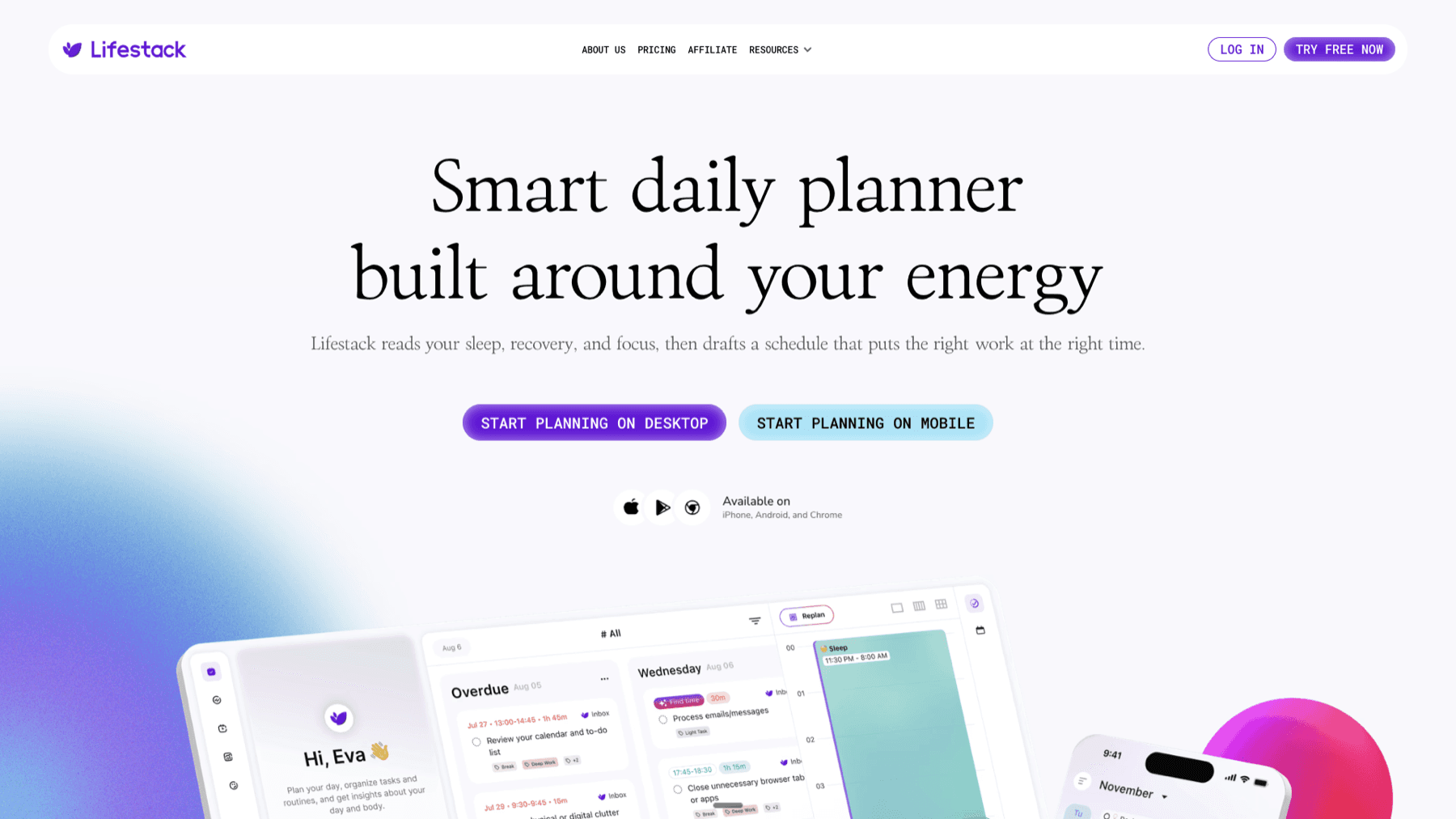
You use your Opove ring to understand how recovered you are. You use Lifestack to translate that awareness into a plan. On mornings when your ring shows a strong HRV recovery, you lean into deep work early. On mornings when your HRV is suppressed, Lifestack's energy-aware structure helps you front-load admin tasks and protect your cognitive reserves rather than draining them on work that could wait.
Lifestack is available for $7 per month, $50 per year, or $120 as a lifetime purchase. There's no subscription required on the Opove side, so together they're a low-overhead combination.
Best Tool for Turning HRV Into a Smarter Day
If you're wearing the Opove O Ring and checking your HRV each morning, you already have a decision framework for how to structure your day. The missing piece is a planning tool that speaks that language. Lifestack reads your sleep, recovery, and energy signals and builds your schedule around them, not around arbitrary time slots. It's the practical layer that makes smart ring data actually change your behavior rather than just inform it.
Lifestack is available on iOS, Android, and as a Chrome extension. Plans start at $7 per month, $50 per year, or $120 for lifetime access.
Frequently Asked Questions
How does the Opove O Ring measure HRV?
The ring uses PPG optical sensors on the inner band to detect beat-to-beat intervals in your heart rate, then derives your RMSSD-based HRV from those readings. It combines this with skin temperature data for its stress tracking metric.
What is a good HRV score for the Opove O Ring?
There's no single target number. HRV scores vary significantly by age, fitness level, and individual baseline. A 35-year-old runner's normal might be 65ms while a sedentary 50-year-old's baseline sits at 28ms. Both are valid. What matters is whether your personal trend is stable or moving upward over time. See our HRV chart by age for typical ranges.
Does the Opove O Ring track HRV during sleep?
Yes. Overnight HRV readings are among the most useful the ring captures because your body isn't moving and the signal is clean. The app surfaces this in your morning recovery summary. Low HRV during sleep is often the first sign that your body is under stress before you notice it consciously.
Does the Opove O Ring require a subscription?
No. The Opove app is free and all features, including HRV tracking, stress monitoring, sleep analysis, and historical trend data, are included at no ongoing cost. The ring itself costs $199.99 and that's the full price.
How do I use HRV data to plan my day?
Check your morning HRV reading before planning your work. A high score relative to your baseline signals a good day for demanding tasks and hard training. A low score is a signal to protect cognitive resources, front-load routine work, and prioritize sleep that night. Pairing the ring with an energy-based scheduling app like Lifestack automates this kind of planning so you don't have to make the call manually each morning.
What is the difference between HRV and stress on the Opove app?
HRV is the raw physiological measurement. Stress in the Opove app is a derived score that the algorithm calculates from HRV patterns, heart rate trends, and activity context. HRV is the more stable and research-backed of the two. The stress metric is useful for spotting spikes throughout the day, but your overnight HRV trend is the number worth watching for weekly planning purposes. A dedicated HRV monitor approach gives you more granular tracking if you want to go deeper.
Your smart ring never sleeps. While you do, it's quietly logging your heart rate variability every few minutes, building a picture of how your nervous system is handling the demands you've put on it. That data is what turns the Opove O Ring from a step counter into something genuinely useful.
The Opove O Ring monitors HRV and stress around the clock, updating you with trend data and recovery tips throughout the day. At $199.99 with no subscription attached, it's one of the more accessible entries in the smart ring market. But the hardware is only part of the story. The bigger question is: once you have the data, what do you do with it?
This guide walks through how the Opove O Ring captures HRV and stress, how to read the numbers it gives you, and how to connect that information to your actual daily schedule so your high-focus work lands when your body is ready for it.
We'll also cover what tanks your HRV, what lifts it, and why Lifestack is the planning layer that makes wearable health data actually change how you work.
Key Takeaways
The Opove O Ring tracks HRV and stress 24/7 using PPG and temperature sensors, with hourly updates and recovery tips in the Opove app.
A single HRV reading means little. What matters is your personal baseline and whether your trend is rising or falling over days.
Pairing your ring data with an energy-based scheduling tool like Lifestack lets you act on what your body is telling you instead of just reading the graph.
What Is HRV and Why Does It Matter?
Heart rate variability is the variation in time between consecutive heartbeats. A heart beating at 60 bpm doesn't fire exactly every 1,000 milliseconds. The gaps fluctuate. More fluctuation generally means your autonomic nervous system is balanced and adaptable. Less fluctuation suggests it's locked in a stress or recovery deficit state.
The metric captures something your resting heart rate misses entirely. Two people can both sit at 60 bpm and have very different HRV scores, reflecting completely different stress loads and recovery statuses. It's why HRV has become one of the more trusted signals in both elite sport and everyday wellness tracking.
The most common measurement you'll see on consumer devices is RMSSD, the root mean square of successive differences between heartbeats. It's sensitive to the parasympathetic nervous system, the "rest and recover" branch, and is why HRV tends to drop after hard training, poor sleep, or a stressful week. Numbers vary widely between individuals, so what counts as a good HRV depends partly on age.
How the Opove O Ring Tracks Stress and HRV
The ring uses a combination of PPG sensors (the same optical technology that measures your pulse) and a skin temperature sensor to capture the data. PPG works by shining light into the skin and detecting how blood flow changes with each heartbeat. From those readings, it derives beat-to-beat intervals and calculates HRV.
Stress tracking on the Opove O Ring is its own derived metric that combines HRV trends with heart rate patterns. When your HRV drops and your resting heart rate climbs, the app registers increased stress and pushes you a recovery tip. The ring does this hourly, not just at the end of the day, which is what makes the "24/7" label meaningful rather than just marketing.
Weight: 3.1 to 3.59 grams. Water resistance: 5 ATM. Battery: 5 to 8 days per charge. The form factor means you can actually wear it to sleep, which is when some of the most useful HRV readings happen.
Reading Your Daily HRV Score
The Opove app shows your HRV alongside a daily stress trend. Mornings are the best time to check. Your overnight reading reflects how well your body recovered from yesterday, and it's the clearest signal for how hard to push today.
What to look for:
Above your baseline: Your nervous system recovered well. Good day for a hard workout, deep focus work, or a demanding meeting block.
Near baseline: Normal day. Schedule as usual but don't pile on extras.
Below baseline: Your body is under load. Protect your recovery. Light movement, shorter focus sessions, and an earlier sleep time will help more than powering through.
The key word above is "your" baseline. A good HRV score for one person is unremarkable for another. The ring is tracking a trend, not a number to compete with. Consistency in when you measure, ideally first thing in the morning before checking your phone, gives you the cleanest data.
What Causes Your HRV to Drop?
The seven most common drivers of a declining HRV trend:
Poor sleep quality: HRV during sleep is often the first metric to reflect a bad night before you even feel it consciously.
Alcohol: Even two drinks the night before will suppress HRV measurably. The alcohol-HRV connection is one of the most consistent findings in consumer wearable research.
Training load: Stacking hard workouts without recovery days will drive HRV down over a week or two, even if you feel fine day to day.
Chronic stress: Work pressure, relationship tension, financial stress. The body doesn't distinguish the source.
Illness: HRV typically drops before you feel sick, making it a useful early warning signal.
Dehydration: Mild dehydration raises heart rate and compresses HRV variability.
Poor diet timing: Eating a heavy meal late at night forces digestion during what should be recovery sleep, raising nighttime heart rate and suppressing HRV.
How to Improve Your HRV Over Time
Short-term spikes don't build a higher HRV baseline. The goal is a slowly rising trend over weeks.
The foundations are not exciting but they work: consistent sleep and wake times, staying hydrated throughout the day, and eating whole foods with a cutoff roughly two to three hours before bed. These three changes alone tend to move the baseline noticeably within a couple of weeks.
The targeted additions come after the basics are solid. Box breathing (four counts in, hold four, out four, hold four) for five minutes in the morning activates the parasympathetic system. Zone 2 cardio, easy aerobic work where you can still hold a conversation, builds cardiac efficiency over months. Even 30 seconds of cold water on your face or neck after a shower has a documented parasympathetic effect that shows up in the data.
Track what you do and watch whether your HRV trend responds. The Opove app gives you enough historical data to start seeing correlations within a week or two.
From HRV Data to a Smarter Daily Schedule
Here's the gap that most smart ring users hit: they have the data, but their calendar doesn't care about it. Meetings still land at 10am whether your HRV is tanked from a bad night or riding high after a great week. Your task list doesn't reorganize itself around your recovery status.
That's where Lifestack fits in. It's a daily planning app built specifically around energy awareness. The whole premise is that time-blocking misses what matters most: the work you do at 9am on a recovered day is not the same quality as the work you do at 9am after three bad nights. Lifestack schedules your tasks to align with your energy curve, putting your highest-demand work when you're sharp and protecting your low-energy windows from cognitive drain.
You use your Opove ring to understand how recovered you are. You use Lifestack to translate that awareness into a plan. On mornings when your ring shows a strong HRV recovery, you lean into deep work early. On mornings when your HRV is suppressed, Lifestack's energy-aware structure helps you front-load admin tasks and protect your cognitive reserves rather than draining them on work that could wait.
Lifestack is available for $7 per month, $50 per year, or $120 as a lifetime purchase. There's no subscription required on the Opove side, so together they're a low-overhead combination.
Best Tool for Turning HRV Into a Smarter Day
If you're wearing the Opove O Ring and checking your HRV each morning, you already have a decision framework for how to structure your day. The missing piece is a planning tool that speaks that language. Lifestack reads your sleep, recovery, and energy signals and builds your schedule around them, not around arbitrary time slots. It's the practical layer that makes smart ring data actually change your behavior rather than just inform it.
Lifestack is available on iOS, Android, and as a Chrome extension. Plans start at $7 per month, $50 per year, or $120 for lifetime access.
Frequently Asked Questions
How does the Opove O Ring measure HRV?
The ring uses PPG optical sensors on the inner band to detect beat-to-beat intervals in your heart rate, then derives your RMSSD-based HRV from those readings. It combines this with skin temperature data for its stress tracking metric.
What is a good HRV score for the Opove O Ring?
There's no single target number. HRV scores vary significantly by age, fitness level, and individual baseline. A 35-year-old runner's normal might be 65ms while a sedentary 50-year-old's baseline sits at 28ms. Both are valid. What matters is whether your personal trend is stable or moving upward over time. See our HRV chart by age for typical ranges.
Does the Opove O Ring track HRV during sleep?
Yes. Overnight HRV readings are among the most useful the ring captures because your body isn't moving and the signal is clean. The app surfaces this in your morning recovery summary. Low HRV during sleep is often the first sign that your body is under stress before you notice it consciously.
Does the Opove O Ring require a subscription?
No. The Opove app is free and all features, including HRV tracking, stress monitoring, sleep analysis, and historical trend data, are included at no ongoing cost. The ring itself costs $199.99 and that's the full price.
How do I use HRV data to plan my day?
Check your morning HRV reading before planning your work. A high score relative to your baseline signals a good day for demanding tasks and hard training. A low score is a signal to protect cognitive resources, front-load routine work, and prioritize sleep that night. Pairing the ring with an energy-based scheduling app like Lifestack automates this kind of planning so you don't have to make the call manually each morning.
What is the difference between HRV and stress on the Opove app?
HRV is the raw physiological measurement. Stress in the Opove app is a derived score that the algorithm calculates from HRV patterns, heart rate trends, and activity context. HRV is the more stable and research-backed of the two. The stress metric is useful for spotting spikes throughout the day, but your overnight HRV trend is the number worth watching for weekly planning purposes. A dedicated HRV monitor approach gives you more granular tracking if you want to go deeper.



FOLLOW ON
FOLLOW ON
FOLLOW ON


Copyright 2026 © Lifestack. All rights reserved
Copyright 2026 © Lifestack. All rights reserved

