
Tips
Performance Anxiety: What It Is and How to Manage It
Performance Anxiety: What It Is and How to Manage It
Performance anxiety is the fear or worry that emerges before or during a situation where you're being evaluated. A presentation at work, a job interview, a sports competition, a musical audition. The anticipation of being judged triggers a physiological stress response, which then interferes with the very performance you're trying to deliver.
Nearly everyone experiences this in some form. Stage fright, test anxiety, work presentation nerves, and social anxiety in high-stakes interactions are all versions of the same underlying dynamic: your nervous system interprets evaluation as threat, and responds accordingly.
For most people, performance anxiety is occasional and manageable. For some, it's frequent and severe enough to significantly constrain what they're willing to attempt. Understanding what's happening and having specific tools changes that relationship with performance pressure in ways that generalized advice usually doesn't.
Key Takeaways
Performance anxiety is a stress response triggered by evaluation, not a character flaw or sign of unreadiness
It affects people across all domains: work, sports, music, public speaking, and social situations
The most effective management strategies combine cognitive techniques (reframing, realistic expectations) with physical ones (breathing, preparation) and structural ones (reducing baseline stress)
What Is Performance Anxiety?
Performance anxiety is the experience of excessive worry, self-consciousness, or fear of failure in situations where you're expected to perform or be evaluated. The physiological response is identical to the general stress response: your sympathetic nervous system activates, releasing adrenaline, increasing heart rate, sharpening attention, and preparing your body for action.
This response was adaptive in contexts involving physical threat. In evaluation contexts, it tends to be counterproductive. The cognitive narrowing that helps in danger situations reduces the flexible thinking needed for complex performance. Physical tension that prepares for action creates trembling hands and a tight voice. The very system trying to help you perform well interferes with the performance.
The experience varies widely. Some people feel it primarily in the body: racing heart, dry mouth, sweating, stomach upset. Others experience it cognitively: intrusive thoughts about failure, difficulty concentrating, mental blanks. Most experience both, with one dimension dominant.
Types of Performance Anxiety
Work performance anxiety shows up around presentations, reviews, high-stakes meetings, and deadlines. The fear of being seen as incompetent or of failing publicly activates the stress response in professional contexts. It often intensifies when the stakes increase (a major client presentation, a promotion review) and can lead to avoidance behaviors like over-preparing to the point of diminishing returns, or avoiding opportunities that feel too risky.
Sports performance anxiety ("choking") involves the disruption of well-practiced physical skills under pressure. Athletes who perform flawlessly in practice find their mechanics fall apart in competition. The mechanism involves excessive self-monitoring: conscious attention to movements that have become automatic. When you think about what your hands are doing during a golf swing you've executed thousands of times, the automaticity breaks down.
Stage or live performance anxiety (stage fright) affects musicians, actors, public speakers, and anyone performing before an audience. The fear of judgment from a crowd activates the same evolutionary "group scrutiny" alarm that made social rejection threatening in ancestral environments. The intensity often bears no relationship to actual stakes.
Social performance anxiety overlaps with social anxiety: the fear of being judged negatively in interpersonal situations, conversations, or social gatherings. For people who experience this, ordinary social situations become performance situations, with all the accompanying self-consciousness.
Symptoms of Performance Anxiety
Physical symptoms are often the most obvious:
Racing or pounding heartbeat
Dry mouth and difficulty swallowing
Sweating, trembling hands or voice
Nausea or stomach upset
Muscle tension and a feeling of tightness in the chest
Cognitive and emotional symptoms can be just as disruptive:
Intrusive thoughts about failure or embarrassment
Difficulty concentrating on the task; attention keeps going to the audience or evaluators
Mental blanks on material you know well
Catastrophizing: imagining the worst possible outcome as if it's inevitable
Avoidance of situations that trigger the response
What Causes Performance Anxiety?
Fear of failure and negative evaluation. The core of most performance anxiety is the fear of being judged negatively by others. This is deeply tied to social belonging instincts. Public failure feels threatening at a level that goes beyond the practical consequences. Understanding that fear of making the wrong choice and fear of evaluation share the same neurological roots helps explain why both tend to respond to the same interventions.
Perfectionism and unrealistic expectations. When the internal standard for acceptable performance is perfection, any realistic outcome becomes a failure. Perfectionism keeps the bar moving: even a successful performance is dissected for flaws. The anxiety comes not just from fear of specific failure but from the impossibility of the standard.
Past negative experiences. A single memorable public failure can create a conditioned association between performance situations and threat. The nervous system learns quickly from high-emotional-impact events and generalizes broadly. One bad presentation can make the next ten more anxiety-provoking.
High stakes and limited control. Anxiety increases as perceived stakes rise and as sense of control decreases. Situations where the outcome matters enormously and where you have limited influence over external factors (the audience, the judges, the conditions) produce more anxiety than situations where you feel prepared and in control.
Chronic stress and insufficient preparation. Baseline anxiety, from overwork, sleep deprivation, or general life stress, lowers the threshold at which performance anxiety activates. Someone running on empty is more reactive to performance pressure than someone who's rested and has adequate capacity. Preparation matters too: the anxiety of feeling underprepared is real and distinct from the anxiety of feeling ready but still nervous.
8 Strategies That Actually Help
Reframe the physical symptoms. The physiological response to performance anxiety (racing heart, adrenaline) is identical to excitement. Research by Alison Wood Brooks found that people who were told to say "I am excited" before an anxiety-inducing task performed significantly better than those told to "calm down." Reframing the state as excitement rather than anxiety is not denial; it's a redirect that uses the same physiological activation productively.
Use controlled breathing to modulate the stress response. Slow, diaphragmatic breathing activates the parasympathetic nervous system and counteracts the stress response physiologically. The 4-7-8 technique (inhale for 4 counts, hold for 7, exhale for 8) and box breathing (equal counts for inhale, hold, exhale, hold) both produce measurable reductions in physiological arousal. Two minutes of this before a performance can take the edge off the acute response.
Prepare specifically for the performance context, not just the content. Practice in conditions that resemble the actual performance: in front of other people, at the same time of day, with the same technology or equipment you'll use. Familiarity with the context reduces the novelty that triggers threat-detection. If you only ever rehearse alone in quiet, the actual conditions will feel more threatening.
Separate the performance from your self-worth. Performance anxiety is largely driven by the equation of performance outcome with personal value. One presentation, one game, one interview is not a referendum on who you are. Building a genuine cognitive separation between "how well I do this" and "what I'm worth" takes time but significantly reduces the stakes the nervous system assigns to the situation.
Use pre-performance routines. Athletes and performers who use consistent pre-performance routines show lower anxiety and better performance than those who don't. The routine activates familiar physical and mental states that signal "this is something I know how to do." It doesn't have to be elaborate: a specific warm-up sequence, a few minutes of focused breathing, a consistent playlist. Consistency is the variable, not complexity.
Challenge catastrophic thinking before it takes hold. Ask what specifically you're afraid will happen. Then ask how likely that is. Then ask what you'd actually do if it did happen. Most catastrophic scenarios are less likely and more survivable than they feel in the moment. Writing through the fear before a high-stakes event can bring the same clarity that distance eventually provides, but faster.
Build habits that lower baseline stress. Regular physical activity, consistent sleep, and deliberate recovery time all reduce the resting level of cortisol and sympathetic activation you bring into performance situations. A nervous system that's already running hot amplifies performance anxiety. One that's regulated responds to performance pressure without being overwhelmed by it. The research on habit formation shows these practices take sustained effort to establish, but the payoff in reduced baseline reactivity is real.
Accumulate low-stakes exposure. Anxiety associated with performance situations decreases with repeated exposure, particularly when the feared outcome doesn't materialize. Seeking out more frequent, lower-stakes opportunities to perform in public, rather than waiting for the big ones, builds tolerance for the evaluation experience and reduces its novelty.
How Your Daily Structure Affects Performance Anxiety
Performance anxiety doesn't emerge in isolation. It's shaped by everything that comes before the performance, including how you've managed your time and energy in the days leading up to it.
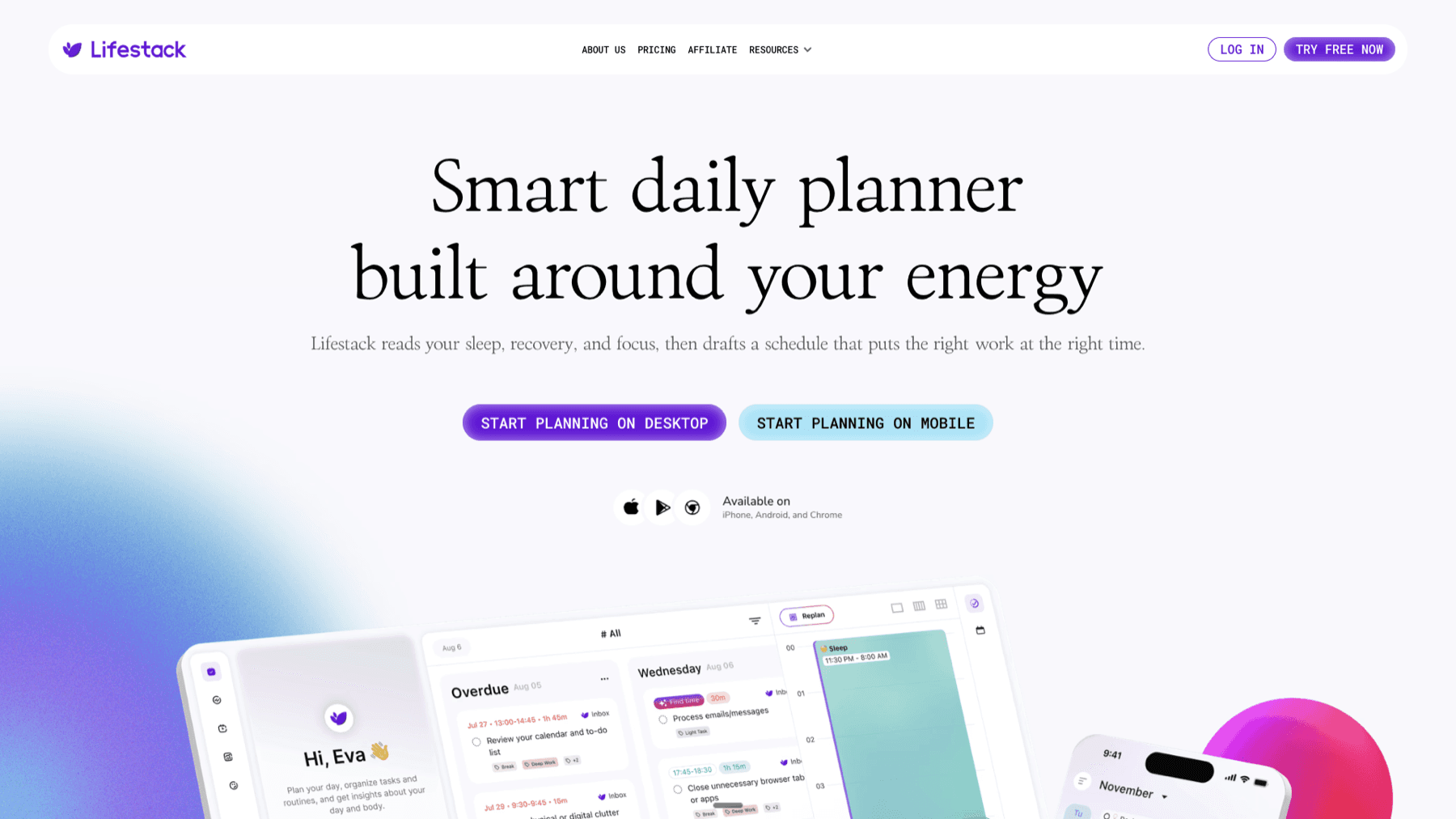
Chronic over-scheduling, inadequate preparation time, and the low-grade stress of always being behind are significant contributors to baseline anxiety that performance pressure then amplifies. Lifestack is a scheduling app that uses energy-aware planning to match demanding work to peak energy windows and protect time for preparation and recovery. For people dealing with performance anxiety, having enough time to genuinely prepare, rather than scrambling to cram at the last minute, changes what they bring to the moment of evaluation. Plans start at $7/month, or $50/year with a 7-day free trial.
Addressing habits that compound stress, like poor sleep, constant task-switching, and over-commitment, is part of reducing the conditions that make performance anxiety worse. And for people whose performance anxiety has an ADHD component, the ADHD hacks guide covers specific strategies for managing the attention and emotional regulation differences that can amplify anxiety in evaluation contexts.
When to Seek Professional Help
Performance anxiety that significantly limits your life, causes you to avoid important opportunities, or is accompanied by panic attacks, generalized anxiety, or depression warrants professional support. Cognitive behavioral therapy (CBT) has strong evidence for performance and social anxiety specifically. Exposure therapy, which involves graduated approach to anxiety-provoking situations, is often the most effective element. Some people also benefit from medication (usually beta-blockers for specific performance situations, or SSRIs for more pervasive anxiety) in conjunction with therapy.
Frequently Asked Questions
What is performance anxiety?
Performance anxiety is the stress response triggered by situations where you're being evaluated or observed. It involves physical symptoms (racing heart, dry mouth, trembling), cognitive symptoms (intrusive thoughts, difficulty concentrating, mental blanks), and emotional ones (fear of failure, self-consciousness). It's extremely common and not a sign of unpreparedness or weakness.
What does performance anxiety feel like?
The physical experience varies by person, but commonly includes a pounding heartbeat, stomach upset, dry mouth, sweating, and muscle tension. Cognitively, it often feels like an inability to access what you know, intrusive worst-case thoughts, and heightened awareness of the audience or evaluators. The experience can range from mild background nervousness to acute panic.
Is performance anxiety the same as stage fright?
Stage fright is a colloquial term for performance anxiety in live performance contexts: music, theater, public speaking. It's a subset of the broader category. The underlying mechanism is the same as work performance anxiety, sports anxiety, or test anxiety: perceived evaluation activates the stress response, which then interferes with performance.
Can performance anxiety be cured?
For most people, the goal is management rather than elimination. Some nervousness before a high-stakes situation is normal and can be channeled productively. The goal is reducing anxiety to a level where it doesn't significantly impair performance and where it doesn't stop you from pursuing important opportunities. Therapy, particularly CBT and exposure work, can produce lasting changes in how performance situations are experienced.
Does everyone get performance anxiety?
Nearly everyone experiences some version of it in high-stakes situations. The difference between people who appear calm and those who don't is partly genuine difference in reactivity, partly the ability to mask it, and partly experience with managing it. Most skilled performers are nervous before going on; they've simply developed enough practice with the response that it doesn't derail them.
Performance anxiety is the fear or worry that emerges before or during a situation where you're being evaluated. A presentation at work, a job interview, a sports competition, a musical audition. The anticipation of being judged triggers a physiological stress response, which then interferes with the very performance you're trying to deliver.
Nearly everyone experiences this in some form. Stage fright, test anxiety, work presentation nerves, and social anxiety in high-stakes interactions are all versions of the same underlying dynamic: your nervous system interprets evaluation as threat, and responds accordingly.
For most people, performance anxiety is occasional and manageable. For some, it's frequent and severe enough to significantly constrain what they're willing to attempt. Understanding what's happening and having specific tools changes that relationship with performance pressure in ways that generalized advice usually doesn't.
Key Takeaways
Performance anxiety is a stress response triggered by evaluation, not a character flaw or sign of unreadiness
It affects people across all domains: work, sports, music, public speaking, and social situations
The most effective management strategies combine cognitive techniques (reframing, realistic expectations) with physical ones (breathing, preparation) and structural ones (reducing baseline stress)
What Is Performance Anxiety?
Performance anxiety is the experience of excessive worry, self-consciousness, or fear of failure in situations where you're expected to perform or be evaluated. The physiological response is identical to the general stress response: your sympathetic nervous system activates, releasing adrenaline, increasing heart rate, sharpening attention, and preparing your body for action.
This response was adaptive in contexts involving physical threat. In evaluation contexts, it tends to be counterproductive. The cognitive narrowing that helps in danger situations reduces the flexible thinking needed for complex performance. Physical tension that prepares for action creates trembling hands and a tight voice. The very system trying to help you perform well interferes with the performance.
The experience varies widely. Some people feel it primarily in the body: racing heart, dry mouth, sweating, stomach upset. Others experience it cognitively: intrusive thoughts about failure, difficulty concentrating, mental blanks. Most experience both, with one dimension dominant.
Types of Performance Anxiety
Work performance anxiety shows up around presentations, reviews, high-stakes meetings, and deadlines. The fear of being seen as incompetent or of failing publicly activates the stress response in professional contexts. It often intensifies when the stakes increase (a major client presentation, a promotion review) and can lead to avoidance behaviors like over-preparing to the point of diminishing returns, or avoiding opportunities that feel too risky.
Sports performance anxiety ("choking") involves the disruption of well-practiced physical skills under pressure. Athletes who perform flawlessly in practice find their mechanics fall apart in competition. The mechanism involves excessive self-monitoring: conscious attention to movements that have become automatic. When you think about what your hands are doing during a golf swing you've executed thousands of times, the automaticity breaks down.
Stage or live performance anxiety (stage fright) affects musicians, actors, public speakers, and anyone performing before an audience. The fear of judgment from a crowd activates the same evolutionary "group scrutiny" alarm that made social rejection threatening in ancestral environments. The intensity often bears no relationship to actual stakes.
Social performance anxiety overlaps with social anxiety: the fear of being judged negatively in interpersonal situations, conversations, or social gatherings. For people who experience this, ordinary social situations become performance situations, with all the accompanying self-consciousness.
Symptoms of Performance Anxiety
Physical symptoms are often the most obvious:
Racing or pounding heartbeat
Dry mouth and difficulty swallowing
Sweating, trembling hands or voice
Nausea or stomach upset
Muscle tension and a feeling of tightness in the chest
Cognitive and emotional symptoms can be just as disruptive:
Intrusive thoughts about failure or embarrassment
Difficulty concentrating on the task; attention keeps going to the audience or evaluators
Mental blanks on material you know well
Catastrophizing: imagining the worst possible outcome as if it's inevitable
Avoidance of situations that trigger the response
What Causes Performance Anxiety?
Fear of failure and negative evaluation. The core of most performance anxiety is the fear of being judged negatively by others. This is deeply tied to social belonging instincts. Public failure feels threatening at a level that goes beyond the practical consequences. Understanding that fear of making the wrong choice and fear of evaluation share the same neurological roots helps explain why both tend to respond to the same interventions.
Perfectionism and unrealistic expectations. When the internal standard for acceptable performance is perfection, any realistic outcome becomes a failure. Perfectionism keeps the bar moving: even a successful performance is dissected for flaws. The anxiety comes not just from fear of specific failure but from the impossibility of the standard.
Past negative experiences. A single memorable public failure can create a conditioned association between performance situations and threat. The nervous system learns quickly from high-emotional-impact events and generalizes broadly. One bad presentation can make the next ten more anxiety-provoking.
High stakes and limited control. Anxiety increases as perceived stakes rise and as sense of control decreases. Situations where the outcome matters enormously and where you have limited influence over external factors (the audience, the judges, the conditions) produce more anxiety than situations where you feel prepared and in control.
Chronic stress and insufficient preparation. Baseline anxiety, from overwork, sleep deprivation, or general life stress, lowers the threshold at which performance anxiety activates. Someone running on empty is more reactive to performance pressure than someone who's rested and has adequate capacity. Preparation matters too: the anxiety of feeling underprepared is real and distinct from the anxiety of feeling ready but still nervous.
8 Strategies That Actually Help
Reframe the physical symptoms. The physiological response to performance anxiety (racing heart, adrenaline) is identical to excitement. Research by Alison Wood Brooks found that people who were told to say "I am excited" before an anxiety-inducing task performed significantly better than those told to "calm down." Reframing the state as excitement rather than anxiety is not denial; it's a redirect that uses the same physiological activation productively.
Use controlled breathing to modulate the stress response. Slow, diaphragmatic breathing activates the parasympathetic nervous system and counteracts the stress response physiologically. The 4-7-8 technique (inhale for 4 counts, hold for 7, exhale for 8) and box breathing (equal counts for inhale, hold, exhale, hold) both produce measurable reductions in physiological arousal. Two minutes of this before a performance can take the edge off the acute response.
Prepare specifically for the performance context, not just the content. Practice in conditions that resemble the actual performance: in front of other people, at the same time of day, with the same technology or equipment you'll use. Familiarity with the context reduces the novelty that triggers threat-detection. If you only ever rehearse alone in quiet, the actual conditions will feel more threatening.
Separate the performance from your self-worth. Performance anxiety is largely driven by the equation of performance outcome with personal value. One presentation, one game, one interview is not a referendum on who you are. Building a genuine cognitive separation between "how well I do this" and "what I'm worth" takes time but significantly reduces the stakes the nervous system assigns to the situation.
Use pre-performance routines. Athletes and performers who use consistent pre-performance routines show lower anxiety and better performance than those who don't. The routine activates familiar physical and mental states that signal "this is something I know how to do." It doesn't have to be elaborate: a specific warm-up sequence, a few minutes of focused breathing, a consistent playlist. Consistency is the variable, not complexity.
Challenge catastrophic thinking before it takes hold. Ask what specifically you're afraid will happen. Then ask how likely that is. Then ask what you'd actually do if it did happen. Most catastrophic scenarios are less likely and more survivable than they feel in the moment. Writing through the fear before a high-stakes event can bring the same clarity that distance eventually provides, but faster.
Build habits that lower baseline stress. Regular physical activity, consistent sleep, and deliberate recovery time all reduce the resting level of cortisol and sympathetic activation you bring into performance situations. A nervous system that's already running hot amplifies performance anxiety. One that's regulated responds to performance pressure without being overwhelmed by it. The research on habit formation shows these practices take sustained effort to establish, but the payoff in reduced baseline reactivity is real.
Accumulate low-stakes exposure. Anxiety associated with performance situations decreases with repeated exposure, particularly when the feared outcome doesn't materialize. Seeking out more frequent, lower-stakes opportunities to perform in public, rather than waiting for the big ones, builds tolerance for the evaluation experience and reduces its novelty.
How Your Daily Structure Affects Performance Anxiety
Performance anxiety doesn't emerge in isolation. It's shaped by everything that comes before the performance, including how you've managed your time and energy in the days leading up to it.
Chronic over-scheduling, inadequate preparation time, and the low-grade stress of always being behind are significant contributors to baseline anxiety that performance pressure then amplifies. Lifestack is a scheduling app that uses energy-aware planning to match demanding work to peak energy windows and protect time for preparation and recovery. For people dealing with performance anxiety, having enough time to genuinely prepare, rather than scrambling to cram at the last minute, changes what they bring to the moment of evaluation. Plans start at $7/month, or $50/year with a 7-day free trial.
Addressing habits that compound stress, like poor sleep, constant task-switching, and over-commitment, is part of reducing the conditions that make performance anxiety worse. And for people whose performance anxiety has an ADHD component, the ADHD hacks guide covers specific strategies for managing the attention and emotional regulation differences that can amplify anxiety in evaluation contexts.
When to Seek Professional Help
Performance anxiety that significantly limits your life, causes you to avoid important opportunities, or is accompanied by panic attacks, generalized anxiety, or depression warrants professional support. Cognitive behavioral therapy (CBT) has strong evidence for performance and social anxiety specifically. Exposure therapy, which involves graduated approach to anxiety-provoking situations, is often the most effective element. Some people also benefit from medication (usually beta-blockers for specific performance situations, or SSRIs for more pervasive anxiety) in conjunction with therapy.
Frequently Asked Questions
What is performance anxiety?
Performance anxiety is the stress response triggered by situations where you're being evaluated or observed. It involves physical symptoms (racing heart, dry mouth, trembling), cognitive symptoms (intrusive thoughts, difficulty concentrating, mental blanks), and emotional ones (fear of failure, self-consciousness). It's extremely common and not a sign of unpreparedness or weakness.
What does performance anxiety feel like?
The physical experience varies by person, but commonly includes a pounding heartbeat, stomach upset, dry mouth, sweating, and muscle tension. Cognitively, it often feels like an inability to access what you know, intrusive worst-case thoughts, and heightened awareness of the audience or evaluators. The experience can range from mild background nervousness to acute panic.
Is performance anxiety the same as stage fright?
Stage fright is a colloquial term for performance anxiety in live performance contexts: music, theater, public speaking. It's a subset of the broader category. The underlying mechanism is the same as work performance anxiety, sports anxiety, or test anxiety: perceived evaluation activates the stress response, which then interferes with performance.
Can performance anxiety be cured?
For most people, the goal is management rather than elimination. Some nervousness before a high-stakes situation is normal and can be channeled productively. The goal is reducing anxiety to a level where it doesn't significantly impair performance and where it doesn't stop you from pursuing important opportunities. Therapy, particularly CBT and exposure work, can produce lasting changes in how performance situations are experienced.
Does everyone get performance anxiety?
Nearly everyone experiences some version of it in high-stakes situations. The difference between people who appear calm and those who don't is partly genuine difference in reactivity, partly the ability to mask it, and partly experience with managing it. Most skilled performers are nervous before going on; they've simply developed enough practice with the response that it doesn't derail them.



FOLLOW ON
FOLLOW ON
FOLLOW ON


Copyright 2026 © Lifestack. All rights reserved
Copyright 2026 © Lifestack. All rights reserved

