
Tips
Sleep Sound: 8 Best Noises for Better Sleep
Sleep Sound: 8 Best Noises for Better Sleep

Sleep sound research is more interesting and more contested than most people realize. The idea that noise helps you sleep seems counterintuitive at first, but the mechanism is actually simple: it is not that sound puts you to sleep, it is that consistent background sound prevents the environmental spikes that wake you up. A car door at 2am is disruptive not because it is loud in absolute terms, but because it contrasts sharply with silence. Background sound reduces that contrast.
But different types of sleep sound work differently, and what helps one person may actively interfere with another's sleep. The research supports several specific types while cautioning against others. And individual variation is real: the best sleep sound for you depends on factors including your sensitivity to sound, whether you have ADHD or a busy brain at bedtime, and what your wearable data shows about your actual sleep quality on different nights.
This guide covers the eight sleep sounds most supported by evidence, what the research actually says about each, and how to use your own sleep data to find which one genuinely improves your recovery rather than just feeling pleasant before bed.
Key Takeaways
Sleep sounds work primarily by masking environmental noise spikes, not by directly inducing sleep
Pink and brown noise appear to have stronger effects on deep sleep quality than white noise for most people
The best sleep sound is the one your wearable data confirms actually improves your recovery score
Does Sleep Sound Actually Help?
Short answer: yes, for most people, and the evidence is reasonably solid. Studies consistently show that continuous background sound reduces sleep onset time, decreases the number of nighttime awakenings, and in some cases increases the proportion of deep sleep. Hospital settings use white noise specifically because the benefit is measurable and consistent across diverse populations.
The mechanism matters because it sets expectations correctly. Sleep sound does not knock you out or produce sedation. It creates a more stable acoustic environment. If you live somewhere genuinely quiet, background sound may do nothing or even make things worse. If you live somewhere with intermittent noise, whether traffic, a snoring partner, or ambient building sounds, a consistent sleep sound covers those spikes and gives your nervous system less to respond to during light sleep stages.
One important caveat: there is evidence that sleeping with earbuds or earphones that produce sound can affect sleep architecture negatively, depending on volume and duration. Keep any sleep sound at a low volume, no higher than 65 decibels, and use a speaker rather than earbuds where possible. See our guide on ADHD sleep tips for additional context on sleep environment optimization.
1. White Noise
White noise contains equal energy across all audible frequencies. The resulting sound is a constant, flat hiss similar to an untuned radio or an air conditioner. It is the most studied sleep sound category and the one most people mean when they say "sleep noise machine."
White noise is highly effective at masking environmental disturbances because it covers the full frequency range that intrusive sounds occupy. A car horn, a neighbor's TV, and a crying infant all get partially masked because white noise is simultaneously present at the frequencies those sounds use.
The limitation is that many people find white noise harsh or fatiguing, particularly at higher volumes. The flat spectral profile, equal energy at every frequency, produces a quality that some nervous systems find activating rather than calming. If white noise keeps you awake or feels irritating, that is not a failure of willpower. It is a legitimate mismatch between the sound and your auditory system.
2. Pink Noise
Pink noise has more energy in the lower frequencies and less in the higher ones. This creates a warmer, softer sound than white noise. Steady rainfall, wind through trees, and the ocean at a distance all approximate pink noise in their spectral profile.
Pink noise has attracted significant research interest for its apparent effects on deep sleep specifically. A 2017 study published in Frontiers in Human Neuroscience found that synchronized pink noise during slow-wave sleep increased the amplitude of slow oscillations associated with memory consolidation. Several other studies support improved deep sleep quality under pink noise conditions.
If you want to use sound specifically to improve deep sleep quality rather than just fall asleep faster, pink noise is the stronger choice over white noise based on current evidence. It is also generally more pleasant to listen to for extended periods, which matters if you are trying to maintain the habit long-term.
One detail the pink noise research often gets flattened in translation: the slow-wave effects come from playing sound in phase with slow oscillations already happening in the brain, not from running pink noise on a loop for eight hours. Timing is doing most of the work.
That is the problem NextSense built Smartbuds to solve. The earbuds use in-ear EEG sensors, a way of reading brain activity directly, to detect slow-wave sleep as it unfolds and deliver sound designed to support that activity when it can actually reinforce it. In a peer-reviewed study in Bioelectronic Medicine, the in-ear EEG reached substantial agreement with polysomnography, the clinical standard for sleep staging (Cohen’s κ = 0.77). The practical difference from an untimed sleep sound is straightforward: audio played into the specific windows where the brain is receptive, rather than a full-night bed of noise and a score in the morning.
3. Brown Noise
Brown noise, sometimes called red noise, has even more energy concentrated in the lower frequencies than pink noise. The result is a deep, rumbling sound similar to a powerful river, distant thunder, or a strong wind. It is the warmest and lowest-pitched of the noise colors.
Brown noise has gained a significant following among people with ADHD, who report that it provides a kind of cognitive quieting that white or pink noise does not. The theory is that the lower-frequency energy occupies the auditory processing bandwidth that the ADHD brain would otherwise fill with internal chatter and racing thoughts, reducing the mental noise that makes sleep onset slow.
This is consistent with reports in ADHD sleep research, where the bedtime racing thoughts problem is distinct from the environmental noise masking problem. Brown noise addresses both simultaneously. If you have tried white or pink noise and found it ineffective, brown noise is worth experimenting with before concluding that sleep sound does not work for you.
4. Nature Sounds
Rain, ocean waves, forest ambience, and similar nature sounds occupy a special category. They are spectrally similar to pink and brown noise in their lower-frequency emphasis, but they add a degree of variation and organic texture that some people find more calming than purely synthetic noise.
The research on nature sounds specifically is smaller than the white noise literature, but several studies support improved stress reduction and positive affect before sleep. Rain is the most commonly reported effective nature sound, possibly because it contains both the frequency profile of pink noise and an associated learned relaxation response for many people.
Nature sounds are also more socially acceptable for people who share a sleeping space. A partner who objects to the hiss of white noise may find rain or ocean waves a reasonable compromise. The masking effect is comparable to synthetic noise at similar volumes, so the practical benefit is the same.
5. Binaural Beats
Binaural beats require headphones: a slightly different frequency is played in each ear, and the brain perceives a beating tone at the difference frequency. Theta wave binaural beats (4-8 Hz) are marketed specifically for sleep induction by targeting the brain state associated with drowsiness.
The evidence here is genuinely mixed. Some studies show benefits for sleep onset and subjective sleep quality. Others find no effect or require very specific conditions to replicate results. The mechanisms proposed are plausible but not as well-established as the white and pink noise masking literature.
If you want to experiment with binaural beats, use them during the wind-down period before sleep rather than throughout the night. The research is clearest for effects during relaxation rather than during deep sleep stages. And headphones during full-night sleep have their own comfort and safety considerations worth thinking through.
6. Sleep Music and Meditations
Slow-tempo instrumental music (below 60 beats per minute) has consistent evidence for reducing heart rate, lowering cortisol, and decreasing the subjective feeling of stress before bed. Classical compositions, ambient electronic music, and specifically composed sleep soundtracks all fall into this category.
Sleep meditations pair guided audio with relaxation techniques, which adds a cognitive component to the acoustic one. Body scan meditations, progressive muscle relaxation, and breathing exercises delivered via audio have strong evidence bases for improving sleep onset, particularly for people whose sleep problem is primarily racing thoughts rather than environmental noise.
Apps like Calm, Headspace, and Insight Timer are the most established sources for sleep meditations. For the purely acoustic benefit without spoken guidance, any instrumental playlist at low volume and slow tempo will produce comparable effects.
7. ASMR
ASMR (Autonomous Sensory Meridian Response) describes a tingling, calming sensation some people experience in response to specific auditory or visual stimuli: soft whispering, paper crinkling, gentle tapping. A significant portion of the population does not experience ASMR at all, making this one of the most individually variable sleep sounds.
For people who do experience the ASMR response, the calming effect on arousal and anxiety before sleep can be substantial. For people who do not, ASMR content is often mildly annoying rather than relaxing. There is no way to predict which category you fall into without trying it. If ASMR does not produce a physical relaxation response for you within a few minutes of listening, it is likely not going to help with sleep.
8. Silence
Silence remains the best option for many people, particularly those who do not live in noisy environments. The evidence for sleep sounds is evidence that they work better than an acoustically variable environment, not evidence that they work better than consistent quiet.
If you live somewhere genuinely quiet, adding background noise may introduce a disruption rather than reducing one. Earplugs or a well-sealed sleep environment may accomplish more than any sound machine in those circumstances. Test this by tracking your sleep quality with a wearable during a week of silence and a week with your preferred sleep sound, then compare recovery scores.
How to Find the Right Sleep Sound With Wearable Data
The most reliable way to find your best sleep sound is not to rely on how you feel falling asleep. It is to measure what your wearable reports about your actual sleep quality. Feeling pleasant as you fall asleep and achieving deep, restorative sleep are not the same thing, and the two can diverge significantly depending on the sound used.
Run a systematic two-week test: one week with your current or no sleep sound, one week with the candidate sound. Compare your average recovery score, deep sleep percentage, and resting heart rate across both periods. Your wearable does not know what it sounds like in your room. It just measures the biological outcomes. That makes it a better judge than your subjective preference.
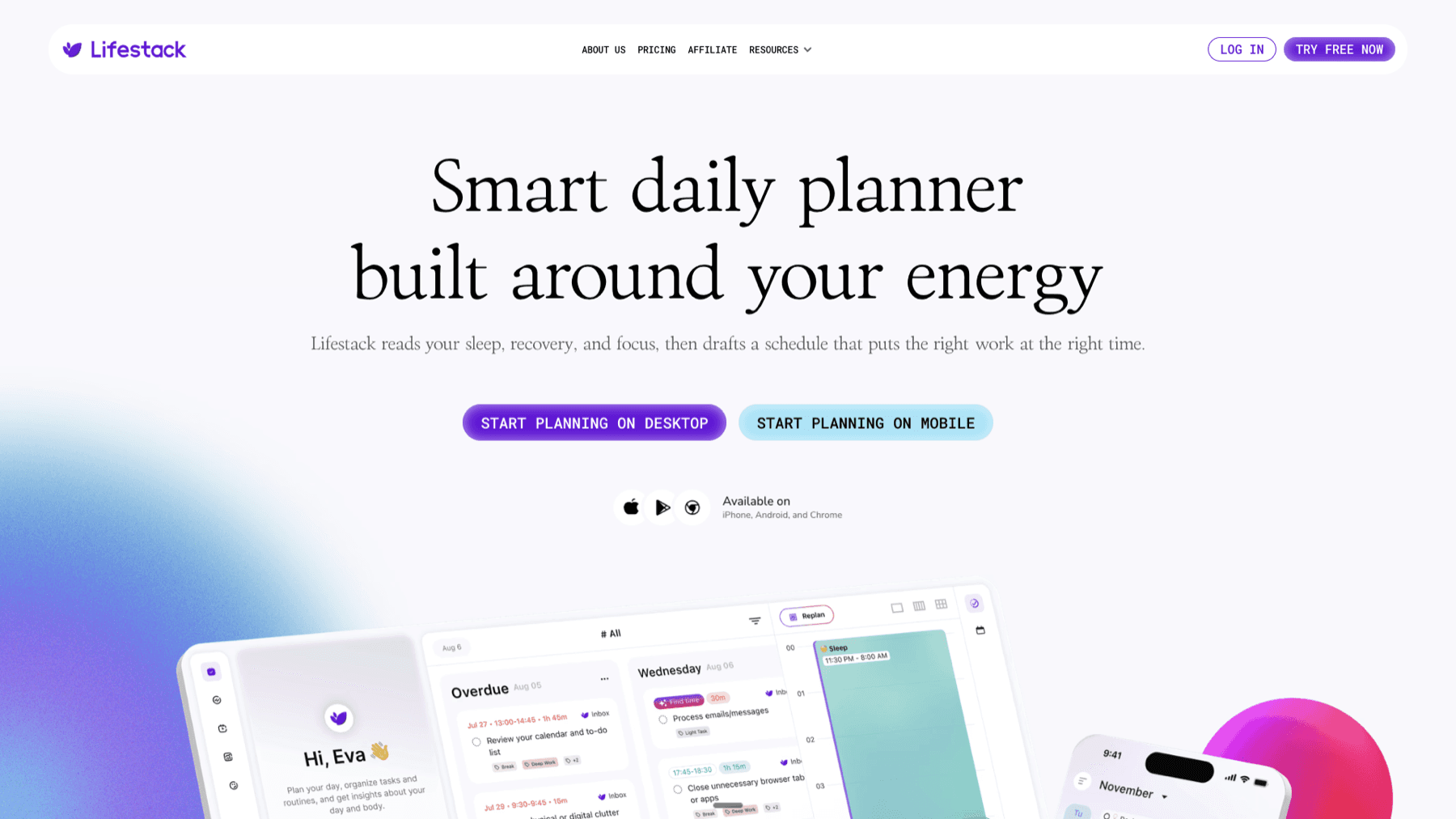
Lifestack integrates with Oura Ring, Apple Watch, and WHOOP to read your nightly recovery data and translate it into the next day's schedule. If your recovery score dropped after a night with a new sleep sound, Lifestack will reflect that in a lighter task load and adjusted priorities for the day. This closes the loop between sleep experiment and daily plan in a way that manual tracking does not. See our guide on using Oura Ring for productivity for more on this data-to-schedule connection.
Pricing for Lifestack is $7/month or $50/year, with a 7-day free trial on the annual plan. If you already use a wearable for sleep tracking, it is the most direct way to connect your nightly sleep data to your daytime performance.
FAQ
What is the best sleep sound for falling asleep faster?
White noise is the most studied and most effective for reducing sleep onset time by masking environmental disturbances. Pink noise is a close second and may be more pleasant for long-term use. If you have ADHD or racing thoughts at bedtime, brown noise or a guided sleep meditation are worth trying before the synthetic noise options, as they address a different underlying mechanism.
What is the best sleep sound for deep sleep?
Pink noise has the strongest evidence for improving deep sleep specifically, based on studies showing increased slow-wave activity during pink noise playback. Brown noise may have comparable effects, particularly for people who find white or pink noise too harsh. The research on binaural beats for deep sleep is less consistent.
Can sleep sounds be harmful?
At high volumes, yes. Any sleep sound above 65-70 decibels over a full night carries hearing risk and may paradoxically disrupt sleep rather than improve it. Earbuds used during sleep can cause ear canal irritation, wax buildup, and in some cases ear infection with extended use. Keep sleep sounds at conversational volume or below, use a speaker rather than earbuds where possible, and stop if your sleep quality tracking shows degradation after introducing a new sound.
Why does brown noise help ADHD sleep?
The most supported theory is that brown noise occupies auditory processing bandwidth that the ADHD brain would otherwise fill with internal chatter, particularly the racing thoughts that are a common ADHD sleep problem. The lower-frequency spectral profile of brown noise also tends to be subjectively calming in a way that the harsher high-frequency content of white noise is not, which may reduce arousal at bedtime independently of the masking effect.
Should I play sleep sounds all night or only while falling asleep?
All-night use is supported by the research and is how most clinical studies are conducted. If you use a sleep timer and the sound stops mid-night, any subsequent environmental noise has no masking. For most people, all-night at low volume produces better outcomes than timed use. The exception is binaural beats, where there is less evidence for full-night use and some evidence for specific benefit during the pre-sleep relaxation period.
How does sleep sound affect the next day's performance?
Better sleep quality directly translates to better cognitive performance, mood regulation, and energy the following day. Energy-aware planning depends on good recovery data, and good recovery data depends on genuine sleep quality. The connection between sleep sound, sleep architecture, recovery score, and next-day cognitive capacity is a single chain. Improving any link in it produces downstream benefits throughout the day.
Sleep sound research is more interesting and more contested than most people realize. The idea that noise helps you sleep seems counterintuitive at first, but the mechanism is actually simple: it is not that sound puts you to sleep, it is that consistent background sound prevents the environmental spikes that wake you up. A car door at 2am is disruptive not because it is loud in absolute terms, but because it contrasts sharply with silence. Background sound reduces that contrast.
But different types of sleep sound work differently, and what helps one person may actively interfere with another's sleep. The research supports several specific types while cautioning against others. And individual variation is real: the best sleep sound for you depends on factors including your sensitivity to sound, whether you have ADHD or a busy brain at bedtime, and what your wearable data shows about your actual sleep quality on different nights.
This guide covers the eight sleep sounds most supported by evidence, what the research actually says about each, and how to use your own sleep data to find which one genuinely improves your recovery rather than just feeling pleasant before bed.
Key Takeaways
Sleep sounds work primarily by masking environmental noise spikes, not by directly inducing sleep
Pink and brown noise appear to have stronger effects on deep sleep quality than white noise for most people
The best sleep sound is the one your wearable data confirms actually improves your recovery score
Does Sleep Sound Actually Help?
Short answer: yes, for most people, and the evidence is reasonably solid. Studies consistently show that continuous background sound reduces sleep onset time, decreases the number of nighttime awakenings, and in some cases increases the proportion of deep sleep. Hospital settings use white noise specifically because the benefit is measurable and consistent across diverse populations.
The mechanism matters because it sets expectations correctly. Sleep sound does not knock you out or produce sedation. It creates a more stable acoustic environment. If you live somewhere genuinely quiet, background sound may do nothing or even make things worse. If you live somewhere with intermittent noise, whether traffic, a snoring partner, or ambient building sounds, a consistent sleep sound covers those spikes and gives your nervous system less to respond to during light sleep stages.
One important caveat: there is evidence that sleeping with earbuds or earphones that produce sound can affect sleep architecture negatively, depending on volume and duration. Keep any sleep sound at a low volume, no higher than 65 decibels, and use a speaker rather than earbuds where possible. See our guide on ADHD sleep tips for additional context on sleep environment optimization.
1. White Noise
White noise contains equal energy across all audible frequencies. The resulting sound is a constant, flat hiss similar to an untuned radio or an air conditioner. It is the most studied sleep sound category and the one most people mean when they say "sleep noise machine."
White noise is highly effective at masking environmental disturbances because it covers the full frequency range that intrusive sounds occupy. A car horn, a neighbor's TV, and a crying infant all get partially masked because white noise is simultaneously present at the frequencies those sounds use.
The limitation is that many people find white noise harsh or fatiguing, particularly at higher volumes. The flat spectral profile, equal energy at every frequency, produces a quality that some nervous systems find activating rather than calming. If white noise keeps you awake or feels irritating, that is not a failure of willpower. It is a legitimate mismatch between the sound and your auditory system.
2. Pink Noise
Pink noise has more energy in the lower frequencies and less in the higher ones. This creates a warmer, softer sound than white noise. Steady rainfall, wind through trees, and the ocean at a distance all approximate pink noise in their spectral profile.
Pink noise has attracted significant research interest for its apparent effects on deep sleep specifically. A 2017 study published in Frontiers in Human Neuroscience found that synchronized pink noise during slow-wave sleep increased the amplitude of slow oscillations associated with memory consolidation. Several other studies support improved deep sleep quality under pink noise conditions.
If you want to use sound specifically to improve deep sleep quality rather than just fall asleep faster, pink noise is the stronger choice over white noise based on current evidence. It is also generally more pleasant to listen to for extended periods, which matters if you are trying to maintain the habit long-term.
One detail the pink noise research often gets flattened in translation: the slow-wave effects come from playing sound in phase with slow oscillations already happening in the brain, not from running pink noise on a loop for eight hours. Timing is doing most of the work.
That is the problem NextSense built Smartbuds to solve. The earbuds use in-ear EEG sensors, a way of reading brain activity directly, to detect slow-wave sleep as it unfolds and deliver sound designed to support that activity when it can actually reinforce it. In a peer-reviewed study in Bioelectronic Medicine, the in-ear EEG reached substantial agreement with polysomnography, the clinical standard for sleep staging (Cohen’s κ = 0.77). The practical difference from an untimed sleep sound is straightforward: audio played into the specific windows where the brain is receptive, rather than a full-night bed of noise and a score in the morning.
3. Brown Noise
Brown noise, sometimes called red noise, has even more energy concentrated in the lower frequencies than pink noise. The result is a deep, rumbling sound similar to a powerful river, distant thunder, or a strong wind. It is the warmest and lowest-pitched of the noise colors.
Brown noise has gained a significant following among people with ADHD, who report that it provides a kind of cognitive quieting that white or pink noise does not. The theory is that the lower-frequency energy occupies the auditory processing bandwidth that the ADHD brain would otherwise fill with internal chatter and racing thoughts, reducing the mental noise that makes sleep onset slow.
This is consistent with reports in ADHD sleep research, where the bedtime racing thoughts problem is distinct from the environmental noise masking problem. Brown noise addresses both simultaneously. If you have tried white or pink noise and found it ineffective, brown noise is worth experimenting with before concluding that sleep sound does not work for you.
4. Nature Sounds
Rain, ocean waves, forest ambience, and similar nature sounds occupy a special category. They are spectrally similar to pink and brown noise in their lower-frequency emphasis, but they add a degree of variation and organic texture that some people find more calming than purely synthetic noise.
The research on nature sounds specifically is smaller than the white noise literature, but several studies support improved stress reduction and positive affect before sleep. Rain is the most commonly reported effective nature sound, possibly because it contains both the frequency profile of pink noise and an associated learned relaxation response for many people.
Nature sounds are also more socially acceptable for people who share a sleeping space. A partner who objects to the hiss of white noise may find rain or ocean waves a reasonable compromise. The masking effect is comparable to synthetic noise at similar volumes, so the practical benefit is the same.
5. Binaural Beats
Binaural beats require headphones: a slightly different frequency is played in each ear, and the brain perceives a beating tone at the difference frequency. Theta wave binaural beats (4-8 Hz) are marketed specifically for sleep induction by targeting the brain state associated with drowsiness.
The evidence here is genuinely mixed. Some studies show benefits for sleep onset and subjective sleep quality. Others find no effect or require very specific conditions to replicate results. The mechanisms proposed are plausible but not as well-established as the white and pink noise masking literature.
If you want to experiment with binaural beats, use them during the wind-down period before sleep rather than throughout the night. The research is clearest for effects during relaxation rather than during deep sleep stages. And headphones during full-night sleep have their own comfort and safety considerations worth thinking through.
6. Sleep Music and Meditations
Slow-tempo instrumental music (below 60 beats per minute) has consistent evidence for reducing heart rate, lowering cortisol, and decreasing the subjective feeling of stress before bed. Classical compositions, ambient electronic music, and specifically composed sleep soundtracks all fall into this category.
Sleep meditations pair guided audio with relaxation techniques, which adds a cognitive component to the acoustic one. Body scan meditations, progressive muscle relaxation, and breathing exercises delivered via audio have strong evidence bases for improving sleep onset, particularly for people whose sleep problem is primarily racing thoughts rather than environmental noise.
Apps like Calm, Headspace, and Insight Timer are the most established sources for sleep meditations. For the purely acoustic benefit without spoken guidance, any instrumental playlist at low volume and slow tempo will produce comparable effects.
7. ASMR
ASMR (Autonomous Sensory Meridian Response) describes a tingling, calming sensation some people experience in response to specific auditory or visual stimuli: soft whispering, paper crinkling, gentle tapping. A significant portion of the population does not experience ASMR at all, making this one of the most individually variable sleep sounds.
For people who do experience the ASMR response, the calming effect on arousal and anxiety before sleep can be substantial. For people who do not, ASMR content is often mildly annoying rather than relaxing. There is no way to predict which category you fall into without trying it. If ASMR does not produce a physical relaxation response for you within a few minutes of listening, it is likely not going to help with sleep.
8. Silence
Silence remains the best option for many people, particularly those who do not live in noisy environments. The evidence for sleep sounds is evidence that they work better than an acoustically variable environment, not evidence that they work better than consistent quiet.
If you live somewhere genuinely quiet, adding background noise may introduce a disruption rather than reducing one. Earplugs or a well-sealed sleep environment may accomplish more than any sound machine in those circumstances. Test this by tracking your sleep quality with a wearable during a week of silence and a week with your preferred sleep sound, then compare recovery scores.
How to Find the Right Sleep Sound With Wearable Data
The most reliable way to find your best sleep sound is not to rely on how you feel falling asleep. It is to measure what your wearable reports about your actual sleep quality. Feeling pleasant as you fall asleep and achieving deep, restorative sleep are not the same thing, and the two can diverge significantly depending on the sound used.
Run a systematic two-week test: one week with your current or no sleep sound, one week with the candidate sound. Compare your average recovery score, deep sleep percentage, and resting heart rate across both periods. Your wearable does not know what it sounds like in your room. It just measures the biological outcomes. That makes it a better judge than your subjective preference.
Lifestack integrates with Oura Ring, Apple Watch, and WHOOP to read your nightly recovery data and translate it into the next day's schedule. If your recovery score dropped after a night with a new sleep sound, Lifestack will reflect that in a lighter task load and adjusted priorities for the day. This closes the loop between sleep experiment and daily plan in a way that manual tracking does not. See our guide on using Oura Ring for productivity for more on this data-to-schedule connection.
Pricing for Lifestack is $7/month or $50/year, with a 7-day free trial on the annual plan. If you already use a wearable for sleep tracking, it is the most direct way to connect your nightly sleep data to your daytime performance.
FAQ
What is the best sleep sound for falling asleep faster?
White noise is the most studied and most effective for reducing sleep onset time by masking environmental disturbances. Pink noise is a close second and may be more pleasant for long-term use. If you have ADHD or racing thoughts at bedtime, brown noise or a guided sleep meditation are worth trying before the synthetic noise options, as they address a different underlying mechanism.
What is the best sleep sound for deep sleep?
Pink noise has the strongest evidence for improving deep sleep specifically, based on studies showing increased slow-wave activity during pink noise playback. Brown noise may have comparable effects, particularly for people who find white or pink noise too harsh. The research on binaural beats for deep sleep is less consistent.
Can sleep sounds be harmful?
At high volumes, yes. Any sleep sound above 65-70 decibels over a full night carries hearing risk and may paradoxically disrupt sleep rather than improve it. Earbuds used during sleep can cause ear canal irritation, wax buildup, and in some cases ear infection with extended use. Keep sleep sounds at conversational volume or below, use a speaker rather than earbuds where possible, and stop if your sleep quality tracking shows degradation after introducing a new sound.
Why does brown noise help ADHD sleep?
The most supported theory is that brown noise occupies auditory processing bandwidth that the ADHD brain would otherwise fill with internal chatter, particularly the racing thoughts that are a common ADHD sleep problem. The lower-frequency spectral profile of brown noise also tends to be subjectively calming in a way that the harsher high-frequency content of white noise is not, which may reduce arousal at bedtime independently of the masking effect.
Should I play sleep sounds all night or only while falling asleep?
All-night use is supported by the research and is how most clinical studies are conducted. If you use a sleep timer and the sound stops mid-night, any subsequent environmental noise has no masking. For most people, all-night at low volume produces better outcomes than timed use. The exception is binaural beats, where there is less evidence for full-night use and some evidence for specific benefit during the pre-sleep relaxation period.
How does sleep sound affect the next day's performance?
Better sleep quality directly translates to better cognitive performance, mood regulation, and energy the following day. Energy-aware planning depends on good recovery data, and good recovery data depends on genuine sleep quality. The connection between sleep sound, sleep architecture, recovery score, and next-day cognitive capacity is a single chain. Improving any link in it produces downstream benefits throughout the day.



FOLLOW ON
FOLLOW ON
FOLLOW ON


Copyright 2026 © Lifestack. All rights reserved
Copyright 2026 © Lifestack. All rights reserved

