
Tips
Yoga Exercises: 10 Poses for Beginners
Yoga Exercises: 10 Poses for Beginners

Yoga is one of the most accessible physical practices for people who are starting from zero. It requires no equipment beyond a mat, no prior fitness, and no studio membership. You can practice at home in 20 minutes. And the benefits -- flexibility, strength, stress reduction, and improved sleep -- compound over weeks and months in ways that most other fitness practices do not.
What stops most beginners is not ability but uncertainty. Which poses should I learn first? What counts as correct form? How long should I hold each position? This guide answers those questions directly. The ten poses below cover the fundamental movement patterns in yoga, are appropriate for beginners, and can be combined into a 20-30 minute practice you can do daily from the start.
Key Takeaways
A 20-minute daily yoga practice produces measurable changes in flexibility, strength, and stress response within four to six weeks
The ten poses below cover all the fundamental movement patterns -- forward folds, backbends, hip openers, twists, and inversions -- that form the basis of most yoga styles
Consistency matters more than duration: a 15-minute daily practice beats a 90-minute weekly class for building both physical change and the habit itself
What Are Yoga Exercises?
Yoga exercises -- called asanas in Sanskrit -- are physical postures held for breath cycles or flowing transitions between positions. Unlike conventional exercise, yoga does not emphasize repetition-to-fatigue as its primary mechanism. Instead, it uses sustained holds, breath coordination, and body awareness to build flexibility, balance, and functional strength simultaneously.
The physical component of yoga is one layer of a broader system that also includes breathing practices (pranayama), meditation, and philosophical principles. Most beginners start with the physical poses and add other layers over time. That is a completely valid entry point. The physical benefits alone -- improved mobility, reduced tension, better posture -- are enough reason to start.
Benefits of Yoga Exercises
The research on yoga is unusually consistent across outcome measures. Regular practice improves flexibility (expected), but also muscle strength, which surprises people who associate strength work only with weights. Holding poses isometrically builds strength in the stabilizer muscles that conventional exercise often misses.
The stress reduction benefits are well-documented. Yoga activates the parasympathetic nervous system, reduces cortisol, and decreases markers of inflammation. For people under chronic work stress, a daily yoga practice functions as a structured recovery tool -- not just a pleasant activity. Exercise reliably increases energy, and yoga is particularly effective at improving the type of energy that comes from better nervous system regulation rather than cardiovascular fitness alone.
Sleep quality also improves with regular practice. The evening wind-down effect of yoga is well-studied; consistent practitioners report faster sleep onset and fewer nighttime wakes. This is partly the cortisol reduction effect and partly the parasympathetic activation that carries into the hours after practice. Sleep hygiene research consistently identifies movement earlier in the day and gentle stretching before bed as among the most effective behavioral sleep interventions.
The 10 Essential Yoga Poses for Beginners
1. Mountain Pose (Tadasana)
Stand with feet hip-width apart, arms alongside the body, weight evenly distributed across both feet. Hold for five breath cycles. Mountain pose looks simple but is the foundation for almost every standing pose in yoga. It builds the postural awareness that makes all other poses more effective. Cue yourself to: lift through the crown of the head, drop the shoulders, and press the feet into the floor without gripping the toes.
2. Child's Pose (Balasana)
Kneel with toes together, knees wide, and fold forward until your forehead rests on the mat. Arms stretch forward or rest alongside the body. Hold for five to ten breath cycles. Child's pose is the default rest position in yoga -- you return to it whenever you need to recover between more demanding poses. It gently stretches the lower back, hips, and thighs while activating the relaxation response.
3. Cat-Cow Stretch (Marjaryasana-Bitilasana)
Start on hands and knees. On an inhale, drop the belly toward the mat and lift the head (Cow). On an exhale, round the spine toward the ceiling and drop the head (Cat). Repeat for ten breath cycles. This spinal mobilization is excellent for desk workers and anyone with lower back tightness. It warms the spine before more demanding poses and can be practiced on its own as a daily back care routine.
4. Downward Facing Dog (Adho Mukha Svanasana)
From hands and knees, tuck toes and lift hips toward the ceiling, forming an inverted V shape. Heels press toward the floor (they do not need to touch at first). Hold for five to eight breaths. Downward dog simultaneously stretches the hamstrings, calves, and spine while strengthening the shoulders and arms. It is one of the most practiced poses in yoga because it accomplishes so much in a single position.
5. Warrior I (Virabhadrasana I)
From standing, step one foot back about four feet. Front knee bends to 90 degrees, back leg stays straight. Arms rise overhead, palms facing. Hold for five breaths per side. Warrior I builds strength in the legs and core while opening the hip flexors. For people who sit for long hours, the hip flexor opening alone makes this one of the most functionally valuable poses in the sequence.
6. Warrior II (Virabhadrasana II)
From Warrior I, open the hips and arms to face the long edge of the mat. Front arm extends forward, back arm extends behind. Hold for five breaths per side. Warrior II develops leg strength and hip stability while building the capacity for sustained attention in a challenging position -- a useful skill that transfers to other areas of practice and life.
7. Triangle Pose (Trikonasana)
Stand with legs wide. Turn the front foot out 90 degrees. Reach the front arm forward and then down toward the front shin, ankle, or a block. Back arm rises toward the ceiling. Hold for five breaths per side. Triangle pose stretches the hamstrings, inner thighs, and lateral torso. It also challenges balance in a way that builds proprioceptive awareness -- your body's ability to sense its position in space.
8. Bridge Pose (Setu Bandha Sarvangasana)
Lie on your back, knees bent, feet hip-width apart and close to the hips. On an inhale, press the feet into the floor and lift the hips toward the ceiling. Hold for five to eight breaths. Bridge pose strengthens the glutes, hamstrings, and lower back while opening the chest and hip flexors. It is a gentle backbend that is appropriate for most beginners and provides the spinal extension that counters hours of seated forward flexion.
9. Seated Forward Fold (Paschimottanasana)
Sit with legs extended forward. On an exhale, hinge from the hips and fold forward toward the feet. Hold whatever you can reach without rounding the back excessively. Hold for eight to ten breaths. This is one of the most effective hamstring stretches in yoga. Tight hamstrings are a source of lower back pain in many people; consistent practice of this pose produces measurable improvement in hamstring flexibility within four to six weeks.
10. Corpse Pose (Savasana)
Lie on your back with arms alongside the body, palms up, eyes closed. Allow all muscles to release. Hold for five to ten minutes. Savasana is not optional -- it is the pose where the physiological effects of the practice integrate. Research on yoga consistently shows that the savasana period produces the deepest reductions in cortisol and heart rate of any part of the session. Skipping it to save time costs more than it saves.
How to Structure a Beginner Yoga Practice
A simple beginner sequence: Mountain Pose to settle, five rounds of Cat-Cow, Downward Dog, Warrior I and II on each side, Triangle on each side, Bridge Pose, Seated Forward Fold, Savasana. This takes approximately 25-30 minutes at a relaxed pace.
Do this sequence daily for four weeks before adding variety. The repetition is intentional: beginners who change their sequence constantly do not develop the movement literacy to do any individual pose well. Repetition builds awareness of what your body is actually doing in each position, which is what makes yoga effective rather than just aerobic.
Morning routines that include yoga produce compounding benefits: the practice starts the day with parasympathetic activation (the opposite of the stress response most people begin their days in), sets a tone of intentional physical movement, and delivers the energy boost that exercise reliably provides. Many consistent practitioners report that their morning yoga session is the variable most correlated with the quality of the rest of their day.
Choosing the Right Style of Yoga
Once you have the basics, exploring different styles helps you find what fits your goals and temperament. Hatha yoga is the most beginner-friendly: slow, with explicit instruction on individual poses. Vinyasa links poses into flowing sequences synchronized with breath -- more dynamic and cardiovascular. Yin yoga holds poses for three to five minutes, targeting deep connective tissue. Restorative yoga uses props to support the body in extended holds, producing the deepest relaxation response of any yoga style.
If your primary goal is stress reduction and nervous system recovery, Yin and Restorative are the most direct paths. If your primary goal is physical strength and mobility, Vinyasa and Hatha provide more muscular work. Both contribute to calming the mind and body over time; the choice is about emphasis rather than right or wrong.
Best Tool for Scheduling Your Yoga Practice
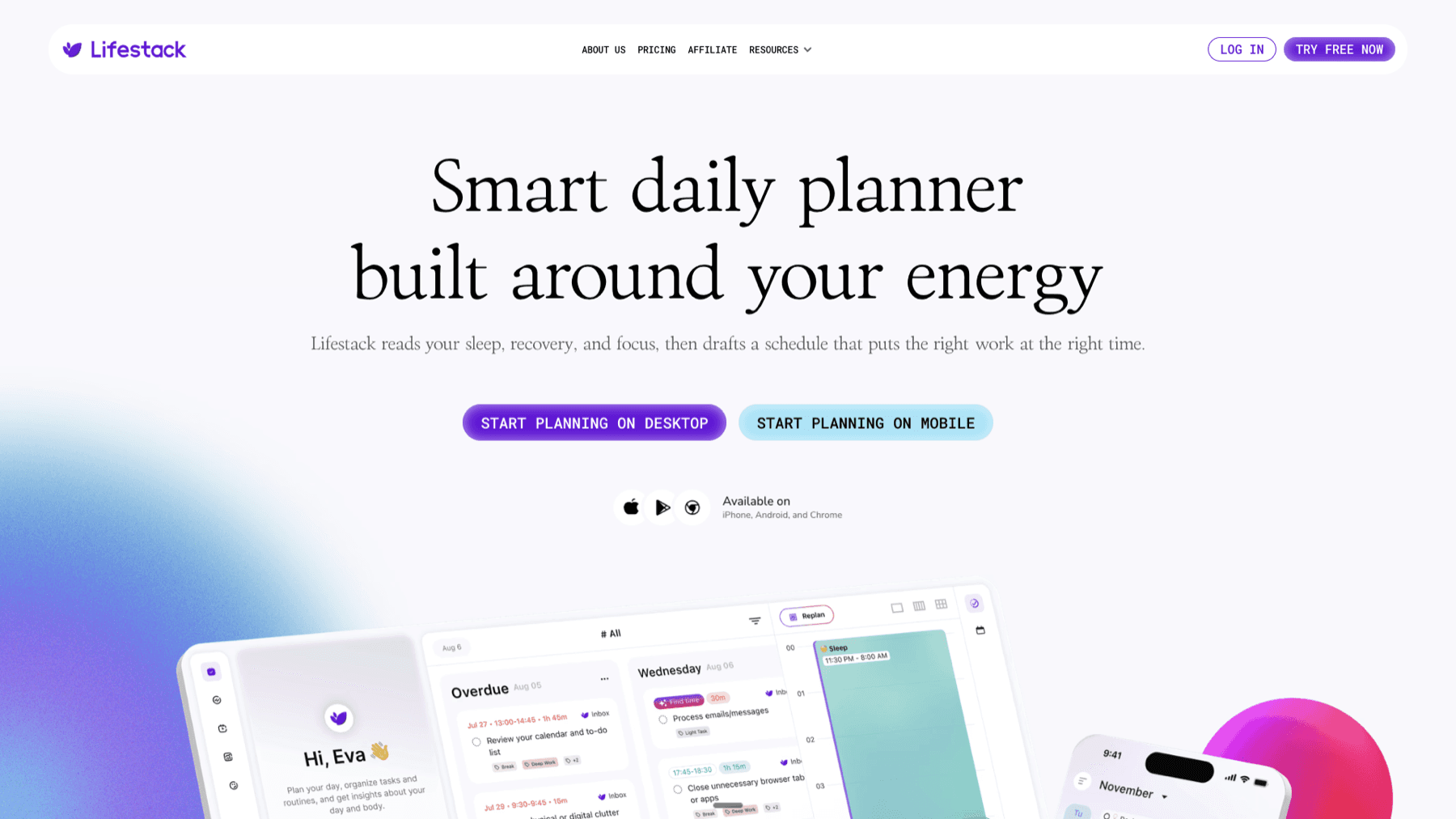
Lifestack is an AI daily planner that schedules your day around your energy levels. For building a consistent yoga practice, this means your session can be automatically placed at the time when your body is most ready for it -- typically the morning transition from sleep to waking activity -- and protected from being displaced by more immediately urgent demands. The planner reads your sleep and recovery data and builds your day around your actual state, not just your calendar availability.
Consistent yoga practice requires consistent scheduling. Energy-based scheduling ensures your physical wellness practices get the same structural protection as your work tasks. You can learn more at Introducing Lifestack: Plan Your Day with Energy in Mind.
Lifestack is $7/month or $50/year, with a 7-day free trial on the annual plan. Available on iOS, Android, and Chrome.
Frequently Asked Questions
What yoga exercises are best for beginners?
The ten poses in this guide are specifically chosen for beginners: Mountain Pose, Child's Pose, Cat-Cow, Downward Dog, Warrior I, Warrior II, Triangle Pose, Bridge Pose, Seated Forward Fold, and Savasana. Together they cover all the fundamental movement patterns -- forward folds, backbends, hip openers, lateral stretches, and inversions -- that form the base of any yoga practice.
How often should I do yoga exercises?
Daily is ideal, even for short sessions. The adaptation in flexibility and nervous system regulation comes from frequency rather than duration. Twenty minutes daily produces more change than 90 minutes once per week. If daily feels like too much commitment, start with four times per week and build from there. The habit formation is as important as the physical practice.
Do I need to be flexible to start yoga?
No. Flexibility is a result of yoga practice, not a prerequisite for it. Every pose can be modified to meet you where your body is today -- using blocks to bring the floor closer, bending the knees in forward folds, holding a strap instead of reaching the feet. The goal is appropriate challenge and sensation, not achieving the aesthetic shape of the pose. Most teachers spend significant time on modifications for exactly this reason.
Can yoga exercises replace strength training?
For general functional strength and muscular endurance, yoga provides meaningful training stimulus, particularly in the upper body, core, and hip stabilizers. For building maximum strength or muscle mass, dedicated resistance training produces better results. Many people use yoga as their primary physical practice with good results; others combine it with strength work for complementary benefits. The choice depends on your specific goals.
What is the best time of day to practice yoga?
Morning practice benefits from the natural cortisol peak that occurs on waking, which provides energy for the session and can be modulated by the parasympathetic activation of yoga into a more regulated form. Evening practice, particularly Yin or Restorative styles, is excellent for managing energy and preparing the nervous system for sleep. Both are effective; the best time is the one you will actually practice consistently.
Yoga is one of the most accessible physical practices for people who are starting from zero. It requires no equipment beyond a mat, no prior fitness, and no studio membership. You can practice at home in 20 minutes. And the benefits -- flexibility, strength, stress reduction, and improved sleep -- compound over weeks and months in ways that most other fitness practices do not.
What stops most beginners is not ability but uncertainty. Which poses should I learn first? What counts as correct form? How long should I hold each position? This guide answers those questions directly. The ten poses below cover the fundamental movement patterns in yoga, are appropriate for beginners, and can be combined into a 20-30 minute practice you can do daily from the start.
Key Takeaways
A 20-minute daily yoga practice produces measurable changes in flexibility, strength, and stress response within four to six weeks
The ten poses below cover all the fundamental movement patterns -- forward folds, backbends, hip openers, twists, and inversions -- that form the basis of most yoga styles
Consistency matters more than duration: a 15-minute daily practice beats a 90-minute weekly class for building both physical change and the habit itself
What Are Yoga Exercises?
Yoga exercises -- called asanas in Sanskrit -- are physical postures held for breath cycles or flowing transitions between positions. Unlike conventional exercise, yoga does not emphasize repetition-to-fatigue as its primary mechanism. Instead, it uses sustained holds, breath coordination, and body awareness to build flexibility, balance, and functional strength simultaneously.
The physical component of yoga is one layer of a broader system that also includes breathing practices (pranayama), meditation, and philosophical principles. Most beginners start with the physical poses and add other layers over time. That is a completely valid entry point. The physical benefits alone -- improved mobility, reduced tension, better posture -- are enough reason to start.
Benefits of Yoga Exercises
The research on yoga is unusually consistent across outcome measures. Regular practice improves flexibility (expected), but also muscle strength, which surprises people who associate strength work only with weights. Holding poses isometrically builds strength in the stabilizer muscles that conventional exercise often misses.
The stress reduction benefits are well-documented. Yoga activates the parasympathetic nervous system, reduces cortisol, and decreases markers of inflammation. For people under chronic work stress, a daily yoga practice functions as a structured recovery tool -- not just a pleasant activity. Exercise reliably increases energy, and yoga is particularly effective at improving the type of energy that comes from better nervous system regulation rather than cardiovascular fitness alone.
Sleep quality also improves with regular practice. The evening wind-down effect of yoga is well-studied; consistent practitioners report faster sleep onset and fewer nighttime wakes. This is partly the cortisol reduction effect and partly the parasympathetic activation that carries into the hours after practice. Sleep hygiene research consistently identifies movement earlier in the day and gentle stretching before bed as among the most effective behavioral sleep interventions.
The 10 Essential Yoga Poses for Beginners
1. Mountain Pose (Tadasana)
Stand with feet hip-width apart, arms alongside the body, weight evenly distributed across both feet. Hold for five breath cycles. Mountain pose looks simple but is the foundation for almost every standing pose in yoga. It builds the postural awareness that makes all other poses more effective. Cue yourself to: lift through the crown of the head, drop the shoulders, and press the feet into the floor without gripping the toes.
2. Child's Pose (Balasana)
Kneel with toes together, knees wide, and fold forward until your forehead rests on the mat. Arms stretch forward or rest alongside the body. Hold for five to ten breath cycles. Child's pose is the default rest position in yoga -- you return to it whenever you need to recover between more demanding poses. It gently stretches the lower back, hips, and thighs while activating the relaxation response.
3. Cat-Cow Stretch (Marjaryasana-Bitilasana)
Start on hands and knees. On an inhale, drop the belly toward the mat and lift the head (Cow). On an exhale, round the spine toward the ceiling and drop the head (Cat). Repeat for ten breath cycles. This spinal mobilization is excellent for desk workers and anyone with lower back tightness. It warms the spine before more demanding poses and can be practiced on its own as a daily back care routine.
4. Downward Facing Dog (Adho Mukha Svanasana)
From hands and knees, tuck toes and lift hips toward the ceiling, forming an inverted V shape. Heels press toward the floor (they do not need to touch at first). Hold for five to eight breaths. Downward dog simultaneously stretches the hamstrings, calves, and spine while strengthening the shoulders and arms. It is one of the most practiced poses in yoga because it accomplishes so much in a single position.
5. Warrior I (Virabhadrasana I)
From standing, step one foot back about four feet. Front knee bends to 90 degrees, back leg stays straight. Arms rise overhead, palms facing. Hold for five breaths per side. Warrior I builds strength in the legs and core while opening the hip flexors. For people who sit for long hours, the hip flexor opening alone makes this one of the most functionally valuable poses in the sequence.
6. Warrior II (Virabhadrasana II)
From Warrior I, open the hips and arms to face the long edge of the mat. Front arm extends forward, back arm extends behind. Hold for five breaths per side. Warrior II develops leg strength and hip stability while building the capacity for sustained attention in a challenging position -- a useful skill that transfers to other areas of practice and life.
7. Triangle Pose (Trikonasana)
Stand with legs wide. Turn the front foot out 90 degrees. Reach the front arm forward and then down toward the front shin, ankle, or a block. Back arm rises toward the ceiling. Hold for five breaths per side. Triangle pose stretches the hamstrings, inner thighs, and lateral torso. It also challenges balance in a way that builds proprioceptive awareness -- your body's ability to sense its position in space.
8. Bridge Pose (Setu Bandha Sarvangasana)
Lie on your back, knees bent, feet hip-width apart and close to the hips. On an inhale, press the feet into the floor and lift the hips toward the ceiling. Hold for five to eight breaths. Bridge pose strengthens the glutes, hamstrings, and lower back while opening the chest and hip flexors. It is a gentle backbend that is appropriate for most beginners and provides the spinal extension that counters hours of seated forward flexion.
9. Seated Forward Fold (Paschimottanasana)
Sit with legs extended forward. On an exhale, hinge from the hips and fold forward toward the feet. Hold whatever you can reach without rounding the back excessively. Hold for eight to ten breaths. This is one of the most effective hamstring stretches in yoga. Tight hamstrings are a source of lower back pain in many people; consistent practice of this pose produces measurable improvement in hamstring flexibility within four to six weeks.
10. Corpse Pose (Savasana)
Lie on your back with arms alongside the body, palms up, eyes closed. Allow all muscles to release. Hold for five to ten minutes. Savasana is not optional -- it is the pose where the physiological effects of the practice integrate. Research on yoga consistently shows that the savasana period produces the deepest reductions in cortisol and heart rate of any part of the session. Skipping it to save time costs more than it saves.
How to Structure a Beginner Yoga Practice
A simple beginner sequence: Mountain Pose to settle, five rounds of Cat-Cow, Downward Dog, Warrior I and II on each side, Triangle on each side, Bridge Pose, Seated Forward Fold, Savasana. This takes approximately 25-30 minutes at a relaxed pace.
Do this sequence daily for four weeks before adding variety. The repetition is intentional: beginners who change their sequence constantly do not develop the movement literacy to do any individual pose well. Repetition builds awareness of what your body is actually doing in each position, which is what makes yoga effective rather than just aerobic.
Morning routines that include yoga produce compounding benefits: the practice starts the day with parasympathetic activation (the opposite of the stress response most people begin their days in), sets a tone of intentional physical movement, and delivers the energy boost that exercise reliably provides. Many consistent practitioners report that their morning yoga session is the variable most correlated with the quality of the rest of their day.
Choosing the Right Style of Yoga
Once you have the basics, exploring different styles helps you find what fits your goals and temperament. Hatha yoga is the most beginner-friendly: slow, with explicit instruction on individual poses. Vinyasa links poses into flowing sequences synchronized with breath -- more dynamic and cardiovascular. Yin yoga holds poses for three to five minutes, targeting deep connective tissue. Restorative yoga uses props to support the body in extended holds, producing the deepest relaxation response of any yoga style.
If your primary goal is stress reduction and nervous system recovery, Yin and Restorative are the most direct paths. If your primary goal is physical strength and mobility, Vinyasa and Hatha provide more muscular work. Both contribute to calming the mind and body over time; the choice is about emphasis rather than right or wrong.
Best Tool for Scheduling Your Yoga Practice
Lifestack is an AI daily planner that schedules your day around your energy levels. For building a consistent yoga practice, this means your session can be automatically placed at the time when your body is most ready for it -- typically the morning transition from sleep to waking activity -- and protected from being displaced by more immediately urgent demands. The planner reads your sleep and recovery data and builds your day around your actual state, not just your calendar availability.
Consistent yoga practice requires consistent scheduling. Energy-based scheduling ensures your physical wellness practices get the same structural protection as your work tasks. You can learn more at Introducing Lifestack: Plan Your Day with Energy in Mind.
Lifestack is $7/month or $50/year, with a 7-day free trial on the annual plan. Available on iOS, Android, and Chrome.
Frequently Asked Questions
What yoga exercises are best for beginners?
The ten poses in this guide are specifically chosen for beginners: Mountain Pose, Child's Pose, Cat-Cow, Downward Dog, Warrior I, Warrior II, Triangle Pose, Bridge Pose, Seated Forward Fold, and Savasana. Together they cover all the fundamental movement patterns -- forward folds, backbends, hip openers, lateral stretches, and inversions -- that form the base of any yoga practice.
How often should I do yoga exercises?
Daily is ideal, even for short sessions. The adaptation in flexibility and nervous system regulation comes from frequency rather than duration. Twenty minutes daily produces more change than 90 minutes once per week. If daily feels like too much commitment, start with four times per week and build from there. The habit formation is as important as the physical practice.
Do I need to be flexible to start yoga?
No. Flexibility is a result of yoga practice, not a prerequisite for it. Every pose can be modified to meet you where your body is today -- using blocks to bring the floor closer, bending the knees in forward folds, holding a strap instead of reaching the feet. The goal is appropriate challenge and sensation, not achieving the aesthetic shape of the pose. Most teachers spend significant time on modifications for exactly this reason.
Can yoga exercises replace strength training?
For general functional strength and muscular endurance, yoga provides meaningful training stimulus, particularly in the upper body, core, and hip stabilizers. For building maximum strength or muscle mass, dedicated resistance training produces better results. Many people use yoga as their primary physical practice with good results; others combine it with strength work for complementary benefits. The choice depends on your specific goals.
What is the best time of day to practice yoga?
Morning practice benefits from the natural cortisol peak that occurs on waking, which provides energy for the session and can be modulated by the parasympathetic activation of yoga into a more regulated form. Evening practice, particularly Yin or Restorative styles, is excellent for managing energy and preparing the nervous system for sleep. Both are effective; the best time is the one you will actually practice consistently.



FOLLOW ON
FOLLOW ON
FOLLOW ON


Copyright 2026 © Lifestack. All rights reserved
Copyright 2026 © Lifestack. All rights reserved

