
Tips
ADHD Closet Organization: 7 Strategies That Stick
ADHD Closet Organization: 7 Strategies That Stick

ADHD closet organization fails for most people not because they lack effort but because the systems they try are designed for neurotypical brains. Color-coded bins, complex folding methods, capsule wardrobe rules with strict categories: these all require consistent recall and sustained attention to maintain. For an ADHD brain, that's exactly where the system breaks down within a week or two.
What actually works is different. ADHD closet organization that lasts is built around reducing friction, not optimizing for visual perfection. The goal isn't a Pinterest-worthy closet. The goal is a closet where you can find what you're looking for in under thirty seconds and where returning clothes is easy enough that you actually do it. Everything else is secondary.
The seven strategies below are designed specifically for how ADHD brains work: out of sight really is out of mind, decision fatigue is real and cumulative, and any system that requires more than one step to maintain won't survive contact with a bad day. These strategies address all three.
Key Takeaways
ADHD closet organization works best when systems require minimal effort to maintain, not just to set up initially.
Visibility is non-negotiable for ADHD brains: if you can't see it, you won't wear it or return it to the right place.
Pairing a physical organization system with a digital wardrobe tool and a structured morning routine removes most of the daily decision load that makes getting dressed hard with ADHD.
1. Start With One Section, Not the Whole Closet
The single most common ADHD closet organization mistake is pulling everything out at once. The advice sounds logical: see everything, make fresh decisions, start from scratch. In practice, it creates an overwhelming pile that triggers task paralysis, and the closet ends up worse than before with clothes living in a chair for two weeks.
Start with one shelf or one category instead. One shelf of folded items. Just your work clothes. Just your shoes. Finish that section completely before touching anything else. Small wins produce momentum, and the completed section becomes a visual anchor for what the rest of the closet is supposed to look like.
Set a time limit for each session: 20 to 30 minutes maximum. When the timer goes off, stop. Put anything undecided back. You can return to a specific section much more easily than you can restart a full overhaul.
2. Declutter Before You Organize
Organizing a closet full of clothes you don't wear is pointless. More importantly, it makes the system harder to maintain because there's simply too much to keep track of. Decluttering first removes the cognitive load of managing things you never actually use.
The ADHD-friendly way to declutter is to use a "maybe" box rather than forcing binary decisions. If you're not sure whether to keep something, put it in a box with today's date. If you haven't gone looking for it in three months, it can go. This removes the decision pressure of the moment and makes decluttering much easier for brains that struggle with fast yes/no choices.
Clothes you haven't worn in six months but feel guilty getting rid of are also strong declutter candidates. ADHD brains often hold onto things because of hypothetical future use, not realistic future use. The "would I buy this today?" test is a more honest filter than "will I ever wear this?"
3. Make Everything Visible
Visual cues are foundational for ADHD organization. If a piece of clothing is folded in a drawer under three other items, it doesn't exist to your brain. This is especially true for items you're less excited about but still need to wear. Out of sight genuinely means out of mind with ADHD, which is why out-of-sight-out-of-mind affects so many areas of ADHD life.
Hang as much as possible rather than folding. Leave drawer and bin lids off. Use clear storage containers if you're using any storage containers at all. Store things at eye level where you can see them without moving anything else. A single hook on the back of the door is more useful than a multi-layer hanger system, because one hook equals one step to use it.
Drawer dividers can also help, but only if they're kept simple: one category per section, never stacked. Folding clothes vertically (file-style) so you can see every item from above is often more ADHD-friendly than traditional horizontal stacking, where the bottom item becomes invisible by default.
4. Organize by How You Use Things, Not by Category
Traditional closet organization groups items by type: all shirts together, all pants together, all dresses together. For ADHD brains, grouping by outfit or by use case is often more functional because it reduces the number of decisions needed each morning.
A "work" section and a "casual" section beats organizing by garment type. Grouping a few complete outfit combinations together so you can grab the whole thing at once eliminates the "what goes with this?" decision that can derail a morning when your brain isn't fully online yet. This is especially useful for days when you have important events or early starts: the outfit is already assembled, and there's nothing to figure out.
Seasonal rotation matters here too. Keeping only current-season clothes at easy reach dramatically reduces the visual noise in your closet and makes daily choices much faster. Off-season items can go in labeled bins on a high shelf or in another closet entirely.
5. Remove Every Possible Friction Point
Friction is the enemy of maintenance for ADHD brains. Every extra step between "I need to return this to the closet" and "the item is actually put away" is a point where the behavior breaks down. The ADHD-friendly closet home management system is one where the path of least resistance leads to the right behavior.
Practical friction removals: no multi-level hangers (single item per hanger always), no lids on any bins or boxes in frequent-use zones, no folding required for anything that can be hung, hampers in the closet rather than across the room, and hooks at eye level for clothes that are "worn but not dirty" (the ambiguous category that causes most floor piles).
The designated "worn not dirty" hook is particularly useful for ADHD. Many people with ADHD pile clothes on a chair or the floor because there's no clear system for clothes that have been worn once but aren't ready for laundry. One hook with one purpose removes that decision entirely.
6. Use a Digital Tool to Reduce Getting-Dressed Decision Fatigue
Even an organized closet presents daily decision fatigue if you're still figuring out what to wear from scratch each morning. Decision fatigue compounds with ADHD, and mornings are often the worst time for it. One way to address this is to take the daily wardrobe decision out of the morning altogether.
Vesta is an AI wardrobe app that digitizes your closet and generates outfit suggestions based on your preferences, the weather, and your calendar events. Rather than standing in front of your closet trying to assemble something that works, Vesta does that planning for you. It also helps you actually use everything you own, including the items that tend to get buried in the back because they're harder to style quickly. The app is free on iOS, with an optional Vesta Pro subscription for daily styling suggestions and unlimited outfit combinations.
For ADHD specifically, the value isn't just convenience. It's removing a cognitively expensive decision from a time of day when your executive function is often at its lowest. Anything that reduces the number of choices you have to make before 9am makes the rest of the morning more manageable.
7. Pair Your Closet System With a Morning Routine Plan
ADHD closet organization solves the physical side of getting dressed. The other half of the problem is the morning itself: ADHD mornings are notoriously hard to run on schedule, and an organized closet doesn't help much if you're still losing track of time or forgetting steps.
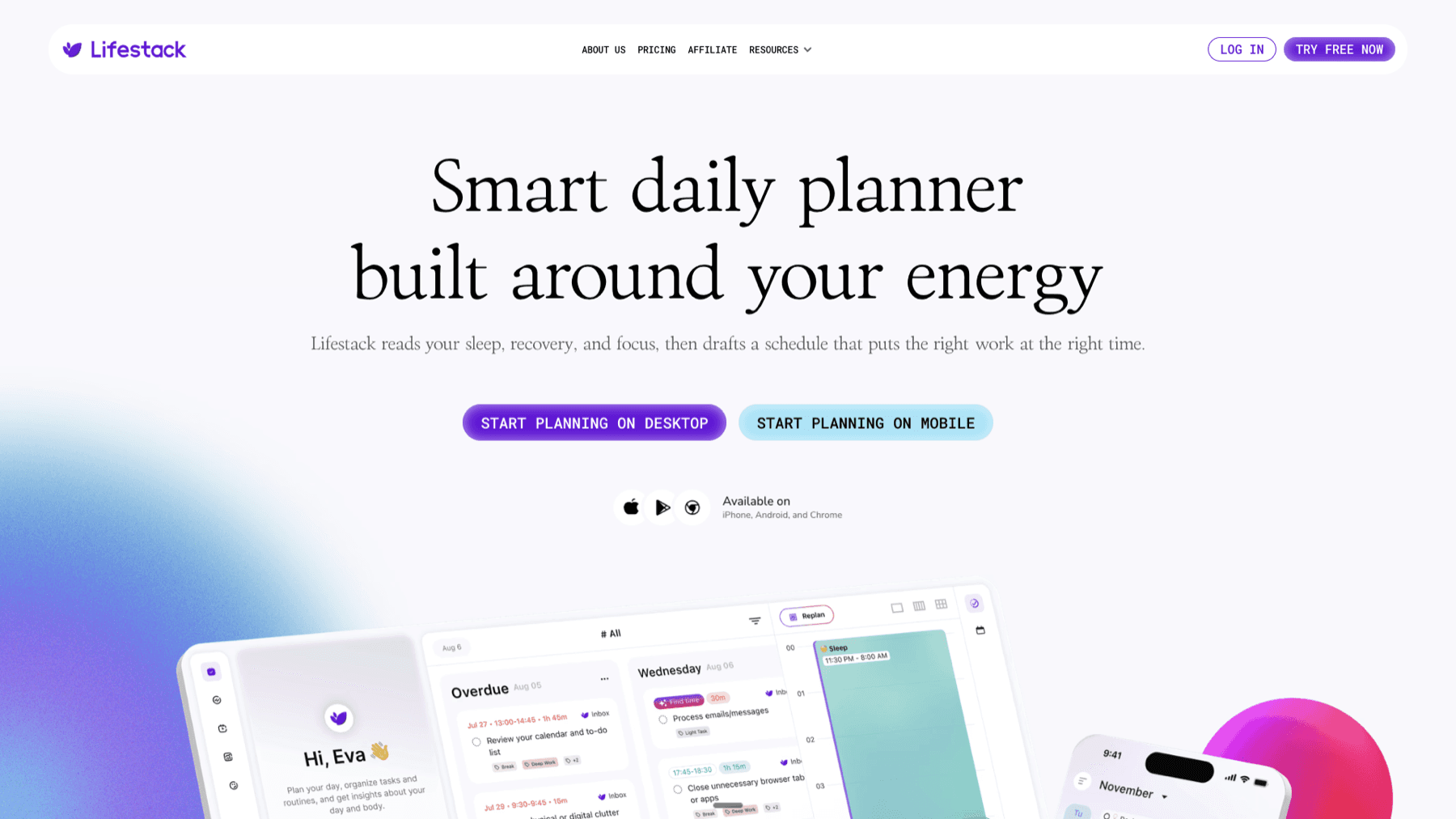
Lifestack handles the scheduling side that a closet system can't. It uses energy-aware AI to build a daily plan that accounts for when you're likely to have the most focus and how long tasks actually take. For ADHD users, this means a morning structure that adapts to how you're actually functioning rather than assuming every day runs the same way. When your schedule shifts, Lifestack automatically adjusts. Lifestack costs $7/month or $50/year, with a 7-day free trial on the annual plan, available on iOS and Android with a Chrome extension.
A well-organized closet and a smart morning schedule work together: one removes the physical friction of getting dressed, the other removes the cognitive friction of what happens next. Together they address the two biggest task initiation barriers that make ADHD mornings harder than they need to be.
Frequently Asked Questions
How do I organize my closet if I have ADHD?
Start with one small section rather than the whole closet, prioritize visibility over tidiness (hang what you can, remove lids from bins), and organize by use case rather than garment type. The most important principle is minimizing the friction of both accessing and returning items, so the system takes less effort to maintain than to ignore.
Why do people with ADHD struggle with closet organization?
ADHD makes it harder to maintain systems that require consistent recall, multiple steps, or binary decisions under time pressure. Most closet organization systems are built around those exact requirements. The ADHD brain also genuinely can't "see" things that aren't visible, so any storage that hides items leads to them being forgotten and unused.
What is the best way to declutter a closet with ADHD?
Use a "maybe box" instead of forcing immediate decisions. Put anything you're unsure about in a box with today's date. If you haven't looked for it in three months, donate it. This removes the decision pressure from the moment and spreads the cognitive load over time, which is far more manageable for ADHD brains.
How do I keep an ADHD closet organized long-term?
Design the system so that the easiest action is always the correct one. Items should have obvious, single-step homes. Bins should have no lids. Hangers should be one item each. Add a "worn not dirty" hook to capture the clothes that otherwise end up on the floor. The system has to be easier to maintain than to abandon, or it won't last.
What apps help with ADHD closet organization?
Vesta (iOS) digitizes your wardrobe and generates outfit suggestions, which reduces daily decision fatigue around getting dressed. For managing your broader morning routine and daily schedule with ADHD, Lifestack uses energy-aware AI scheduling to build a structured plan that adapts to how you're actually functioning each day.
ADHD closet organization fails for most people not because they lack effort but because the systems they try are designed for neurotypical brains. Color-coded bins, complex folding methods, capsule wardrobe rules with strict categories: these all require consistent recall and sustained attention to maintain. For an ADHD brain, that's exactly where the system breaks down within a week or two.
What actually works is different. ADHD closet organization that lasts is built around reducing friction, not optimizing for visual perfection. The goal isn't a Pinterest-worthy closet. The goal is a closet where you can find what you're looking for in under thirty seconds and where returning clothes is easy enough that you actually do it. Everything else is secondary.
The seven strategies below are designed specifically for how ADHD brains work: out of sight really is out of mind, decision fatigue is real and cumulative, and any system that requires more than one step to maintain won't survive contact with a bad day. These strategies address all three.
Key Takeaways
ADHD closet organization works best when systems require minimal effort to maintain, not just to set up initially.
Visibility is non-negotiable for ADHD brains: if you can't see it, you won't wear it or return it to the right place.
Pairing a physical organization system with a digital wardrobe tool and a structured morning routine removes most of the daily decision load that makes getting dressed hard with ADHD.
1. Start With One Section, Not the Whole Closet
The single most common ADHD closet organization mistake is pulling everything out at once. The advice sounds logical: see everything, make fresh decisions, start from scratch. In practice, it creates an overwhelming pile that triggers task paralysis, and the closet ends up worse than before with clothes living in a chair for two weeks.
Start with one shelf or one category instead. One shelf of folded items. Just your work clothes. Just your shoes. Finish that section completely before touching anything else. Small wins produce momentum, and the completed section becomes a visual anchor for what the rest of the closet is supposed to look like.
Set a time limit for each session: 20 to 30 minutes maximum. When the timer goes off, stop. Put anything undecided back. You can return to a specific section much more easily than you can restart a full overhaul.
2. Declutter Before You Organize
Organizing a closet full of clothes you don't wear is pointless. More importantly, it makes the system harder to maintain because there's simply too much to keep track of. Decluttering first removes the cognitive load of managing things you never actually use.
The ADHD-friendly way to declutter is to use a "maybe" box rather than forcing binary decisions. If you're not sure whether to keep something, put it in a box with today's date. If you haven't gone looking for it in three months, it can go. This removes the decision pressure of the moment and makes decluttering much easier for brains that struggle with fast yes/no choices.
Clothes you haven't worn in six months but feel guilty getting rid of are also strong declutter candidates. ADHD brains often hold onto things because of hypothetical future use, not realistic future use. The "would I buy this today?" test is a more honest filter than "will I ever wear this?"
3. Make Everything Visible
Visual cues are foundational for ADHD organization. If a piece of clothing is folded in a drawer under three other items, it doesn't exist to your brain. This is especially true for items you're less excited about but still need to wear. Out of sight genuinely means out of mind with ADHD, which is why out-of-sight-out-of-mind affects so many areas of ADHD life.
Hang as much as possible rather than folding. Leave drawer and bin lids off. Use clear storage containers if you're using any storage containers at all. Store things at eye level where you can see them without moving anything else. A single hook on the back of the door is more useful than a multi-layer hanger system, because one hook equals one step to use it.
Drawer dividers can also help, but only if they're kept simple: one category per section, never stacked. Folding clothes vertically (file-style) so you can see every item from above is often more ADHD-friendly than traditional horizontal stacking, where the bottom item becomes invisible by default.
4. Organize by How You Use Things, Not by Category
Traditional closet organization groups items by type: all shirts together, all pants together, all dresses together. For ADHD brains, grouping by outfit or by use case is often more functional because it reduces the number of decisions needed each morning.
A "work" section and a "casual" section beats organizing by garment type. Grouping a few complete outfit combinations together so you can grab the whole thing at once eliminates the "what goes with this?" decision that can derail a morning when your brain isn't fully online yet. This is especially useful for days when you have important events or early starts: the outfit is already assembled, and there's nothing to figure out.
Seasonal rotation matters here too. Keeping only current-season clothes at easy reach dramatically reduces the visual noise in your closet and makes daily choices much faster. Off-season items can go in labeled bins on a high shelf or in another closet entirely.
5. Remove Every Possible Friction Point
Friction is the enemy of maintenance for ADHD brains. Every extra step between "I need to return this to the closet" and "the item is actually put away" is a point where the behavior breaks down. The ADHD-friendly closet home management system is one where the path of least resistance leads to the right behavior.
Practical friction removals: no multi-level hangers (single item per hanger always), no lids on any bins or boxes in frequent-use zones, no folding required for anything that can be hung, hampers in the closet rather than across the room, and hooks at eye level for clothes that are "worn but not dirty" (the ambiguous category that causes most floor piles).
The designated "worn not dirty" hook is particularly useful for ADHD. Many people with ADHD pile clothes on a chair or the floor because there's no clear system for clothes that have been worn once but aren't ready for laundry. One hook with one purpose removes that decision entirely.
6. Use a Digital Tool to Reduce Getting-Dressed Decision Fatigue
Even an organized closet presents daily decision fatigue if you're still figuring out what to wear from scratch each morning. Decision fatigue compounds with ADHD, and mornings are often the worst time for it. One way to address this is to take the daily wardrobe decision out of the morning altogether.
Vesta is an AI wardrobe app that digitizes your closet and generates outfit suggestions based on your preferences, the weather, and your calendar events. Rather than standing in front of your closet trying to assemble something that works, Vesta does that planning for you. It also helps you actually use everything you own, including the items that tend to get buried in the back because they're harder to style quickly. The app is free on iOS, with an optional Vesta Pro subscription for daily styling suggestions and unlimited outfit combinations.
For ADHD specifically, the value isn't just convenience. It's removing a cognitively expensive decision from a time of day when your executive function is often at its lowest. Anything that reduces the number of choices you have to make before 9am makes the rest of the morning more manageable.
7. Pair Your Closet System With a Morning Routine Plan
ADHD closet organization solves the physical side of getting dressed. The other half of the problem is the morning itself: ADHD mornings are notoriously hard to run on schedule, and an organized closet doesn't help much if you're still losing track of time or forgetting steps.
Lifestack handles the scheduling side that a closet system can't. It uses energy-aware AI to build a daily plan that accounts for when you're likely to have the most focus and how long tasks actually take. For ADHD users, this means a morning structure that adapts to how you're actually functioning rather than assuming every day runs the same way. When your schedule shifts, Lifestack automatically adjusts. Lifestack costs $7/month or $50/year, with a 7-day free trial on the annual plan, available on iOS and Android with a Chrome extension.
A well-organized closet and a smart morning schedule work together: one removes the physical friction of getting dressed, the other removes the cognitive friction of what happens next. Together they address the two biggest task initiation barriers that make ADHD mornings harder than they need to be.
Frequently Asked Questions
How do I organize my closet if I have ADHD?
Start with one small section rather than the whole closet, prioritize visibility over tidiness (hang what you can, remove lids from bins), and organize by use case rather than garment type. The most important principle is minimizing the friction of both accessing and returning items, so the system takes less effort to maintain than to ignore.
Why do people with ADHD struggle with closet organization?
ADHD makes it harder to maintain systems that require consistent recall, multiple steps, or binary decisions under time pressure. Most closet organization systems are built around those exact requirements. The ADHD brain also genuinely can't "see" things that aren't visible, so any storage that hides items leads to them being forgotten and unused.
What is the best way to declutter a closet with ADHD?
Use a "maybe box" instead of forcing immediate decisions. Put anything you're unsure about in a box with today's date. If you haven't looked for it in three months, donate it. This removes the decision pressure from the moment and spreads the cognitive load over time, which is far more manageable for ADHD brains.
How do I keep an ADHD closet organized long-term?
Design the system so that the easiest action is always the correct one. Items should have obvious, single-step homes. Bins should have no lids. Hangers should be one item each. Add a "worn not dirty" hook to capture the clothes that otherwise end up on the floor. The system has to be easier to maintain than to abandon, or it won't last.
What apps help with ADHD closet organization?
Vesta (iOS) digitizes your wardrobe and generates outfit suggestions, which reduces daily decision fatigue around getting dressed. For managing your broader morning routine and daily schedule with ADHD, Lifestack uses energy-aware AI scheduling to build a structured plan that adapts to how you're actually functioning each day.



FOLLOW ON
FOLLOW ON
FOLLOW ON


Copyright 2026 © Lifestack. All rights reserved
Copyright 2026 © Lifestack. All rights reserved

