
Tips
ADHD To-Do List: 7 Strategies That Actually Work
ADHD To-Do List: 7 Strategies That Actually Work
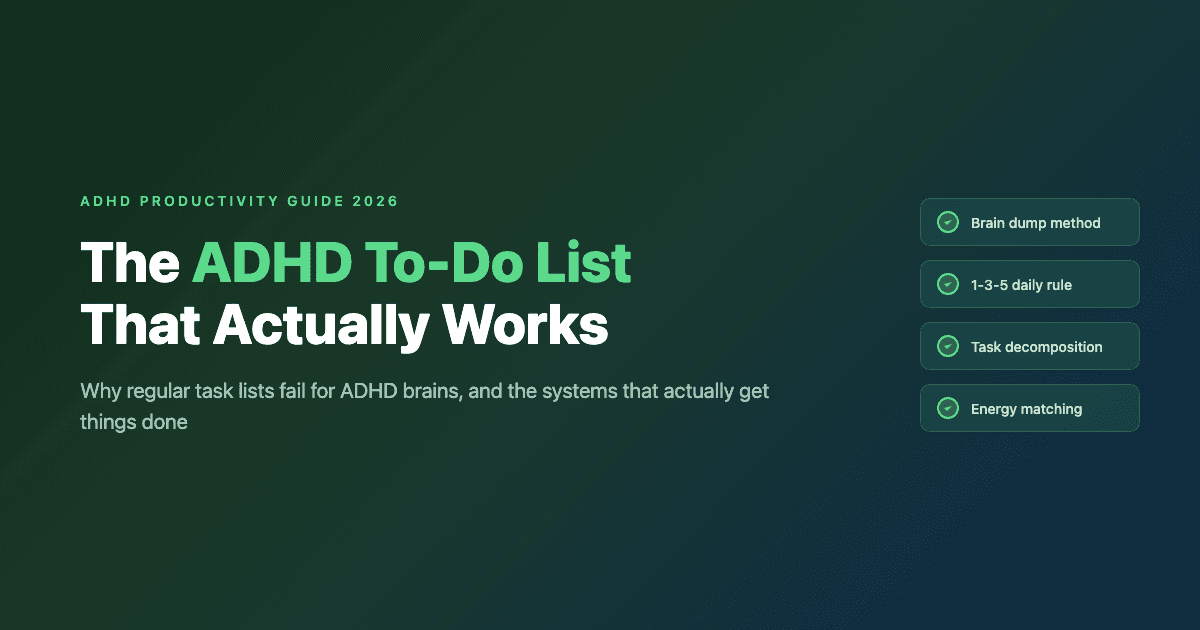
Most to-do list advice doesn't account for how ADHD brains actually work. The traditional approach, write everything down, check it off in order, is built around a working memory and attention system that ADHD specifically disrupts. A list sitting on a piece of paper or buried in an app is invisible if your brain doesn't have a reliable mechanism for surfacing it. And a list full of vague tasks like "work on project" or "deal with taxes" creates a task paralysis loop rather than action.
The good news: to-do lists can work well for ADHD brains. The design just needs to be different. These seven strategies address the specific points where standard lists break down.
Key Takeaways
ADHD to-do lists need to be visible, actionable, and limited. Long undifferentiated lists amplify overwhelm rather than reduce it.
Separating capture from planning prevents both from happening poorly. Use a brain dump list plus a short daily action list.
Tasks that never get done usually need to be broken into smaller steps, paired with a specific time, or removed.
1. Separate Your Brain Dump from Your Daily List
One of the biggest mistakes is using a single list for everything. When capture and prioritization happen in the same place, the list becomes a sprawling record of everything you've ever thought of doing, which is paralyzing to look at and useless for deciding what to do right now.
The fix: two lists. A brain dump (or master capture list) where everything goes, immediately, as it occurs to you. And a separate daily list of three to five items that you are actually going to do today. The brain dump is infinite. The daily list is short by design.
At the start of each day or the night before, look through the brain dump and pull out today's items. This is the only time you interact with the full list. During the day, you only look at the short list. This keeps working memory load low and makes "what's next" obvious rather than a daily research project.
2. Write Tasks as Specific Actions, Not Categories
Vague tasks are invisible to the ADHD brain. "Work on report," "deal with email," and "call doctor" are all categories, not actions. Looking at them doesn't trigger anything because the brain has to do an entire planning cycle before it can even start.
Rewrite every task as the specific next physical action. "Work on report" becomes "open report doc and write the methodology section intro, 25 min." "Call doctor" becomes "call Dr. Chen's office at 555-0123 to reschedule Thursday appointment." "Deal with email" becomes "reply to Sarah's project email and mark done."
Specific tasks have a clear entry point, a clear ending, and no ambiguity about what "doing it" means. This matters a lot for task initiation: the harder the first step is to identify, the less likely it is to happen.
3. Use the 1-3-5 Rule to Limit Your Daily List
The 1-3-5 rule structures a day into one big task, three medium tasks, and five small tasks. This sounds specific, but the real purpose is limiting scope. You're not supposed to add more once those slots are filled.
For ADHD specifically, the value is in the constraint. A to-do list with 20 items isn't a plan; it's a source of anxiety. A list with 9 items is manageable enough to prioritize and small enough to actually complete most of on a good day. Completing most of your list builds momentum and makes tomorrow's planning less demoralizing than carrying 15 items forward.
If you have more than nine things you think need to happen today, they don't all need to happen today. The brain dump holds the rest. Our post on the 1-3-5 method goes deeper on how to use this system effectively.
4. Break Tasks Until They Feel Easy to Start
Any task that has sat on your list for more than two days without getting started is too vague or too large. Full stop. The failure to start is information about the task, not about you.
The test: look at the task and ask, "What would I literally do first, in the next sixty seconds, if I decided to start this right now?" If the answer isn't obvious, break it down until it is. "Clean the kitchen" becomes "put the dishes in the sink into the dishwasher" (and stop there for now). "Write the proposal" becomes "open a blank doc and write one sentence about what the proposal is for."
Extremely small starting steps work with ADHD task initiation patterns rather than against them. The ADHD inertia problem is about starting. Once you're in motion, staying in motion is usually easier.
5. Match Tasks to Energy Windows
Not all tasks are equally demanding, and ADHD brains have pronounced energy variation throughout the day, often with a clear peak focus window (usually a few hours in the morning or early afternoon) and a lower-capacity period in the afternoon or evening.
Scheduling tasks against energy, not just time, is one of the most practical things you can do. Deep work, creative work, and anything requiring sustained attention goes in your high-focus window. Emails, scheduling, and administrative tasks go in lower-capacity periods. Doing it backwards, trying to focus on complex work when you're depleted, is when ADHD symptoms are at their worst.
This is also where ADHD time blindness becomes relevant. The intention to do a focused task "when I have the energy" often runs out of runway because the day didn't have visible structure. Assign specific time slots to high-focus tasks rather than leaving them to whenever they "feel right."
6. Make the List Visible
A to-do list you can't see is not a to-do list for an ADHD brain. It's a thought you had once. Out of sight, out of mind is a real neurological pattern, not a personality flaw. The list needs to be in your environment, not your memory.
What this looks like varies: a whiteboard next to your monitor, a notecard sitting on your keyboard, a phone widget on your home screen, a sticky note at eye level. The format matters less than the fact that it's physically or digitally in view without any action required to access it. If you have to open an app, navigate to a list, and remember the list exists, it will often not happen. See our guide on ADHD visual cues for more on making your environment work with your attention rather than against it.
7. Do a Weekly Reset
Even a well-maintained to-do list accumulates tasks that are no longer relevant, things that were urgent last Tuesday but aren't anymore, tasks that were added to the brain dump and have since been handled verbally, and aspirational items that need to be either committed to or removed.
A weekly reset, 15-20 minutes once a week, clears this debris. Go through the brain dump, mark everything that's been done or is no longer relevant, and move the remaining items that matter into next week's planning queue. This keeps the list accurate enough to trust. A list that's full of stale items loses its credibility as an external memory tool and stops being consulted.
The weekly reset pairs well with a weekly planning session, covered in our post on ADHD strategies for adults.
Best Tool for ADHD Task Management

Lifestack is built around the specific patterns above. Its energy-aware scheduling automatically places tasks in time blocks matched to your focus capacity, which addresses the energy-matching problem without requiring manual decision-making throughout the day. It integrates with your existing calendars, so the schedule reflects your actual day rather than an idealized one. For an ADHD brain that struggles with manual prioritization, having a system that proposes a daily plan based on your energy patterns and existing commitments removes a significant amount of friction. Lifestack starts at $7/month or $50/year (7-day free trial on the annual plan). Our deeper guide on ADHD daily planner covers how to set up a full daily system alongside it.
Frequently Asked Questions
Why do to-do lists not work for people with ADHD?
Standard to-do lists fail for a few reasons: they're often too long, too vague, out of sight, and not tied to specific times. ADHD affects working memory, task initiation, and attention, which means a passive list requires too much active processing to turn into action. Lists designed around these constraints, short, specific, visible, and time-linked, work considerably better.
What's the best to-do list format for ADHD?
A two-part system works well: a brain dump capture list for everything, and a daily short list (no more than five items) for what you're actually doing today. Tasks should be written as specific next actions, not categories. Daily lists should be visible throughout the day without requiring navigation to access.
How do you prioritize a to-do list with ADHD?
The 1-3-5 rule is a practical starting point: one big item, three medium items, five small items per day. Urgency and importance both matter, but energy availability matters too. High-attention tasks should be scheduled for your peak focus window, not left to whenever you get to them. If prioritization itself becomes a paralysis point, having a pre-built daily plan tool like Lifestack removes that decision from your morning.
What should you do if a task keeps getting pushed to the next day?
That task is either too vague (needs to be broken into a smaller first step), too large for a single day (needs to be split into multiple tasks), not actually a priority (needs to be removed), or needs a specific time block rather than just a list slot. A task that sits for more than two days is signaling something about its definition, not your motivation.
Is it better to use paper or digital to-do lists for ADHD?
Both can work. Paper has the advantage of being always visible and requiring no navigation, which matters for out-of-sight-out-of-mind patterns. Digital has the advantage of reminders, cross-device access, and easier reorganization. Many people with ADHD do best with a hybrid: a digital brain dump and a paper daily list that's physically present throughout the day. Test both and choose based on what you actually consult, not what seems most organized in theory.
Most to-do list advice doesn't account for how ADHD brains actually work. The traditional approach, write everything down, check it off in order, is built around a working memory and attention system that ADHD specifically disrupts. A list sitting on a piece of paper or buried in an app is invisible if your brain doesn't have a reliable mechanism for surfacing it. And a list full of vague tasks like "work on project" or "deal with taxes" creates a task paralysis loop rather than action.
The good news: to-do lists can work well for ADHD brains. The design just needs to be different. These seven strategies address the specific points where standard lists break down.
Key Takeaways
ADHD to-do lists need to be visible, actionable, and limited. Long undifferentiated lists amplify overwhelm rather than reduce it.
Separating capture from planning prevents both from happening poorly. Use a brain dump list plus a short daily action list.
Tasks that never get done usually need to be broken into smaller steps, paired with a specific time, or removed.
1. Separate Your Brain Dump from Your Daily List
One of the biggest mistakes is using a single list for everything. When capture and prioritization happen in the same place, the list becomes a sprawling record of everything you've ever thought of doing, which is paralyzing to look at and useless for deciding what to do right now.
The fix: two lists. A brain dump (or master capture list) where everything goes, immediately, as it occurs to you. And a separate daily list of three to five items that you are actually going to do today. The brain dump is infinite. The daily list is short by design.
At the start of each day or the night before, look through the brain dump and pull out today's items. This is the only time you interact with the full list. During the day, you only look at the short list. This keeps working memory load low and makes "what's next" obvious rather than a daily research project.
2. Write Tasks as Specific Actions, Not Categories
Vague tasks are invisible to the ADHD brain. "Work on report," "deal with email," and "call doctor" are all categories, not actions. Looking at them doesn't trigger anything because the brain has to do an entire planning cycle before it can even start.
Rewrite every task as the specific next physical action. "Work on report" becomes "open report doc and write the methodology section intro, 25 min." "Call doctor" becomes "call Dr. Chen's office at 555-0123 to reschedule Thursday appointment." "Deal with email" becomes "reply to Sarah's project email and mark done."
Specific tasks have a clear entry point, a clear ending, and no ambiguity about what "doing it" means. This matters a lot for task initiation: the harder the first step is to identify, the less likely it is to happen.
3. Use the 1-3-5 Rule to Limit Your Daily List
The 1-3-5 rule structures a day into one big task, three medium tasks, and five small tasks. This sounds specific, but the real purpose is limiting scope. You're not supposed to add more once those slots are filled.
For ADHD specifically, the value is in the constraint. A to-do list with 20 items isn't a plan; it's a source of anxiety. A list with 9 items is manageable enough to prioritize and small enough to actually complete most of on a good day. Completing most of your list builds momentum and makes tomorrow's planning less demoralizing than carrying 15 items forward.
If you have more than nine things you think need to happen today, they don't all need to happen today. The brain dump holds the rest. Our post on the 1-3-5 method goes deeper on how to use this system effectively.
4. Break Tasks Until They Feel Easy to Start
Any task that has sat on your list for more than two days without getting started is too vague or too large. Full stop. The failure to start is information about the task, not about you.
The test: look at the task and ask, "What would I literally do first, in the next sixty seconds, if I decided to start this right now?" If the answer isn't obvious, break it down until it is. "Clean the kitchen" becomes "put the dishes in the sink into the dishwasher" (and stop there for now). "Write the proposal" becomes "open a blank doc and write one sentence about what the proposal is for."
Extremely small starting steps work with ADHD task initiation patterns rather than against them. The ADHD inertia problem is about starting. Once you're in motion, staying in motion is usually easier.
5. Match Tasks to Energy Windows
Not all tasks are equally demanding, and ADHD brains have pronounced energy variation throughout the day, often with a clear peak focus window (usually a few hours in the morning or early afternoon) and a lower-capacity period in the afternoon or evening.
Scheduling tasks against energy, not just time, is one of the most practical things you can do. Deep work, creative work, and anything requiring sustained attention goes in your high-focus window. Emails, scheduling, and administrative tasks go in lower-capacity periods. Doing it backwards, trying to focus on complex work when you're depleted, is when ADHD symptoms are at their worst.
This is also where ADHD time blindness becomes relevant. The intention to do a focused task "when I have the energy" often runs out of runway because the day didn't have visible structure. Assign specific time slots to high-focus tasks rather than leaving them to whenever they "feel right."
6. Make the List Visible
A to-do list you can't see is not a to-do list for an ADHD brain. It's a thought you had once. Out of sight, out of mind is a real neurological pattern, not a personality flaw. The list needs to be in your environment, not your memory.
What this looks like varies: a whiteboard next to your monitor, a notecard sitting on your keyboard, a phone widget on your home screen, a sticky note at eye level. The format matters less than the fact that it's physically or digitally in view without any action required to access it. If you have to open an app, navigate to a list, and remember the list exists, it will often not happen. See our guide on ADHD visual cues for more on making your environment work with your attention rather than against it.
7. Do a Weekly Reset
Even a well-maintained to-do list accumulates tasks that are no longer relevant, things that were urgent last Tuesday but aren't anymore, tasks that were added to the brain dump and have since been handled verbally, and aspirational items that need to be either committed to or removed.
A weekly reset, 15-20 minutes once a week, clears this debris. Go through the brain dump, mark everything that's been done or is no longer relevant, and move the remaining items that matter into next week's planning queue. This keeps the list accurate enough to trust. A list that's full of stale items loses its credibility as an external memory tool and stops being consulted.
The weekly reset pairs well with a weekly planning session, covered in our post on ADHD strategies for adults.
Best Tool for ADHD Task Management
Lifestack is built around the specific patterns above. Its energy-aware scheduling automatically places tasks in time blocks matched to your focus capacity, which addresses the energy-matching problem without requiring manual decision-making throughout the day. It integrates with your existing calendars, so the schedule reflects your actual day rather than an idealized one. For an ADHD brain that struggles with manual prioritization, having a system that proposes a daily plan based on your energy patterns and existing commitments removes a significant amount of friction. Lifestack starts at $7/month or $50/year (7-day free trial on the annual plan). Our deeper guide on ADHD daily planner covers how to set up a full daily system alongside it.
Frequently Asked Questions
Why do to-do lists not work for people with ADHD?
Standard to-do lists fail for a few reasons: they're often too long, too vague, out of sight, and not tied to specific times. ADHD affects working memory, task initiation, and attention, which means a passive list requires too much active processing to turn into action. Lists designed around these constraints, short, specific, visible, and time-linked, work considerably better.
What's the best to-do list format for ADHD?
A two-part system works well: a brain dump capture list for everything, and a daily short list (no more than five items) for what you're actually doing today. Tasks should be written as specific next actions, not categories. Daily lists should be visible throughout the day without requiring navigation to access.
How do you prioritize a to-do list with ADHD?
The 1-3-5 rule is a practical starting point: one big item, three medium items, five small items per day. Urgency and importance both matter, but energy availability matters too. High-attention tasks should be scheduled for your peak focus window, not left to whenever you get to them. If prioritization itself becomes a paralysis point, having a pre-built daily plan tool like Lifestack removes that decision from your morning.
What should you do if a task keeps getting pushed to the next day?
That task is either too vague (needs to be broken into a smaller first step), too large for a single day (needs to be split into multiple tasks), not actually a priority (needs to be removed), or needs a specific time block rather than just a list slot. A task that sits for more than two days is signaling something about its definition, not your motivation.
Is it better to use paper or digital to-do lists for ADHD?
Both can work. Paper has the advantage of being always visible and requiring no navigation, which matters for out-of-sight-out-of-mind patterns. Digital has the advantage of reminders, cross-device access, and easier reorganization. Many people with ADHD do best with a hybrid: a digital brain dump and a paper daily list that's physically present throughout the day. Test both and choose based on what you actually consult, not what seems most organized in theory.



FOLLOW ON
FOLLOW ON
FOLLOW ON


Copyright 2026 © Lifestack. All rights reserved
Copyright 2026 © Lifestack. All rights reserved

