
Device
Amazfit Bip 6 Review: Is It Worth $79.99 in 2026?
Amazfit Bip 6 Review: Is It Worth $79.99 in 2026?

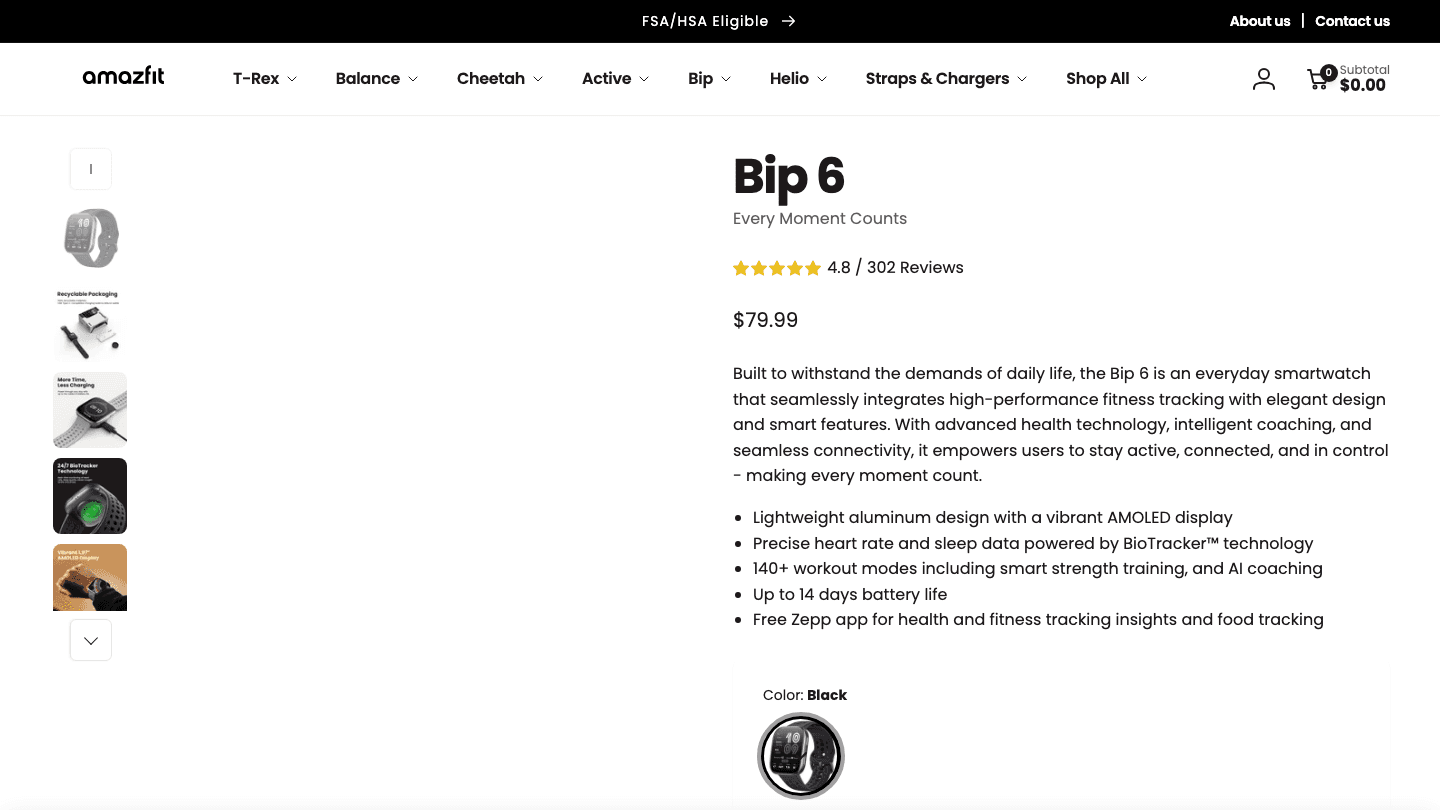
Most budget smartwatches are budget smartwatches. You get a basic step counter, a mediocre display, and a handful of health metrics that feel more like marketing checkboxes than useful data. The Amazfit Bip 6 is an exception worth paying attention to. At $79.99, it ships with a 1.97-inch AMOLED display, built-in GPS with five satellite systems, Bluetooth calling, AI coaching, and a 14-day battery life. That feature set puts it in direct competition with trackers costing two or three times as much.
Amazfit sits under the Zepp Health umbrella, a spinoff from Huami that supplies wearable hardware to several major brands. The Bip line has always been their value play, and the Bip 6 is the most capable version yet. The question is whether the price compromises the experience in the areas that matter.
This review covers the display, health tracking accuracy, battery life, GPS performance, and whether the Amazfit Bip 6 is actually worth buying in 2026 or whether spending more money makes more sense.
Key Takeaways
The Bip 6 offers the best display-to-price ratio of any smartwatch under $100 in 2026
GPS accuracy and heart rate monitoring are solid for casual athletes but fall short for structured training
14-day battery life is a genuine advantage at this price point and competes with watches costing $300+
Design and Display
The Bip 6 weighs 27.9 grams without the strap. On the wrist, it sits almost invisibly. The 44mm aluminum case has a slim 10.45mm profile, and the rounded corners keep it from feeling chunky during workouts or while sleeping.
The 1.97-inch AMOLED display is genuinely impressive for this price tier. Colors are vivid, contrast is high, and the screen is readable in direct sunlight. This is not a display you have to shade with your hand to read at the gym. By comparison, LCD displays on similarly priced watches (including some Fitbits) look washed out and dim next to it.
Amazfit offers 400+ customizable watch faces plus the option to set your own photo as a background. The interface is clean, navigation is handled by side-swipe gestures and a single button, and response time is fast enough that the watch never feels sluggish.
Health Tracking
The Bip 6 runs BioTracker technology for continuous heart rate monitoring, blood oxygen levels, stress scoring, sleep analysis, and breathing rate. It measures these 24 hours a day without needing to activate a specific mode. The Zepp app displays trends over days and weeks, which is where this data becomes actionable rather than just a snapshot.
Heart rate monitoring accuracy is adequate for everyday use and moderate workouts. During high-intensity intervals, optical wrist sensors at this price point tend to lag or drift, and the Bip 6 is not an exception. For structured interval training where precise zone data matters, you are better served by a chest strap paired with a more dedicated HRV tracker or a fitness-focused watch.
Sleep tracking is a highlight. The Bip 6 records sleep onset, wake time, and light, deep, and REM cycles. The accuracy is competitive with watches at higher price points for total sleep time and stage estimation. If sleep quality is a primary reason you want a wearable, the Bip 6 makes a strong case.
GPS and Fitness Tracking
The Bip 6 has built-in GPS with five satellite systems: GPS, GLONASS, BeiDou, Galileo, and QZSS. First lock takes 10-20 seconds in open sky. Route accuracy on runs and bike rides is reliable for casual athletes tracking distance and pace. The GPS track on the Zepp app follows roads and trails accurately for most activities.
For runners looking to improve their VO2 max with serious interval training, the Bip 6 provides Zepp Coach AI training plans that adapt based on your fitness level. These plans are genuinely useful for beginners and intermediate runners who want guided progression. The 140+ sport modes cover everything from strength training with rep-counting to HYROX race mode, which is an unusual addition at this price.
Offline maps with turn-by-turn navigation are available via free map downloads. This is a feature usually reserved for premium hiking and adventure watches. For day hikes or urban exploration, it works. For off-trail navigation in remote terrain, you should still use a dedicated device.
Battery Life
Fourteen days of typical use is the headline number, and it holds up. With GPS active and continuous health monitoring, expect closer to 6-8 days. In power saver mode the battery can stretch to 26 days, which disables most continuous monitoring. Charging via USB-C takes about 90 minutes from near-empty to full. Note that the USB-C cable is not included in the box (Amazfit cites sustainability reasons), so you need to have one on hand.
For perspective: the Fitbit Inspire 3 gets about 10 days and costs $20 more. The Amazfit Active 2 gets around 10 days with GPS and costs $149. The Bip 6's battery advantage is real and meaningful for anyone who dislikes charging their watch every few days.
Smart Features
Bluetooth calling is a genuine differentiator at this price. The Bip 6 connects to your phone and lets you answer calls, dial numbers, and use the microphone on your wrist. Call quality through the watch speaker is not going to replace your phone for long conversations, but for quick calls during a run or in a situation where your phone is in a bag, it works well.
Notification mirroring displays incoming messages and alerts from any app. Quick replies work for Android users only on iOS. Voice control via Zepp Flow handles timers, settings changes, and quick dictations. The watch also supports over 50 watch complication types, cycle tracking for women, and weather displays.
The Gaps Worth Knowing
A few limitations affect how suitable the Bip 6 is for specific use cases. There is no NFC for contactless payments. No music storage means you cannot leave your phone at home on a run. Third-party app installation is not supported, so you are limited to Zepp's native app ecosystem. Samsung Health and MyFitnessPal do not integrate directly.
These are trade-offs that define a $79.99 watch. If contactless payments or third-party app support are essential, you are looking at a different product at a higher price. For users who want health tracking, GPS, and smart notifications without paying more, these gaps are entirely livable.
Pairing Your Fitness Data with Smarter Planning
The Bip 6 generates daily data on your activity, sleep, stress, and heart rate. The gap most wearable users leave unfilled is translating that data into better daily decisions. If last night's sleep was poor and your morning stress score is high, your schedule should reflect that. Lifestack is an AI planner that does exactly this.
Lifestack schedules your tasks and calendar around your energy levels, protecting high-focus windows for demanding work and shifting lighter tasks to recovery periods. For anyone building a sustainable wellness routine, having a planner that accounts for recovery is the missing link between tracking data and actually using it. Plans start at $50 per year with a 7-day free trial.
Should You Buy the Amazfit Bip 6?
Buy it if you want a full-featured smartwatch with GPS, AMOLED, and two-week battery life and do not want to spend more than $80. For casual fitness tracking, daily activity monitoring, sleep analysis, and occasional outdoor activities, the Bip 6 delivers far more than its price suggests. It is the best budget smartwatch available in 2026 without qualification.
Pass on it if you train seriously with structured intervals and need precise heart rate zones, want contactless payment, need offline music storage for phone-free runs, or require third-party app integration. In those cases, the best smartwatch for iPhone guide covers higher-tier options worth the additional investment.
Frequently Asked Questions
What is the Amazfit Bip 6 price?
The Amazfit Bip 6 retails for $79.99. It is available on the Amazfit website, Amazon, and Best Buy.
Does the Amazfit Bip 6 have GPS?
Yes. The Amazfit Bip 6 has built-in GPS with five satellite systems: GPS, GLONASS, BeiDou, Galileo, and QZSS. It does not require your phone for location tracking during workouts.
How accurate is the Amazfit Bip 6 heart rate monitor?
Accuracy is reliable for resting heart rate and moderate aerobic activity. During high-intensity intervals, some lag and deviation from chest strap readings is typical for optical wrist sensors at this price. For general fitness tracking the readings are sufficient. For serious training zone work, a dedicated chest strap is more precise.
Does the Amazfit Bip 6 work with iPhone?
Yes. The Bip 6 works with both iOS and Android via the Zepp app. Bluetooth calling and health sync work on both platforms. Quick reply to messages is Android-only.
Is the Amazfit Bip 6 waterproof?
The Bip 6 is rated 5 ATM, meaning it can handle swimming in pools and shallow open water. It is not suitable for diving or water sports that involve high-speed water entry.
How does the Amazfit Bip 6 compare to Fitbit Inspire 3?
The Bip 6 has a larger AMOLED display, built-in GPS (the Inspire 3 requires your phone for GPS), Bluetooth calling, and a longer 14-day battery compared to the Inspire 3's 10 days. The Fitbit Inspire 3 edges it on the depth of its sleep analysis and the integration with the Google Health ecosystem if you already use Fitbit devices. At $79.99 versus $99, the Bip 6 offers more hardware for less money.
Most budget smartwatches are budget smartwatches. You get a basic step counter, a mediocre display, and a handful of health metrics that feel more like marketing checkboxes than useful data. The Amazfit Bip 6 is an exception worth paying attention to. At $79.99, it ships with a 1.97-inch AMOLED display, built-in GPS with five satellite systems, Bluetooth calling, AI coaching, and a 14-day battery life. That feature set puts it in direct competition with trackers costing two or three times as much.
Amazfit sits under the Zepp Health umbrella, a spinoff from Huami that supplies wearable hardware to several major brands. The Bip line has always been their value play, and the Bip 6 is the most capable version yet. The question is whether the price compromises the experience in the areas that matter.
This review covers the display, health tracking accuracy, battery life, GPS performance, and whether the Amazfit Bip 6 is actually worth buying in 2026 or whether spending more money makes more sense.
Key Takeaways
The Bip 6 offers the best display-to-price ratio of any smartwatch under $100 in 2026
GPS accuracy and heart rate monitoring are solid for casual athletes but fall short for structured training
14-day battery life is a genuine advantage at this price point and competes with watches costing $300+
Design and Display
The Bip 6 weighs 27.9 grams without the strap. On the wrist, it sits almost invisibly. The 44mm aluminum case has a slim 10.45mm profile, and the rounded corners keep it from feeling chunky during workouts or while sleeping.
The 1.97-inch AMOLED display is genuinely impressive for this price tier. Colors are vivid, contrast is high, and the screen is readable in direct sunlight. This is not a display you have to shade with your hand to read at the gym. By comparison, LCD displays on similarly priced watches (including some Fitbits) look washed out and dim next to it.
Amazfit offers 400+ customizable watch faces plus the option to set your own photo as a background. The interface is clean, navigation is handled by side-swipe gestures and a single button, and response time is fast enough that the watch never feels sluggish.
Health Tracking
The Bip 6 runs BioTracker technology for continuous heart rate monitoring, blood oxygen levels, stress scoring, sleep analysis, and breathing rate. It measures these 24 hours a day without needing to activate a specific mode. The Zepp app displays trends over days and weeks, which is where this data becomes actionable rather than just a snapshot.
Heart rate monitoring accuracy is adequate for everyday use and moderate workouts. During high-intensity intervals, optical wrist sensors at this price point tend to lag or drift, and the Bip 6 is not an exception. For structured interval training where precise zone data matters, you are better served by a chest strap paired with a more dedicated HRV tracker or a fitness-focused watch.
Sleep tracking is a highlight. The Bip 6 records sleep onset, wake time, and light, deep, and REM cycles. The accuracy is competitive with watches at higher price points for total sleep time and stage estimation. If sleep quality is a primary reason you want a wearable, the Bip 6 makes a strong case.
GPS and Fitness Tracking
The Bip 6 has built-in GPS with five satellite systems: GPS, GLONASS, BeiDou, Galileo, and QZSS. First lock takes 10-20 seconds in open sky. Route accuracy on runs and bike rides is reliable for casual athletes tracking distance and pace. The GPS track on the Zepp app follows roads and trails accurately for most activities.
For runners looking to improve their VO2 max with serious interval training, the Bip 6 provides Zepp Coach AI training plans that adapt based on your fitness level. These plans are genuinely useful for beginners and intermediate runners who want guided progression. The 140+ sport modes cover everything from strength training with rep-counting to HYROX race mode, which is an unusual addition at this price.
Offline maps with turn-by-turn navigation are available via free map downloads. This is a feature usually reserved for premium hiking and adventure watches. For day hikes or urban exploration, it works. For off-trail navigation in remote terrain, you should still use a dedicated device.
Battery Life
Fourteen days of typical use is the headline number, and it holds up. With GPS active and continuous health monitoring, expect closer to 6-8 days. In power saver mode the battery can stretch to 26 days, which disables most continuous monitoring. Charging via USB-C takes about 90 minutes from near-empty to full. Note that the USB-C cable is not included in the box (Amazfit cites sustainability reasons), so you need to have one on hand.
For perspective: the Fitbit Inspire 3 gets about 10 days and costs $20 more. The Amazfit Active 2 gets around 10 days with GPS and costs $149. The Bip 6's battery advantage is real and meaningful for anyone who dislikes charging their watch every few days.
Smart Features
Bluetooth calling is a genuine differentiator at this price. The Bip 6 connects to your phone and lets you answer calls, dial numbers, and use the microphone on your wrist. Call quality through the watch speaker is not going to replace your phone for long conversations, but for quick calls during a run or in a situation where your phone is in a bag, it works well.
Notification mirroring displays incoming messages and alerts from any app. Quick replies work for Android users only on iOS. Voice control via Zepp Flow handles timers, settings changes, and quick dictations. The watch also supports over 50 watch complication types, cycle tracking for women, and weather displays.
The Gaps Worth Knowing
A few limitations affect how suitable the Bip 6 is for specific use cases. There is no NFC for contactless payments. No music storage means you cannot leave your phone at home on a run. Third-party app installation is not supported, so you are limited to Zepp's native app ecosystem. Samsung Health and MyFitnessPal do not integrate directly.
These are trade-offs that define a $79.99 watch. If contactless payments or third-party app support are essential, you are looking at a different product at a higher price. For users who want health tracking, GPS, and smart notifications without paying more, these gaps are entirely livable.
Pairing Your Fitness Data with Smarter Planning
The Bip 6 generates daily data on your activity, sleep, stress, and heart rate. The gap most wearable users leave unfilled is translating that data into better daily decisions. If last night's sleep was poor and your morning stress score is high, your schedule should reflect that. Lifestack is an AI planner that does exactly this.
Lifestack schedules your tasks and calendar around your energy levels, protecting high-focus windows for demanding work and shifting lighter tasks to recovery periods. For anyone building a sustainable wellness routine, having a planner that accounts for recovery is the missing link between tracking data and actually using it. Plans start at $50 per year with a 7-day free trial.
Should You Buy the Amazfit Bip 6?
Buy it if you want a full-featured smartwatch with GPS, AMOLED, and two-week battery life and do not want to spend more than $80. For casual fitness tracking, daily activity monitoring, sleep analysis, and occasional outdoor activities, the Bip 6 delivers far more than its price suggests. It is the best budget smartwatch available in 2026 without qualification.
Pass on it if you train seriously with structured intervals and need precise heart rate zones, want contactless payment, need offline music storage for phone-free runs, or require third-party app integration. In those cases, the best smartwatch for iPhone guide covers higher-tier options worth the additional investment.
Frequently Asked Questions
What is the Amazfit Bip 6 price?
The Amazfit Bip 6 retails for $79.99. It is available on the Amazfit website, Amazon, and Best Buy.
Does the Amazfit Bip 6 have GPS?
Yes. The Amazfit Bip 6 has built-in GPS with five satellite systems: GPS, GLONASS, BeiDou, Galileo, and QZSS. It does not require your phone for location tracking during workouts.
How accurate is the Amazfit Bip 6 heart rate monitor?
Accuracy is reliable for resting heart rate and moderate aerobic activity. During high-intensity intervals, some lag and deviation from chest strap readings is typical for optical wrist sensors at this price. For general fitness tracking the readings are sufficient. For serious training zone work, a dedicated chest strap is more precise.
Does the Amazfit Bip 6 work with iPhone?
Yes. The Bip 6 works with both iOS and Android via the Zepp app. Bluetooth calling and health sync work on both platforms. Quick reply to messages is Android-only.
Is the Amazfit Bip 6 waterproof?
The Bip 6 is rated 5 ATM, meaning it can handle swimming in pools and shallow open water. It is not suitable for diving or water sports that involve high-speed water entry.
How does the Amazfit Bip 6 compare to Fitbit Inspire 3?
The Bip 6 has a larger AMOLED display, built-in GPS (the Inspire 3 requires your phone for GPS), Bluetooth calling, and a longer 14-day battery compared to the Inspire 3's 10 days. The Fitbit Inspire 3 edges it on the depth of its sleep analysis and the integration with the Google Health ecosystem if you already use Fitbit devices. At $79.99 versus $99, the Bip 6 offers more hardware for less money.



FOLLOW ON
FOLLOW ON
FOLLOW ON


Copyright 2026 © Lifestack. All rights reserved
Copyright 2026 © Lifestack. All rights reserved

