
Device
Amazfit Active 2 Review: Is It Worth It?
Amazfit Active 2 Review: Is It Worth It?

The Amazfit Active 2 is one of the few smartwatches that makes you check the price twice. A 1.32-inch AMOLED display, GPS, HRV tracking, 160-plus sports modes, and up to 10 days of battery life at $99.99 is the kind of spec sheet that should cost $250. For casual athletes and fitness beginners, it is one of the easiest buying decisions in the wearables market right now.
This review covers the standard model ($99.99) and the premium version ($129.99), which adds ECG and blood glucose trend monitoring. Both share the same hardware and software platform.
Key Takeaways
The AMOLED display is genuinely bright at 2,000 nits, readable outdoors even in direct sunlight.
Sleep and HRV tracking are solid for the price, though the Zepp app trails Garmin and COROS for actionable analytics.
At $99.99, the standard model is the best entry point in wearables. At $129.99, the premium ECG features face tougher competition.
Specs at a Glance
Price: $99.99 (standard) / $129.99 (premium)
Display: 1.32-inch AMOLED, 466x466 px, 2,000 nits brightness
Battery: 10 days standard use, 16 days basic watch mode, 22 hours GPS
GPS: Built-in multi-system GPS
Sensors: Optical HR, SpO2, skin temperature, altitude, HRV, accelerometer
Premium-only sensors: ECG, blood glucose trend
Sports modes: 160+
Water resistance: 5 ATM
App: Zepp (iOS and Android)
Design and Display
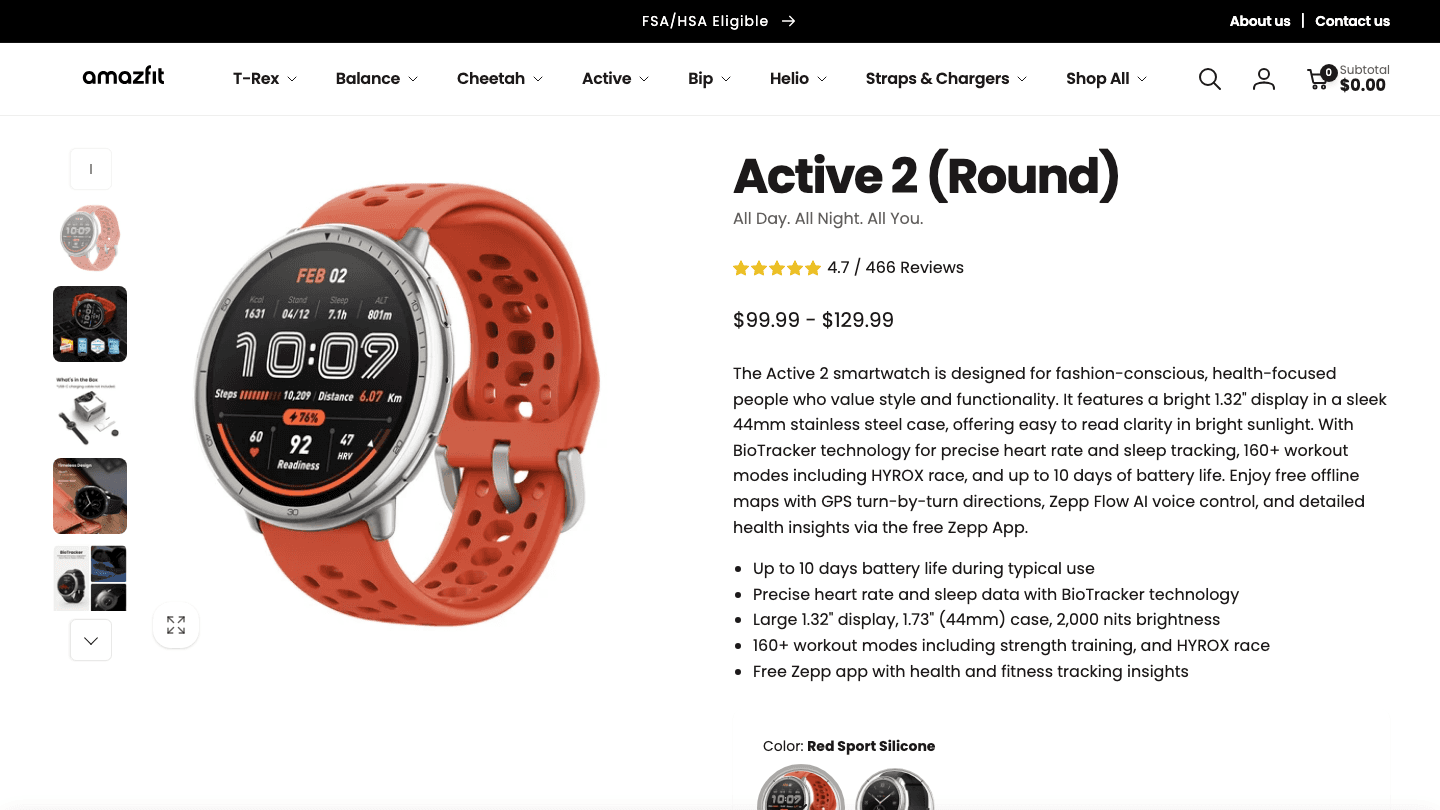
The Active 2 Round sits at 44mm, weighs 33 grams without the band, and sits flat enough on the wrist that it disappears under a long sleeve. The chassis is aluminum, the glass is treated for scratch resistance, and the build feels more expensive than the price suggests. The silicone bands swap quickly, and third-party 20mm bands fit.
The AMOLED panel is the headline. At 2,000 nits, it competes with watches that cost three times as much. Text is sharp, color is rich, and it reads clearly jogging in afternoon sun. Compared to the MIP screens found on comparably priced COROS models, the Active 2 is no contest for daily wear aesthetics.
Always-On Display is available and drains battery by about 30 percent, bringing 10-day life down to roughly 7 days. Most users will leave it off unless they have a specific need.
GPS and Activity Tracking
Built-in GPS locks on quickly and tracks well on open roads. The accuracy gap between single-frequency GPS (what most budget watches use) and dual-frequency GPS (what pricier hardware uses) shows up most on trail runs and in urban canyons. The Active 2 uses single-frequency GPS, so distance on technical trails can drift 3 to 8 percent from actual.
For road runners and cyclists, the tracking is accurate enough. For trail runners who want clean route data under tree canopy, it is worth considering whether the $99 price point justifies some accuracy trade-offs or whether stepping up to a dual-frequency device makes more sense for your training.
The 160-plus sport modes include running, cycling, swimming, strength training, yoga, HIIT, and a long tail of niche activities. Auto-detection handles common workouts reliably. Swim tracking supports both pool and open water, which is above average for the price tier.
Health and Sleep Tracking
Continuous heart rate monitoring runs 24/7 and feeds into the Zepp app's daily health score. SpO2 and skin temperature measurements run automatically during sleep. The data quality is on par with Fitbit's mid-range offerings and better than most sub-$100 alternatives.
Sleep tracking records duration, stages (awake, REM, light, deep), and a sleep score. The stage detection is good at identifying fragmented sleep nights versus consolidated ones. It does not reach the granularity of dedicated sleep devices like Oura, but it is meaningfully more useful than "you slept 7 hours."
HRV is measured nightly and reported in the Zepp app. For HRV-aware training, the trend data is usable but the app does not give you explicit recovery guidance the way COROS EvoLab or Garmin's body battery does. You get the number; you have to interpret it yourself or use a companion app to act on it.
ECG and Blood Glucose (Premium Model)
The $129.99 premium model adds ECG recording and blood glucose trend monitoring. The ECG requires you to hold two fingers on the bezel for 30 seconds and generates a reading you can share with your doctor. It is FDA-cleared for detecting atrial fibrillation.
The blood glucose monitoring is optical, not a finger stick. It estimates glucose trends rather than providing clinical-grade readings. For casual awareness of how meals and activity affect your glucose response, it is interesting data. It is not a replacement for a continuous glucose monitor for people managing diabetes or pre-diabetes conditions.
At the $30 price difference, the premium tier makes sense for anyone over 40 or with a specific interest in cardiovascular health monitoring. For general fitness tracking, the standard model covers everything you need.
Battery Life
Ten days of standard use is the number Amazfit advertises, and it holds up with moderate GPS use and Always-On Display off. With daily GPS workouts of 45 to 60 minutes, real-world battery lands closer to 7 to 8 days. That is still better than most AMOLED watches at this price, where 3 to 5 days is typical.
Charging from zero to full takes about 65 minutes via the magnetic cable. The cable is proprietary, so losing it requires an Amazfit replacement rather than any USB-C cable.
The Zepp App
Zepp is Amazfit's companion app and it is functional without being exceptional. The main dashboard shows sleep score, daily activity, heart rate trends, and training history. Data syncs to Apple Health and Google Fit, making it compatible with third-party analysis tools.
Zepp Coach offers AI-generated training plans for running and cycling, which is a nice addition at this price but produces fairly generic plans without the calibration depth of TrainingPeaks or Garmin Coach. For runners building up to a first 5K or 10K, it is adequate. For anyone following a structured training block, you will want to pair the watch data with a dedicated coaching platform.
Plan Training Around Your Energy, Not Just Your Calendar

The Amazfit Active 2 captures your health data. Making good decisions with it is a separate challenge. Your recovery score goes up or down based on sleep, HRV, and training load, but if your schedule ignores those signals, the data does not translate into better outcomes.
Lifestack fills that gap. Its energy-based scheduling maps your tasks and workouts to the windows when you are genuinely ready to perform. For athletes tracking HRV trends, this means hard training sessions land on high-readiness days and recovery work fills the low-energy windows, rather than fitting workouts wherever the calendar has a gap.
The combination of Amazfit Active 2 for health tracking and Lifestack for scheduling gives you a feedback loop between your body data and your actual day. Lifestack starts at $7/month or $50/year, with a 7-day free trial on the annual plan.
How It Compares
Against the Garmin Forerunner 165 at $249, the Active 2 loses on GPS accuracy, training analytics depth, and Garmin's ecosystem, but wins on price and display brightness. The Forerunner 165 is the better running watch. The Active 2 is the better all-day smartwatch for someone who is not a dedicated athlete.
Against the Fitbit Charge 6 at $159, the Active 2 wins on display, sports modes, and price while trailing on Google ecosystem integration. For anyone not invested in Google Fit or Google Health Connect, the Active 2 is the stronger buy.
For iPhone users specifically, the watch pairs cleanly with iOS and syncs to Apple Health without issues.
Who Should Buy the Amazfit Active 2?
Fitness beginners who want a capable tracker without committing to a premium price.
Casual athletes doing 3 to 5 workouts per week across mixed activities.
Daily wearers who want an AMOLED display that looks good in meetings and during workouts.
Budget-conscious buyers who want ECG monitoring at the lowest available price point.
Skip it if you need precise trail GPS, a rich training analytics platform, or offline music storage without your phone.
Frequently Asked Questions
Is the Amazfit Active 2 good for running?
Yes for road running. Built-in GPS tracks pace and distance accurately on open pavement. Trail runners who need precise distance under canopy may want a dual-frequency GPS device at a higher price point.
Does the Amazfit Active 2 work with iPhone?
Yes. The Zepp app runs on iOS and syncs data to Apple Health. Core features including GPS tracking, notifications, and health monitoring all function correctly with iPhone.
How long does the Amazfit Active 2 battery last with GPS on?
Up to 22 hours of continuous GPS use. For reference, a typical daily 1-hour GPS workout leaves roughly 95 percent of that budget each day, putting real-world battery closer to 7 to 8 days.
What is the difference between standard and premium Amazfit Active 2?
The $129.99 premium model adds ECG recording and blood glucose trend monitoring. All other hardware and software is identical. The $30 upgrade is worth it for anyone interested in cardiovascular health monitoring.
Does Amazfit Active 2 track sleep accurately?
It captures sleep stages (awake, REM, light, deep) and provides a sleep score through the Zepp app. For a full comparison of sleep tracking apps and devices, wrist-based optical tracking is generally accurate for total sleep duration and identifying fragmented nights, though stage classification can vary from clinical polysomnography.
The Amazfit Active 2 is one of the few smartwatches that makes you check the price twice. A 1.32-inch AMOLED display, GPS, HRV tracking, 160-plus sports modes, and up to 10 days of battery life at $99.99 is the kind of spec sheet that should cost $250. For casual athletes and fitness beginners, it is one of the easiest buying decisions in the wearables market right now.
This review covers the standard model ($99.99) and the premium version ($129.99), which adds ECG and blood glucose trend monitoring. Both share the same hardware and software platform.
Key Takeaways
The AMOLED display is genuinely bright at 2,000 nits, readable outdoors even in direct sunlight.
Sleep and HRV tracking are solid for the price, though the Zepp app trails Garmin and COROS for actionable analytics.
At $99.99, the standard model is the best entry point in wearables. At $129.99, the premium ECG features face tougher competition.
Specs at a Glance
Price: $99.99 (standard) / $129.99 (premium)
Display: 1.32-inch AMOLED, 466x466 px, 2,000 nits brightness
Battery: 10 days standard use, 16 days basic watch mode, 22 hours GPS
GPS: Built-in multi-system GPS
Sensors: Optical HR, SpO2, skin temperature, altitude, HRV, accelerometer
Premium-only sensors: ECG, blood glucose trend
Sports modes: 160+
Water resistance: 5 ATM
App: Zepp (iOS and Android)
Design and Display
The Active 2 Round sits at 44mm, weighs 33 grams without the band, and sits flat enough on the wrist that it disappears under a long sleeve. The chassis is aluminum, the glass is treated for scratch resistance, and the build feels more expensive than the price suggests. The silicone bands swap quickly, and third-party 20mm bands fit.
The AMOLED panel is the headline. At 2,000 nits, it competes with watches that cost three times as much. Text is sharp, color is rich, and it reads clearly jogging in afternoon sun. Compared to the MIP screens found on comparably priced COROS models, the Active 2 is no contest for daily wear aesthetics.
Always-On Display is available and drains battery by about 30 percent, bringing 10-day life down to roughly 7 days. Most users will leave it off unless they have a specific need.
GPS and Activity Tracking
Built-in GPS locks on quickly and tracks well on open roads. The accuracy gap between single-frequency GPS (what most budget watches use) and dual-frequency GPS (what pricier hardware uses) shows up most on trail runs and in urban canyons. The Active 2 uses single-frequency GPS, so distance on technical trails can drift 3 to 8 percent from actual.
For road runners and cyclists, the tracking is accurate enough. For trail runners who want clean route data under tree canopy, it is worth considering whether the $99 price point justifies some accuracy trade-offs or whether stepping up to a dual-frequency device makes more sense for your training.
The 160-plus sport modes include running, cycling, swimming, strength training, yoga, HIIT, and a long tail of niche activities. Auto-detection handles common workouts reliably. Swim tracking supports both pool and open water, which is above average for the price tier.
Health and Sleep Tracking
Continuous heart rate monitoring runs 24/7 and feeds into the Zepp app's daily health score. SpO2 and skin temperature measurements run automatically during sleep. The data quality is on par with Fitbit's mid-range offerings and better than most sub-$100 alternatives.
Sleep tracking records duration, stages (awake, REM, light, deep), and a sleep score. The stage detection is good at identifying fragmented sleep nights versus consolidated ones. It does not reach the granularity of dedicated sleep devices like Oura, but it is meaningfully more useful than "you slept 7 hours."
HRV is measured nightly and reported in the Zepp app. For HRV-aware training, the trend data is usable but the app does not give you explicit recovery guidance the way COROS EvoLab or Garmin's body battery does. You get the number; you have to interpret it yourself or use a companion app to act on it.
ECG and Blood Glucose (Premium Model)
The $129.99 premium model adds ECG recording and blood glucose trend monitoring. The ECG requires you to hold two fingers on the bezel for 30 seconds and generates a reading you can share with your doctor. It is FDA-cleared for detecting atrial fibrillation.
The blood glucose monitoring is optical, not a finger stick. It estimates glucose trends rather than providing clinical-grade readings. For casual awareness of how meals and activity affect your glucose response, it is interesting data. It is not a replacement for a continuous glucose monitor for people managing diabetes or pre-diabetes conditions.
At the $30 price difference, the premium tier makes sense for anyone over 40 or with a specific interest in cardiovascular health monitoring. For general fitness tracking, the standard model covers everything you need.
Battery Life
Ten days of standard use is the number Amazfit advertises, and it holds up with moderate GPS use and Always-On Display off. With daily GPS workouts of 45 to 60 minutes, real-world battery lands closer to 7 to 8 days. That is still better than most AMOLED watches at this price, where 3 to 5 days is typical.
Charging from zero to full takes about 65 minutes via the magnetic cable. The cable is proprietary, so losing it requires an Amazfit replacement rather than any USB-C cable.
The Zepp App
Zepp is Amazfit's companion app and it is functional without being exceptional. The main dashboard shows sleep score, daily activity, heart rate trends, and training history. Data syncs to Apple Health and Google Fit, making it compatible with third-party analysis tools.
Zepp Coach offers AI-generated training plans for running and cycling, which is a nice addition at this price but produces fairly generic plans without the calibration depth of TrainingPeaks or Garmin Coach. For runners building up to a first 5K or 10K, it is adequate. For anyone following a structured training block, you will want to pair the watch data with a dedicated coaching platform.
Plan Training Around Your Energy, Not Just Your Calendar
The Amazfit Active 2 captures your health data. Making good decisions with it is a separate challenge. Your recovery score goes up or down based on sleep, HRV, and training load, but if your schedule ignores those signals, the data does not translate into better outcomes.
Lifestack fills that gap. Its energy-based scheduling maps your tasks and workouts to the windows when you are genuinely ready to perform. For athletes tracking HRV trends, this means hard training sessions land on high-readiness days and recovery work fills the low-energy windows, rather than fitting workouts wherever the calendar has a gap.
The combination of Amazfit Active 2 for health tracking and Lifestack for scheduling gives you a feedback loop between your body data and your actual day. Lifestack starts at $7/month or $50/year, with a 7-day free trial on the annual plan.
How It Compares
Against the Garmin Forerunner 165 at $249, the Active 2 loses on GPS accuracy, training analytics depth, and Garmin's ecosystem, but wins on price and display brightness. The Forerunner 165 is the better running watch. The Active 2 is the better all-day smartwatch for someone who is not a dedicated athlete.
Against the Fitbit Charge 6 at $159, the Active 2 wins on display, sports modes, and price while trailing on Google ecosystem integration. For anyone not invested in Google Fit or Google Health Connect, the Active 2 is the stronger buy.
For iPhone users specifically, the watch pairs cleanly with iOS and syncs to Apple Health without issues.
Who Should Buy the Amazfit Active 2?
Fitness beginners who want a capable tracker without committing to a premium price.
Casual athletes doing 3 to 5 workouts per week across mixed activities.
Daily wearers who want an AMOLED display that looks good in meetings and during workouts.
Budget-conscious buyers who want ECG monitoring at the lowest available price point.
Skip it if you need precise trail GPS, a rich training analytics platform, or offline music storage without your phone.
Frequently Asked Questions
Is the Amazfit Active 2 good for running?
Yes for road running. Built-in GPS tracks pace and distance accurately on open pavement. Trail runners who need precise distance under canopy may want a dual-frequency GPS device at a higher price point.
Does the Amazfit Active 2 work with iPhone?
Yes. The Zepp app runs on iOS and syncs data to Apple Health. Core features including GPS tracking, notifications, and health monitoring all function correctly with iPhone.
How long does the Amazfit Active 2 battery last with GPS on?
Up to 22 hours of continuous GPS use. For reference, a typical daily 1-hour GPS workout leaves roughly 95 percent of that budget each day, putting real-world battery closer to 7 to 8 days.
What is the difference between standard and premium Amazfit Active 2?
The $129.99 premium model adds ECG recording and blood glucose trend monitoring. All other hardware and software is identical. The $30 upgrade is worth it for anyone interested in cardiovascular health monitoring.
Does Amazfit Active 2 track sleep accurately?
It captures sleep stages (awake, REM, light, deep) and provides a sleep score through the Zepp app. For a full comparison of sleep tracking apps and devices, wrist-based optical tracking is generally accurate for total sleep duration and identifying fragmented nights, though stage classification can vary from clinical polysomnography.



FOLLOW ON
FOLLOW ON
FOLLOW ON


Copyright 2026 © Lifestack. All rights reserved
Copyright 2026 © Lifestack. All rights reserved

