
App
Best Fitness Trackers for Athletes (2026)
Best Fitness Trackers for Athletes (2026)

Serious athletes need more than step counts. The trackers that actually improve performance give you recovery data, training load, GPS accuracy, and enough battery life to track long workouts without worrying. This list covers the six best fitness trackers for athletes in 2026, ranked by how much they help you train smarter, not just track more data.
All prices verified from official product pages as of November 2026.
Key Takeaways
The best fitness tracker for athletes is the one you'll actually use daily; raw data means nothing if it doesn't change your training decisions
Energy-aware scheduling (automatically blocking hard sessions during low-recovery windows) is the most underutilized performance tool in most athletes' arsenals
Hardware alone doesn't optimize training; pairing your tracker with a scheduling layer like Lifestack is what turns data into decisions
How We Evaluated These Trackers
Training load tracking and recovery scoring quality
GPS accuracy and battery in GPS mode
HRV and sleep monitoring depth
Subscription vs one-time cost model
Integration with coaching and scheduling tools
1. Lifestack
Best for: Athletes who want their training schedule to adapt to their recovery data automatically.
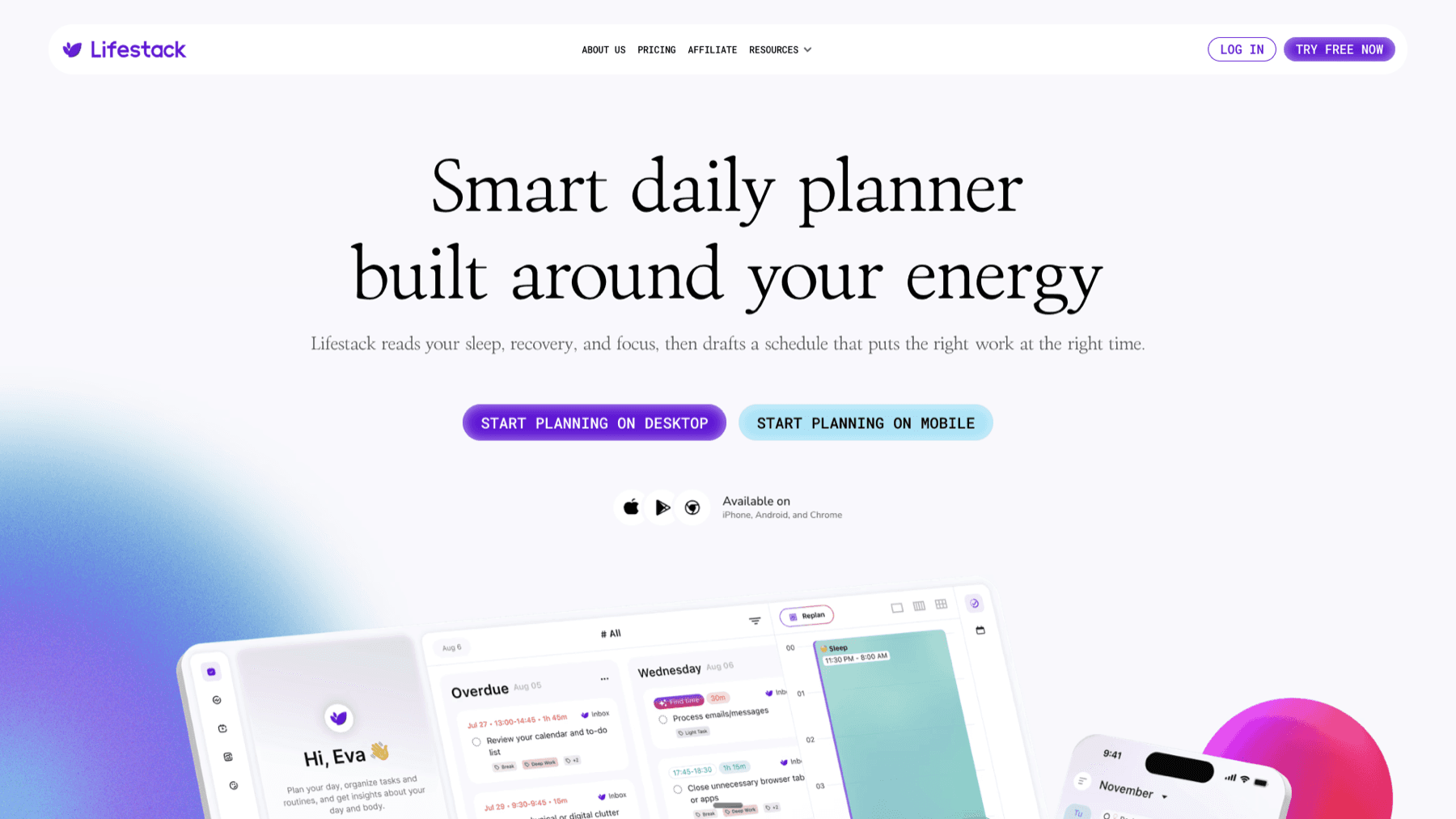
Lifestack is not a wearable. It's the layer that sits between your fitness tracker and your calendar, turning recovery scores and HRV data into an automatically optimized schedule. When your Oura Ring, Apple Watch, WHOOP, Garmin, or COROS reports low recovery overnight, Lifestack reschedules your demanding training sessions and cognitive work to windows when your body is actually ready for them. When you're recovered and rested, it front-loads the hard work before your day fills with meetings.
Most athletes have good data. The challenge is acting on it consistently when real life gets in the way. Lifestack removes the daily calculation: you don't decide when to place your interval session, your strength block, or your deep work. The system reads your readiness and places them for you. This is energy-aware scheduling applied to athletic performance, not just productivity.
Key features: Wearable integration (Oura, Apple Watch, WHOOP, Garmin, COROS), energy-aware task and calendar scheduling, HRV-based recovery-to-schedule mapping
What Works: Turns tracker data into actionable schedule changes without manual intervention; works across all major wearable ecosystems; available on iOS, Android, and Chrome extension
Limitations: Not a wearable; requires a paired tracker to function at full capability
Pricing: $9.99/month or $49.99/year. 7-day free trial on the annual plan. No lifetime cost ceiling.
Best for: Any athlete who already wears a fitness tracker and wants their actual schedule to reflect their recovery status.
2. WHOOP 5.0
Best for: Athletes who want the most sophisticated recovery coaching available from a subscription-based band.
WHOOP 5.0 is the recovery coaching tool most committed athletes use as their primary performance signal. Its Strain and Recovery scores are built specifically for athletic performance: strain quantifies how hard your cardiovascular system worked across all activity during the day; recovery quantifies how well you've bounced back overnight. The daily recommendations tell you exactly how much strain your body can handle today.
The 5.0's new Healthspan metric tracks physiological age across sleep efficiency, cardiovascular fitness, and stress resilience over time. The WHOOP Life tier adds the WHOOP MG hardware with ECG and daily blood pressure estimates. See our full WHOOP comparison for how it stacks against alternatives.
Key features: Daily Recovery and Strain scores, 14-day battery, IP68, Healthspan metric, coaching recommendations
What Works: Best recovery coaching loop of any tracker; 14-day battery removes charging friction
Limitations: Subscription-only ($199-$359/year); no GPS; no screen
Pricing: $199/year (WHOOP One), $239/year (Peak), $359/year (Life with WHOOP MG).
Best for: Athletes who want daily coaching on effort and recovery and are willing to pay a recurring subscription for it.
3. Garmin Forerunner 965
Best for: Serious runners and triathletes who need advanced GPS metrics without paying flagship watch prices.

Garmin's Forerunner 965 is the gold standard GPS running watch for competitive athletes who don't need an expedition-grade device. It tracks training load, training status, body battery, sleep, HRV, race predictors, and recovery time across running, cycling, swimming, and 30+ additional sport profiles. The maps are turn-by-turn. The GPS is dual-frequency for precision in dense urban environments. Battery lasts up to 31 days in smartwatch mode, 31 hours in GPS mode.
Garmin's Training Readiness score is one of the most sophisticated single metrics in consumer fitness, combining sleep quality, HRV, training load history, and body battery into one number. For runners training with structured plans, Garmin Coach provides adaptive training plans that adjust based on your actual performance. No subscription required. See our full Garmin watch comparison for how it fits in the lineup.
Key features: Training Readiness, 31h GPS battery, dual-frequency GPS, triathlon mode, Garmin Coach, no subscription
What Works: Best GPS accuracy; deepest running metrics; no subscription; extensive sport profiles
Limitations: No energy-aware scheduling; $500+ price point
Pricing: ~$499-529 (prices have dropped from the original $599 MSRP).
Best for: Competitive runners and triathletes who want the deepest training metrics available from a GPS watch.
4. Apple Watch Series 12 (GPS + Cellular)
Best for: Athletes deeply embedded in the Apple ecosystem who want all-day health monitoring with smartwatch convenience.

Apple Watch Series 12 covers ECG, blood oxygen, temperature sensing, crash detection, and dual-frequency GPS in a 42mm or 46mm case with AMOLED display. For athletes specifically, the Series 12's Health Sensing System adds continuous monitoring of biomarkers beyond what most sport watches track. The cellular model lets you leave your phone behind during runs and still receive Emergency SOS anywhere.
Apple Fitness+ provides guided workout classes with real-time metrics. For sleep and recovery, the watch tracks HRV alongside sleep stages. The limitation for serious athletes is that Garmin and COROS provide deeper running metrics (ground contact time, stride length, vertical oscillation) and significantly longer GPS battery life. See our Apple Watch GPS vs Cellular comparison for configuration decisions.
Key features: ECG, SpO2, temperature, crash detection, dual-frequency GPS, cellular option, Apple Fitness+
What Works: Best all-around smartwatch for health breadth; best iPhone integration; large app ecosystem
Limitations: 18-hour GPS battery; weaker advanced running metrics vs Garmin/COROS
Pricing: GPS from $399 (42mm aluminum), GPS+Cellular from $449.
Best for: iPhone-centric athletes who want health tracking plus smartwatch features in one device.
5. COROS Pace 4
Best for: Runners and triathletes who want excellent GPS performance at a price that doesn't require a second thought.

COROS Pace 4 delivers competitive GPS accuracy, 41 hours of GPS battery, and a full suite of training metrics at $249. For athletes who don't need ECG, music storage, or a large display, it's the best-value GPS running watch available. The 32g weight (nylon band) is lighter than any competitor at the same feature level. It includes a barometric altimeter, 3D compass, thermometer, and dual-frequency GPS. No subscription required.
The training metrics cover training load, recovery time, fitness trend, race predictors, and all running dynamics. For trail runners specifically, the compass and thermometer add genuine utility over the WHOOP 5.0 and Apple Watch. See our detailed COROS Pace 4 vs Pace Pro comparison if you're weighing the upgrade.
Key features: 41h GPS battery, 32g, dual-frequency GPS, compass, thermometer, no subscription
What Works: Best value GPS running watch; lightest in class; trail-ready sensors
Limitations: No music storage; no ECG; no ANT+
Pricing: $249 (standard nylon), $279 (aluminum).
Best for: Budget-conscious runners who want serious GPS performance without paying for features they won't use.
6. Polar Loop
Best for: Athletes who want 24/7 health monitoring with no subscription and no screen distraction.
Polar Loop is a screenless fitness band that tracks sleep, recovery, activity, and training load at $199.99 one-time, with no ongoing fees. All Polar Flow features are included from day one, including Sleep Plus Stages, Nightly Recharge (HRV-based recovery score), and Training Load Pro. At 29 grams and 8-day battery life, it's light enough to wear around the clock without noticing it.
For athletes who already use a GPS watch for workouts but want dedicated 24/7 recovery monitoring without paying WHOOP's annual subscription, the Polar Loop is the best alternative. It doesn't have WHOOP's coaching depth, but over three years the total cost difference is over $400. See our Polar Loop vs WHOOP comparison for the full breakdown.
Key features: Sleep Plus Stages, Nightly Recharge, Training Load Pro, no subscription, 8-day battery
What Works: No subscription; solid recovery metrics; lightweight for 24/7 wear
Limitations: No GPS; shorter battery than WHOOP; no coaching recommendations
Pricing: $199.99 one-time. No subscription.
Best for: Athletes who want continuous recovery monitoring without a recurring fee.
Which Fitness Tracker Is Right for You?
You want your schedule to adapt to your recovery: Lifestack. Pairs with any tracker below.
You want the best recovery coaching: WHOOP 5.0, if you'll actively engage with the coaching. Polar Loop if you want similar recovery data without the subscription.
You're a competitive runner or triathlete: Garmin Forerunner 965 for GPS depth, or COROS Pace 4 for lightweight budget performance.
You're on the Apple ecosystem and want everything in one device: Apple Watch Series 12.
You want the best value GPS watch: COROS Pace 4.
For more context on HRV monitoring specifically, see our guide to the best HRV trackers for athletes.
Frequently Asked Questions
What is the best fitness tracker for serious athletes?
The best combination for serious athletes is a hardware tracker (Garmin Forerunner 965, WHOOP 5.0, or COROS Pace 4 depending on your sport) paired with Lifestack to automatically schedule training around your recovery data. Hardware alone gives you data; Lifestack turns that data into an optimized schedule.
Is WHOOP worth it for athletes?
Yes, if you actively use the daily coaching recommendations. WHOOP's Strain and Recovery scores are genuinely useful for training periodization. If you just want the data without paying annually, the Polar Loop provides similar overnight recovery metrics at a one-time price. See our Polar Loop vs WHOOP comparison for the cost-benefit breakdown.
Can you use Apple Watch for serious athletic training?
Yes, with caveats. Apple Watch Series 12 covers health monitoring well and handles most workout types. For serious runners and triathletes, the GPS battery (18 hours) is insufficient for long events, and the advanced running dynamics (ground contact time, stride length, vertical oscillation) available on Garmin aren't present on Apple Watch. For multi-sport athletes who need their watch for daily life and workouts, Apple Watch is a reasonable all-rounder.
Which fitness tracker has the best HRV tracking?
WHOOP 5.0 and Garmin Forerunner 965 both provide high-quality overnight HRV monitoring. Polar's Nightly Recharge metric is also based on HRV and performs well in independent testing. For a detailed comparison, see our guide on the best HRV trackers.
Do fitness trackers actually improve athletic performance?
Only when you act on the data. Trackers that measure recovery but don't change your training behavior provide no performance benefit. The most effective use pattern is using recovery scores to modulate training intensity day-to-day: pushing harder on high-recovery days, pulling back on low-recovery days. Tools like Lifestack automate this scheduling layer so you don't have to decide manually each morning.
Serious athletes need more than step counts. The trackers that actually improve performance give you recovery data, training load, GPS accuracy, and enough battery life to track long workouts without worrying. This list covers the six best fitness trackers for athletes in 2026, ranked by how much they help you train smarter, not just track more data.
All prices verified from official product pages as of November 2026.
Key Takeaways
The best fitness tracker for athletes is the one you'll actually use daily; raw data means nothing if it doesn't change your training decisions
Energy-aware scheduling (automatically blocking hard sessions during low-recovery windows) is the most underutilized performance tool in most athletes' arsenals
Hardware alone doesn't optimize training; pairing your tracker with a scheduling layer like Lifestack is what turns data into decisions
How We Evaluated These Trackers
Training load tracking and recovery scoring quality
GPS accuracy and battery in GPS mode
HRV and sleep monitoring depth
Subscription vs one-time cost model
Integration with coaching and scheduling tools
1. Lifestack
Best for: Athletes who want their training schedule to adapt to their recovery data automatically.
Lifestack is not a wearable. It's the layer that sits between your fitness tracker and your calendar, turning recovery scores and HRV data into an automatically optimized schedule. When your Oura Ring, Apple Watch, WHOOP, Garmin, or COROS reports low recovery overnight, Lifestack reschedules your demanding training sessions and cognitive work to windows when your body is actually ready for them. When you're recovered and rested, it front-loads the hard work before your day fills with meetings.
Most athletes have good data. The challenge is acting on it consistently when real life gets in the way. Lifestack removes the daily calculation: you don't decide when to place your interval session, your strength block, or your deep work. The system reads your readiness and places them for you. This is energy-aware scheduling applied to athletic performance, not just productivity.
Key features: Wearable integration (Oura, Apple Watch, WHOOP, Garmin, COROS), energy-aware task and calendar scheduling, HRV-based recovery-to-schedule mapping
What Works: Turns tracker data into actionable schedule changes without manual intervention; works across all major wearable ecosystems; available on iOS, Android, and Chrome extension
Limitations: Not a wearable; requires a paired tracker to function at full capability
Pricing: $9.99/month or $49.99/year. 7-day free trial on the annual plan. No lifetime cost ceiling.
Best for: Any athlete who already wears a fitness tracker and wants their actual schedule to reflect their recovery status.
2. WHOOP 5.0
Best for: Athletes who want the most sophisticated recovery coaching available from a subscription-based band.
WHOOP 5.0 is the recovery coaching tool most committed athletes use as their primary performance signal. Its Strain and Recovery scores are built specifically for athletic performance: strain quantifies how hard your cardiovascular system worked across all activity during the day; recovery quantifies how well you've bounced back overnight. The daily recommendations tell you exactly how much strain your body can handle today.
The 5.0's new Healthspan metric tracks physiological age across sleep efficiency, cardiovascular fitness, and stress resilience over time. The WHOOP Life tier adds the WHOOP MG hardware with ECG and daily blood pressure estimates. See our full WHOOP comparison for how it stacks against alternatives.
Key features: Daily Recovery and Strain scores, 14-day battery, IP68, Healthspan metric, coaching recommendations
What Works: Best recovery coaching loop of any tracker; 14-day battery removes charging friction
Limitations: Subscription-only ($199-$359/year); no GPS; no screen
Pricing: $199/year (WHOOP One), $239/year (Peak), $359/year (Life with WHOOP MG).
Best for: Athletes who want daily coaching on effort and recovery and are willing to pay a recurring subscription for it.
3. Garmin Forerunner 965
Best for: Serious runners and triathletes who need advanced GPS metrics without paying flagship watch prices.
Garmin's Forerunner 965 is the gold standard GPS running watch for competitive athletes who don't need an expedition-grade device. It tracks training load, training status, body battery, sleep, HRV, race predictors, and recovery time across running, cycling, swimming, and 30+ additional sport profiles. The maps are turn-by-turn. The GPS is dual-frequency for precision in dense urban environments. Battery lasts up to 31 days in smartwatch mode, 31 hours in GPS mode.
Garmin's Training Readiness score is one of the most sophisticated single metrics in consumer fitness, combining sleep quality, HRV, training load history, and body battery into one number. For runners training with structured plans, Garmin Coach provides adaptive training plans that adjust based on your actual performance. No subscription required. See our full Garmin watch comparison for how it fits in the lineup.
Key features: Training Readiness, 31h GPS battery, dual-frequency GPS, triathlon mode, Garmin Coach, no subscription
What Works: Best GPS accuracy; deepest running metrics; no subscription; extensive sport profiles
Limitations: No energy-aware scheduling; $500+ price point
Pricing: ~$499-529 (prices have dropped from the original $599 MSRP).
Best for: Competitive runners and triathletes who want the deepest training metrics available from a GPS watch.
4. Apple Watch Series 12 (GPS + Cellular)
Best for: Athletes deeply embedded in the Apple ecosystem who want all-day health monitoring with smartwatch convenience.
Apple Watch Series 12 covers ECG, blood oxygen, temperature sensing, crash detection, and dual-frequency GPS in a 42mm or 46mm case with AMOLED display. For athletes specifically, the Series 12's Health Sensing System adds continuous monitoring of biomarkers beyond what most sport watches track. The cellular model lets you leave your phone behind during runs and still receive Emergency SOS anywhere.
Apple Fitness+ provides guided workout classes with real-time metrics. For sleep and recovery, the watch tracks HRV alongside sleep stages. The limitation for serious athletes is that Garmin and COROS provide deeper running metrics (ground contact time, stride length, vertical oscillation) and significantly longer GPS battery life. See our Apple Watch GPS vs Cellular comparison for configuration decisions.
Key features: ECG, SpO2, temperature, crash detection, dual-frequency GPS, cellular option, Apple Fitness+
What Works: Best all-around smartwatch for health breadth; best iPhone integration; large app ecosystem
Limitations: 18-hour GPS battery; weaker advanced running metrics vs Garmin/COROS
Pricing: GPS from $399 (42mm aluminum), GPS+Cellular from $449.
Best for: iPhone-centric athletes who want health tracking plus smartwatch features in one device.
5. COROS Pace 4
Best for: Runners and triathletes who want excellent GPS performance at a price that doesn't require a second thought.
COROS Pace 4 delivers competitive GPS accuracy, 41 hours of GPS battery, and a full suite of training metrics at $249. For athletes who don't need ECG, music storage, or a large display, it's the best-value GPS running watch available. The 32g weight (nylon band) is lighter than any competitor at the same feature level. It includes a barometric altimeter, 3D compass, thermometer, and dual-frequency GPS. No subscription required.
The training metrics cover training load, recovery time, fitness trend, race predictors, and all running dynamics. For trail runners specifically, the compass and thermometer add genuine utility over the WHOOP 5.0 and Apple Watch. See our detailed COROS Pace 4 vs Pace Pro comparison if you're weighing the upgrade.
Key features: 41h GPS battery, 32g, dual-frequency GPS, compass, thermometer, no subscription
What Works: Best value GPS running watch; lightest in class; trail-ready sensors
Limitations: No music storage; no ECG; no ANT+
Pricing: $249 (standard nylon), $279 (aluminum).
Best for: Budget-conscious runners who want serious GPS performance without paying for features they won't use.
6. Polar Loop
Best for: Athletes who want 24/7 health monitoring with no subscription and no screen distraction.
Polar Loop is a screenless fitness band that tracks sleep, recovery, activity, and training load at $199.99 one-time, with no ongoing fees. All Polar Flow features are included from day one, including Sleep Plus Stages, Nightly Recharge (HRV-based recovery score), and Training Load Pro. At 29 grams and 8-day battery life, it's light enough to wear around the clock without noticing it.
For athletes who already use a GPS watch for workouts but want dedicated 24/7 recovery monitoring without paying WHOOP's annual subscription, the Polar Loop is the best alternative. It doesn't have WHOOP's coaching depth, but over three years the total cost difference is over $400. See our Polar Loop vs WHOOP comparison for the full breakdown.
Key features: Sleep Plus Stages, Nightly Recharge, Training Load Pro, no subscription, 8-day battery
What Works: No subscription; solid recovery metrics; lightweight for 24/7 wear
Limitations: No GPS; shorter battery than WHOOP; no coaching recommendations
Pricing: $199.99 one-time. No subscription.
Best for: Athletes who want continuous recovery monitoring without a recurring fee.
Which Fitness Tracker Is Right for You?
You want your schedule to adapt to your recovery: Lifestack. Pairs with any tracker below.
You want the best recovery coaching: WHOOP 5.0, if you'll actively engage with the coaching. Polar Loop if you want similar recovery data without the subscription.
You're a competitive runner or triathlete: Garmin Forerunner 965 for GPS depth, or COROS Pace 4 for lightweight budget performance.
You're on the Apple ecosystem and want everything in one device: Apple Watch Series 12.
You want the best value GPS watch: COROS Pace 4.
For more context on HRV monitoring specifically, see our guide to the best HRV trackers for athletes.
Frequently Asked Questions
What is the best fitness tracker for serious athletes?
The best combination for serious athletes is a hardware tracker (Garmin Forerunner 965, WHOOP 5.0, or COROS Pace 4 depending on your sport) paired with Lifestack to automatically schedule training around your recovery data. Hardware alone gives you data; Lifestack turns that data into an optimized schedule.
Is WHOOP worth it for athletes?
Yes, if you actively use the daily coaching recommendations. WHOOP's Strain and Recovery scores are genuinely useful for training periodization. If you just want the data without paying annually, the Polar Loop provides similar overnight recovery metrics at a one-time price. See our Polar Loop vs WHOOP comparison for the cost-benefit breakdown.
Can you use Apple Watch for serious athletic training?
Yes, with caveats. Apple Watch Series 12 covers health monitoring well and handles most workout types. For serious runners and triathletes, the GPS battery (18 hours) is insufficient for long events, and the advanced running dynamics (ground contact time, stride length, vertical oscillation) available on Garmin aren't present on Apple Watch. For multi-sport athletes who need their watch for daily life and workouts, Apple Watch is a reasonable all-rounder.
Which fitness tracker has the best HRV tracking?
WHOOP 5.0 and Garmin Forerunner 965 both provide high-quality overnight HRV monitoring. Polar's Nightly Recharge metric is also based on HRV and performs well in independent testing. For a detailed comparison, see our guide on the best HRV trackers.
Do fitness trackers actually improve athletic performance?
Only when you act on the data. Trackers that measure recovery but don't change your training behavior provide no performance benefit. The most effective use pattern is using recovery scores to modulate training intensity day-to-day: pushing harder on high-recovery days, pulling back on low-recovery days. Tools like Lifestack automate this scheduling layer so you don't have to decide manually each morning.



FOLLOW ON
FOLLOW ON
FOLLOW ON



Copyright 2026 © Lifestack. All rights reserved
Copyright 2026 © Lifestack. All rights reserved

