
Tips
Cognitive Biases List: 12 Common Biases Explained
Cognitive Biases List: 12 Common Biases Explained

Cognitive biases are not character flaws or signs of low intelligence. They are systematic patterns in how human brains process information - shortcuts that evolved because they worked well enough in most situations, and that cause predictable errors when applied to the wrong contexts. Understanding them is useful because the biases don't disappear once you name them, but knowing they exist helps you design better decision environments and catch specific patterns before they cost you.
This list covers 12 of the most common cognitive biases, with real-world examples of each and practical notes on how they show up in planning, decision-making, and daily work.
Key Takeaways
Cognitive biases are systematic thinking errors that affect everyone, including experts. Awareness alone doesn't prevent them, but it creates opportunities to add checks and external structure.
Many of the most costly biases - sunk cost fallacy, status quo bias, optimism bias - directly affect planning and productivity decisions, not just high-stakes choices.
The most effective countermeasures involve structural changes (checklists, external accountability, separating information gathering from decision-making) rather than trying to think harder.
What Are Cognitive Biases?
A cognitive bias is a systematic error in thinking that deviates from rationality or good judgment. The word "systematic" is important - these are not random mistakes that vary unpredictably from person to person. They are predictable patterns that show up consistently across individuals and situations.
They arise primarily from the brain's need to process large amounts of information quickly with limited resources. Rather than computing every decision from scratch, the brain uses heuristics - mental shortcuts that are fast, low-effort, and usually close enough to correct. Cognitive biases are what happens when those shortcuts misfire. Understanding them doesn't give you immunity, but it does give you the information to design better systems and ask better questions.
12 Common Cognitive Biases (With Examples)
1. Confirmation Bias
What it is: The tendency to search for, interpret, and remember information in a way that confirms what you already believe, while discounting contradictory evidence.
Example: A manager who believes a particular employee is underperforming notices every mistake they make and forgets the times they performed well. When reviewing the employee, the overall picture feels clear even though half the evidence was ignored.
Counteract it: Actively seek out the strongest version of the opposing view before making a judgment. Ask "What would have to be true for the opposite to be correct?"
2. Anchoring Bias
What it is: Relying too heavily on the first piece of information encountered when making a decision. That initial number or fact becomes a reference point (anchor) that influences all subsequent judgment, even when the anchor is arbitrary.
Example: A salary negotiation that opens at $80,000 anchors the discussion there. A counteroffer of $95,000 feels generous, even though the person might have gotten $110,000 if the first number had been different.
Counteract it: Before seeing any anchor, generate your own estimate independently. Then examine the anchor critically: is it relevant, and how was it arrived at?
3. Availability Heuristic
What it is: Judging the probability or frequency of something based on how easily examples come to mind. Events that are vivid, recent, or emotionally charged feel more common than they actually are.
Example: After news coverage of a plane crash, people dramatically overestimate the probability of dying in a plane crash and underestimate the more statistically significant risk of dying in a car on the way to the airport.
Counteract it: When assessing risk or frequency, look at base rate data rather than relying on examples you can recall. "How often does this actually happen?" is a different question from "Can I think of a case where this happened?"
4. The Dunning-Kruger Effect
What it is: People with limited knowledge or skill in a domain tend to overestimate their competence because they lack the knowledge to recognize what they don't know. Conversely, genuine experts often underestimate their own competence because they're aware of how much they still don't understand.
Example: A first-year student who has read one book on a subject often speaks with more confidence than a doctoral researcher in the same field who understands the genuine complexity and open questions.
Counteract it: Measure performance objectively rather than relying on self-assessment. Actively seek feedback from people with more domain knowledge, and be especially skeptical of high confidence in unfamiliar domains.
5. The Sunk Cost Fallacy
What it is: Continuing to invest time, money, or effort into something because of what you've already put in, rather than because of the expected future value. Past costs are sunk and cannot be recovered; they shouldn't affect forward-looking decisions.
Example: Continuing to work on a business idea that clearly isn't working because you've already spent 18 months and $40,000 on it. The 18 months and $40,000 are gone either way. The question is whether the next 18 months and $40,000 are worth it on their own merits.
Counteract it: Evaluate decisions based on future costs and benefits only. Ask: "If I were starting fresh today with no prior investment, would I choose to do this?"
6. Status Quo Bias
What it is: The preference for the current state of affairs, where any change from the baseline feels like a loss. Even when alternatives are clearly better, the inertia of the status quo exerts disproportionate influence on choices.
Example: Staying with a mediocre bank, insurance provider, or internet plan for years because switching feels like effort, even when the financial benefit of switching is objectively clear.
Counteract it: Frame the decision as "if I were choosing fresh today with no existing option, what would I choose?" Status quo options should compete on their own merits, not benefit from inertia.
7. Framing Effect
What it is: Reaching different conclusions about the same information depending on how it is presented. A choice described as "90% survival rate" produces different decisions than one described as "10% mortality rate" even though they convey identical information.
Example: Ground beef marketed as "95% lean" sells better than beef marketed as "5% fat." Same product, same nutritional profile, different purchase rates based purely on framing.
Counteract it: Reframe the information in multiple ways before deciding. If someone presents data as a gain, ask what it looks like as a loss. Check whether your response changes.
8. Fundamental Attribution Error
What it is: The tendency to attribute other people's behavior to their character or personality, while attributing your own behavior to external circumstances. When someone else is late, they're irresponsible. When you're late, you were stuck in traffic.
Example: Watching a colleague rush through a presentation and concluding they don't care about quality - without considering that they may have been dealing with a family emergency or a system failure in the hour before they went on.
Counteract it: Before judging someone's behavior, ask what situational factors might explain it. Apply the same charitable interpretation to others that you'd want applied to yourself.
9. Optimism Bias
What it is: Overestimating the probability of positive outcomes and underestimating the probability of negative ones. Most people believe they are less likely than average to experience car accidents, divorce, job loss, or illness - which is mathematically impossible across the population.
Example: Project planning that assumes everything will go roughly to schedule, without building in buffer time for the near-certain supply of unexpected complications that always materialize. The result is projects that are routinely late and over budget. For practical ways to plan more realistically, building in contingency time explicitly addresses this bias.
Counteract it: Use reference class forecasting: ask "What percentage of similar projects/decisions/initiatives succeed?" and apply that base rate to your own situation before adjusting for specific factors.
10. Recency Bias
What it is: Weighting recent events more heavily than older ones when forming judgments or making predictions. What happened last month feels more representative of underlying trends than what happened over the past decade.
Example: An investor who watched a market drop 15% last quarter becomes convinced that the long-term trend is downward, despite a 20-year record of growth. The recent experience dominates the full data set.
Counteract it: When assessing trends, deliberately look at a longer time horizon and weight the full dataset rather than letting recent events dominate. Ask: "Is the recent period actually representative?"
11. In-group Bias
What it is: Favoring members of your own group over outsiders - whether defined by nationality, company, team, profession, or any other shared identity. People tend to assign more positive attributes to in-group members and view their behavior more charitably.
Example: Evaluating a job candidate from your own university more positively than one from an unfamiliar school, holding qualifications equal. Or advocating more strongly for your team's budget than another team's equally important requests.
Counteract it: In hiring and evaluation contexts, use structured criteria applied identically across candidates. Blind review processes (where evaluators don't know group membership) significantly reduce in-group bias effects.
12. Self-serving Bias
What it is: Attributing successes to personal qualities and failures to external factors. This preserves self-esteem and self-image by ensuring credit for wins while avoiding responsibility for losses.
Example: After a successful product launch, a team credits their strategy and execution. After a failed launch, they attribute it to market conditions, timing, or competitor behavior. In both cases, the external environment played a significant role, but it only gets named when the outcome was negative.
Counteract it: After any significant outcome, conduct an honest post-mortem that attributes causes to both internal and external factors. Ask: "What did I or we actually control, and how much did that determine the result?"
How Cognitive Biases Affect Productivity and Planning
Several of the biases above show up with particular frequency in how people manage their work and time. Optimism bias causes project timelines to be systematically underestimated. Sunk cost fallacy causes people to keep working on low-value projects because they've "already invested so much." Status quo bias makes it difficult to change systems or habits that clearly aren't working. Recency bias skews how people evaluate their own performance and prioritize what to work on.
The reason these matter for planning specifically is that planning decisions compound. A biased project estimate affects not just the project but everything downstream in the schedule. Breaking bad patterns driven by these biases - like always underestimating task duration - is one of the highest-ROI improvements in how most people work. Our post on why habits are hard to change covers some of the underlying psychology, our ADHD project management guide addresses how cognitive patterns specifically affect task completion, and our ADHD productivity hacks post covers practical workarounds for common attention and decision patterns.
How to Counteract Cognitive Biases in Your Daily Planning
Awareness of cognitive biases is necessary but not sufficient. Research consistently shows that knowing about a bias does not prevent it from affecting your judgment. What does help is structural intervention: designing the decision environment so that biases are harder to act on.
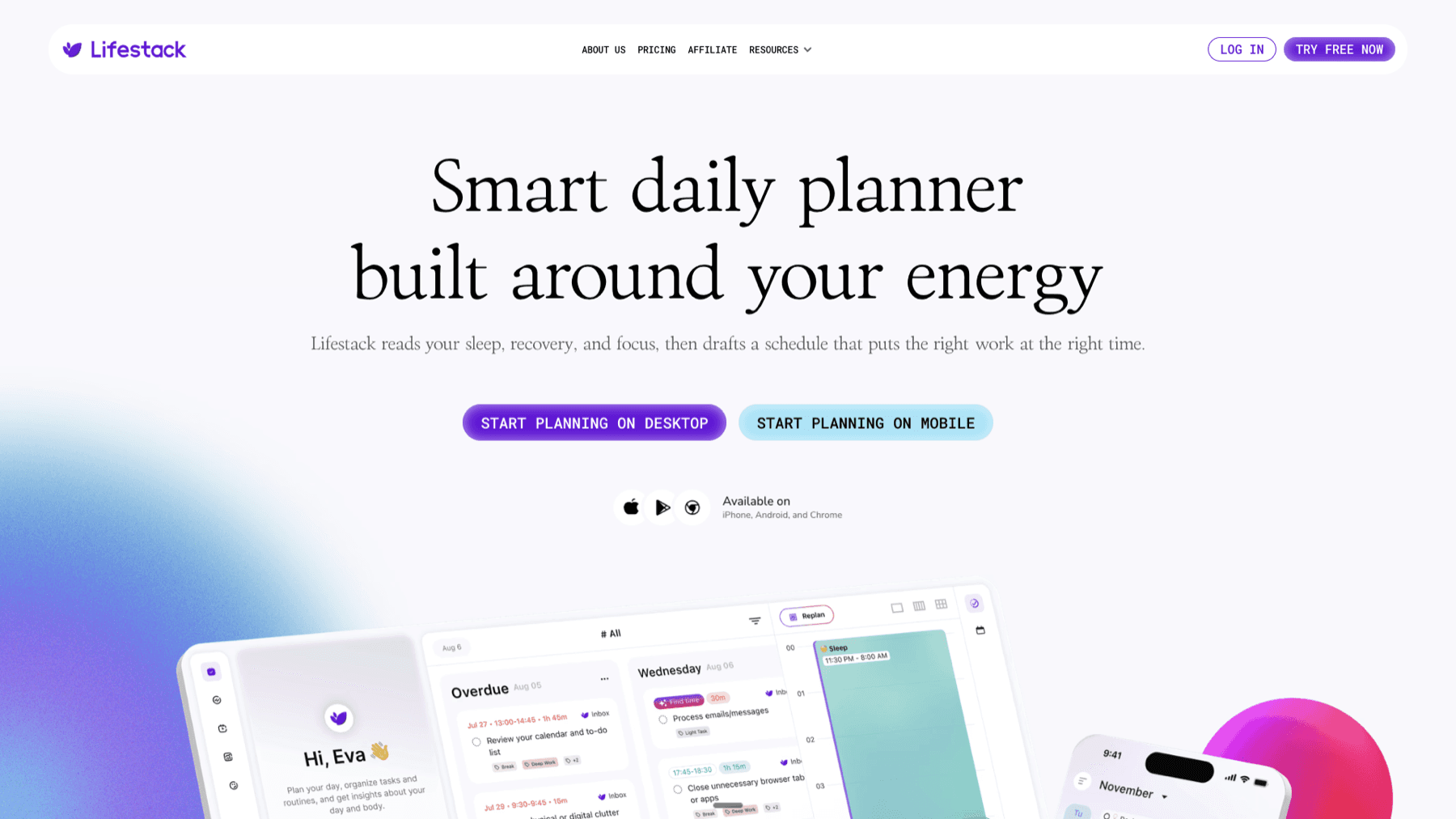
One of the most effective structural interventions for planning is to offload decision-making to an external system. Lifestack is an AI scheduler that builds your daily plan based on your tasks, calendar, and energy levels rather than on in-the-moment judgment. This helps counteract several biases at once: it prevents status quo bias from keeping the same tasks at the top of the list indefinitely, it applies realistic time estimates rather than optimistic ones, and it surfaces priorities based on importance rather than recency.
Structuring your planning externally doesn't eliminate biases, but it shifts you from relying on in-the-moment intuition (where biases are strongest) to following a system that was built with deliberation. That's also why time blocking templates reduce decision fatigue - the structure was made when you were thinking clearly, not under deadline pressure. Lifestack costs $7/month or $50/year with a 7-day free trial. It's available on iOS, Android, and Chrome.
Frequently Asked Questions
What is the most common cognitive bias?
Confirmation bias is consistently cited as one of the most widespread and impactful cognitive biases. Because it affects how we seek and interpret information, it amplifies other biases and makes them harder to correct. Optimism bias and the availability heuristic also appear across virtually all studies of human judgment.
Can cognitive biases be eliminated?
No. Cognitive biases are structural features of how human cognition works, not errors that can be debugged and removed. Awareness reduces some biases in some conditions, but the effect is modest. The most effective approach is designing systems, processes, and environments that reduce the influence of biases rather than trying to override them through willpower or attention alone.
How do cognitive biases affect decision-making?
Cognitive biases affect every stage of decision-making: which information you seek out (confirmation bias), how you weight it (anchoring, availability heuristic), what options you consider (status quo bias), how you predict outcomes (optimism bias), and how you evaluate results after the fact (self-serving bias, recency bias). Because they affect the entire pipeline, complex decisions are rarely free of multiple biases operating simultaneously.
What is the difference between a cognitive bias and a logical fallacy?
A logical fallacy is an error in the structure of an argument - a flaw in reasoning that can be identified and called out in a formal debate or analysis. A cognitive bias is a systematic pattern in how people perceive and process information, operating largely below conscious awareness. Logical fallacies involve explicit reasoning chains; cognitive biases operate in how we perceive reality before explicit reasoning begins. Both produce errors in judgment, but through different mechanisms.
Are cognitive biases good or bad?
Neither, exactly. Cognitive biases are adaptations that evolved because they worked - they allow fast, low-resource decision-making in environments where perfect information was unavailable. They become "bad" when applied outside the contexts where they're adaptive: in complex, data-rich environments with high stakes. The heuristic that helped a hunter assess prey in the wild doesn't translate to evaluating a financial investment, and that mismatch is where the harm comes from.
Cognitive biases are not character flaws or signs of low intelligence. They are systematic patterns in how human brains process information - shortcuts that evolved because they worked well enough in most situations, and that cause predictable errors when applied to the wrong contexts. Understanding them is useful because the biases don't disappear once you name them, but knowing they exist helps you design better decision environments and catch specific patterns before they cost you.
This list covers 12 of the most common cognitive biases, with real-world examples of each and practical notes on how they show up in planning, decision-making, and daily work.
Key Takeaways
Cognitive biases are systematic thinking errors that affect everyone, including experts. Awareness alone doesn't prevent them, but it creates opportunities to add checks and external structure.
Many of the most costly biases - sunk cost fallacy, status quo bias, optimism bias - directly affect planning and productivity decisions, not just high-stakes choices.
The most effective countermeasures involve structural changes (checklists, external accountability, separating information gathering from decision-making) rather than trying to think harder.
What Are Cognitive Biases?
A cognitive bias is a systematic error in thinking that deviates from rationality or good judgment. The word "systematic" is important - these are not random mistakes that vary unpredictably from person to person. They are predictable patterns that show up consistently across individuals and situations.
They arise primarily from the brain's need to process large amounts of information quickly with limited resources. Rather than computing every decision from scratch, the brain uses heuristics - mental shortcuts that are fast, low-effort, and usually close enough to correct. Cognitive biases are what happens when those shortcuts misfire. Understanding them doesn't give you immunity, but it does give you the information to design better systems and ask better questions.
12 Common Cognitive Biases (With Examples)
1. Confirmation Bias
What it is: The tendency to search for, interpret, and remember information in a way that confirms what you already believe, while discounting contradictory evidence.
Example: A manager who believes a particular employee is underperforming notices every mistake they make and forgets the times they performed well. When reviewing the employee, the overall picture feels clear even though half the evidence was ignored.
Counteract it: Actively seek out the strongest version of the opposing view before making a judgment. Ask "What would have to be true for the opposite to be correct?"
2. Anchoring Bias
What it is: Relying too heavily on the first piece of information encountered when making a decision. That initial number or fact becomes a reference point (anchor) that influences all subsequent judgment, even when the anchor is arbitrary.
Example: A salary negotiation that opens at $80,000 anchors the discussion there. A counteroffer of $95,000 feels generous, even though the person might have gotten $110,000 if the first number had been different.
Counteract it: Before seeing any anchor, generate your own estimate independently. Then examine the anchor critically: is it relevant, and how was it arrived at?
3. Availability Heuristic
What it is: Judging the probability or frequency of something based on how easily examples come to mind. Events that are vivid, recent, or emotionally charged feel more common than they actually are.
Example: After news coverage of a plane crash, people dramatically overestimate the probability of dying in a plane crash and underestimate the more statistically significant risk of dying in a car on the way to the airport.
Counteract it: When assessing risk or frequency, look at base rate data rather than relying on examples you can recall. "How often does this actually happen?" is a different question from "Can I think of a case where this happened?"
4. The Dunning-Kruger Effect
What it is: People with limited knowledge or skill in a domain tend to overestimate their competence because they lack the knowledge to recognize what they don't know. Conversely, genuine experts often underestimate their own competence because they're aware of how much they still don't understand.
Example: A first-year student who has read one book on a subject often speaks with more confidence than a doctoral researcher in the same field who understands the genuine complexity and open questions.
Counteract it: Measure performance objectively rather than relying on self-assessment. Actively seek feedback from people with more domain knowledge, and be especially skeptical of high confidence in unfamiliar domains.
5. The Sunk Cost Fallacy
What it is: Continuing to invest time, money, or effort into something because of what you've already put in, rather than because of the expected future value. Past costs are sunk and cannot be recovered; they shouldn't affect forward-looking decisions.
Example: Continuing to work on a business idea that clearly isn't working because you've already spent 18 months and $40,000 on it. The 18 months and $40,000 are gone either way. The question is whether the next 18 months and $40,000 are worth it on their own merits.
Counteract it: Evaluate decisions based on future costs and benefits only. Ask: "If I were starting fresh today with no prior investment, would I choose to do this?"
6. Status Quo Bias
What it is: The preference for the current state of affairs, where any change from the baseline feels like a loss. Even when alternatives are clearly better, the inertia of the status quo exerts disproportionate influence on choices.
Example: Staying with a mediocre bank, insurance provider, or internet plan for years because switching feels like effort, even when the financial benefit of switching is objectively clear.
Counteract it: Frame the decision as "if I were choosing fresh today with no existing option, what would I choose?" Status quo options should compete on their own merits, not benefit from inertia.
7. Framing Effect
What it is: Reaching different conclusions about the same information depending on how it is presented. A choice described as "90% survival rate" produces different decisions than one described as "10% mortality rate" even though they convey identical information.
Example: Ground beef marketed as "95% lean" sells better than beef marketed as "5% fat." Same product, same nutritional profile, different purchase rates based purely on framing.
Counteract it: Reframe the information in multiple ways before deciding. If someone presents data as a gain, ask what it looks like as a loss. Check whether your response changes.
8. Fundamental Attribution Error
What it is: The tendency to attribute other people's behavior to their character or personality, while attributing your own behavior to external circumstances. When someone else is late, they're irresponsible. When you're late, you were stuck in traffic.
Example: Watching a colleague rush through a presentation and concluding they don't care about quality - without considering that they may have been dealing with a family emergency or a system failure in the hour before they went on.
Counteract it: Before judging someone's behavior, ask what situational factors might explain it. Apply the same charitable interpretation to others that you'd want applied to yourself.
9. Optimism Bias
What it is: Overestimating the probability of positive outcomes and underestimating the probability of negative ones. Most people believe they are less likely than average to experience car accidents, divorce, job loss, or illness - which is mathematically impossible across the population.
Example: Project planning that assumes everything will go roughly to schedule, without building in buffer time for the near-certain supply of unexpected complications that always materialize. The result is projects that are routinely late and over budget. For practical ways to plan more realistically, building in contingency time explicitly addresses this bias.
Counteract it: Use reference class forecasting: ask "What percentage of similar projects/decisions/initiatives succeed?" and apply that base rate to your own situation before adjusting for specific factors.
10. Recency Bias
What it is: Weighting recent events more heavily than older ones when forming judgments or making predictions. What happened last month feels more representative of underlying trends than what happened over the past decade.
Example: An investor who watched a market drop 15% last quarter becomes convinced that the long-term trend is downward, despite a 20-year record of growth. The recent experience dominates the full data set.
Counteract it: When assessing trends, deliberately look at a longer time horizon and weight the full dataset rather than letting recent events dominate. Ask: "Is the recent period actually representative?"
11. In-group Bias
What it is: Favoring members of your own group over outsiders - whether defined by nationality, company, team, profession, or any other shared identity. People tend to assign more positive attributes to in-group members and view their behavior more charitably.
Example: Evaluating a job candidate from your own university more positively than one from an unfamiliar school, holding qualifications equal. Or advocating more strongly for your team's budget than another team's equally important requests.
Counteract it: In hiring and evaluation contexts, use structured criteria applied identically across candidates. Blind review processes (where evaluators don't know group membership) significantly reduce in-group bias effects.
12. Self-serving Bias
What it is: Attributing successes to personal qualities and failures to external factors. This preserves self-esteem and self-image by ensuring credit for wins while avoiding responsibility for losses.
Example: After a successful product launch, a team credits their strategy and execution. After a failed launch, they attribute it to market conditions, timing, or competitor behavior. In both cases, the external environment played a significant role, but it only gets named when the outcome was negative.
Counteract it: After any significant outcome, conduct an honest post-mortem that attributes causes to both internal and external factors. Ask: "What did I or we actually control, and how much did that determine the result?"
How Cognitive Biases Affect Productivity and Planning
Several of the biases above show up with particular frequency in how people manage their work and time. Optimism bias causes project timelines to be systematically underestimated. Sunk cost fallacy causes people to keep working on low-value projects because they've "already invested so much." Status quo bias makes it difficult to change systems or habits that clearly aren't working. Recency bias skews how people evaluate their own performance and prioritize what to work on.
The reason these matter for planning specifically is that planning decisions compound. A biased project estimate affects not just the project but everything downstream in the schedule. Breaking bad patterns driven by these biases - like always underestimating task duration - is one of the highest-ROI improvements in how most people work. Our post on why habits are hard to change covers some of the underlying psychology, our ADHD project management guide addresses how cognitive patterns specifically affect task completion, and our ADHD productivity hacks post covers practical workarounds for common attention and decision patterns.
How to Counteract Cognitive Biases in Your Daily Planning
Awareness of cognitive biases is necessary but not sufficient. Research consistently shows that knowing about a bias does not prevent it from affecting your judgment. What does help is structural intervention: designing the decision environment so that biases are harder to act on.
One of the most effective structural interventions for planning is to offload decision-making to an external system. Lifestack is an AI scheduler that builds your daily plan based on your tasks, calendar, and energy levels rather than on in-the-moment judgment. This helps counteract several biases at once: it prevents status quo bias from keeping the same tasks at the top of the list indefinitely, it applies realistic time estimates rather than optimistic ones, and it surfaces priorities based on importance rather than recency.
Structuring your planning externally doesn't eliminate biases, but it shifts you from relying on in-the-moment intuition (where biases are strongest) to following a system that was built with deliberation. That's also why time blocking templates reduce decision fatigue - the structure was made when you were thinking clearly, not under deadline pressure. Lifestack costs $7/month or $50/year with a 7-day free trial. It's available on iOS, Android, and Chrome.
Frequently Asked Questions
What is the most common cognitive bias?
Confirmation bias is consistently cited as one of the most widespread and impactful cognitive biases. Because it affects how we seek and interpret information, it amplifies other biases and makes them harder to correct. Optimism bias and the availability heuristic also appear across virtually all studies of human judgment.
Can cognitive biases be eliminated?
No. Cognitive biases are structural features of how human cognition works, not errors that can be debugged and removed. Awareness reduces some biases in some conditions, but the effect is modest. The most effective approach is designing systems, processes, and environments that reduce the influence of biases rather than trying to override them through willpower or attention alone.
How do cognitive biases affect decision-making?
Cognitive biases affect every stage of decision-making: which information you seek out (confirmation bias), how you weight it (anchoring, availability heuristic), what options you consider (status quo bias), how you predict outcomes (optimism bias), and how you evaluate results after the fact (self-serving bias, recency bias). Because they affect the entire pipeline, complex decisions are rarely free of multiple biases operating simultaneously.
What is the difference between a cognitive bias and a logical fallacy?
A logical fallacy is an error in the structure of an argument - a flaw in reasoning that can be identified and called out in a formal debate or analysis. A cognitive bias is a systematic pattern in how people perceive and process information, operating largely below conscious awareness. Logical fallacies involve explicit reasoning chains; cognitive biases operate in how we perceive reality before explicit reasoning begins. Both produce errors in judgment, but through different mechanisms.
Are cognitive biases good or bad?
Neither, exactly. Cognitive biases are adaptations that evolved because they worked - they allow fast, low-resource decision-making in environments where perfect information was unavailable. They become "bad" when applied outside the contexts where they're adaptive: in complex, data-rich environments with high stakes. The heuristic that helped a hunter assess prey in the wild doesn't translate to evaluating a financial investment, and that mismatch is where the harm comes from.



FOLLOW ON
FOLLOW ON
FOLLOW ON


Copyright 2026 © Lifestack. All rights reserved
Copyright 2026 © Lifestack. All rights reserved

