
Tips
Time Blocking Template: How to Build and Use One
Time Blocking Template: How to Build and Use One

Most people know they should plan their days. Fewer people actually do it, because the blank calendar is intimidating and deciding what goes where takes more mental energy than the planning itself is supposed to save. A time blocking template solves this by giving you a reusable structure you only have to think through once.
This guide explains how time blocking works, walks through building a template that fits your schedule, and provides a ready-to-use weekly version you can copy. It also covers the rules that make time blocking actually work and when an AI scheduling tool is worth using instead.
Key Takeaways
A time blocking template is a reusable weekly schedule where each block is pre-assigned a type of work - deep focus, meetings, admin, recovery. You fill in specifics each week, not structure.
The most important rules are: schedule your hardest work first, reserve buffer blocks between sessions, and never fill more than 60-70% of your calendar.
AI scheduling tools like Lifestack can build and adjust your time blocks automatically, factoring in your energy levels so you don't have to manually place every task.
What Is Time Blocking?
Time blocking is a scheduling method where you assign specific blocks of time to specific types of work, rather than working from a to-do list and deciding in the moment what to tackle next. Each block has a defined start time, end time, and purpose. You protect those windows and treat them like meetings you cannot skip.
Cal Newport, who popularized the phrase in academic productivity circles, argues that to-do lists fail because they don't account for when work will actually happen. Time blocking forces that decision to be made during planning, when you're thinking clearly, rather than mid-day when you're already depleted and prone to doing whatever feels easiest.
It works for the same reason that meal prepping works: front-loading decisions reduces the moment-by-moment friction of choosing what to do next. The cost is the planning time itself, which is why a template is essential. You should not need to reinvent your schedule every Monday morning. See our guide on how to plan effectively for the broader framework that makes scheduling decisions easier.
How to Build Your Time Blocking Template
Step 1: Identify Your Block Types
Before you assign any times, define the categories of work in your life. Most people have four to six types:
Deep work - the cognitively demanding work that moves the needle: writing, coding, designing, strategic thinking
Meetings and calls - any synchronous communication
Admin - email, Slack, scheduling, expense reports, anything reactive
Recovery - lunch, breaks, transitions between contexts
Learning - reading, courses, research (optional, depends on your role)
Buffer - unassigned time that absorbs overruns and surprises
Step 2: Know Your Peak Hours
Most people have 2 to 4 hours of peak cognitive performance per day. For the majority, this is in the late morning. For genuine night owls, it shifts later. Your template should place deep work in your peak window, not in whatever time is leftover after meetings get scheduled. If you let meetings colonize your mornings, you'll be doing your most important work when your focus is at its lowest.
Step 3: Set Recurring Blocks
Some blocks should be identical every week: team standups, 1:1s, focus time. Place these in the template as fixed anchors. Variable tasks get dropped into the appropriate block type each Sunday when you plan the week. You're choosing the slot type now; you'll choose the specific task later.
Step 4: Leave 30-40% Unblocked
The biggest mistake in time blocking is overscheduling. Blocking every hour sounds productive but creates a system that collapses at the first unexpected interruption. Reserve at least 30% of your work hours as buffer or open time. Things always take longer than planned, and you need room for the unexpected without derailing the entire day.
A Simple Weekly Time Blocking Template
This is a starting-point template for a standard Monday to Friday work schedule. Adjust times to match your actual peak hours and meeting patterns. The specific tasks inside each block change weekly; the block types and times stay fixed.
Monday
8:00 - 9:00 AM: Weekly planning: review goals, fill in specific tasks for the week's blocks
9:00 - 11:30 AM: Deep work block (your hardest or most important project)
11:30 - 12:00 PM: Buffer / overflow
12:00 - 1:00 PM: Lunch and recovery
1:00 - 3:00 PM: Meetings (batch these in the afternoon)
3:00 - 4:30 PM: Admin: email, Slack, scheduling
4:30 - 5:00 PM: Daily shutdown: review tomorrow, capture loose ends
Tuesday - Thursday
8:00 - 9:00 AM: Admin: process email and messages from overnight
9:00 - 12:00 PM: Deep work block (guard this aggressively)
12:00 - 1:00 PM: Lunch and recovery
1:00 - 3:00 PM: Meetings, calls, collaboration
3:00 - 4:00 PM: Secondary deep work or project continuation
4:00 - 4:30 PM: Buffer / reactive tasks
4:30 - 5:00 PM: Daily shutdown
Friday
9:00 - 11:00 AM: Finishing work: complete anything open, wrap up projects
11:00 - 12:00 PM: Learning block: reading, courses, or reflection
12:00 - 1:00 PM: Lunch
1:00 - 3:00 PM: Admin catch-up and email zero
3:00 - 4:30 PM: Weekly review: what worked, what didn't, what's on next week
4:30 - 5:00 PM: Shutdown
Copy this structure, adjust the times to match your peak hours, and drop your specific recurring meetings into the appropriate slots. Then each Sunday, decide which tasks go inside each block for the coming week. The template does not change; the content inside changes weekly.
Rules That Make Time Blocking Actually Work
Time blocking fails when people treat it as a rigid script rather than a flexible structure. Three rules prevent the most common breakdowns:
Block types, not tasks, in the template
Your template should say "deep work block," not "write the Q3 report." Specific tasks change weekly. Block types don't. This is why the template can be reused without rebuilding.
Protect the deep work block
Everything in your calendar is negotiable except the deep work block. Meetings that could be email should be email. Meetings that must happen should be batched away from deep work windows. If you let meetings scatter through the morning, you will never have sustained focus time. For related strategies, see our post on work focusing tools and desktop productivity setups that protect concentration.
Use the shutdown ritual
A daily 15-minute shutdown captures loose ends, confirms tomorrow's blocks are set, and signals to your brain that work is done. Without it, cognitive residue bleeds into evenings and weekends. Cal Newport calls this "plan shutdown complete" - a literal verbal declaration that work is closed. It sounds slightly absurd but it works. Combined with good project management habits, it prevents the anxiety of "did I forget something" that follows incomplete closure.
The Smarter Alternative: Let AI Do the Blocking
The friction of manually managing a time blocking template every week is real. You have to decide where each task goes, estimate how long it will take, move blocks when meetings change, and re-plan when something runs over. This works well once you have the habit, but many people find it adds cognitive load rather than removing it.
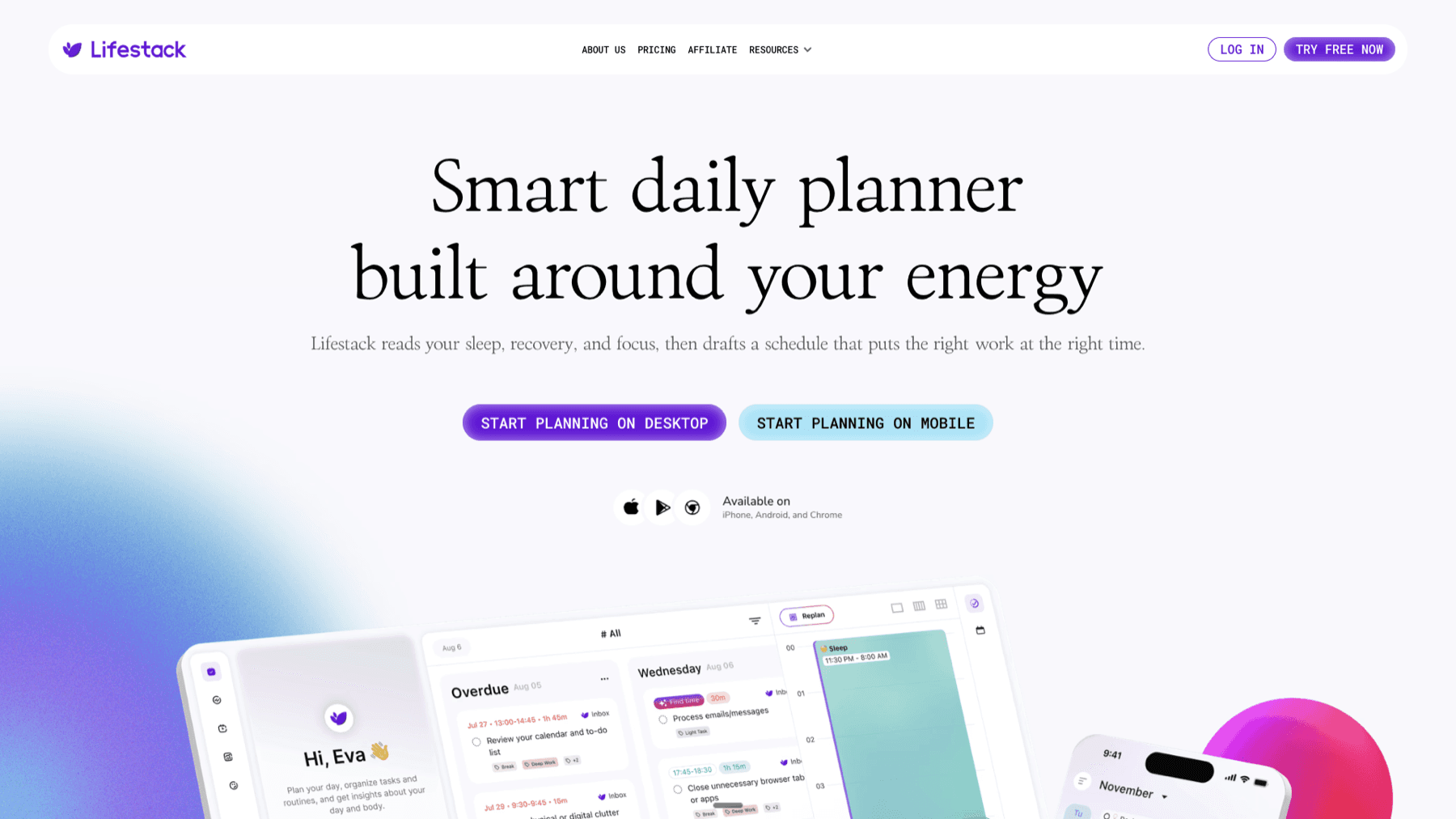
Lifestack is an AI-powered scheduler that builds and adjusts your time blocks automatically. It syncs your tasks and calendar, asks how you're feeling at the start of each day, and places work in the schedule based on your energy levels and task priorities. Deep work lands when your energy is high. Admin fills the lower-energy windows. You don't need to manually build a template or decide where each task goes.
The difference from a manual template is that Lifestack adjusts daily, not weekly. If a meeting runs long, it moves what comes next. If you're low-energy today, it front-loads lighter tasks. A static template can't do this. For teams and individuals who want the benefits of time blocking without rebuilding the schedule each week, Lifestack handles the structure automatically.
It costs $7/month or $50/year, with a 7-day free trial on the annual plan. It works on iOS, Android, and as a Chrome extension. You can see how it compares to other time optimization tools in a standalone post, or check our broader guide to planning your days effectively.
Frequently Asked Questions
How long should a time block be?
Deep work blocks are most effective at 90 minutes to 3 hours. Admin and meeting blocks work at 30 to 60 minutes. Buffer blocks are typically 15 to 30 minutes. Avoid blocks shorter than 25 minutes for any real work - the ramp-up time to get into focus eats too much of the block.
What if my schedule changes mid-week?
A schedule change means moving blocks, not abandoning them. If a meeting gets added to your deep work window, find another deep work slot. The goal is protecting the total hours of focused work per week, even if the specific slots shift. If you are constantly moving blocks, your meeting culture is the real problem to solve.
Is time blocking good for ADHD?
Time blocking can work well for ADHD when it includes external cues (timers, alarms) and shorter blocks (60 minutes rather than 3 hours). The structure reduces the decision load that commonly causes paralysis. The downside is that rigid blocks can create anxiety when transitions don't happen naturally. Flexible AI schedulers that adjust automatically tend to be more forgiving than static templates for ADHD users. See our post on ADHD project management for more tailored strategies.
Can I use a time blocking template in Google Calendar?
Yes. Create recurring calendar events for each block type in your template - "Deep Work," "Admin," "Buffer" - and set them to repeat weekly. Color-code by block type for visual clarity. Each Sunday, add specific tasks inside those event descriptions for the week ahead. Google Calendar does not reorder blocks automatically based on your energy, which is the main limitation of a manual approach.
How is time blocking different from a to-do list?
A to-do list tells you what to do. A time blocking template tells you when to do it. The to-do list leaves open when each task happens; you decide in the moment, which is when you're most susceptible to doing easy tasks instead of important ones. Time blocking forces that decision during planning, when you can see the full week and make deliberate choices about priority order.
Most people know they should plan their days. Fewer people actually do it, because the blank calendar is intimidating and deciding what goes where takes more mental energy than the planning itself is supposed to save. A time blocking template solves this by giving you a reusable structure you only have to think through once.
This guide explains how time blocking works, walks through building a template that fits your schedule, and provides a ready-to-use weekly version you can copy. It also covers the rules that make time blocking actually work and when an AI scheduling tool is worth using instead.
Key Takeaways
A time blocking template is a reusable weekly schedule where each block is pre-assigned a type of work - deep focus, meetings, admin, recovery. You fill in specifics each week, not structure.
The most important rules are: schedule your hardest work first, reserve buffer blocks between sessions, and never fill more than 60-70% of your calendar.
AI scheduling tools like Lifestack can build and adjust your time blocks automatically, factoring in your energy levels so you don't have to manually place every task.
What Is Time Blocking?
Time blocking is a scheduling method where you assign specific blocks of time to specific types of work, rather than working from a to-do list and deciding in the moment what to tackle next. Each block has a defined start time, end time, and purpose. You protect those windows and treat them like meetings you cannot skip.
Cal Newport, who popularized the phrase in academic productivity circles, argues that to-do lists fail because they don't account for when work will actually happen. Time blocking forces that decision to be made during planning, when you're thinking clearly, rather than mid-day when you're already depleted and prone to doing whatever feels easiest.
It works for the same reason that meal prepping works: front-loading decisions reduces the moment-by-moment friction of choosing what to do next. The cost is the planning time itself, which is why a template is essential. You should not need to reinvent your schedule every Monday morning. See our guide on how to plan effectively for the broader framework that makes scheduling decisions easier.
How to Build Your Time Blocking Template
Step 1: Identify Your Block Types
Before you assign any times, define the categories of work in your life. Most people have four to six types:
Deep work - the cognitively demanding work that moves the needle: writing, coding, designing, strategic thinking
Meetings and calls - any synchronous communication
Admin - email, Slack, scheduling, expense reports, anything reactive
Recovery - lunch, breaks, transitions between contexts
Learning - reading, courses, research (optional, depends on your role)
Buffer - unassigned time that absorbs overruns and surprises
Step 2: Know Your Peak Hours
Most people have 2 to 4 hours of peak cognitive performance per day. For the majority, this is in the late morning. For genuine night owls, it shifts later. Your template should place deep work in your peak window, not in whatever time is leftover after meetings get scheduled. If you let meetings colonize your mornings, you'll be doing your most important work when your focus is at its lowest.
Step 3: Set Recurring Blocks
Some blocks should be identical every week: team standups, 1:1s, focus time. Place these in the template as fixed anchors. Variable tasks get dropped into the appropriate block type each Sunday when you plan the week. You're choosing the slot type now; you'll choose the specific task later.
Step 4: Leave 30-40% Unblocked
The biggest mistake in time blocking is overscheduling. Blocking every hour sounds productive but creates a system that collapses at the first unexpected interruption. Reserve at least 30% of your work hours as buffer or open time. Things always take longer than planned, and you need room for the unexpected without derailing the entire day.
A Simple Weekly Time Blocking Template
This is a starting-point template for a standard Monday to Friday work schedule. Adjust times to match your actual peak hours and meeting patterns. The specific tasks inside each block change weekly; the block types and times stay fixed.
Monday
8:00 - 9:00 AM: Weekly planning: review goals, fill in specific tasks for the week's blocks
9:00 - 11:30 AM: Deep work block (your hardest or most important project)
11:30 - 12:00 PM: Buffer / overflow
12:00 - 1:00 PM: Lunch and recovery
1:00 - 3:00 PM: Meetings (batch these in the afternoon)
3:00 - 4:30 PM: Admin: email, Slack, scheduling
4:30 - 5:00 PM: Daily shutdown: review tomorrow, capture loose ends
Tuesday - Thursday
8:00 - 9:00 AM: Admin: process email and messages from overnight
9:00 - 12:00 PM: Deep work block (guard this aggressively)
12:00 - 1:00 PM: Lunch and recovery
1:00 - 3:00 PM: Meetings, calls, collaboration
3:00 - 4:00 PM: Secondary deep work or project continuation
4:00 - 4:30 PM: Buffer / reactive tasks
4:30 - 5:00 PM: Daily shutdown
Friday
9:00 - 11:00 AM: Finishing work: complete anything open, wrap up projects
11:00 - 12:00 PM: Learning block: reading, courses, or reflection
12:00 - 1:00 PM: Lunch
1:00 - 3:00 PM: Admin catch-up and email zero
3:00 - 4:30 PM: Weekly review: what worked, what didn't, what's on next week
4:30 - 5:00 PM: Shutdown
Copy this structure, adjust the times to match your peak hours, and drop your specific recurring meetings into the appropriate slots. Then each Sunday, decide which tasks go inside each block for the coming week. The template does not change; the content inside changes weekly.
Rules That Make Time Blocking Actually Work
Time blocking fails when people treat it as a rigid script rather than a flexible structure. Three rules prevent the most common breakdowns:
Block types, not tasks, in the template
Your template should say "deep work block," not "write the Q3 report." Specific tasks change weekly. Block types don't. This is why the template can be reused without rebuilding.
Protect the deep work block
Everything in your calendar is negotiable except the deep work block. Meetings that could be email should be email. Meetings that must happen should be batched away from deep work windows. If you let meetings scatter through the morning, you will never have sustained focus time. For related strategies, see our post on work focusing tools and desktop productivity setups that protect concentration.
Use the shutdown ritual
A daily 15-minute shutdown captures loose ends, confirms tomorrow's blocks are set, and signals to your brain that work is done. Without it, cognitive residue bleeds into evenings and weekends. Cal Newport calls this "plan shutdown complete" - a literal verbal declaration that work is closed. It sounds slightly absurd but it works. Combined with good project management habits, it prevents the anxiety of "did I forget something" that follows incomplete closure.
The Smarter Alternative: Let AI Do the Blocking
The friction of manually managing a time blocking template every week is real. You have to decide where each task goes, estimate how long it will take, move blocks when meetings change, and re-plan when something runs over. This works well once you have the habit, but many people find it adds cognitive load rather than removing it.
Lifestack is an AI-powered scheduler that builds and adjusts your time blocks automatically. It syncs your tasks and calendar, asks how you're feeling at the start of each day, and places work in the schedule based on your energy levels and task priorities. Deep work lands when your energy is high. Admin fills the lower-energy windows. You don't need to manually build a template or decide where each task goes.
The difference from a manual template is that Lifestack adjusts daily, not weekly. If a meeting runs long, it moves what comes next. If you're low-energy today, it front-loads lighter tasks. A static template can't do this. For teams and individuals who want the benefits of time blocking without rebuilding the schedule each week, Lifestack handles the structure automatically.
It costs $7/month or $50/year, with a 7-day free trial on the annual plan. It works on iOS, Android, and as a Chrome extension. You can see how it compares to other time optimization tools in a standalone post, or check our broader guide to planning your days effectively.
Frequently Asked Questions
How long should a time block be?
Deep work blocks are most effective at 90 minutes to 3 hours. Admin and meeting blocks work at 30 to 60 minutes. Buffer blocks are typically 15 to 30 minutes. Avoid blocks shorter than 25 minutes for any real work - the ramp-up time to get into focus eats too much of the block.
What if my schedule changes mid-week?
A schedule change means moving blocks, not abandoning them. If a meeting gets added to your deep work window, find another deep work slot. The goal is protecting the total hours of focused work per week, even if the specific slots shift. If you are constantly moving blocks, your meeting culture is the real problem to solve.
Is time blocking good for ADHD?
Time blocking can work well for ADHD when it includes external cues (timers, alarms) and shorter blocks (60 minutes rather than 3 hours). The structure reduces the decision load that commonly causes paralysis. The downside is that rigid blocks can create anxiety when transitions don't happen naturally. Flexible AI schedulers that adjust automatically tend to be more forgiving than static templates for ADHD users. See our post on ADHD project management for more tailored strategies.
Can I use a time blocking template in Google Calendar?
Yes. Create recurring calendar events for each block type in your template - "Deep Work," "Admin," "Buffer" - and set them to repeat weekly. Color-code by block type for visual clarity. Each Sunday, add specific tasks inside those event descriptions for the week ahead. Google Calendar does not reorder blocks automatically based on your energy, which is the main limitation of a manual approach.
How is time blocking different from a to-do list?
A to-do list tells you what to do. A time blocking template tells you when to do it. The to-do list leaves open when each task happens; you decide in the moment, which is when you're most susceptible to doing easy tasks instead of important ones. Time blocking forces that decision during planning, when you can see the full week and make deliberate choices about priority order.



FOLLOW ON
FOLLOW ON
FOLLOW ON


Copyright 2026 © Lifestack. All rights reserved
Copyright 2026 © Lifestack. All rights reserved

