
Tips
Distractions at Work: 7 Ways to Stay Focused
Distractions at Work: 7 Ways to Stay Focused

The average employee takes 23 minutes to recover from a single distraction at work. Not 23 minutes lost to the distraction itself. Twenty-three minutes to get back to where they were before the phone buzzed or a colleague walked over.
Multiply that by the dozens of interruptions a typical workday contains and you're looking at hours of recovered focus time that simply never comes back. Distractions at work aren't just annoying. They're expensive in a way that doesn't show up on any report.
The good news is that most workplace distractions follow predictable patterns. They come from the same sources, hit at similar times, and respond to the same countermeasures. This guide covers seven techniques that address the root causes rather than just muting your phone for an hour.
Key Takeaways
Most workplace distractions come from four sources: notifications, interruptions from other people, low-value meetings, and task-switching. Addressing the source matters more than trying to power through.
Recovery time matters as much as distraction time. A two-minute interruption can cost 20+ minutes of productive work.
Scheduling your hardest tasks during your natural energy peaks makes distractions easier to resist without relying purely on willpower.
Why Distractions at Work Are So Hard to Resist
Notifications are engineered to pull your attention. The same dopamine response that makes social media apps sticky also applies to email and Slack. Every new message is a potential reward, and your brain has been conditioned to check.
The other challenge is that many distractions at work are social. Saying no to a colleague who stops by your desk, or declining a meeting invitation, carries social costs that muting a phone notification doesn't. This is why individual willpower is a poor defense. The environment has to do most of the work.
Understanding why focus breaks down in the first place is the starting point. For some people, the issue isn't the external environment at all. It's that they're trying to do difficult cognitive work during an energy valley, which makes distraction feel irresistible rather than merely tempting.
The Most Common Distractions at Work
Notifications: Email, Slack, Teams, and phone notifications interrupt on average every 5-7 minutes in most office environments.
Interruptions from colleagues: "Got a minute?" is one of the most focus-killing phrases in the workplace. It rarely takes a minute.
Low-value meetings: Meetings that could have been emails land in the middle of deep work blocks and take 90-minute chunks out of the day.
Task-switching: Jumping between projects, tabs, or communication platforms fragments attention in ways that feel productive but aren't.
Social media: Brief checks that extend into scrolling sessions, often during transitions between tasks.
Environmental noise: Open offices and home environments with ambient sound create a constant cognitive load.
7 Techniques to Cut Distractions at Work
1. Batch your notifications instead of responding in real time
Real-time notification response is a choice disguised as a necessity. Most messages don't require an answer within minutes. The expectation that they do is cultural, not functional.
Set two or three specific times each day to check and respond to email and Slack. Outside those windows, close the apps or silence notifications entirely. Teams adapt quickly once the pattern is clear. Let colleagues know you batch your messages, and most will adjust their expectations within a week.
2. Design a signal for deep work
For in-office workers, a visible signal that you're in focus mode reduces interruptions without requiring a conversation every time. Headphones are the most common version of this. A status indicator in Slack ("In deep work until 11am") does the same thing asynchronously.
The signal only works if it's respected. That requires team agreement, not just individual action. A five-minute conversation at a team meeting about focus norms will do more for workplace distraction than any individual tool or technique.
3. Time-block your deep work on the calendar
Unscheduled time gets claimed by whoever asks first. If your calendar shows free blocks, meetings will fill them. Blocking two to three hours of deep work time each day, and treating those blocks as real appointments, keeps the space protected. Effective planning means deciding in advance where your best hours go, not filling them reactively.
4. Use the two-minute rule for task-switching
Before switching tasks, ask: can the thing pulling my attention be handled in two minutes? If yes, handle it immediately and return to what you were doing. If no, write it down and schedule a time to deal with it.
This keeps the mental list of "things I should probably deal with" from becoming a constant background distraction. The act of writing something down signals to your brain that it won't be forgotten, which releases some of the cognitive load of holding it.
5. Schedule your hardest work during your energy peak
Willpower is not a reliable defense against distraction. Most people have a narrow window each day when concentration feels natural, usually in the morning, and a longer stretch when any excuse to check the phone feels welcome.
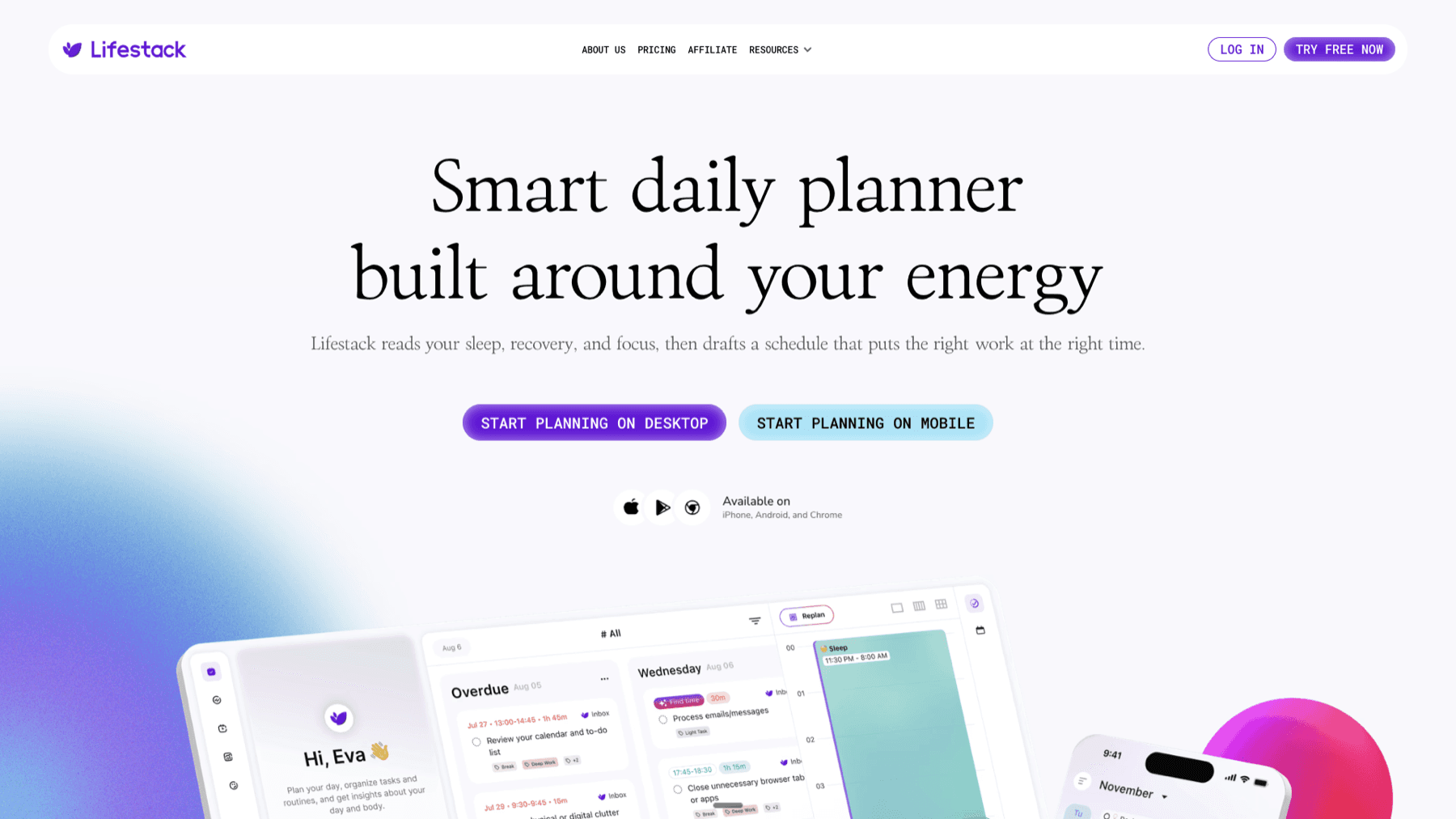
Lifestack reads your energy data from Apple Health, Oura, or your wearable and builds a schedule that puts your high-focus tasks during your natural peak. When your hardest work lands at the right moment, distractions lose much of their pull. This is different from time management advice that treats all hours as equal. They're not. Project management feels easier when the work happens at the right moment in the day.
6. Block distracting sites during focus blocks
Willpower has limited range. A site blocker removes the choice entirely, which is more effective than trying to resist. Tools like Freedom, Cold Turkey, or even Screen Time on Mac can block social media and news sites during designated focus windows. The goal isn't to never use these sites; it's to use them on your terms rather than on the algorithm's.
7. Audit your meetings for distraction cost
Meetings are the most socially acceptable form of distraction at work. A one-hour meeting costs an hour plus the recovery time on either side. Once a week, look at your calendar and ask which meetings could be shorter, less frequent, or replaced by an async update. Managing time constraints at work often means protecting calendar space as aggressively as any other resource. The average professional can reclaim two to four hours per week just by cutting meetings that don't require live discussion.
Best Tool for Managing Distractions at Work
Environment changes and scheduling techniques handle most workplace distractions. But the ones that feel hardest to resist often have an energy component. You're more distractible when you're tired, after a demanding meeting, or late in the afternoon.
Lifestack addresses this by building your daily schedule around your actual energy patterns, not just your task list. When deep work lands at your peak and lower-energy tasks fill the valleys, you're less likely to reach for your phone out of boredom or mental fatigue. It costs $7 per month or $50 per year, with a 7-day free trial on the annual plan. It pairs well with any desktop productivity setup that takes calendar management seriously. For those with ADHD, the ADHD-specific productivity techniques in energy-aware scheduling are especially relevant.
Frequently Asked Questions
What are the biggest distractions at work?
Research consistently identifies notifications (email, Slack, phone), interruptions from colleagues, and unplanned meetings as the top three sources. Social media and task-switching are close behind. The specific ranking depends on your role and work environment.
How long does it take to refocus after a distraction at work?
Studies put the average recovery time at 23 minutes for complex cognitive tasks. Simpler tasks recover faster. The practical implication is that an interruption that lasts two minutes can cost more than 20 minutes of productive work.
How do I avoid distractions when working from home?
Home environments have different distraction profiles than offices. Household tasks, family members, and the absence of social accountability are the main challenges. Dedicated workspace, clear working hours communicated to others in your home, and the same notification-batching habits you'd use in an office all transfer. Time-blocking is often more important working from home because the environment provides fewer natural cues for when to start and stop work.
Can multitasking help me get more done and avoid feeling distracted?
No. Multitasking is task-switching at a high frequency. The brain can't process two demanding cognitive tasks simultaneously. What feels like multitasking is actually rapid alternation, which carries a switching cost every time. Focused single-tasking, even if it feels slower, produces higher quality output and faster completion for complex work.
Is it normal to feel distracted at work all the time?
Frequent distraction is common, but it's not inevitable. Chronic distractibility can be a symptom of mismatched work scheduling (doing hard work when energy is low), a poorly designed notification environment, or in some cases, underlying focus challenges worth exploring with a professional. The distinction between normal distraction and something worth addressing is whether the techniques in this guide make a noticeable difference.
The average employee takes 23 minutes to recover from a single distraction at work. Not 23 minutes lost to the distraction itself. Twenty-three minutes to get back to where they were before the phone buzzed or a colleague walked over.
Multiply that by the dozens of interruptions a typical workday contains and you're looking at hours of recovered focus time that simply never comes back. Distractions at work aren't just annoying. They're expensive in a way that doesn't show up on any report.
The good news is that most workplace distractions follow predictable patterns. They come from the same sources, hit at similar times, and respond to the same countermeasures. This guide covers seven techniques that address the root causes rather than just muting your phone for an hour.
Key Takeaways
Most workplace distractions come from four sources: notifications, interruptions from other people, low-value meetings, and task-switching. Addressing the source matters more than trying to power through.
Recovery time matters as much as distraction time. A two-minute interruption can cost 20+ minutes of productive work.
Scheduling your hardest tasks during your natural energy peaks makes distractions easier to resist without relying purely on willpower.
Why Distractions at Work Are So Hard to Resist
Notifications are engineered to pull your attention. The same dopamine response that makes social media apps sticky also applies to email and Slack. Every new message is a potential reward, and your brain has been conditioned to check.
The other challenge is that many distractions at work are social. Saying no to a colleague who stops by your desk, or declining a meeting invitation, carries social costs that muting a phone notification doesn't. This is why individual willpower is a poor defense. The environment has to do most of the work.
Understanding why focus breaks down in the first place is the starting point. For some people, the issue isn't the external environment at all. It's that they're trying to do difficult cognitive work during an energy valley, which makes distraction feel irresistible rather than merely tempting.
The Most Common Distractions at Work
Notifications: Email, Slack, Teams, and phone notifications interrupt on average every 5-7 minutes in most office environments.
Interruptions from colleagues: "Got a minute?" is one of the most focus-killing phrases in the workplace. It rarely takes a minute.
Low-value meetings: Meetings that could have been emails land in the middle of deep work blocks and take 90-minute chunks out of the day.
Task-switching: Jumping between projects, tabs, or communication platforms fragments attention in ways that feel productive but aren't.
Social media: Brief checks that extend into scrolling sessions, often during transitions between tasks.
Environmental noise: Open offices and home environments with ambient sound create a constant cognitive load.
7 Techniques to Cut Distractions at Work
1. Batch your notifications instead of responding in real time
Real-time notification response is a choice disguised as a necessity. Most messages don't require an answer within minutes. The expectation that they do is cultural, not functional.
Set two or three specific times each day to check and respond to email and Slack. Outside those windows, close the apps or silence notifications entirely. Teams adapt quickly once the pattern is clear. Let colleagues know you batch your messages, and most will adjust their expectations within a week.
2. Design a signal for deep work
For in-office workers, a visible signal that you're in focus mode reduces interruptions without requiring a conversation every time. Headphones are the most common version of this. A status indicator in Slack ("In deep work until 11am") does the same thing asynchronously.
The signal only works if it's respected. That requires team agreement, not just individual action. A five-minute conversation at a team meeting about focus norms will do more for workplace distraction than any individual tool or technique.
3. Time-block your deep work on the calendar
Unscheduled time gets claimed by whoever asks first. If your calendar shows free blocks, meetings will fill them. Blocking two to three hours of deep work time each day, and treating those blocks as real appointments, keeps the space protected. Effective planning means deciding in advance where your best hours go, not filling them reactively.
4. Use the two-minute rule for task-switching
Before switching tasks, ask: can the thing pulling my attention be handled in two minutes? If yes, handle it immediately and return to what you were doing. If no, write it down and schedule a time to deal with it.
This keeps the mental list of "things I should probably deal with" from becoming a constant background distraction. The act of writing something down signals to your brain that it won't be forgotten, which releases some of the cognitive load of holding it.
5. Schedule your hardest work during your energy peak
Willpower is not a reliable defense against distraction. Most people have a narrow window each day when concentration feels natural, usually in the morning, and a longer stretch when any excuse to check the phone feels welcome.
Lifestack reads your energy data from Apple Health, Oura, or your wearable and builds a schedule that puts your high-focus tasks during your natural peak. When your hardest work lands at the right moment, distractions lose much of their pull. This is different from time management advice that treats all hours as equal. They're not. Project management feels easier when the work happens at the right moment in the day.
6. Block distracting sites during focus blocks
Willpower has limited range. A site blocker removes the choice entirely, which is more effective than trying to resist. Tools like Freedom, Cold Turkey, or even Screen Time on Mac can block social media and news sites during designated focus windows. The goal isn't to never use these sites; it's to use them on your terms rather than on the algorithm's.
7. Audit your meetings for distraction cost
Meetings are the most socially acceptable form of distraction at work. A one-hour meeting costs an hour plus the recovery time on either side. Once a week, look at your calendar and ask which meetings could be shorter, less frequent, or replaced by an async update. Managing time constraints at work often means protecting calendar space as aggressively as any other resource. The average professional can reclaim two to four hours per week just by cutting meetings that don't require live discussion.
Best Tool for Managing Distractions at Work
Environment changes and scheduling techniques handle most workplace distractions. But the ones that feel hardest to resist often have an energy component. You're more distractible when you're tired, after a demanding meeting, or late in the afternoon.
Lifestack addresses this by building your daily schedule around your actual energy patterns, not just your task list. When deep work lands at your peak and lower-energy tasks fill the valleys, you're less likely to reach for your phone out of boredom or mental fatigue. It costs $7 per month or $50 per year, with a 7-day free trial on the annual plan. It pairs well with any desktop productivity setup that takes calendar management seriously. For those with ADHD, the ADHD-specific productivity techniques in energy-aware scheduling are especially relevant.
Frequently Asked Questions
What are the biggest distractions at work?
Research consistently identifies notifications (email, Slack, phone), interruptions from colleagues, and unplanned meetings as the top three sources. Social media and task-switching are close behind. The specific ranking depends on your role and work environment.
How long does it take to refocus after a distraction at work?
Studies put the average recovery time at 23 minutes for complex cognitive tasks. Simpler tasks recover faster. The practical implication is that an interruption that lasts two minutes can cost more than 20 minutes of productive work.
How do I avoid distractions when working from home?
Home environments have different distraction profiles than offices. Household tasks, family members, and the absence of social accountability are the main challenges. Dedicated workspace, clear working hours communicated to others in your home, and the same notification-batching habits you'd use in an office all transfer. Time-blocking is often more important working from home because the environment provides fewer natural cues for when to start and stop work.
Can multitasking help me get more done and avoid feeling distracted?
No. Multitasking is task-switching at a high frequency. The brain can't process two demanding cognitive tasks simultaneously. What feels like multitasking is actually rapid alternation, which carries a switching cost every time. Focused single-tasking, even if it feels slower, produces higher quality output and faster completion for complex work.
Is it normal to feel distracted at work all the time?
Frequent distraction is common, but it's not inevitable. Chronic distractibility can be a symptom of mismatched work scheduling (doing hard work when energy is low), a poorly designed notification environment, or in some cases, underlying focus challenges worth exploring with a professional. The distinction between normal distraction and something worth addressing is whether the techniques in this guide make a noticeable difference.



FOLLOW ON
FOLLOW ON
FOLLOW ON


Copyright 2026 © Lifestack. All rights reserved
Copyright 2026 © Lifestack. All rights reserved

