
Tips
Fitbit VO2 Max Explained: How to Read and Improve It
Fitbit VO2 Max Explained: How to Read and Improve It

If you've ever opened your Fitbit app and noticed a number labeled "Cardio Fitness Score," you've already seen your estimated VO2 max. It's one of the most meaningful health metrics your wearable can give you, and most people scroll past it without a second look.
VO2 max measures how efficiently your body can use oxygen during intense exercise. It's the single best predictor of cardiovascular fitness and, according to a growing body of research, one of the strongest predictors of long-term health outcomes. A low VO2 max raises your risk of heart disease, metabolic issues, and early mortality. A high VO2 max is associated with better energy, sharper cognition, and a longer healthspan.
The good news: VO2 max is highly trainable. Most people see meaningful improvements within 8 to 12 weeks of consistent, targeted training. The tricky part is understanding what your Fitbit score actually reflects, how accurate it is compared to a lab test, and which training approaches actually move the number versus which ones just make you tired.
This guide covers all of it, plus what to do with your daily energy and recovery once your fitness starts improving.
Key Takeaways
Fitbit's VO2 max estimate is based on your resting heart rate and GPS running data, not a direct oxygen measurement.
Run-based estimates land within about 10% of a lab test; resting-heart-rate-only estimates have larger error margins.
Zone 2 aerobic training and HIIT intervals are the two most effective training methods for raising VO2 max.
What Is VO2 Max?
VO2 max stands for "maximum oxygen uptake." During intense exercise, your muscles demand more oxygen than at rest. VO2 max measures the maximum rate at which your body can deliver and use that oxygen, expressed in milliliters of oxygen per kilogram of body weight per minute (mL/kg/min).
A higher number means your cardiovascular and respiratory systems can supply more oxygen to working muscles before they run out of fuel. Elite endurance athletes often score above 70 mL/kg/min. The average sedentary adult sits somewhere in the mid-30s. Most people fall somewhere between those extremes, and the gap closes more than most expect with consistent training.
Beyond athletic performance, VO2 max has become a longevity marker. Studies published in JAMA and the New England Journal of Medicine found that cardiorespiratory fitness (as measured by VO2 max) predicts mortality risk better than traditional risk factors like blood pressure or cholesterol levels. Even moving from "low" to "below average" on the fitness spectrum cuts all-cause mortality risk significantly.
How Fitbit Measures VO2 Max
Fitbit calls its VO2 max estimate the "Cardio Fitness Score" and displays it in the Google Health app (the renamed Fitbit app as of 2026). The score updates automatically, without a formal test.
There are two calculation methods, depending on your device and activity:
Resting heart rate method: Used on all Fitbit models. The algorithm combines your resting heart rate with your age and sex to estimate cardiorespiratory fitness. This method has a higher error margin because it doesn't account for how hard you're actually working during exercise.
GPS run method: Available on Fitbit models with GPS or paired to your phone's GPS. During an outdoor run, the algorithm combines your heart rate and pace to estimate VO2 max. This is significantly more accurate, typically within 10% of a lab measurement.
The more regularly you log GPS runs, the more accurate your score becomes. A few months of consistent run data will produce a far more reliable baseline than the resting heart rate estimate alone.
Fitbit VO2 Max Ranges: What Your Score Means
Fitbit classifies scores into five fitness levels, calibrated by age and sex. The labels below are approximate midpoints across age groups:
Below Average: Under 33 (women) / under 35 (men)
Average: 33-36 (women) / 35-40 (men)
Good: 37-41 (women) / 40-45 (men)
Very Good: 42-46 (women) / 46-51 (men)
Excellent: 47+ (women) / 52+ (men)
VO2 max declines roughly 1% per year after age 30 without intervention. But that decline is almost entirely reversible with training. Research consistently shows that adults who exercise regularly maintain VO2 max scores 15 to 25 points higher than sedentary peers of the same age.
One important note: your personal trend matters more than where you sit on the chart. A three-to-five point increase over eight weeks of training is a meaningful, real improvement, regardless of which category you start in.
How Accurate Is Fitbit VO2 Max?
Honest answer: good enough for trend tracking, not precise enough for clinical use.
Independent validation studies put Fitbit's GPS run-based VO2 max estimates within 8 to 12% of lab measurements. That error range means a score of 40 could reflect a true VO2 max anywhere from 35 to 45. It also means you should never compare your Fitbit number directly against someone else's Garmin or Apple Watch number, since each device uses a different algorithm.
What the score is reliable for: tracking your own trend over time. If your Fitbit score goes from 38 to 43 over three months of consistent training, that upward movement reflects a real improvement in cardiovascular fitness. The absolute number is an estimate; the direction of travel is meaningful.
The resting-heart-rate-only method (used when you don't log GPS runs) is less reliable. Resting heart rate is influenced by hydration, caffeine, stress, and sleep quality, so the estimate can fluctuate without any real change in fitness. For the most accurate Fitbit VO2 max readings, log outdoor GPS runs at least once or twice a week. Improving your resting heart rate with consistent aerobic training also improves the baseline estimate over time. See how that connects in our guide to lowering resting heart rate.
6 Ways to Improve Your Fitbit VO2 Max
VO2 max responds to the right kind of training stress. Most people who plateau have the training frequency right but the intensity distribution wrong. These six approaches target the actual physiological adaptations that raise the ceiling.
1. Build a Zone 2 aerobic base
Zone 2 training, which means sustained effort at a pace where you can hold a full conversation, is the most underused tool in cardiovascular development. It builds mitochondrial density and capillary networks in muscle tissue, which directly supports VO2 max gains. Most people who train "medium hard" all the time never get the base adaptations that make harder efforts productive. See our breakdown of Zone 2 vs Zone 3 training for the full explanation.
2. Add HIIT intervals once or twice a week
High-intensity interval training pushes your cardiovascular system to its ceiling and creates the acute stress that drives VO2 max adaptation upward. Classic protocols: 4 to 6 rounds of 4 minutes at near-maximal effort with 3 minutes of easy recovery between rounds. Done once or twice a week on top of Zone 2 work, intervals accelerate improvements significantly compared to moderate-intensity training alone.
3. Prioritize sleep quality
Training adaptation happens during sleep, not during the workout. Your body repairs cardiac tissue, synthesizes proteins, and consolidates fitness gains in deep and REM sleep. Poor sleep slows VO2 max improvement even when training volume is high. The Fitbit sleep score is a useful proxy for tracking sleep quality trends alongside your Cardio Fitness Score. See how they tend to move together over time, and use that correlation to guide recovery decisions.
4. Be consistent over months, not weeks
VO2 max is a slow-moving metric. You won't see a meaningful score change in two weeks. Eight to twelve weeks of consistent training is the minimum window for real adaptation, and most of the gains happen in the first six months of a new training program. Missing workouts, taking unplanned weeks off, or cycling between intense and inactive periods stalls the process. Moderate, consistent effort beats sporadic bursts of intensity every time.
5. Manage training stress and recovery
More training isn't always better. Accumulated fatigue without adequate recovery leads to CNS burnout, which suppresses HRV, raises resting heart rate, and can actually lower your VO2 max over time. Hard training weeks should alternate with easier recovery weeks. Monitoring your HRV alongside VO2 max gives you a more complete picture of whether your body is adapting or just accumulating stress.
6. Reduce sedentary time
Daily movement volume matters beyond structured workouts. People who accumulate more low-intensity activity throughout the day, through walking, standing, taking stairs, consistently score higher on VO2 max tests than people who exercise hard for 45 minutes and sit for 10 hours. Total daily energy expenditure contributes to cardiovascular adaptation. Even a standing desk or a 15-minute post-dinner walk makes a measurable difference over months.
Best Tool for Improving VO2 Max
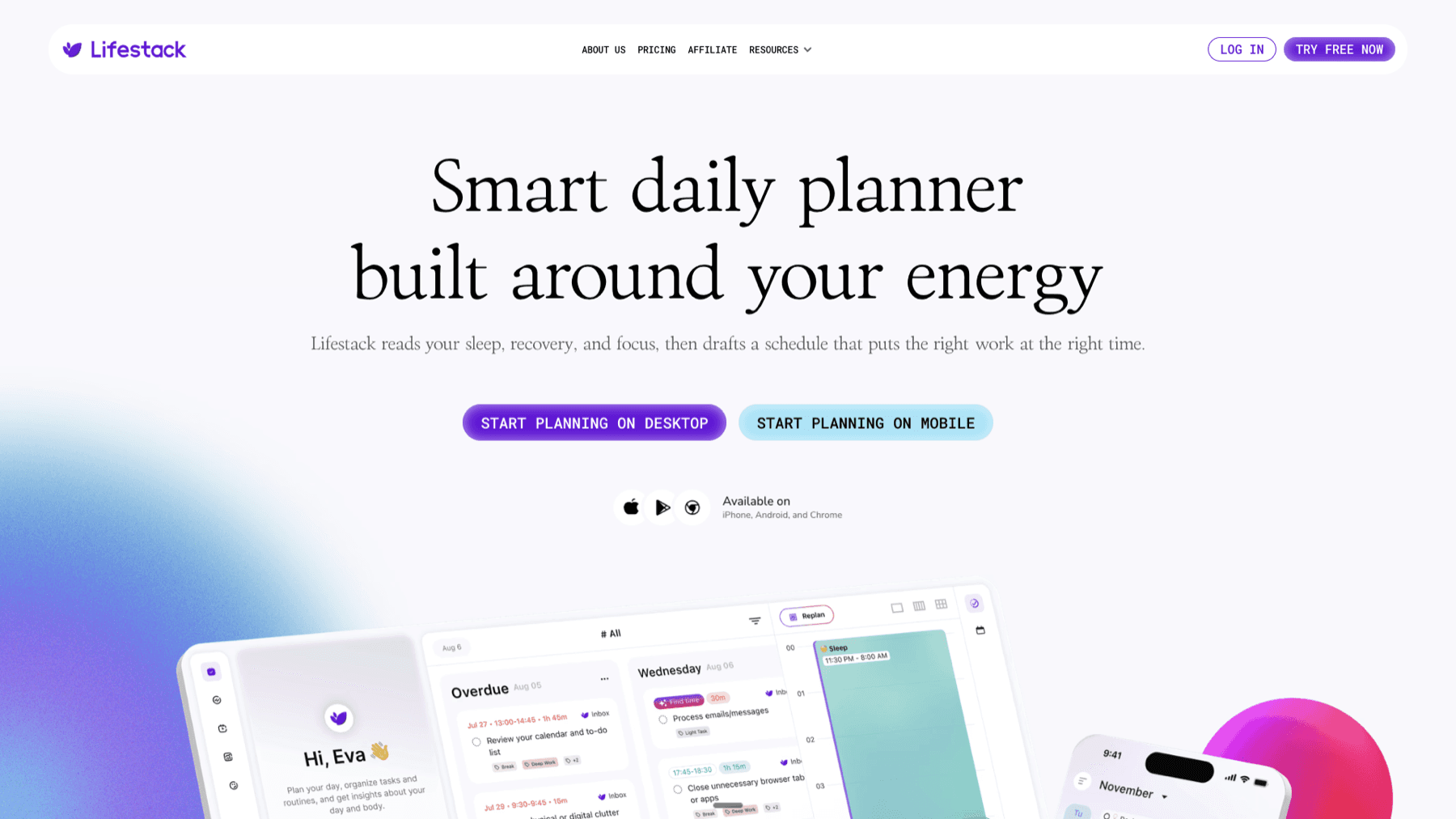
Raising VO2 max requires consistent training, which requires showing up for workouts even when you're tired, busy, or not sure whether to push or recover. That's where most people lose momentum. Lifestack is an AI daily planner that connects to your health data and schedules your workouts during windows when your energy and recovery actually support hard effort. On a high-readiness day, it places your interval session where you'll get the most from it. On a low-readiness day, it flags recovery and suggests easier movement instead.
The result is a training schedule that adapts to how your body is actually doing, not just when a generic calendar says it's time to run. Combined with consistent sleep tracking, this kind of energy-aware scheduling reduces missed workouts and overtraining in equal measure. Learn more about how Lifestack works and why energy-aware planning produces better long-term fitness outcomes than willpower alone.
Frequently Asked Questions
Where do I find my VO2 max on Fitbit?
Open the Google Health app (formerly the Fitbit app), tap the Today tab, then tap the heart rate tile. Scroll down to "Cardio Fitness" to see your current score and fitness level. The score updates automatically after workouts and when you sync your device. If your score shows "Not Tracked," it usually means you haven't logged enough GPS activity or your device doesn't support the feature.
How long does it take to improve Fitbit VO2 max?
Most people see measurable score increases after 8 to 12 weeks of consistent aerobic training. The early gains are often the fastest, as the body adapts quickly to a new training stimulus. After that initial improvement period, progress slows and requires more deliberate periodization to continue rising.
Is Fitbit VO2 max accurate?
For GPS run-based estimates, Fitbit's algorithm lands within about 8 to 12% of a laboratory VO2 max test. For resting-heart-rate-based estimates (when you don't run outdoors), the error margin is larger. Both methods are useful for tracking your personal trend over time, but neither should be compared directly against scores from Garmin, Apple Watch, or WHOOP, which use different algorithms.
Does walking improve Fitbit VO2 max?
Walking at a moderate pace contributes to cardiovascular health and reduces sedentary time, both of which support VO2 max improvement. But brisk walking or running at higher intensities produces faster gains because the cardiovascular demand is higher. If you're new to exercise, starting with consistent walking is an effective foundation before adding running or intervals.
What is a good Fitbit VO2 max for my age?
Fitbit's Cardio Fitness ranges are calibrated by age and sex, so the app's fitness level label (Average, Good, Very Good, etc.) already factors in your demographic. A "Good" rating at 55 reflects a higher actual fitness level than a "Good" rating at 30. Rather than optimizing for a specific number, focus on moving your personal score upward over time and keeping the fitness level at "Good" or above as you age.
Why did my Fitbit VO2 max go down?
Short-term drops are common and often reflect a higher resting heart rate from illness, poor sleep, high stress, alcohol, or dehydration rather than actual fitness loss. A single week of reduced training won't meaningfully change your cardiovascular fitness. If the score drops and stays down for several weeks alongside high resting heart rate, that's a signal to check sleep quality, training load, and recovery. Our guide to the best sleep trackers can help you identify whether sleep is the underlying factor.
If you've ever opened your Fitbit app and noticed a number labeled "Cardio Fitness Score," you've already seen your estimated VO2 max. It's one of the most meaningful health metrics your wearable can give you, and most people scroll past it without a second look.
VO2 max measures how efficiently your body can use oxygen during intense exercise. It's the single best predictor of cardiovascular fitness and, according to a growing body of research, one of the strongest predictors of long-term health outcomes. A low VO2 max raises your risk of heart disease, metabolic issues, and early mortality. A high VO2 max is associated with better energy, sharper cognition, and a longer healthspan.
The good news: VO2 max is highly trainable. Most people see meaningful improvements within 8 to 12 weeks of consistent, targeted training. The tricky part is understanding what your Fitbit score actually reflects, how accurate it is compared to a lab test, and which training approaches actually move the number versus which ones just make you tired.
This guide covers all of it, plus what to do with your daily energy and recovery once your fitness starts improving.
Key Takeaways
Fitbit's VO2 max estimate is based on your resting heart rate and GPS running data, not a direct oxygen measurement.
Run-based estimates land within about 10% of a lab test; resting-heart-rate-only estimates have larger error margins.
Zone 2 aerobic training and HIIT intervals are the two most effective training methods for raising VO2 max.
What Is VO2 Max?
VO2 max stands for "maximum oxygen uptake." During intense exercise, your muscles demand more oxygen than at rest. VO2 max measures the maximum rate at which your body can deliver and use that oxygen, expressed in milliliters of oxygen per kilogram of body weight per minute (mL/kg/min).
A higher number means your cardiovascular and respiratory systems can supply more oxygen to working muscles before they run out of fuel. Elite endurance athletes often score above 70 mL/kg/min. The average sedentary adult sits somewhere in the mid-30s. Most people fall somewhere between those extremes, and the gap closes more than most expect with consistent training.
Beyond athletic performance, VO2 max has become a longevity marker. Studies published in JAMA and the New England Journal of Medicine found that cardiorespiratory fitness (as measured by VO2 max) predicts mortality risk better than traditional risk factors like blood pressure or cholesterol levels. Even moving from "low" to "below average" on the fitness spectrum cuts all-cause mortality risk significantly.
How Fitbit Measures VO2 Max
Fitbit calls its VO2 max estimate the "Cardio Fitness Score" and displays it in the Google Health app (the renamed Fitbit app as of 2026). The score updates automatically, without a formal test.
There are two calculation methods, depending on your device and activity:
Resting heart rate method: Used on all Fitbit models. The algorithm combines your resting heart rate with your age and sex to estimate cardiorespiratory fitness. This method has a higher error margin because it doesn't account for how hard you're actually working during exercise.
GPS run method: Available on Fitbit models with GPS or paired to your phone's GPS. During an outdoor run, the algorithm combines your heart rate and pace to estimate VO2 max. This is significantly more accurate, typically within 10% of a lab measurement.
The more regularly you log GPS runs, the more accurate your score becomes. A few months of consistent run data will produce a far more reliable baseline than the resting heart rate estimate alone.
Fitbit VO2 Max Ranges: What Your Score Means
Fitbit classifies scores into five fitness levels, calibrated by age and sex. The labels below are approximate midpoints across age groups:
Below Average: Under 33 (women) / under 35 (men)
Average: 33-36 (women) / 35-40 (men)
Good: 37-41 (women) / 40-45 (men)
Very Good: 42-46 (women) / 46-51 (men)
Excellent: 47+ (women) / 52+ (men)
VO2 max declines roughly 1% per year after age 30 without intervention. But that decline is almost entirely reversible with training. Research consistently shows that adults who exercise regularly maintain VO2 max scores 15 to 25 points higher than sedentary peers of the same age.
One important note: your personal trend matters more than where you sit on the chart. A three-to-five point increase over eight weeks of training is a meaningful, real improvement, regardless of which category you start in.
How Accurate Is Fitbit VO2 Max?
Honest answer: good enough for trend tracking, not precise enough for clinical use.
Independent validation studies put Fitbit's GPS run-based VO2 max estimates within 8 to 12% of lab measurements. That error range means a score of 40 could reflect a true VO2 max anywhere from 35 to 45. It also means you should never compare your Fitbit number directly against someone else's Garmin or Apple Watch number, since each device uses a different algorithm.
What the score is reliable for: tracking your own trend over time. If your Fitbit score goes from 38 to 43 over three months of consistent training, that upward movement reflects a real improvement in cardiovascular fitness. The absolute number is an estimate; the direction of travel is meaningful.
The resting-heart-rate-only method (used when you don't log GPS runs) is less reliable. Resting heart rate is influenced by hydration, caffeine, stress, and sleep quality, so the estimate can fluctuate without any real change in fitness. For the most accurate Fitbit VO2 max readings, log outdoor GPS runs at least once or twice a week. Improving your resting heart rate with consistent aerobic training also improves the baseline estimate over time. See how that connects in our guide to lowering resting heart rate.
6 Ways to Improve Your Fitbit VO2 Max
VO2 max responds to the right kind of training stress. Most people who plateau have the training frequency right but the intensity distribution wrong. These six approaches target the actual physiological adaptations that raise the ceiling.
1. Build a Zone 2 aerobic base
Zone 2 training, which means sustained effort at a pace where you can hold a full conversation, is the most underused tool in cardiovascular development. It builds mitochondrial density and capillary networks in muscle tissue, which directly supports VO2 max gains. Most people who train "medium hard" all the time never get the base adaptations that make harder efforts productive. See our breakdown of Zone 2 vs Zone 3 training for the full explanation.
2. Add HIIT intervals once or twice a week
High-intensity interval training pushes your cardiovascular system to its ceiling and creates the acute stress that drives VO2 max adaptation upward. Classic protocols: 4 to 6 rounds of 4 minutes at near-maximal effort with 3 minutes of easy recovery between rounds. Done once or twice a week on top of Zone 2 work, intervals accelerate improvements significantly compared to moderate-intensity training alone.
3. Prioritize sleep quality
Training adaptation happens during sleep, not during the workout. Your body repairs cardiac tissue, synthesizes proteins, and consolidates fitness gains in deep and REM sleep. Poor sleep slows VO2 max improvement even when training volume is high. The Fitbit sleep score is a useful proxy for tracking sleep quality trends alongside your Cardio Fitness Score. See how they tend to move together over time, and use that correlation to guide recovery decisions.
4. Be consistent over months, not weeks
VO2 max is a slow-moving metric. You won't see a meaningful score change in two weeks. Eight to twelve weeks of consistent training is the minimum window for real adaptation, and most of the gains happen in the first six months of a new training program. Missing workouts, taking unplanned weeks off, or cycling between intense and inactive periods stalls the process. Moderate, consistent effort beats sporadic bursts of intensity every time.
5. Manage training stress and recovery
More training isn't always better. Accumulated fatigue without adequate recovery leads to CNS burnout, which suppresses HRV, raises resting heart rate, and can actually lower your VO2 max over time. Hard training weeks should alternate with easier recovery weeks. Monitoring your HRV alongside VO2 max gives you a more complete picture of whether your body is adapting or just accumulating stress.
6. Reduce sedentary time
Daily movement volume matters beyond structured workouts. People who accumulate more low-intensity activity throughout the day, through walking, standing, taking stairs, consistently score higher on VO2 max tests than people who exercise hard for 45 minutes and sit for 10 hours. Total daily energy expenditure contributes to cardiovascular adaptation. Even a standing desk or a 15-minute post-dinner walk makes a measurable difference over months.
Best Tool for Improving VO2 Max
Raising VO2 max requires consistent training, which requires showing up for workouts even when you're tired, busy, or not sure whether to push or recover. That's where most people lose momentum. Lifestack is an AI daily planner that connects to your health data and schedules your workouts during windows when your energy and recovery actually support hard effort. On a high-readiness day, it places your interval session where you'll get the most from it. On a low-readiness day, it flags recovery and suggests easier movement instead.
The result is a training schedule that adapts to how your body is actually doing, not just when a generic calendar says it's time to run. Combined with consistent sleep tracking, this kind of energy-aware scheduling reduces missed workouts and overtraining in equal measure. Learn more about how Lifestack works and why energy-aware planning produces better long-term fitness outcomes than willpower alone.
Frequently Asked Questions
Where do I find my VO2 max on Fitbit?
Open the Google Health app (formerly the Fitbit app), tap the Today tab, then tap the heart rate tile. Scroll down to "Cardio Fitness" to see your current score and fitness level. The score updates automatically after workouts and when you sync your device. If your score shows "Not Tracked," it usually means you haven't logged enough GPS activity or your device doesn't support the feature.
How long does it take to improve Fitbit VO2 max?
Most people see measurable score increases after 8 to 12 weeks of consistent aerobic training. The early gains are often the fastest, as the body adapts quickly to a new training stimulus. After that initial improvement period, progress slows and requires more deliberate periodization to continue rising.
Is Fitbit VO2 max accurate?
For GPS run-based estimates, Fitbit's algorithm lands within about 8 to 12% of a laboratory VO2 max test. For resting-heart-rate-based estimates (when you don't run outdoors), the error margin is larger. Both methods are useful for tracking your personal trend over time, but neither should be compared directly against scores from Garmin, Apple Watch, or WHOOP, which use different algorithms.
Does walking improve Fitbit VO2 max?
Walking at a moderate pace contributes to cardiovascular health and reduces sedentary time, both of which support VO2 max improvement. But brisk walking or running at higher intensities produces faster gains because the cardiovascular demand is higher. If you're new to exercise, starting with consistent walking is an effective foundation before adding running or intervals.
What is a good Fitbit VO2 max for my age?
Fitbit's Cardio Fitness ranges are calibrated by age and sex, so the app's fitness level label (Average, Good, Very Good, etc.) already factors in your demographic. A "Good" rating at 55 reflects a higher actual fitness level than a "Good" rating at 30. Rather than optimizing for a specific number, focus on moving your personal score upward over time and keeping the fitness level at "Good" or above as you age.
Why did my Fitbit VO2 max go down?
Short-term drops are common and often reflect a higher resting heart rate from illness, poor sleep, high stress, alcohol, or dehydration rather than actual fitness loss. A single week of reduced training won't meaningfully change your cardiovascular fitness. If the score drops and stays down for several weeks alongside high resting heart rate, that's a signal to check sleep quality, training load, and recovery. Our guide to the best sleep trackers can help you identify whether sleep is the underlying factor.



FOLLOW ON
FOLLOW ON
FOLLOW ON


Copyright 2026 © Lifestack. All rights reserved
Copyright 2026 © Lifestack. All rights reserved

