
Tips
Gamified Habit Formation: 6 Mechanics That Work
Gamified Habit Formation: 6 Mechanics That Work

Why Willpower Is the Wrong Engine for Habit Building
Willpower is a finite resource. It depletes during the day, drops when you are stressed, and disappears entirely when you are tired. Building a daily habit on willpower alone means your system works only when you feel good, which is exactly the condition you can't rely on.
Games don't have this problem. People spend hours on games without any willpower at all, pulled forward by immediate feedback, visible progress, and the satisfaction of completing something. Gamified habit formation takes those same mechanics and applies them to real behaviors. The goal is not to make your life a game. It is to use the feedback structures that games get right and apply them to behaviors that actually matter.
This guide covers six game mechanics that make a real difference in habit formation, the psychology behind why each one works, and how to build them into a system you will actually maintain. For context on how habits connect to larger goals, process goals define the behavioral layer that gamification can then reinforce.
Key Takeaways
Gamification works because it changes the feedback loop around behavior. Immediate positive feedback is one of the most powerful mechanisms for habit formation.
The most effective game mechanics for habits are points/XP, streaks, progression levels, challenges, social accountability, and loss aversion triggers. You don't need all of them at once.
Gamification fails when the mechanics become the goal. Points are a feedback signal, not a substitute for the behavior they represent.
1. Points and XP: Making Invisible Progress Visible
The simplest and most durable gamification mechanic is a point system. Every completed habit earns points. Higher-difficulty habits earn more. Over time, you watch a number grow, and that growth is evidence that your system is working even when the outcome hasn't arrived yet.
Experience points (XP) work by creating a proxy for progress when the real outcome is weeks or months away. You can't see your improved health after one workout. You can see your XP go up by ten. That immediate feedback triggers a dopamine response that the habit itself might not yet produce.
To implement this without an app: assign a point value to each habit in your tracker. Daily exercise might be worth 10 points. Five minutes of meditation worth 3. Weekly review worth 15. Track the total each week. The number matters less than the act of accumulating it. Apps like Habitica automate this with full RPG mechanics, but a spreadsheet works just as well for the underlying principle.
2. Streaks: Using Loss Aversion in Your Favor
Loss aversion is one of the most replicated findings in behavioral economics. People feel the pain of losing something roughly twice as strongly as they feel the pleasure of gaining the same thing. Streaks weaponize this in a useful direction: once you have a 12-day streak, breaking it feels like a real loss.
A streak does not depend on motivation. It depends on not wanting to lose the number. On a day when you genuinely don't feel like exercising, the streak is often enough to get you started. Once started, the behavior usually follows.
The design matters though. A rigid streak that resets to zero on any miss is punishing rather than motivating for most people. A more durable version includes a "streak shield" or recovery period: one miss in seven days doesn't break the streak, but two consecutive misses do. This keeps the loss aversion active without making one bad day catastrophic. Understanding habit failure patterns helps you calibrate how strict your streak rules need to be for your specific behaviors.
3. Progression Levels: Creating a Sense of Becoming
Levels work by giving you a narrative arc. You are not just doing the same thing every day. You are becoming something. Moving from Level 1 to Level 2 represents real accumulated effort, and the level itself signals that to you and to anyone you share it with.
In habit systems, progression levels are usually tied to accumulated days or points. After 30 days of a habit, you reach Level 2. After 90 days, Level 3. Each level can unlock a small reward you set in advance: a new piece of gear, a meal at a restaurant you enjoy, an afternoon off from a responsibility you have been deferring.
Levels also reduce the psychological weight of the early stage. When you start a new habit, everything is slow and uncertain. Knowing that the current difficulty is "Level 1 difficulty" makes it easier to stay patient. You are expected to find this hard. That's what Level 1 means. The Tiny Habits framework pairs well here: small habits at Level 1 that grow into larger commitments as you level up.
4. Challenges: Creating a Finite Frame
Challenges are bounded commitments: do this specific thing every day for 30 days. They work because they convert an open-ended behavior into a defined project with a finish line. Finite commitments are psychologically easier to commit to than indefinite ones.
"I will meditate every day for the rest of my life" produces anxiety. "I will meditate for five minutes every day for the next 30 days" produces focus. The target is the same behavior. The frame is completely different.
Challenges also create a natural evaluation point. At the end of 30 days, you decide whether to extend, modify, or replace the challenge. This gives you permission to experiment rather than committing to permanent change, which lowers the barrier to starting significantly. For ADHD-friendly habit building, challenges are particularly effective because they have clear endpoints that prevent the open-ended boredom that causes many habits to collapse. ADHD goal strategies discuss this dynamic in more depth.
5. Social Accountability: The Multiplayer Layer
Most games are more engaging with other players. The same principle applies to habits. Social accountability adds an external reference point: someone else knows what you said you would do, and their awareness creates a mild social pressure to follow through.
This works through several mechanisms. First, public commitment raises the psychological cost of abandonment. Second, seeing another person's progress creates a social comparison effect that can increase your own effort. Third, sharing milestones with others makes the rewards feel more real.
You don't need an app for this. A weekly check-in with one other person who is building a habit works. An accountability partner who texts you their daily completion works. Dedicated apps like Habitica add a social layer with leaderboards and party quests for people who want more structure. The key is that at least one other person knows your commitment and will notice if you go quiet.
6. Immediate Rewards: Closing the Feedback Gap
The fundamental problem with most habits is a long delay between the behavior and its benefit. You exercise today. You feel better in three months. That gap is enough for the brain to fail to connect cause and effect, which is why motivation erodes even when you logically know the habit is worth it.
Immediate rewards close the gap artificially. After completing a habit, you get something now. The reward doesn't need to be significant. It needs to be genuine and immediate. A piece of music you love only during workouts. A specific coffee you allow yourself only on days you complete your morning routine. An episode of a show you reserve for evenings when you hit your targets.
BJ Fogg, in the Tiny Habits book, calls the emotional version of this "Shine," a moment of genuine self-celebration immediately after the behavior. The mechanism is the same: the brain needs a positive signal right at the moment of completion to begin encoding the behavior as a habit rather than a one-time effort. A habit tracker that gives you a satisfying visual confirmation when you check a habit off is using this exact mechanic.
Best Tool for Energy-Aware Habit Scheduling
Gamification makes habits more engaging, but it can't schedule them for you. A habit that keeps getting pushed to "later" because the day fills up will collapse regardless of how well-designed its point system is. Scheduling is the structural layer that gamification depends on.
Lifestack is a daily planner that reads your sleep, recovery, and focus data and places your highest-effort habits during your peak energy windows automatically. For gamified habit formation, this means your hardest habits get protected time in the part of your day when you can actually complete them, not just whenever a gap appears.
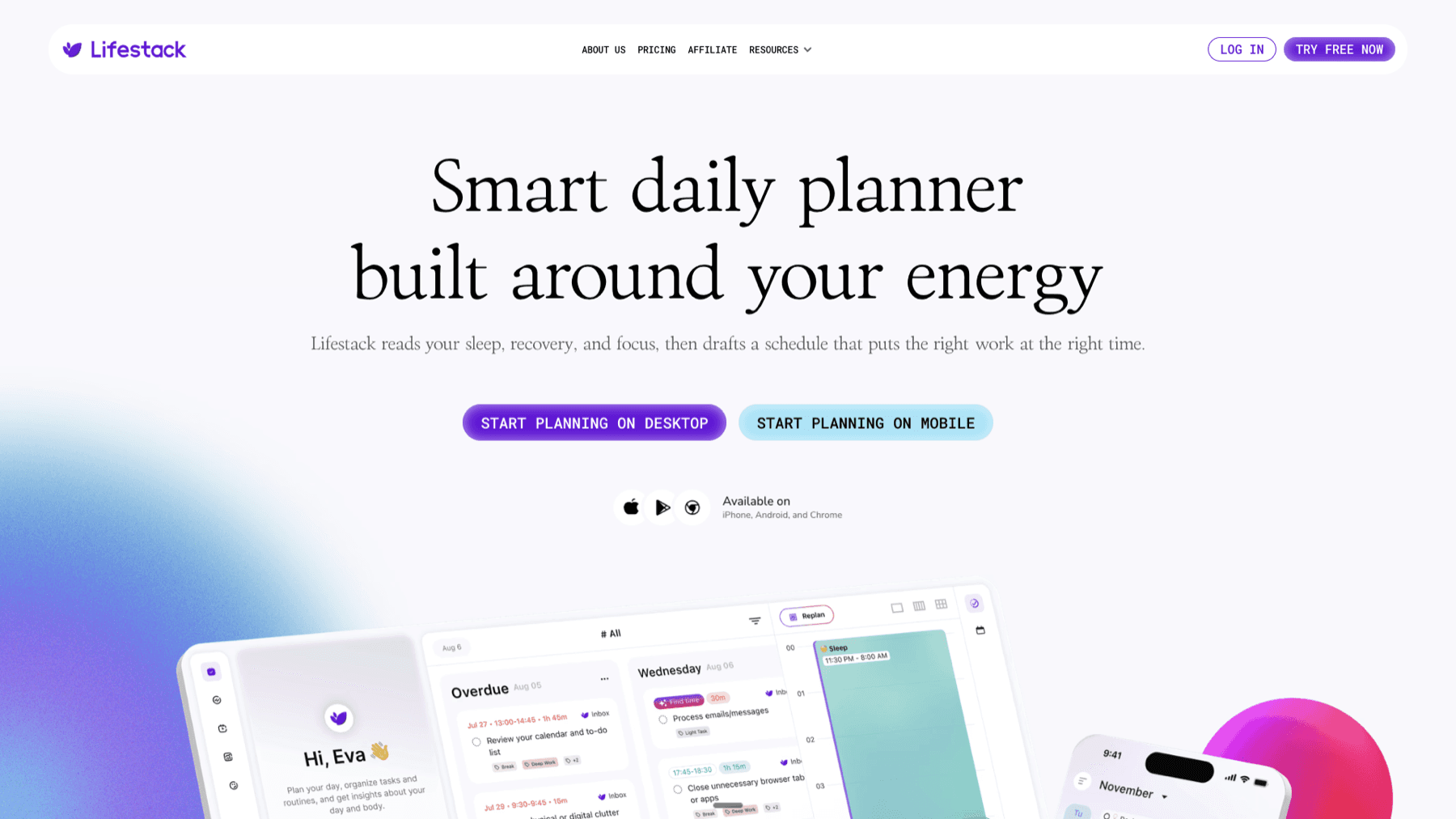
Lifestack works on iOS, Android, and as a Chrome extension with Google Calendar and Apple Calendar integration. Plans start at $7 per month or $50 per year, with a 7-day free trial on the annual plan. Energy-based scheduling explains the full approach behind why the timing of a habit matters as much as the design of the habit itself.
Frequently Asked Questions
What is gamified habit formation?
Gamified habit formation applies game mechanics (points, streaks, levels, challenges, social feedback, and immediate rewards) to real-world behavior change. The goal is to provide the kind of immediate, visible feedback that makes game behaviors addictive, applied to habits that actually matter to you.
Does gamification really work for building habits?
Research supports the core mechanisms. Immediate feedback, loss aversion through streaks, and social accountability all have strong evidence bases in behavioral psychology. What doesn't work is shallow gamification that adds points to behaviors without genuine personal stakes. The design matters.
How many gamified habits should you track at once?
Three to five is a practical starting range. More than that and the tracking itself becomes a burden, which defeats the purpose. Start with your two or three highest-priority behaviors, build the gamification system around those, and add more only once the core system feels natural.
What apps use gamified habit formation?
Habitica is the most complete, applying full RPG mechanics to daily habits and tasks. Streaks focuses specifically on streak mechanics. Finch uses a virtual pet that grows based on your habit completion. The best app is whichever mechanic fits how you are motivated. Many people find a simple spreadsheet with their own point system more durable than any app.
Can gamified habit formation work for ADHD?
Yes, and it often works particularly well. The dopamine-relevant feedback loops that gamification creates are especially useful for ADHD brains that struggle with delayed gratification. Short challenges, visible streaks, and immediate rewards all directly address the motivation structure that ADHD affects. The key is keeping the system simple enough to maintain during low-executive-function days.
What is the biggest mistake people make with habit gamification?
Optimizing for the points rather than the behavior. When maintaining the streak or accumulating XP becomes more important than doing the actual habit, people start cutting corners, doing the minimum version of the behavior, or gaming the system in ways that undermine the original purpose. The mechanics are feedback tools. They work only when the underlying behavior stays the real goal.
Why Willpower Is the Wrong Engine for Habit Building
Willpower is a finite resource. It depletes during the day, drops when you are stressed, and disappears entirely when you are tired. Building a daily habit on willpower alone means your system works only when you feel good, which is exactly the condition you can't rely on.
Games don't have this problem. People spend hours on games without any willpower at all, pulled forward by immediate feedback, visible progress, and the satisfaction of completing something. Gamified habit formation takes those same mechanics and applies them to real behaviors. The goal is not to make your life a game. It is to use the feedback structures that games get right and apply them to behaviors that actually matter.
This guide covers six game mechanics that make a real difference in habit formation, the psychology behind why each one works, and how to build them into a system you will actually maintain. For context on how habits connect to larger goals, process goals define the behavioral layer that gamification can then reinforce.
Key Takeaways
Gamification works because it changes the feedback loop around behavior. Immediate positive feedback is one of the most powerful mechanisms for habit formation.
The most effective game mechanics for habits are points/XP, streaks, progression levels, challenges, social accountability, and loss aversion triggers. You don't need all of them at once.
Gamification fails when the mechanics become the goal. Points are a feedback signal, not a substitute for the behavior they represent.
1. Points and XP: Making Invisible Progress Visible
The simplest and most durable gamification mechanic is a point system. Every completed habit earns points. Higher-difficulty habits earn more. Over time, you watch a number grow, and that growth is evidence that your system is working even when the outcome hasn't arrived yet.
Experience points (XP) work by creating a proxy for progress when the real outcome is weeks or months away. You can't see your improved health after one workout. You can see your XP go up by ten. That immediate feedback triggers a dopamine response that the habit itself might not yet produce.
To implement this without an app: assign a point value to each habit in your tracker. Daily exercise might be worth 10 points. Five minutes of meditation worth 3. Weekly review worth 15. Track the total each week. The number matters less than the act of accumulating it. Apps like Habitica automate this with full RPG mechanics, but a spreadsheet works just as well for the underlying principle.
2. Streaks: Using Loss Aversion in Your Favor
Loss aversion is one of the most replicated findings in behavioral economics. People feel the pain of losing something roughly twice as strongly as they feel the pleasure of gaining the same thing. Streaks weaponize this in a useful direction: once you have a 12-day streak, breaking it feels like a real loss.
A streak does not depend on motivation. It depends on not wanting to lose the number. On a day when you genuinely don't feel like exercising, the streak is often enough to get you started. Once started, the behavior usually follows.
The design matters though. A rigid streak that resets to zero on any miss is punishing rather than motivating for most people. A more durable version includes a "streak shield" or recovery period: one miss in seven days doesn't break the streak, but two consecutive misses do. This keeps the loss aversion active without making one bad day catastrophic. Understanding habit failure patterns helps you calibrate how strict your streak rules need to be for your specific behaviors.
3. Progression Levels: Creating a Sense of Becoming
Levels work by giving you a narrative arc. You are not just doing the same thing every day. You are becoming something. Moving from Level 1 to Level 2 represents real accumulated effort, and the level itself signals that to you and to anyone you share it with.
In habit systems, progression levels are usually tied to accumulated days or points. After 30 days of a habit, you reach Level 2. After 90 days, Level 3. Each level can unlock a small reward you set in advance: a new piece of gear, a meal at a restaurant you enjoy, an afternoon off from a responsibility you have been deferring.
Levels also reduce the psychological weight of the early stage. When you start a new habit, everything is slow and uncertain. Knowing that the current difficulty is "Level 1 difficulty" makes it easier to stay patient. You are expected to find this hard. That's what Level 1 means. The Tiny Habits framework pairs well here: small habits at Level 1 that grow into larger commitments as you level up.
4. Challenges: Creating a Finite Frame
Challenges are bounded commitments: do this specific thing every day for 30 days. They work because they convert an open-ended behavior into a defined project with a finish line. Finite commitments are psychologically easier to commit to than indefinite ones.
"I will meditate every day for the rest of my life" produces anxiety. "I will meditate for five minutes every day for the next 30 days" produces focus. The target is the same behavior. The frame is completely different.
Challenges also create a natural evaluation point. At the end of 30 days, you decide whether to extend, modify, or replace the challenge. This gives you permission to experiment rather than committing to permanent change, which lowers the barrier to starting significantly. For ADHD-friendly habit building, challenges are particularly effective because they have clear endpoints that prevent the open-ended boredom that causes many habits to collapse. ADHD goal strategies discuss this dynamic in more depth.
5. Social Accountability: The Multiplayer Layer
Most games are more engaging with other players. The same principle applies to habits. Social accountability adds an external reference point: someone else knows what you said you would do, and their awareness creates a mild social pressure to follow through.
This works through several mechanisms. First, public commitment raises the psychological cost of abandonment. Second, seeing another person's progress creates a social comparison effect that can increase your own effort. Third, sharing milestones with others makes the rewards feel more real.
You don't need an app for this. A weekly check-in with one other person who is building a habit works. An accountability partner who texts you their daily completion works. Dedicated apps like Habitica add a social layer with leaderboards and party quests for people who want more structure. The key is that at least one other person knows your commitment and will notice if you go quiet.
6. Immediate Rewards: Closing the Feedback Gap
The fundamental problem with most habits is a long delay between the behavior and its benefit. You exercise today. You feel better in three months. That gap is enough for the brain to fail to connect cause and effect, which is why motivation erodes even when you logically know the habit is worth it.
Immediate rewards close the gap artificially. After completing a habit, you get something now. The reward doesn't need to be significant. It needs to be genuine and immediate. A piece of music you love only during workouts. A specific coffee you allow yourself only on days you complete your morning routine. An episode of a show you reserve for evenings when you hit your targets.
BJ Fogg, in the Tiny Habits book, calls the emotional version of this "Shine," a moment of genuine self-celebration immediately after the behavior. The mechanism is the same: the brain needs a positive signal right at the moment of completion to begin encoding the behavior as a habit rather than a one-time effort. A habit tracker that gives you a satisfying visual confirmation when you check a habit off is using this exact mechanic.
Best Tool for Energy-Aware Habit Scheduling
Gamification makes habits more engaging, but it can't schedule them for you. A habit that keeps getting pushed to "later" because the day fills up will collapse regardless of how well-designed its point system is. Scheduling is the structural layer that gamification depends on.
Lifestack is a daily planner that reads your sleep, recovery, and focus data and places your highest-effort habits during your peak energy windows automatically. For gamified habit formation, this means your hardest habits get protected time in the part of your day when you can actually complete them, not just whenever a gap appears.
Lifestack works on iOS, Android, and as a Chrome extension with Google Calendar and Apple Calendar integration. Plans start at $7 per month or $50 per year, with a 7-day free trial on the annual plan. Energy-based scheduling explains the full approach behind why the timing of a habit matters as much as the design of the habit itself.
Frequently Asked Questions
What is gamified habit formation?
Gamified habit formation applies game mechanics (points, streaks, levels, challenges, social feedback, and immediate rewards) to real-world behavior change. The goal is to provide the kind of immediate, visible feedback that makes game behaviors addictive, applied to habits that actually matter to you.
Does gamification really work for building habits?
Research supports the core mechanisms. Immediate feedback, loss aversion through streaks, and social accountability all have strong evidence bases in behavioral psychology. What doesn't work is shallow gamification that adds points to behaviors without genuine personal stakes. The design matters.
How many gamified habits should you track at once?
Three to five is a practical starting range. More than that and the tracking itself becomes a burden, which defeats the purpose. Start with your two or three highest-priority behaviors, build the gamification system around those, and add more only once the core system feels natural.
What apps use gamified habit formation?
Habitica is the most complete, applying full RPG mechanics to daily habits and tasks. Streaks focuses specifically on streak mechanics. Finch uses a virtual pet that grows based on your habit completion. The best app is whichever mechanic fits how you are motivated. Many people find a simple spreadsheet with their own point system more durable than any app.
Can gamified habit formation work for ADHD?
Yes, and it often works particularly well. The dopamine-relevant feedback loops that gamification creates are especially useful for ADHD brains that struggle with delayed gratification. Short challenges, visible streaks, and immediate rewards all directly address the motivation structure that ADHD affects. The key is keeping the system simple enough to maintain during low-executive-function days.
What is the biggest mistake people make with habit gamification?
Optimizing for the points rather than the behavior. When maintaining the streak or accumulating XP becomes more important than doing the actual habit, people start cutting corners, doing the minimum version of the behavior, or gaming the system in ways that undermine the original purpose. The mechanics are feedback tools. They work only when the underlying behavior stays the real goal.



FOLLOW ON
FOLLOW ON
FOLLOW ON


Copyright 2026 © Lifestack. All rights reserved
Copyright 2026 © Lifestack. All rights reserved

