
Tips
Energy Calendar: Schedule Your Day Around Your Energy
Energy Calendar: Schedule Your Day Around Your Energy
Your calendar is lying to you. Not about when your meetings are, but about when you're actually capable of doing your best work. A 9am slot and a 3pm slot look identical on a calendar. They don't feel identical in your brain.
An energy calendar fixes that mismatch. Instead of filling time slots based on availability, you fill them based on cognitive state. Your hardest work goes when your brain is at its sharpest. Administrative tasks, meetings, and routine work fill the gaps. Nothing important gets scheduled at the wrong time again.
This isn't a productivity trend. It's a straightforward application of what we know about circadian rhythms, ultradian cycles, and prefrontal cortex function. This guide walks you through how to build one that actually works for your specific pattern.
Pricing for tools mentioned is verified as of June 2026.
Key Takeaways
Most people have 3 to 5 hours of genuine peak cognitive performance per day. An energy calendar protects those hours for the work that actually requires them.
Not all calendar slots are equal. Aligning task type to energy state has a bigger impact on output quality than most time management techniques.
Wearable data (sleep, HRV, recovery scores) removes the guesswork. Apps like Lifestack can read your data and schedule your day automatically.
What Is an Energy Calendar?
A traditional calendar organizes your time. An energy calendar organizes your time by cognitive capacity.
The idea is that your brain moves through distinct states throughout the day: high-focus peak periods where deep work feels almost effortless, mid-level functional periods where you can handle meetings and correspondence, and low-energy troughs where willpower runs thin and complex thinking falters. These states aren't random. They follow predictable patterns tied to your sleep timing, circadian rhythm, and biological chronotype.
An energy calendar maps those states onto your schedule, then assigns tasks based on fit. A focused writing session goes in your peak window. A budget review goes mid-level. Email and routine admin go in the trough. The calendar looks busier but the work inside it actually gets done.
Step 1: Map Your Natural Energy Curve
Before you can build an energy calendar, you need to know your pattern. Most people have a rough intuition about this but haven't made it explicit.
For one week, rate your focus and energy on a scale of 1 to 5 at three points in the day: morning (9 to 11am), early afternoon (1 to 3pm), and late afternoon (4 to 6pm). Write the number down, don't rely on memory. After a week, a pattern will be visible. Most people find one of three profiles: morning-dominant (peak focus in the first half of the day), split (two peaks with a midday trough), or evening-leaning (focus builds through the day and peaks late afternoon).
If you use a wearable device, you already have this data. Sleep quality, HRV, and recovery scores correlate strongly with cognitive performance. The numbers from the night before are often a better predictor of your day's peak than any self-assessment.
Step 2: Categorize Your Tasks by Cognitive Demand
Not all work requires the same mental resources. Before you can assign tasks to energy zones, you need to categorize them.
High-demand tasks require sustained concentration, complex reasoning, or creative synthesis: writing, analysis, programming, strategy work, anything that requires you to hold multiple variables in working memory simultaneously. These are the tasks that fall apart when you're tired.
Medium-demand tasks require attention but not peak focus: reviewing documents, editing, most meetings, planning and prioritization. You can do these well at 70% capacity.
Low-demand tasks are essentially automatic: email, calendar management, filing, basic logistics. These can and should be done during your energy trough. Doing high-demand work at trough time is one of the most common productivity mistakes people make.
Step 3: Assign Tasks to Energy Zones
With your energy curve mapped and your tasks categorized, the scheduling logic follows directly.
Your peak window gets your highest-demand tasks, protected as hard blocks. Treat this the same way you'd treat an important external meeting: it doesn't move, it doesn't shrink, and it doesn't get turned into a call. This is where you do time blocking in its most important form.
Your medium-energy window handles collaborative work and reviews. Schedule meetings here, not during your peak. A meeting during peak hours costs more than most people realize. An hour of meeting time during your peak window doesn't just cost that hour. It costs the focus state you can't fully recover within the same block.
Your trough handles everything that doesn't require concentration. If you find yourself struggling to stay on task in the afternoon, that's your trough, and fighting it with effort is the wrong approach. Route low-demand work there instead.
Step 4: Build Recovery Blocks Into the Calendar
A common mistake when building an energy calendar is treating recovery time as waste. It isn't.
Cognitive performance degrades with sustained effort even within a peak window. Research on ultradian rhythms suggests the brain cycles through roughly 90-minute focused work periods followed by a natural dip. Trying to push through that dip generally produces worse work than taking a short break.
Build deliberate 10 to 15 minute recovery blocks after each 90-minute work period. Mark them on your calendar so they're protected, not just aspirational. A quick mental offload at the end of a work block, writing down where you left off and what comes next, reduces restart friction and makes the recovery break actually restorative.
Step 5: Anchor Your Energy Calendar to Your Morning
How your morning starts shapes your energy for the rest of the day more than most people account for.
Consistent wake time stabilizes the cortisol awakening response, which is the hormonal signal that primes alertness. Variable wake times, even by an hour or two, delay and flatten that response. The result is a morning that feels sluggish even when sleep duration was adequate.
A structured morning routine that delays phone use, includes brief movement, and ends with a review of your priorities before starting work sets up your energy calendar to work as designed. Without it, your first "peak window" of the day starts already compromised.
Step 6: Use Your Data to Stop Guessing
The biggest limitation of a manually constructed energy calendar is that it's based on self-assessment, which is noisy. A night of poor sleep shifts your peak window. Stress compresses it. Illness eliminates it. A static schedule doesn't adapt to any of this.
If you use a wearable device (Oura Ring, Garmin, Fitbit, or Apple Watch), you're already collecting the data that would allow your schedule to adapt automatically. The question is whether anything acts on it.
A data-driven scheduling app that reads your recovery scores and adjusts your daily task layout accordingly replaces the guesswork with something more reliable. This is where the concept of an energy calendar becomes something that runs continuously rather than something you set up once and hope holds.
Step 7: Review and Adjust Weekly
An energy calendar isn't set-and-forget. The first version you build will be based on an approximation of your pattern. The actual pattern will differ in ways you can only discover by running the system for a few weeks.
Schedule a short weekly review, 10 to 15 minutes, to ask three questions: Did my peak blocks actually contain my best work? Did any tasks end up in the wrong energy zone? Did I protect recovery time, or did it get eroded by scheduling pressure?
Use what you find to adjust the next week's template. Over four to six weeks, most people develop an energy calendar that reflects their actual pattern with enough accuracy that it substantially improves the quality of their work without requiring more total hours. See also: the daily planning practices that complement an energy-based schedule.
Best Tool for Building an Energy Calendar
Lifestack is built specifically around the energy calendar concept. It reads your sleep and recovery data from connected wearable devices and uses that data to lay out your day automatically, placing high-demand task blocks during your predicted peak windows and lighter work during your lower-energy periods.
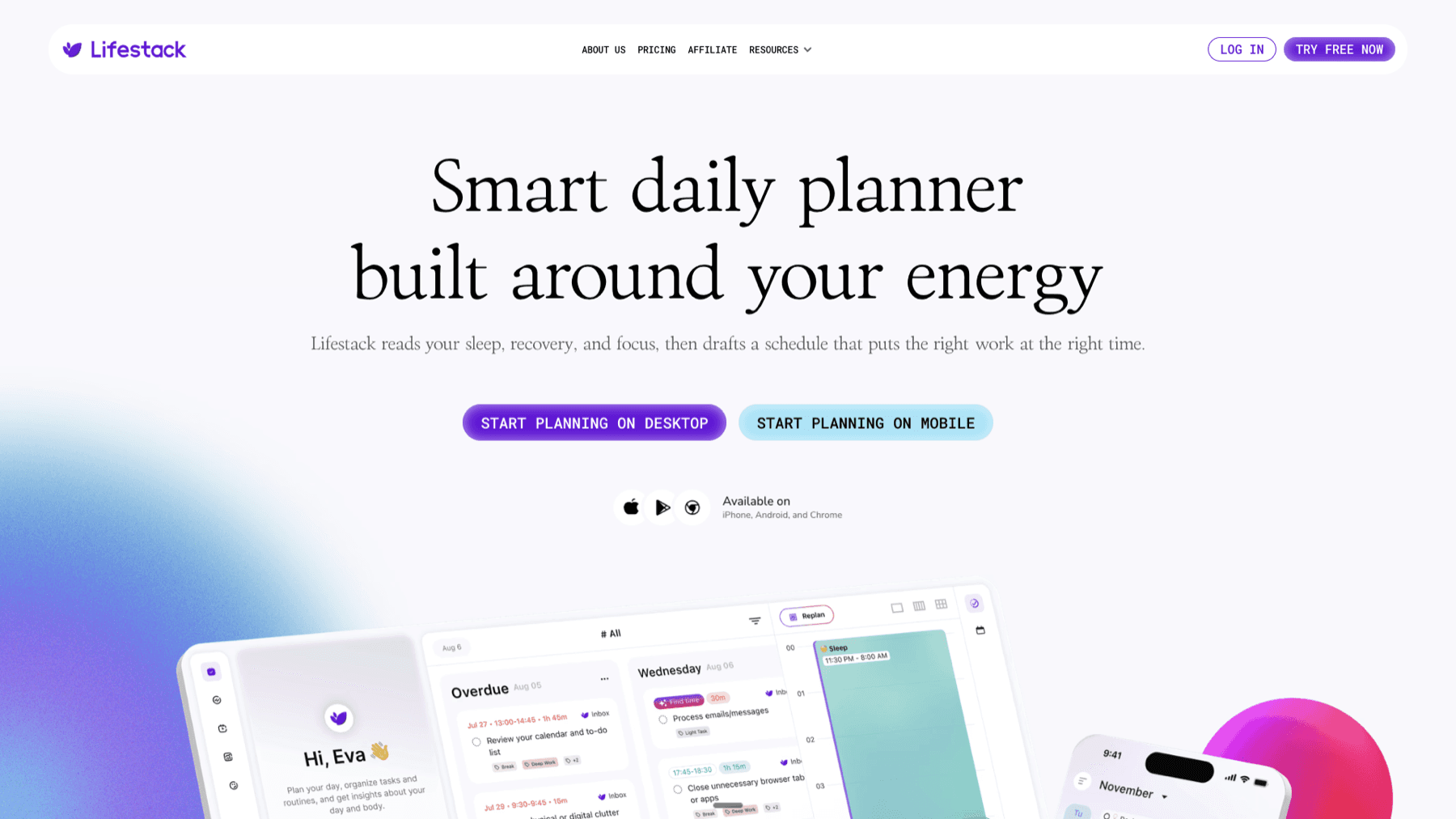
Where most scheduling apps treat all calendar slots as identical, Lifestack makes the energy dimension a first-class variable. If you slept poorly last night, today's schedule reflects that. Your deep work block moves to when you're actually likely to perform, not when you were scheduled to perform.
It integrates with Google Calendar, Outlook, and major wearable platforms. Pricing is $7/month or $50/year (the annual plan includes a 7-day free trial). For anyone who has tried to maintain an energy calendar manually and found it too easy to override when life gets busy, having it run automatically from wearable data removes the most common failure point.
FAQ
What is an energy calendar?
An energy calendar is a scheduling approach where you assign tasks based on your natural energy and cognitive state, not just when time is available. High-demand work gets scheduled during peak focus windows. Meetings and routine tasks go in lower-energy periods. The result is better work quality without more hours.
How do I know when my peak energy is?
Track your focus on a 1-5 scale three times a day for one week. Most people identify a clear pattern within a few days. If you use a wearable device, your sleep and HRV data is a more precise predictor than self-assessment. Apps like Lifestack automate this by reading wearable data directly.
How is an energy calendar different from time blocking?
Time blocking assigns tasks to specific time slots. An energy calendar adds a layer on top of that: the time slots themselves are categorized by cognitive demand level before any tasks are assigned. You're still time-blocking, but the block selection is informed by energy state rather than just availability.
Can I build an energy calendar without a wearable?
Yes. Self-rating your energy manually for one week is enough to identify a working pattern. The limitation is that a static pattern doesn't account for daily variation from sleep quality or stress. A wearable makes the schedule adaptive. Without one, you're working from an average that will sometimes be wrong.
How long does it take to see results from an energy calendar?
Most people notice an improvement in work quality within the first week, simply from protecting their peak window from meetings and low-priority tasks. The full benefit, including schedule adaptation and weekly iteration, typically becomes clear over three to four weeks.
Is an energy calendar useful for people with ADHD?
Especially useful. ADHD makes the mismatch between energy state and task type disproportionately costly. When task demand exceeds current cognitive capacity, ADHD brains are particularly prone to procrastination and task-switching. An energy calendar reduces that mismatch systematically. See: daily planning approaches for ADHD.
Your calendar is lying to you. Not about when your meetings are, but about when you're actually capable of doing your best work. A 9am slot and a 3pm slot look identical on a calendar. They don't feel identical in your brain.
An energy calendar fixes that mismatch. Instead of filling time slots based on availability, you fill them based on cognitive state. Your hardest work goes when your brain is at its sharpest. Administrative tasks, meetings, and routine work fill the gaps. Nothing important gets scheduled at the wrong time again.
This isn't a productivity trend. It's a straightforward application of what we know about circadian rhythms, ultradian cycles, and prefrontal cortex function. This guide walks you through how to build one that actually works for your specific pattern.
Pricing for tools mentioned is verified as of June 2026.
Key Takeaways
Most people have 3 to 5 hours of genuine peak cognitive performance per day. An energy calendar protects those hours for the work that actually requires them.
Not all calendar slots are equal. Aligning task type to energy state has a bigger impact on output quality than most time management techniques.
Wearable data (sleep, HRV, recovery scores) removes the guesswork. Apps like Lifestack can read your data and schedule your day automatically.
What Is an Energy Calendar?
A traditional calendar organizes your time. An energy calendar organizes your time by cognitive capacity.
The idea is that your brain moves through distinct states throughout the day: high-focus peak periods where deep work feels almost effortless, mid-level functional periods where you can handle meetings and correspondence, and low-energy troughs where willpower runs thin and complex thinking falters. These states aren't random. They follow predictable patterns tied to your sleep timing, circadian rhythm, and biological chronotype.
An energy calendar maps those states onto your schedule, then assigns tasks based on fit. A focused writing session goes in your peak window. A budget review goes mid-level. Email and routine admin go in the trough. The calendar looks busier but the work inside it actually gets done.
Step 1: Map Your Natural Energy Curve
Before you can build an energy calendar, you need to know your pattern. Most people have a rough intuition about this but haven't made it explicit.
For one week, rate your focus and energy on a scale of 1 to 5 at three points in the day: morning (9 to 11am), early afternoon (1 to 3pm), and late afternoon (4 to 6pm). Write the number down, don't rely on memory. After a week, a pattern will be visible. Most people find one of three profiles: morning-dominant (peak focus in the first half of the day), split (two peaks with a midday trough), or evening-leaning (focus builds through the day and peaks late afternoon).
If you use a wearable device, you already have this data. Sleep quality, HRV, and recovery scores correlate strongly with cognitive performance. The numbers from the night before are often a better predictor of your day's peak than any self-assessment.
Step 2: Categorize Your Tasks by Cognitive Demand
Not all work requires the same mental resources. Before you can assign tasks to energy zones, you need to categorize them.
High-demand tasks require sustained concentration, complex reasoning, or creative synthesis: writing, analysis, programming, strategy work, anything that requires you to hold multiple variables in working memory simultaneously. These are the tasks that fall apart when you're tired.
Medium-demand tasks require attention but not peak focus: reviewing documents, editing, most meetings, planning and prioritization. You can do these well at 70% capacity.
Low-demand tasks are essentially automatic: email, calendar management, filing, basic logistics. These can and should be done during your energy trough. Doing high-demand work at trough time is one of the most common productivity mistakes people make.
Step 3: Assign Tasks to Energy Zones
With your energy curve mapped and your tasks categorized, the scheduling logic follows directly.
Your peak window gets your highest-demand tasks, protected as hard blocks. Treat this the same way you'd treat an important external meeting: it doesn't move, it doesn't shrink, and it doesn't get turned into a call. This is where you do time blocking in its most important form.
Your medium-energy window handles collaborative work and reviews. Schedule meetings here, not during your peak. A meeting during peak hours costs more than most people realize. An hour of meeting time during your peak window doesn't just cost that hour. It costs the focus state you can't fully recover within the same block.
Your trough handles everything that doesn't require concentration. If you find yourself struggling to stay on task in the afternoon, that's your trough, and fighting it with effort is the wrong approach. Route low-demand work there instead.
Step 4: Build Recovery Blocks Into the Calendar
A common mistake when building an energy calendar is treating recovery time as waste. It isn't.
Cognitive performance degrades with sustained effort even within a peak window. Research on ultradian rhythms suggests the brain cycles through roughly 90-minute focused work periods followed by a natural dip. Trying to push through that dip generally produces worse work than taking a short break.
Build deliberate 10 to 15 minute recovery blocks after each 90-minute work period. Mark them on your calendar so they're protected, not just aspirational. A quick mental offload at the end of a work block, writing down where you left off and what comes next, reduces restart friction and makes the recovery break actually restorative.
Step 5: Anchor Your Energy Calendar to Your Morning
How your morning starts shapes your energy for the rest of the day more than most people account for.
Consistent wake time stabilizes the cortisol awakening response, which is the hormonal signal that primes alertness. Variable wake times, even by an hour or two, delay and flatten that response. The result is a morning that feels sluggish even when sleep duration was adequate.
A structured morning routine that delays phone use, includes brief movement, and ends with a review of your priorities before starting work sets up your energy calendar to work as designed. Without it, your first "peak window" of the day starts already compromised.
Step 6: Use Your Data to Stop Guessing
The biggest limitation of a manually constructed energy calendar is that it's based on self-assessment, which is noisy. A night of poor sleep shifts your peak window. Stress compresses it. Illness eliminates it. A static schedule doesn't adapt to any of this.
If you use a wearable device (Oura Ring, Garmin, Fitbit, or Apple Watch), you're already collecting the data that would allow your schedule to adapt automatically. The question is whether anything acts on it.
A data-driven scheduling app that reads your recovery scores and adjusts your daily task layout accordingly replaces the guesswork with something more reliable. This is where the concept of an energy calendar becomes something that runs continuously rather than something you set up once and hope holds.
Step 7: Review and Adjust Weekly
An energy calendar isn't set-and-forget. The first version you build will be based on an approximation of your pattern. The actual pattern will differ in ways you can only discover by running the system for a few weeks.
Schedule a short weekly review, 10 to 15 minutes, to ask three questions: Did my peak blocks actually contain my best work? Did any tasks end up in the wrong energy zone? Did I protect recovery time, or did it get eroded by scheduling pressure?
Use what you find to adjust the next week's template. Over four to six weeks, most people develop an energy calendar that reflects their actual pattern with enough accuracy that it substantially improves the quality of their work without requiring more total hours. See also: the daily planning practices that complement an energy-based schedule.
Best Tool for Building an Energy Calendar
Lifestack is built specifically around the energy calendar concept. It reads your sleep and recovery data from connected wearable devices and uses that data to lay out your day automatically, placing high-demand task blocks during your predicted peak windows and lighter work during your lower-energy periods.
Where most scheduling apps treat all calendar slots as identical, Lifestack makes the energy dimension a first-class variable. If you slept poorly last night, today's schedule reflects that. Your deep work block moves to when you're actually likely to perform, not when you were scheduled to perform.
It integrates with Google Calendar, Outlook, and major wearable platforms. Pricing is $7/month or $50/year (the annual plan includes a 7-day free trial). For anyone who has tried to maintain an energy calendar manually and found it too easy to override when life gets busy, having it run automatically from wearable data removes the most common failure point.
FAQ
What is an energy calendar?
An energy calendar is a scheduling approach where you assign tasks based on your natural energy and cognitive state, not just when time is available. High-demand work gets scheduled during peak focus windows. Meetings and routine tasks go in lower-energy periods. The result is better work quality without more hours.
How do I know when my peak energy is?
Track your focus on a 1-5 scale three times a day for one week. Most people identify a clear pattern within a few days. If you use a wearable device, your sleep and HRV data is a more precise predictor than self-assessment. Apps like Lifestack automate this by reading wearable data directly.
How is an energy calendar different from time blocking?
Time blocking assigns tasks to specific time slots. An energy calendar adds a layer on top of that: the time slots themselves are categorized by cognitive demand level before any tasks are assigned. You're still time-blocking, but the block selection is informed by energy state rather than just availability.
Can I build an energy calendar without a wearable?
Yes. Self-rating your energy manually for one week is enough to identify a working pattern. The limitation is that a static pattern doesn't account for daily variation from sleep quality or stress. A wearable makes the schedule adaptive. Without one, you're working from an average that will sometimes be wrong.
How long does it take to see results from an energy calendar?
Most people notice an improvement in work quality within the first week, simply from protecting their peak window from meetings and low-priority tasks. The full benefit, including schedule adaptation and weekly iteration, typically becomes clear over three to four weeks.
Is an energy calendar useful for people with ADHD?
Especially useful. ADHD makes the mismatch between energy state and task type disproportionately costly. When task demand exceeds current cognitive capacity, ADHD brains are particularly prone to procrastination and task-switching. An energy calendar reduces that mismatch systematically. See: daily planning approaches for ADHD.



FOLLOW ON
FOLLOW ON
FOLLOW ON


Copyright 2026 © Lifestack. All rights reserved
Copyright 2026 © Lifestack. All rights reserved

