
Tips
How to Stay on Task: 8 Strategies That Actually Work
How to Stay on Task: 8 Strategies That Actually Work
You sit down with a clear plan for the next hour. Twenty minutes later you are three browser tabs deep into something unrelated, a half-finished message sits in Slack, and the thing you actually meant to do has not moved. Staying on task is one of those skills that sounds simple and feels nearly impossible in a world built to pull your attention in every direction.
The good news: focus is not a fixed trait you either have or lack. It is a set of habits and conditions you can set up on purpose. Some of it is about cutting distractions. A lot of it is about working with your attention instead of fighting it.
Below are eight strategies for staying on task that hold up in real workdays, not just in theory. None of them require willpower you do not have. Pick two or three to start with and build from there.
Key Takeaways
Staying on task is less about discipline and more about designing your day and environment so focus is the path of least resistance.
The biggest wins come from defining one clear task at a time, protecting your attention from interruptions, and scheduling work when your energy is naturally highest.
An energy-based planning tool like Lifestack can do the scheduling for you, so you spend effort on the work instead of on deciding what to do next.
1. Define One Clear Task Before You Start
A vague goal like "work on the report" is an invitation to drift. Your brain does not know when it is done, so it keeps wandering toward easier, clearer things. Before you begin, name the single next action in concrete terms: "write the first two sections of the report," not "do the report."
This matters more than most people think. A defined task has a finish line, and a finish line gives your attention something to lock onto. It also makes it obvious when you have wandered off, because you can ask a simple question: is what I am doing right now moving this specific thing forward? If the answer is no, you have caught the drift early.
If you struggle to even begin, the problem is often that the task is too big to picture. Shrink it. The first action should feel almost too small to skip. Our guide on task initiation goes deeper on this, but the short version is that motion beats motivation. Start the small piece and the rest tends to follow.
2. Schedule Work Around Your Energy, Not Just the Clock
Most people plan their day by slotting tasks into open calendar hours. The trouble is that a 2 p.m. slot during an afternoon slump is not the same as a 10 a.m. slot when you are sharp. Treating every hour as equal is why so many carefully built schedules fall apart by lunch.
A better approach is to match your hardest, most focus-heavy work to the windows when your attention is naturally strongest, and save low-stakes admin for the dips. Most people have a clear morning or late-morning peak, a post-lunch trough, and a smaller second wind in the late afternoon. Once you know your pattern, you can stop blaming yourself for losing focus at 3 p.m. and simply stop scheduling deep work there.
This is the core idea behind energy-based planning, and it is the single change that helps the most people stay on task without grinding harder.
3. Remove Distractions Before They Reach You
Willpower is a terrible filter for distractions. Every time a notification lights up and you decide not to check it, you spend a little focus. Do that fifty times a day and there is nothing left. The fix is to stop the interruptions from arriving in the first place.
Turn off non-essential notifications on your phone and computer. Close the tabs and apps you are not actively using. If a particular site is your weak spot, use a blocker during focus blocks so the choice is already made. The goal is an environment where staying on task requires no decisions, because the distractions never show up to tempt you.
Your physical space counts too. A cluttered desk gives your eyes somewhere to wander. A clean one keeps your attention on the screen. You do not need a minimalist shrine, just fewer competing things in view.
4. Work in Focused Sprints With the Pomodoro Technique
Trying to concentrate for hours straight is how most focus attempts collapse. Attention works better in shorter, intense bursts followed by real rest. The Pomodoro Technique formalizes this: work for 25 minutes, then take a 5-minute break, and after four rounds take a longer break.
The timer does two useful things. It creates a small sense of urgency that crowds out the urge to check your phone, and it gives you permission to ignore everything else, because you know a break is coming soon. If 25 minutes feels too short for deep work, stretch it to 45 or 50. The exact numbers matter less than the rhythm of focused push, then recover.
5. Eat the Frog: Do the Hard Thing First
The task you most want to avoid is usually the one that drains your attention all day. It sits in the back of your mind while you do everything else, quietly pulling focus from whatever is in front of you. Doing it first, before email and meetings eat your best hours, clears that background noise.
"Eating the frog" works because your willpower and focus are highest early in the day for most people. Spend that peak on the thing that actually matters, not on clearing your inbox. Once the hardest task is done, the rest of the day feels lighter, and you are far less likely to drift, because the looming dread is gone.
6. Make Starting Easier Than Stopping
A lot of off-task behavior is really avoidance in disguise. When a task feels heavy, your brain reaches for anything that offers a quicker reward. The two-minute rule helps here: commit to doing just two minutes of the task. Almost always, starting is the hard part, and once you are in motion you keep going.
You can also lower the starting friction by setting up everything the night before. Leave the document open, the tab loaded, the notes ready. When you sit down, there is no gap between intention and action for distraction to sneak into. If chronic difficulty starting is a pattern for you, our piece on time management tools covers apps that reduce that friction.
7. Schedule Real Breaks, Not Accidental Ones
If you do not plan breaks, your brain takes them anyway, usually as an unplanned scroll through your phone in the middle of a task. Those accidental breaks are the worst kind, because they fracture your focus right when you need it. Planned breaks protect the focus blocks around them.
Step away from the screen during a break. A short walk, some water, looking out a window. The point is to let your attention reset so the next block starts fresh. Treat breaks as part of the work, not a reward you have to earn, and you will hold focus far longer across the day.
8. Track What Pulls You Off Task
You cannot fix a distraction you have not noticed. For a few days, keep a simple log: every time you catch yourself off task, jot down what pulled you away and roughly what time it was. Patterns show up fast. Maybe it is always Slack right after lunch, or a specific project you keep avoiding.
Once you can see your patterns, you can plan around them. Block the site that keeps winning. Move the dreaded task to your peak hours. Build a buffer into the time of day you reliably lose. Staying on task gets much easier when you stop relying on memory and start working from your own data. Building this awareness is also a core part of stronger organizational skills overall.
The Best Tool for Staying on Task
Most of the strategies above share a hidden cost: they ask you to plan, decide, and re-decide all day. That planning effort is itself a drain on focus. This is where the right tool earns its place, by handling the scheduling so you can spend your attention on the actual work.
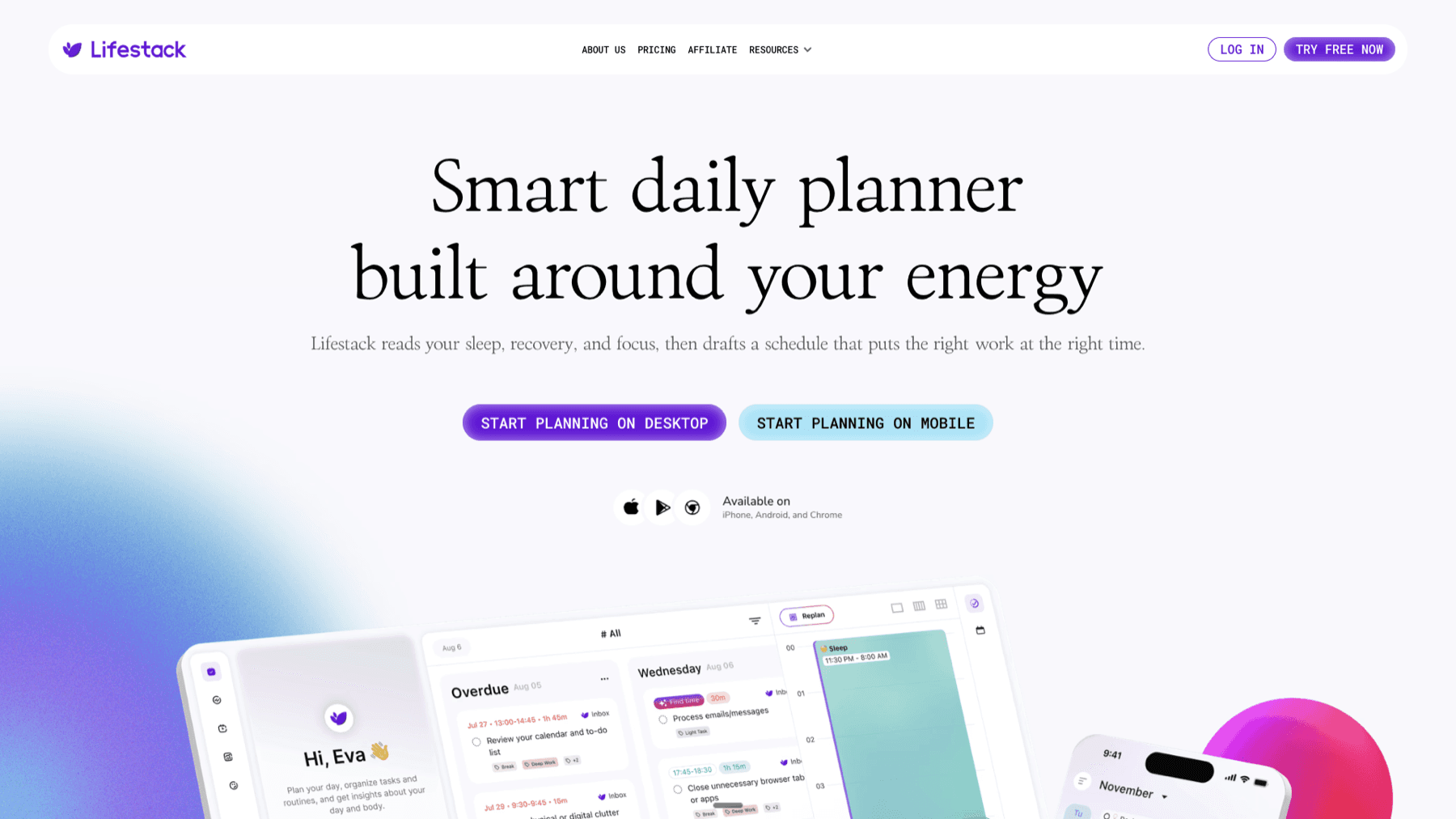
Lifestack builds your day around your energy instead of just empty calendar slots. It reads signals like your sleep and recovery, then schedules your tasks so demanding work lands during your natural focus peaks and lighter work fills the dips. In practice, that means your hardest task is already placed at the time you are most likely to actually do it, which removes the guesswork that usually leads to drift.
It connects to your existing calendar and to-do tools, so you are not starting from scratch. If you want the deeper reasoning behind this approach, read why energy-based planning beats time blocking, or see how Lifestack works. Pricing is straightforward: $7 per month, $50 per year (with a 7-day free trial on the annual plan), or a one-time $120 lifetime purchase. There is no permanent free tier.
Frequently Asked Questions
Why can't I stay on task even when I want to?
Usually it is not a discipline problem. It is some mix of a task that is too vaguely defined, an environment full of interruptions, and trying to focus during a low-energy window. Define the next action clearly, cut the notifications, and move hard work to your peak hours, and most of the struggle eases.
How long should I be able to focus at one time?
For most people, genuine deep focus lasts somewhere between 25 and 90 minutes before attention starts to fade. That is why working in timed sprints with real breaks tends to beat marathon sessions. Find your own ceiling and structure your blocks just under it.
What is the fastest way to stop getting distracted?
Remove the distraction before it reaches you instead of resisting it in the moment. Silence notifications, close unused tabs, and put your phone in another room during focus blocks. Eliminating the choice is far more reliable than trying to win it fifty times a day.
Does the Pomodoro Technique actually work?
For many people, yes, because it creates urgency and guarantees rest. It is not magic, and the exact 25-minute interval is not sacred. The real value is the rhythm of focused work followed by a genuine break, which you can tune to whatever length suits your task.
Can an app help me stay on task?
It can, when it reduces decisions rather than adding more. A planner like Lifestack that schedules your day around your energy means you spend less effort figuring out what to do next, which is often where focus leaks away. Apps that just add more lists and notifications can make things worse.
You sit down with a clear plan for the next hour. Twenty minutes later you are three browser tabs deep into something unrelated, a half-finished message sits in Slack, and the thing you actually meant to do has not moved. Staying on task is one of those skills that sounds simple and feels nearly impossible in a world built to pull your attention in every direction.
The good news: focus is not a fixed trait you either have or lack. It is a set of habits and conditions you can set up on purpose. Some of it is about cutting distractions. A lot of it is about working with your attention instead of fighting it.
Below are eight strategies for staying on task that hold up in real workdays, not just in theory. None of them require willpower you do not have. Pick two or three to start with and build from there.
Key Takeaways
Staying on task is less about discipline and more about designing your day and environment so focus is the path of least resistance.
The biggest wins come from defining one clear task at a time, protecting your attention from interruptions, and scheduling work when your energy is naturally highest.
An energy-based planning tool like Lifestack can do the scheduling for you, so you spend effort on the work instead of on deciding what to do next.
1. Define One Clear Task Before You Start
A vague goal like "work on the report" is an invitation to drift. Your brain does not know when it is done, so it keeps wandering toward easier, clearer things. Before you begin, name the single next action in concrete terms: "write the first two sections of the report," not "do the report."
This matters more than most people think. A defined task has a finish line, and a finish line gives your attention something to lock onto. It also makes it obvious when you have wandered off, because you can ask a simple question: is what I am doing right now moving this specific thing forward? If the answer is no, you have caught the drift early.
If you struggle to even begin, the problem is often that the task is too big to picture. Shrink it. The first action should feel almost too small to skip. Our guide on task initiation goes deeper on this, but the short version is that motion beats motivation. Start the small piece and the rest tends to follow.
2. Schedule Work Around Your Energy, Not Just the Clock
Most people plan their day by slotting tasks into open calendar hours. The trouble is that a 2 p.m. slot during an afternoon slump is not the same as a 10 a.m. slot when you are sharp. Treating every hour as equal is why so many carefully built schedules fall apart by lunch.
A better approach is to match your hardest, most focus-heavy work to the windows when your attention is naturally strongest, and save low-stakes admin for the dips. Most people have a clear morning or late-morning peak, a post-lunch trough, and a smaller second wind in the late afternoon. Once you know your pattern, you can stop blaming yourself for losing focus at 3 p.m. and simply stop scheduling deep work there.
This is the core idea behind energy-based planning, and it is the single change that helps the most people stay on task without grinding harder.
3. Remove Distractions Before They Reach You
Willpower is a terrible filter for distractions. Every time a notification lights up and you decide not to check it, you spend a little focus. Do that fifty times a day and there is nothing left. The fix is to stop the interruptions from arriving in the first place.
Turn off non-essential notifications on your phone and computer. Close the tabs and apps you are not actively using. If a particular site is your weak spot, use a blocker during focus blocks so the choice is already made. The goal is an environment where staying on task requires no decisions, because the distractions never show up to tempt you.
Your physical space counts too. A cluttered desk gives your eyes somewhere to wander. A clean one keeps your attention on the screen. You do not need a minimalist shrine, just fewer competing things in view.
4. Work in Focused Sprints With the Pomodoro Technique
Trying to concentrate for hours straight is how most focus attempts collapse. Attention works better in shorter, intense bursts followed by real rest. The Pomodoro Technique formalizes this: work for 25 minutes, then take a 5-minute break, and after four rounds take a longer break.
The timer does two useful things. It creates a small sense of urgency that crowds out the urge to check your phone, and it gives you permission to ignore everything else, because you know a break is coming soon. If 25 minutes feels too short for deep work, stretch it to 45 or 50. The exact numbers matter less than the rhythm of focused push, then recover.
5. Eat the Frog: Do the Hard Thing First
The task you most want to avoid is usually the one that drains your attention all day. It sits in the back of your mind while you do everything else, quietly pulling focus from whatever is in front of you. Doing it first, before email and meetings eat your best hours, clears that background noise.
"Eating the frog" works because your willpower and focus are highest early in the day for most people. Spend that peak on the thing that actually matters, not on clearing your inbox. Once the hardest task is done, the rest of the day feels lighter, and you are far less likely to drift, because the looming dread is gone.
6. Make Starting Easier Than Stopping
A lot of off-task behavior is really avoidance in disguise. When a task feels heavy, your brain reaches for anything that offers a quicker reward. The two-minute rule helps here: commit to doing just two minutes of the task. Almost always, starting is the hard part, and once you are in motion you keep going.
You can also lower the starting friction by setting up everything the night before. Leave the document open, the tab loaded, the notes ready. When you sit down, there is no gap between intention and action for distraction to sneak into. If chronic difficulty starting is a pattern for you, our piece on time management tools covers apps that reduce that friction.
7. Schedule Real Breaks, Not Accidental Ones
If you do not plan breaks, your brain takes them anyway, usually as an unplanned scroll through your phone in the middle of a task. Those accidental breaks are the worst kind, because they fracture your focus right when you need it. Planned breaks protect the focus blocks around them.
Step away from the screen during a break. A short walk, some water, looking out a window. The point is to let your attention reset so the next block starts fresh. Treat breaks as part of the work, not a reward you have to earn, and you will hold focus far longer across the day.
8. Track What Pulls You Off Task
You cannot fix a distraction you have not noticed. For a few days, keep a simple log: every time you catch yourself off task, jot down what pulled you away and roughly what time it was. Patterns show up fast. Maybe it is always Slack right after lunch, or a specific project you keep avoiding.
Once you can see your patterns, you can plan around them. Block the site that keeps winning. Move the dreaded task to your peak hours. Build a buffer into the time of day you reliably lose. Staying on task gets much easier when you stop relying on memory and start working from your own data. Building this awareness is also a core part of stronger organizational skills overall.
The Best Tool for Staying on Task
Most of the strategies above share a hidden cost: they ask you to plan, decide, and re-decide all day. That planning effort is itself a drain on focus. This is where the right tool earns its place, by handling the scheduling so you can spend your attention on the actual work.
Lifestack builds your day around your energy instead of just empty calendar slots. It reads signals like your sleep and recovery, then schedules your tasks so demanding work lands during your natural focus peaks and lighter work fills the dips. In practice, that means your hardest task is already placed at the time you are most likely to actually do it, which removes the guesswork that usually leads to drift.
It connects to your existing calendar and to-do tools, so you are not starting from scratch. If you want the deeper reasoning behind this approach, read why energy-based planning beats time blocking, or see how Lifestack works. Pricing is straightforward: $7 per month, $50 per year (with a 7-day free trial on the annual plan), or a one-time $120 lifetime purchase. There is no permanent free tier.
Frequently Asked Questions
Why can't I stay on task even when I want to?
Usually it is not a discipline problem. It is some mix of a task that is too vaguely defined, an environment full of interruptions, and trying to focus during a low-energy window. Define the next action clearly, cut the notifications, and move hard work to your peak hours, and most of the struggle eases.
How long should I be able to focus at one time?
For most people, genuine deep focus lasts somewhere between 25 and 90 minutes before attention starts to fade. That is why working in timed sprints with real breaks tends to beat marathon sessions. Find your own ceiling and structure your blocks just under it.
What is the fastest way to stop getting distracted?
Remove the distraction before it reaches you instead of resisting it in the moment. Silence notifications, close unused tabs, and put your phone in another room during focus blocks. Eliminating the choice is far more reliable than trying to win it fifty times a day.
Does the Pomodoro Technique actually work?
For many people, yes, because it creates urgency and guarantees rest. It is not magic, and the exact 25-minute interval is not sacred. The real value is the rhythm of focused work followed by a genuine break, which you can tune to whatever length suits your task.
Can an app help me stay on task?
It can, when it reduces decisions rather than adding more. A planner like Lifestack that schedules your day around your energy means you spend less effort figuring out what to do next, which is often where focus leaks away. Apps that just add more lists and notifications can make things worse.



FOLLOW ON
FOLLOW ON
FOLLOW ON


Copyright 2026 © Lifestack. All rights reserved
Copyright 2026 © Lifestack. All rights reserved

