
Tips
How to Improve Organizational Skills in 2026
How to Improve Organizational Skills in 2026
Organizational skills get treated like a personality type. Either you were born tidy and on top of things, or you weren't. But that framing lets a lot of people off the hook from building habits that actually work.
The truth is that organization is a set of practiced behaviors. And the behaviors aren't that complicated. The problem is most advice asks you to overhaul everything at once, which means you try it for a week, life happens, and the system collapses. What actually works is picking one or two behaviors, doing them until they're automatic, then adding the next one.
This guide covers eight strategies drawn from research on attention, planning, and how people actually stay on top of things over time. Not productivity theater. Things that hold up when you're busy.
Key Takeaways
Having five half-used organizational systems is worse than having one mediocre one you actually use. Consolidate first.
Most organizational failures happen at the planning stage, not the execution stage. People skip the weekly review and then wonder why things slip.
When you do your work matters as much as what work you do. Scheduling demanding tasks during low-energy hours is a setup for frustration.
1. Pick One Place for Everything and Actually Use It
The most common reason people feel disorganized isn't that they lack a system. It's that they have too many. Tasks scattered across email, a notes app, a physical notebook, three different messaging threads, and their own head. None of those places talk to each other. Things slip between them constantly.
Fix: one inbox. One place where every task, commitment, and idea lands before you decide what to do with it. The specific tool doesn't matter much. What matters is that when something needs to be remembered, your first instinct is to put it there, not to try to hold it mentally until later.
Todoist works well for this because the quick-add shortcut is fast enough to become a reflex. TickTick is similar. A physical index card works too if that's what you'll actually use. The only rule is that there's one of them, not four.
2. Plan the Week Before It Starts
Daily planning sounds like the right move but it mostly doesn't work. By Monday morning you're already reacting: emails have arrived, something changed, someone needs something. Planning in that state produces a to-do list built around whatever feels urgent right now, not around what actually matters.
Sunday evening, 20 minutes. Review what's open, what's due, and what you're trying to accomplish this week. Pick two or three outcomes that would make the week a success. Block time on the calendar for the work that requires focus before meetings fill those slots.
That's it. You're not building a minute-by-minute schedule. You're just answering: what am I trying to get done, and when am I doing it? Those two questions prevent most of the week's organizational failures before they happen.
3. Time-Block Your Most Important Work
A calendar full of meetings isn't the problem. A calendar full of meetings with no protected time for actual work is the problem. The difference is whether you've put your own work on the calendar before other people's requests fill it.
Time-blocking doesn't mean scheduling every task. It means reserving slots for focused work the same way you'd reserve time for a meeting. Tuesday 9-11am: project work. Thursday morning: deep work. Those blocks are yours unless something genuinely urgent comes up.
The Eisenhower Matrix is useful for deciding what gets a block. The quadrant most people neglect is important-but-not-urgent work: the strategic tasks, the things that prevent problems down the road. Those never feel urgent, so they never get done without a deliberate time slot.
4. The Two-Minute Rule: Do It Now or Schedule It
David Allen's rule from Getting Things Done is one of the few productivity ideas that actually transfers to real life: if a task takes under two minutes, do it immediately. Don't add it to a list. Don't mentally defer it. Just do it.
For anything longer, the rule flips. It goes on the list immediately, not back into your head. The cognitive cost of carrying an unresolved task around is surprisingly high. Every time your brain surfaces it ("I should really email that person"), it spends mental energy without making progress. Getting it out of your head and onto paper removes that drain.
Email is where this discipline matters most. Most people treat their inbox like a to-do list. It isn't. Process it in batches: reply to anything quick, schedule longer responses for a dedicated block, archive everything else. An inbox with 3,000 messages in it isn't a system. It's a pile.
5. Do a Weekly Digital Declutter
Physical clutter is visible so you feel the pressure to deal with it. Digital clutter is invisible, which is why a desktop covered in files, a downloads folder no one has touched since last year, and 40 open browser tabs can quietly drain your attention without you noticing why.
Notion helps with the consolidation side of this: notes, reference docs, and project materials in one searchable place instead of scattered across apps. But the weekly habit matters more than the tool. Fifteen minutes once a week: clear the desktop, file or delete what's in downloads, close tabs that aren't actively in use.
Open tabs are deferred decisions. Each one is your brain saying "I might need this later." At some point "later" becomes "never" and you're carrying 60 deferred decisions around all day. Close them. If it mattered, you'll find it again.
6. Match Hard Work to Your Peak Energy Hours
Energy management gets talked about a lot less than time management, but it's at least as important. A two-hour focus block at 3pm when you're running on empty produces worse work than 45 minutes at 10am when you're sharp. The calendar can look perfectly organized and still be set up for failure if the tasks are in the wrong slots.
Most people have a rough sense of their peak window: usually 2-3 hours in the morning, though it varies. The practice is protecting that window for work that requires real cognitive load, and pushing administrative tasks, easy emails, and meetings to the hours when your focus naturally dips.
Wearables like Oura and WHOOP now give you actual readiness scores, so on days when recovery is poor, you can adjust the plan before you've already committed to four hours of deep work that won't happen. Lifestack reads that data and builds a daily schedule around it automatically, which is useful if you consistently override your own intuitions about when you're actually in shape to do hard things.
7. Build a Weekly Review Habit
If there's one habit that separates people who stay consistently organized from people who periodically are, it's the weekly review. Without it, tasks that didn't get done last week quietly disappear. Projects that were moving stall. The gap between your intentions and your actual priorities widens every week until a deadline reminds you it exists.
The review itself is simple. Four questions: what did I finish this week? What's still open? What's due next week? What am I forgetting? That takes 15-20 minutes with your task list and calendar in front of you. Done consistently, it means nothing stays lost for more than seven days.
Schedule it as a recurring calendar event, not as something you do when you remember to. Friday afternoon or Sunday evening both work. The specific time matters less than having it locked in.
8. Stop Multitasking
Multitasking on cognitive work doesn't exist. What actually happens is rapid context-switching, and each switch costs 15-20 minutes of regaining focus. So an hour of "multitasking" produces maybe 20 minutes of actual concentrated work. It feels productive because you're busy. It isn't.
The fix is simple to describe and annoying to implement: work on one thing until it's done or until a defined time block ends, with notifications off and unrelated tabs closed. The Pomodoro technique (25 minutes on, 5 minutes off) helps if you struggle to stay on task, because the timer removes the decision of "how long should I do this."
Organizational systems don't fail because people are lazy. They fail because people try to manage too many things at the same time. The clearest sign of good organizational skills is usually a person who's doing one thing and doing it fully. Not someone with a more sophisticated system.
The Best Tool for This
Most of the strategies above can be done with a notebook and a calendar app. But one tool handles strategies 2, 3, and 6 together better than anything else we've found.
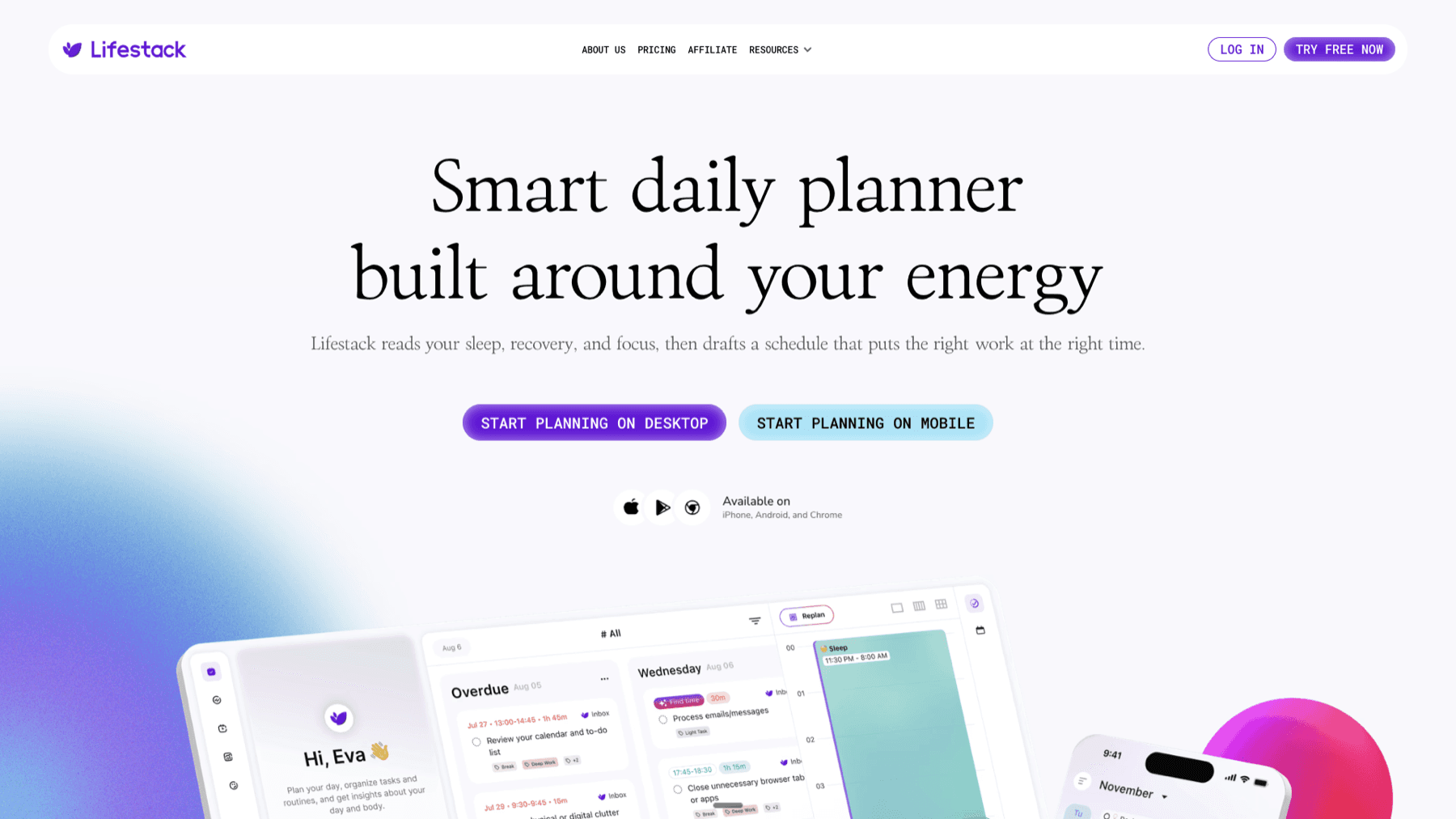
Lifestack is an AI daily planner that reads your sleep and recovery data from Oura, WHOOP, or Apple Watch and builds your daily schedule around your actual energy, not just your calendar. It connects to your task list, sees what's due, and decides what gets scheduled in which slot based on how ready your body and brain are to do that type of work.
The part that makes it practically useful is the rescheduling. When something runs long or a meeting drops in, it rebuilds the plan around the new reality instead of leaving you with a broken schedule and no good sense of what comes next. For people who struggle with the planning and sequencing part specifically, handing that decision to an AI removes a significant amount of daily friction.
Pricing: $7/month or $50/year. Seven-day free trial on the annual plan. iOS, Android, and Chrome extension.
Frequently Asked Questions
How long does it take to actually improve organizational skills?
Two to four weeks for the first noticeable shift, if you're consistent. The fastest gains come from the capture inbox and the weekly review because they produce immediate results: less stuff falling through the cracks, less anxiety about what you might be forgetting. Building the full set of habits takes longer, but most people find that the first habit makes the second one easier to start.
What organizational skills matter most at work?
Prioritization and deadline management are cited most often, but the one that tends to differentiate people in practice is communication around timelines. Knowing what's on your plate, what's slipping, and flagging it early is more valued than having a perfect system that you operate in silence. Good task management makes that communication easier because you actually know what's on your plate.
Can people with ADHD improve their organizational skills?
Yes, but the standard advice often doesn't fit. Systems that rely on working memory, consistent initiation, or willpower to maintain tend to fall apart for ADHD brains, not because of laziness but because of how executive function actually works. Energy-based planning and tools that automate the sequencing decisions tend to work better than rigid manual systems. The goal is reducing the number of decisions required to stay organized, not adding more structure to manage.
Is it better to use a digital or paper system?
Both work. Research doesn't favor either. Paper is faster for capturing raw ideas and doesn't have notifications. Digital syncs across devices and is searchable. Most people who stay consistently organized use some combination: paper for thinking and quick capture, digital for storage and scheduling. The critical rule is one primary system, not five partially used ones.
What's the fastest way to feel less overwhelmed when everything piles up?
Brain dump first. Write down every open task, commitment, and thing you're worried about forgetting, all in one place, without trying to organize it. Then go through the list and ask: what actually has a consequence today if it doesn't happen? That question usually reduces 40 items to three. Do those three. The rest goes back on the list for tomorrow's review. It doesn't solve everything, but it gets you moving when paralysis sets in.
Organizational skills get treated like a personality type. Either you were born tidy and on top of things, or you weren't. But that framing lets a lot of people off the hook from building habits that actually work.
The truth is that organization is a set of practiced behaviors. And the behaviors aren't that complicated. The problem is most advice asks you to overhaul everything at once, which means you try it for a week, life happens, and the system collapses. What actually works is picking one or two behaviors, doing them until they're automatic, then adding the next one.
This guide covers eight strategies drawn from research on attention, planning, and how people actually stay on top of things over time. Not productivity theater. Things that hold up when you're busy.
Key Takeaways
Having five half-used organizational systems is worse than having one mediocre one you actually use. Consolidate first.
Most organizational failures happen at the planning stage, not the execution stage. People skip the weekly review and then wonder why things slip.
When you do your work matters as much as what work you do. Scheduling demanding tasks during low-energy hours is a setup for frustration.
1. Pick One Place for Everything and Actually Use It
The most common reason people feel disorganized isn't that they lack a system. It's that they have too many. Tasks scattered across email, a notes app, a physical notebook, three different messaging threads, and their own head. None of those places talk to each other. Things slip between them constantly.
Fix: one inbox. One place where every task, commitment, and idea lands before you decide what to do with it. The specific tool doesn't matter much. What matters is that when something needs to be remembered, your first instinct is to put it there, not to try to hold it mentally until later.
Todoist works well for this because the quick-add shortcut is fast enough to become a reflex. TickTick is similar. A physical index card works too if that's what you'll actually use. The only rule is that there's one of them, not four.
2. Plan the Week Before It Starts
Daily planning sounds like the right move but it mostly doesn't work. By Monday morning you're already reacting: emails have arrived, something changed, someone needs something. Planning in that state produces a to-do list built around whatever feels urgent right now, not around what actually matters.
Sunday evening, 20 minutes. Review what's open, what's due, and what you're trying to accomplish this week. Pick two or three outcomes that would make the week a success. Block time on the calendar for the work that requires focus before meetings fill those slots.
That's it. You're not building a minute-by-minute schedule. You're just answering: what am I trying to get done, and when am I doing it? Those two questions prevent most of the week's organizational failures before they happen.
3. Time-Block Your Most Important Work
A calendar full of meetings isn't the problem. A calendar full of meetings with no protected time for actual work is the problem. The difference is whether you've put your own work on the calendar before other people's requests fill it.
Time-blocking doesn't mean scheduling every task. It means reserving slots for focused work the same way you'd reserve time for a meeting. Tuesday 9-11am: project work. Thursday morning: deep work. Those blocks are yours unless something genuinely urgent comes up.
The Eisenhower Matrix is useful for deciding what gets a block. The quadrant most people neglect is important-but-not-urgent work: the strategic tasks, the things that prevent problems down the road. Those never feel urgent, so they never get done without a deliberate time slot.
4. The Two-Minute Rule: Do It Now or Schedule It
David Allen's rule from Getting Things Done is one of the few productivity ideas that actually transfers to real life: if a task takes under two minutes, do it immediately. Don't add it to a list. Don't mentally defer it. Just do it.
For anything longer, the rule flips. It goes on the list immediately, not back into your head. The cognitive cost of carrying an unresolved task around is surprisingly high. Every time your brain surfaces it ("I should really email that person"), it spends mental energy without making progress. Getting it out of your head and onto paper removes that drain.
Email is where this discipline matters most. Most people treat their inbox like a to-do list. It isn't. Process it in batches: reply to anything quick, schedule longer responses for a dedicated block, archive everything else. An inbox with 3,000 messages in it isn't a system. It's a pile.
5. Do a Weekly Digital Declutter
Physical clutter is visible so you feel the pressure to deal with it. Digital clutter is invisible, which is why a desktop covered in files, a downloads folder no one has touched since last year, and 40 open browser tabs can quietly drain your attention without you noticing why.
Notion helps with the consolidation side of this: notes, reference docs, and project materials in one searchable place instead of scattered across apps. But the weekly habit matters more than the tool. Fifteen minutes once a week: clear the desktop, file or delete what's in downloads, close tabs that aren't actively in use.
Open tabs are deferred decisions. Each one is your brain saying "I might need this later." At some point "later" becomes "never" and you're carrying 60 deferred decisions around all day. Close them. If it mattered, you'll find it again.
6. Match Hard Work to Your Peak Energy Hours
Energy management gets talked about a lot less than time management, but it's at least as important. A two-hour focus block at 3pm when you're running on empty produces worse work than 45 minutes at 10am when you're sharp. The calendar can look perfectly organized and still be set up for failure if the tasks are in the wrong slots.
Most people have a rough sense of their peak window: usually 2-3 hours in the morning, though it varies. The practice is protecting that window for work that requires real cognitive load, and pushing administrative tasks, easy emails, and meetings to the hours when your focus naturally dips.
Wearables like Oura and WHOOP now give you actual readiness scores, so on days when recovery is poor, you can adjust the plan before you've already committed to four hours of deep work that won't happen. Lifestack reads that data and builds a daily schedule around it automatically, which is useful if you consistently override your own intuitions about when you're actually in shape to do hard things.
7. Build a Weekly Review Habit
If there's one habit that separates people who stay consistently organized from people who periodically are, it's the weekly review. Without it, tasks that didn't get done last week quietly disappear. Projects that were moving stall. The gap between your intentions and your actual priorities widens every week until a deadline reminds you it exists.
The review itself is simple. Four questions: what did I finish this week? What's still open? What's due next week? What am I forgetting? That takes 15-20 minutes with your task list and calendar in front of you. Done consistently, it means nothing stays lost for more than seven days.
Schedule it as a recurring calendar event, not as something you do when you remember to. Friday afternoon or Sunday evening both work. The specific time matters less than having it locked in.
8. Stop Multitasking
Multitasking on cognitive work doesn't exist. What actually happens is rapid context-switching, and each switch costs 15-20 minutes of regaining focus. So an hour of "multitasking" produces maybe 20 minutes of actual concentrated work. It feels productive because you're busy. It isn't.
The fix is simple to describe and annoying to implement: work on one thing until it's done or until a defined time block ends, with notifications off and unrelated tabs closed. The Pomodoro technique (25 minutes on, 5 minutes off) helps if you struggle to stay on task, because the timer removes the decision of "how long should I do this."
Organizational systems don't fail because people are lazy. They fail because people try to manage too many things at the same time. The clearest sign of good organizational skills is usually a person who's doing one thing and doing it fully. Not someone with a more sophisticated system.
The Best Tool for This
Most of the strategies above can be done with a notebook and a calendar app. But one tool handles strategies 2, 3, and 6 together better than anything else we've found.
Lifestack is an AI daily planner that reads your sleep and recovery data from Oura, WHOOP, or Apple Watch and builds your daily schedule around your actual energy, not just your calendar. It connects to your task list, sees what's due, and decides what gets scheduled in which slot based on how ready your body and brain are to do that type of work.
The part that makes it practically useful is the rescheduling. When something runs long or a meeting drops in, it rebuilds the plan around the new reality instead of leaving you with a broken schedule and no good sense of what comes next. For people who struggle with the planning and sequencing part specifically, handing that decision to an AI removes a significant amount of daily friction.
Pricing: $7/month or $50/year. Seven-day free trial on the annual plan. iOS, Android, and Chrome extension.
Frequently Asked Questions
How long does it take to actually improve organizational skills?
Two to four weeks for the first noticeable shift, if you're consistent. The fastest gains come from the capture inbox and the weekly review because they produce immediate results: less stuff falling through the cracks, less anxiety about what you might be forgetting. Building the full set of habits takes longer, but most people find that the first habit makes the second one easier to start.
What organizational skills matter most at work?
Prioritization and deadline management are cited most often, but the one that tends to differentiate people in practice is communication around timelines. Knowing what's on your plate, what's slipping, and flagging it early is more valued than having a perfect system that you operate in silence. Good task management makes that communication easier because you actually know what's on your plate.
Can people with ADHD improve their organizational skills?
Yes, but the standard advice often doesn't fit. Systems that rely on working memory, consistent initiation, or willpower to maintain tend to fall apart for ADHD brains, not because of laziness but because of how executive function actually works. Energy-based planning and tools that automate the sequencing decisions tend to work better than rigid manual systems. The goal is reducing the number of decisions required to stay organized, not adding more structure to manage.
Is it better to use a digital or paper system?
Both work. Research doesn't favor either. Paper is faster for capturing raw ideas and doesn't have notifications. Digital syncs across devices and is searchable. Most people who stay consistently organized use some combination: paper for thinking and quick capture, digital for storage and scheduling. The critical rule is one primary system, not five partially used ones.
What's the fastest way to feel less overwhelmed when everything piles up?
Brain dump first. Write down every open task, commitment, and thing you're worried about forgetting, all in one place, without trying to organize it. Then go through the list and ask: what actually has a consequence today if it doesn't happen? That question usually reduces 40 items to three. Do those three. The rest goes back on the list for tomorrow's review. It doesn't solve everything, but it gets you moving when paralysis sets in.



FOLLOW ON
FOLLOW ON
FOLLOW ON


Copyright 2026 © Lifestack. All rights reserved
Copyright 2026 © Lifestack. All rights reserved

