
Device
Garmin Forerunner 55 Review: Worth Buying in 2026?
Garmin Forerunner 55 Review: Worth Buying in 2026?
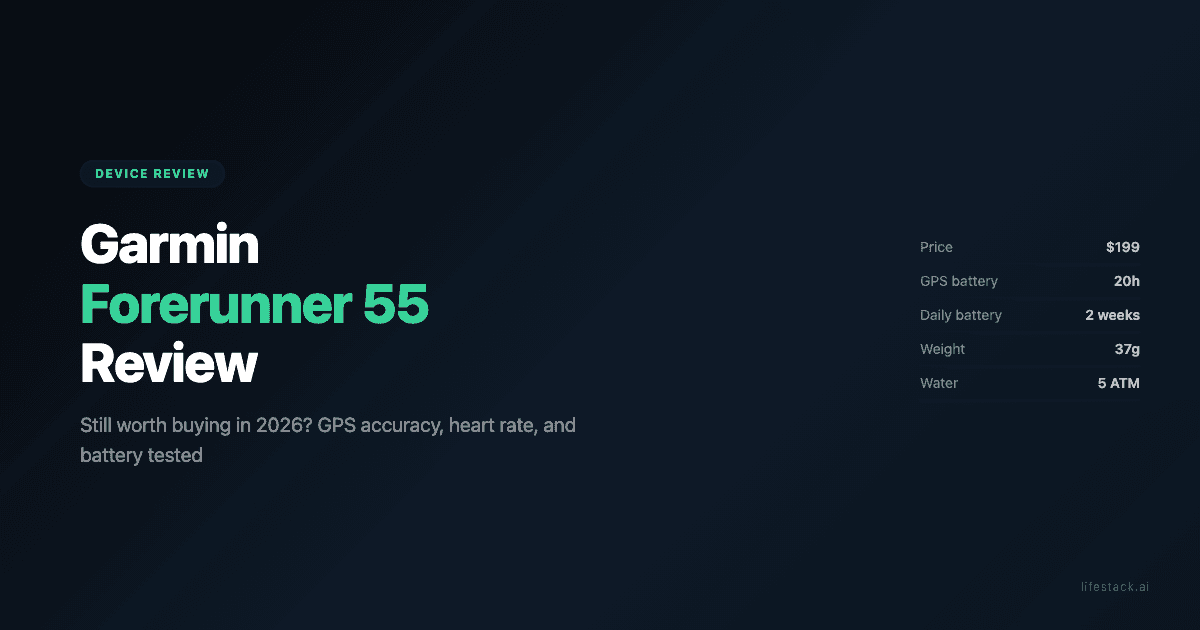
The Garmin Forerunner 55 launched in 2021 as Garmin's entry-level GPS running watch and has spent the last several years as the default recommendation for new runners who want reliable GPS data without paying $300 or more. In 2026, Garmin officially discontinued it, replacing it with the Forerunner 165. But the Forerunner 55 still appears regularly on sale, in used markets, and on retailer shelves working through remaining inventory.
So the question for anyone considering one is simple: is the Forerunner 55 still worth buying in 2026 at its current price, or does the newer Forerunner 165 make it irrelevant?
This review covers the Forerunner 55's actual performance: GPS accuracy, heart rate monitoring, battery life, and training features. Then we answer the buy-or-skip question directly.
Key Takeaways
The Forerunner 55 is an excellent entry-level GPS running watch with solid accuracy at an accessible price, but it is now discontinued
GPS distance accuracy is within 2% of reference devices in most conditions; single-band GPS struggles in dense urban canyons
If you can find it at $149 or below, it is worth buying. At $199 or above, the Forerunner 165 is a better long-term investment
A Note on Discontinued Status
Garmin's official product page lists the Forerunner 55 as discontinued and redirects to their current running watch lineup. This does not mean it has stopped working. Garmin typically supports older devices with software updates for several years after discontinuation. Connect IQ apps, Garmin Connect sync, and all training features remain fully functional on existing devices.
What discontinuation means practically: no new color variants, accessories may become harder to find, and Garmin's customer support will eventually deprioritize it. For a buyer looking at a three-to-five year horizon, this is a consideration worth taking seriously.
Design and Comfort
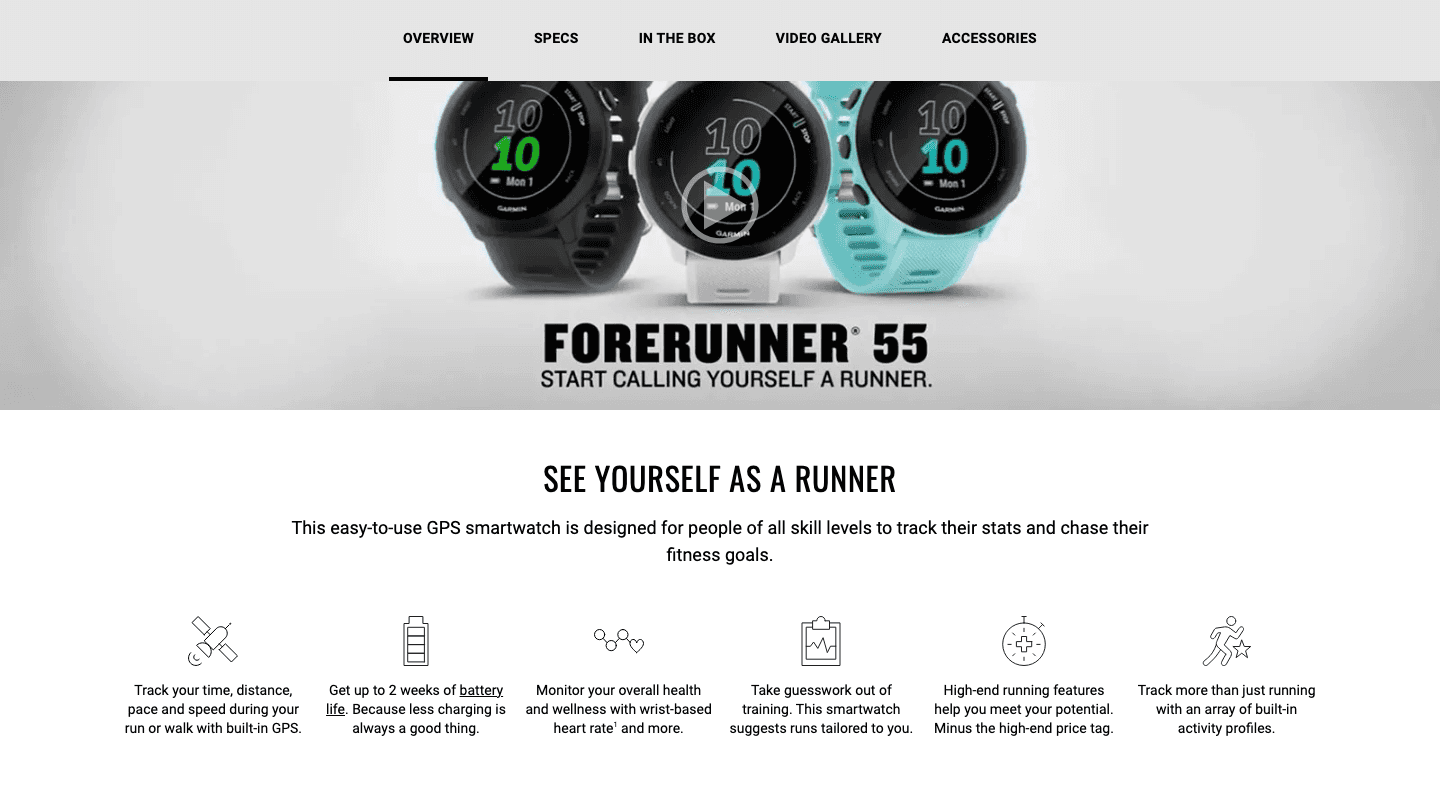
The Forerunner 55 is small by GPS watch standards. The 42mm case at 37 grams sits almost invisibly on smaller wrists. The 1.04-inch transflective display is readable in sunlight without needing to shade it, though it lacks the color vibrancy of the AMOLED panels on newer models. If you are used to a smartphone screen, the display looks modest. If you are used to running with a basic GPS watch, it looks fine.
The silicone strap is comfortable for training but not the most attractive band for everyday wear. Garmin uses standard 20mm swappable bands, so third-party options are widely available. The 50-meter water resistance makes it safe for swimming and rain without worrying about damage.
GPS Accuracy
The Forerunner 55 uses a single-band GPS chip with support for GPS, GLONASS, and Galileo satellite systems. In open conditions, distance accuracy is within 2% of reference chest-strap measurements in most test runs. Route tracking follows roads and trail surfaces accurately in parks, open paths, and standard urban environments.
In dense urban canyons with tall buildings on both sides, single-band GPS can show the occasional zigzag or inaccurate distance. This is a hardware limitation that multi-band GPS (available on higher-end Garmin watches like the Forerunner 265) handles better. For most recreational runners training in parks, neighborhoods, and on trails, it will not be a noticeable problem.
Heart Rate Monitoring
Garmin's V3 optical heart rate sensor averages around 1.8 bpm variance against a Polar H10 chest strap during steady aerobic runs. That is accurate enough to make heart rate zone training reliable for most athletes. During high-intensity intervals, the sensor shows the typical optical lag of 5-10 seconds. If interval precision is critical, pairing the watch with an external chest strap gives you more accurate zone data.
Garmin's calorie burn estimates use heart rate data as an input alongside weight, age, and activity type. Like all wrist-based calorie calculations, they are directionally useful but not precise to the calorie.
Battery Life
Two weeks of daily smartwatch use and 20 hours of GPS tracking are the headline numbers, and both hold up in real-world testing. For runners doing up to 10 hours of GPS time per week, the Forerunner 55 needs charging about once a week. For lower-mileage runners, the two-week smartwatch battery eliminates the daily charging habit entirely. This remains a genuine advantage over competitors like the Apple Watch at any tier.
Training Features
The Forerunner 55 includes daily suggested workouts that adapt based on your recent training load and fitness level. PacePro strategies let you set a target finish time for a race and then follow pace guidance that adjusts for elevation. Both features are genuinely useful for runners following a training plan, not just logging miles.
Body Battery tracks energy level throughout the day based on heart rate variability, stress, and activity. Understanding Garmin Body Battery is worth reading if you are new to this metric. Recovery Advisor estimates how long to rest after a hard workout. VO2 max tracking estimates your aerobic fitness over time; the guide on how to improve VO2 max explains how to act on those numbers.
Triathlon mode is included, which is unusual at this price point. It supports swim, bike, and run segments with automatic transitions. Not a full triathlon watch, but functional for sprint and Olympic distance events.
Forerunner 55 vs Forerunner 165: Should You Upgrade?
The Forerunner 165 is the current replacement and starts at $249. For the extra $50-$100 over a discounted Forerunner 55, you get an AMOLED display that looks dramatically better, multi-band GPS for improved accuracy in challenging environments, Bluetooth music controls, and a more recent optical heart rate sensor. The 165's training features are broadly similar to the 55's.
If you find the Forerunner 55 for $149 or less and plan to replace your watch in two to three years anyway, it is still a smart buy. At $179-199 against the 165 at $249, the $50-70 difference is worth paying for the hardware improvements and a watch that has a longer support life ahead of it. See also the COROS vs Garmin comparison if you are considering the COROS PACE 3 or PACE 4 as well.
Your Training Data Deserves Better Planning
The Forerunner 55 collects pace, distance, heart rate, and Body Battery data. What it cannot do is help you structure your full day around that data. A high training load day should look different from a rest day not just in your running plan but in your work calendar and task list. Lifestack is an AI planner that connects fitness recovery to daily scheduling automatically.
It learns when your energy is high and schedules demanding work there, protecting those windows from meetings and lighter tasks. For runners who train consistently and want their daily plan to match their actual energy, not just a calendar template, Lifestack fills the gap no watch can fill. Plans start at $50 per year with a 7-day free trial. Read more about building a training and wellness routine that holds up.
Frequently Asked Questions
Is the Garmin Forerunner 55 discontinued?
Yes. Garmin officially discontinued the Forerunner 55 in 2026. It is no longer available new from Garmin directly and has been replaced by the Forerunner 165. Remaining stock may still be available from third-party retailers.
What replaced the Garmin Forerunner 55?
The Garmin Forerunner 165 is the direct replacement. It adds an AMOLED display, multi-band GPS, and Bluetooth music controls. It starts at $249 compared to the Forerunner 55's original $199 price.
Does the Garmin Forerunner 55 have sleep tracking?
Yes. The Forerunner 55 tracks sleep automatically each night, recording total sleep time and sleep stages. It feeds into the Body Battery and recovery metrics the next day.
Can the Garmin Forerunner 55 be used for swimming?
Yes, for open-water swimming. It is rated to 5 ATM and will track open-water swim distance. It does not support pool swimming mode with automatic lap detection, which is available on higher-tier Forerunner models.
Does the Garmin Forerunner 55 work with iPhone?
Yes. The Forerunner 55 syncs to Garmin Connect on both iOS and Android. It supports notifications from any app, including calls and texts, displayed on the watch screen.
What is the heart rate accuracy of the Garmin Forerunner 55?
Garmin's V3 optical sensor averages around 1.8 bpm variance against a reference chest strap during steady aerobic running. Accuracy drops during high-intensity intervals due to typical optical sensor lag. For precision interval training, a paired Garmin chest strap provides more accurate zone data in real time.
The Garmin Forerunner 55 launched in 2021 as Garmin's entry-level GPS running watch and has spent the last several years as the default recommendation for new runners who want reliable GPS data without paying $300 or more. In 2026, Garmin officially discontinued it, replacing it with the Forerunner 165. But the Forerunner 55 still appears regularly on sale, in used markets, and on retailer shelves working through remaining inventory.
So the question for anyone considering one is simple: is the Forerunner 55 still worth buying in 2026 at its current price, or does the newer Forerunner 165 make it irrelevant?
This review covers the Forerunner 55's actual performance: GPS accuracy, heart rate monitoring, battery life, and training features. Then we answer the buy-or-skip question directly.
Key Takeaways
The Forerunner 55 is an excellent entry-level GPS running watch with solid accuracy at an accessible price, but it is now discontinued
GPS distance accuracy is within 2% of reference devices in most conditions; single-band GPS struggles in dense urban canyons
If you can find it at $149 or below, it is worth buying. At $199 or above, the Forerunner 165 is a better long-term investment
A Note on Discontinued Status
Garmin's official product page lists the Forerunner 55 as discontinued and redirects to their current running watch lineup. This does not mean it has stopped working. Garmin typically supports older devices with software updates for several years after discontinuation. Connect IQ apps, Garmin Connect sync, and all training features remain fully functional on existing devices.
What discontinuation means practically: no new color variants, accessories may become harder to find, and Garmin's customer support will eventually deprioritize it. For a buyer looking at a three-to-five year horizon, this is a consideration worth taking seriously.
Design and Comfort
The Forerunner 55 is small by GPS watch standards. The 42mm case at 37 grams sits almost invisibly on smaller wrists. The 1.04-inch transflective display is readable in sunlight without needing to shade it, though it lacks the color vibrancy of the AMOLED panels on newer models. If you are used to a smartphone screen, the display looks modest. If you are used to running with a basic GPS watch, it looks fine.
The silicone strap is comfortable for training but not the most attractive band for everyday wear. Garmin uses standard 20mm swappable bands, so third-party options are widely available. The 50-meter water resistance makes it safe for swimming and rain without worrying about damage.
GPS Accuracy
The Forerunner 55 uses a single-band GPS chip with support for GPS, GLONASS, and Galileo satellite systems. In open conditions, distance accuracy is within 2% of reference chest-strap measurements in most test runs. Route tracking follows roads and trail surfaces accurately in parks, open paths, and standard urban environments.
In dense urban canyons with tall buildings on both sides, single-band GPS can show the occasional zigzag or inaccurate distance. This is a hardware limitation that multi-band GPS (available on higher-end Garmin watches like the Forerunner 265) handles better. For most recreational runners training in parks, neighborhoods, and on trails, it will not be a noticeable problem.
Heart Rate Monitoring
Garmin's V3 optical heart rate sensor averages around 1.8 bpm variance against a Polar H10 chest strap during steady aerobic runs. That is accurate enough to make heart rate zone training reliable for most athletes. During high-intensity intervals, the sensor shows the typical optical lag of 5-10 seconds. If interval precision is critical, pairing the watch with an external chest strap gives you more accurate zone data.
Garmin's calorie burn estimates use heart rate data as an input alongside weight, age, and activity type. Like all wrist-based calorie calculations, they are directionally useful but not precise to the calorie.
Battery Life
Two weeks of daily smartwatch use and 20 hours of GPS tracking are the headline numbers, and both hold up in real-world testing. For runners doing up to 10 hours of GPS time per week, the Forerunner 55 needs charging about once a week. For lower-mileage runners, the two-week smartwatch battery eliminates the daily charging habit entirely. This remains a genuine advantage over competitors like the Apple Watch at any tier.
Training Features
The Forerunner 55 includes daily suggested workouts that adapt based on your recent training load and fitness level. PacePro strategies let you set a target finish time for a race and then follow pace guidance that adjusts for elevation. Both features are genuinely useful for runners following a training plan, not just logging miles.
Body Battery tracks energy level throughout the day based on heart rate variability, stress, and activity. Understanding Garmin Body Battery is worth reading if you are new to this metric. Recovery Advisor estimates how long to rest after a hard workout. VO2 max tracking estimates your aerobic fitness over time; the guide on how to improve VO2 max explains how to act on those numbers.
Triathlon mode is included, which is unusual at this price point. It supports swim, bike, and run segments with automatic transitions. Not a full triathlon watch, but functional for sprint and Olympic distance events.
Forerunner 55 vs Forerunner 165: Should You Upgrade?
The Forerunner 165 is the current replacement and starts at $249. For the extra $50-$100 over a discounted Forerunner 55, you get an AMOLED display that looks dramatically better, multi-band GPS for improved accuracy in challenging environments, Bluetooth music controls, and a more recent optical heart rate sensor. The 165's training features are broadly similar to the 55's.
If you find the Forerunner 55 for $149 or less and plan to replace your watch in two to three years anyway, it is still a smart buy. At $179-199 against the 165 at $249, the $50-70 difference is worth paying for the hardware improvements and a watch that has a longer support life ahead of it. See also the COROS vs Garmin comparison if you are considering the COROS PACE 3 or PACE 4 as well.
Your Training Data Deserves Better Planning
The Forerunner 55 collects pace, distance, heart rate, and Body Battery data. What it cannot do is help you structure your full day around that data. A high training load day should look different from a rest day not just in your running plan but in your work calendar and task list. Lifestack is an AI planner that connects fitness recovery to daily scheduling automatically.
It learns when your energy is high and schedules demanding work there, protecting those windows from meetings and lighter tasks. For runners who train consistently and want their daily plan to match their actual energy, not just a calendar template, Lifestack fills the gap no watch can fill. Plans start at $50 per year with a 7-day free trial. Read more about building a training and wellness routine that holds up.
Frequently Asked Questions
Is the Garmin Forerunner 55 discontinued?
Yes. Garmin officially discontinued the Forerunner 55 in 2026. It is no longer available new from Garmin directly and has been replaced by the Forerunner 165. Remaining stock may still be available from third-party retailers.
What replaced the Garmin Forerunner 55?
The Garmin Forerunner 165 is the direct replacement. It adds an AMOLED display, multi-band GPS, and Bluetooth music controls. It starts at $249 compared to the Forerunner 55's original $199 price.
Does the Garmin Forerunner 55 have sleep tracking?
Yes. The Forerunner 55 tracks sleep automatically each night, recording total sleep time and sleep stages. It feeds into the Body Battery and recovery metrics the next day.
Can the Garmin Forerunner 55 be used for swimming?
Yes, for open-water swimming. It is rated to 5 ATM and will track open-water swim distance. It does not support pool swimming mode with automatic lap detection, which is available on higher-tier Forerunner models.
Does the Garmin Forerunner 55 work with iPhone?
Yes. The Forerunner 55 syncs to Garmin Connect on both iOS and Android. It supports notifications from any app, including calls and texts, displayed on the watch screen.
What is the heart rate accuracy of the Garmin Forerunner 55?
Garmin's V3 optical sensor averages around 1.8 bpm variance against a reference chest strap during steady aerobic running. Accuracy drops during high-intensity intervals due to typical optical sensor lag. For precision interval training, a paired Garmin chest strap provides more accurate zone data in real time.



FOLLOW ON
FOLLOW ON
FOLLOW ON


Copyright 2026 © Lifestack. All rights reserved
Copyright 2026 © Lifestack. All rights reserved

