
Device
Garmin Forerunner 55 vs 165: Which Should You Buy?
Garmin Forerunner 55 vs 165: Which Should You Buy?

The Garmin Forerunner 55 and Forerunner 165 are both excellent entry-level running watches, and they're only $50 apart at full retail. But that $50 buys you something specific: a jump from a basic transflective display to a vibrant AMOLED touchscreen, plus a handful of sensors and smart features the 55 doesn't have.
The Forerunner 55 launched in 2021 at $199.99 as Garmin's most affordable GPS running watch. The Forerunner 165 arrived in early 2024 at $249.99 (or $299.99 with music storage), built on the same core platform but with meaningfully better hardware. Both sync to Garmin Connect, support Garmin Coach training plans, offer daily suggested workouts, and track the same fundamentals: pace, distance, heart rate, and VO2 Max.
The question is whether the 165's upgrade justifies the extra spend for your specific running habits. If you run mostly indoors or in bright daylight where a dim display frustrates you, the 165's AMOLED is a quality-of-life improvement that's hard to unsee. If you run at dawn or dusk and prefer two weeks between charges, the 55 makes a strong case.
We tested both across training cycles to give you an honest read. Here's what actually matters.
Key Takeaways
The Forerunner 165 ($249.99) adds an AMOLED touchscreen, barometric altimeter, SpO2, Garmin Pay, and HRV Status over the Forerunner 55 ($199.99) for $50 more.
The Forerunner 55 wins on battery life (14 days vs 11 days) and is the lighter, simpler choice for runners who want GPS basics without extra sensors.
Both support Garmin Coach, daily suggested workouts, PacePro, and race predictors. The core running training features are nearly identical.
Quick Verdict
Garmin Forerunner 55: Best for budget-focused runners who want reliable GPS tracking and two weeks of battery with no frills.
Garmin Forerunner 165: Best for runners who want a bright AMOLED display, Garmin Pay, HRV monitoring, and a more capable sensor suite for not much more money.
Garmin Forerunner 55 Overview
The no-nonsense GPS running watch that gets the basics right
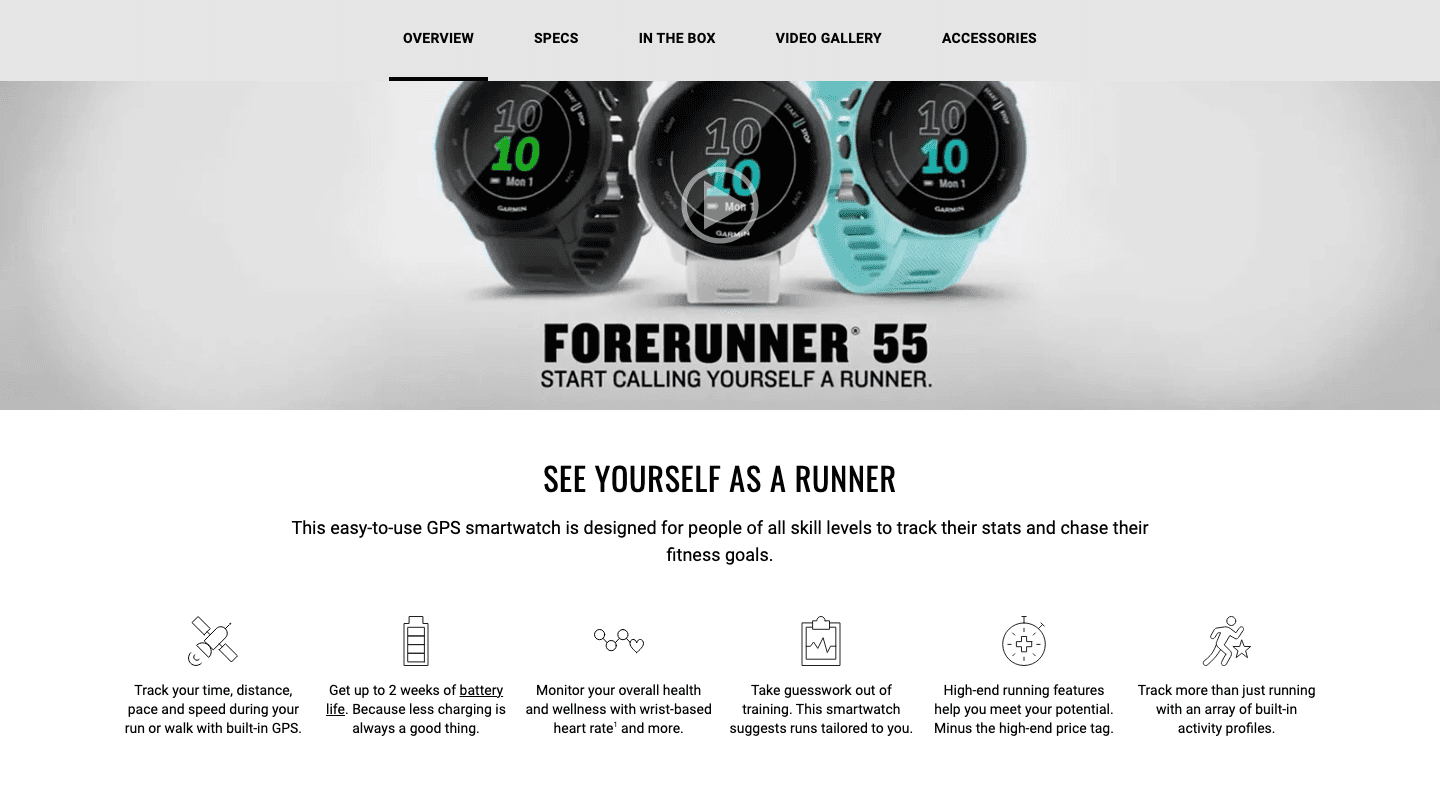
The Forerunner 55 remains one of Garmin's most popular entry-level running watches three years after launch. At $199.99, it covers everything a newer runner needs: GPS tracking, wrist-based heart rate, cadence, VO2 Max estimation, daily suggested workouts, and Garmin Coach plan integration. The 42mm case weighs just 37g and feels almost weightless on the wrist during long runs.
The display is where it shows its age. It uses a transflective MIP (memory-in-pixel) screen, which reads well in direct sunlight but looks dim indoors and lacks the color richness of newer AMOLED watches. There's no touchscreen; you navigate entirely with five physical buttons. For many runners that's a feature rather than a flaw: gloves work, sweat is not an issue, and the interface is predictable.
Battery life is the 55's strongest argument: 14 days in smartwatch mode and 20 hours in GPS mode. That means a full marathon training block between charges. If you're comparing across Garmin's lineup, see how the 55 fits in our Forerunner 965 vs 970 comparison to understand how the full Forerunner range scales up.
Transflective MIP display (color, but not AMOLED)
14-day battery (smartwatch mode), 20h GPS
42mm case, 37g weight
GPS, GLONASS, Galileo support
Wrist-based heart rate, VO2 Max, cadence
Garmin Coach, daily suggested workouts, PacePro, race predictor
No altimeter, no SpO2, no Garmin Pay, no touchscreen
What Works
Outstanding battery life compared to any AMOLED alternative
Lightweight and comfortable for long training runs
Covers every core running metric a beginner or intermediate runner needs
Button-only interface is glove-friendly and works in any conditions
Limitations
MIP display looks dated next to AMOLED competitors at similar prices
No barometric altimeter; elevation from GPS is less accurate on hilly routes
No Garmin Pay, no SpO2, no HRV Status
Three-year-old hardware in a fast-moving market
Price: $199.99
Best for: Budget-first runners, beginners, and anyone who prioritizes battery life and simplicity over display quality
Garmin Forerunner 165 Overview
Everything the 55 offers, plus an AMOLED screen and modern health sensors
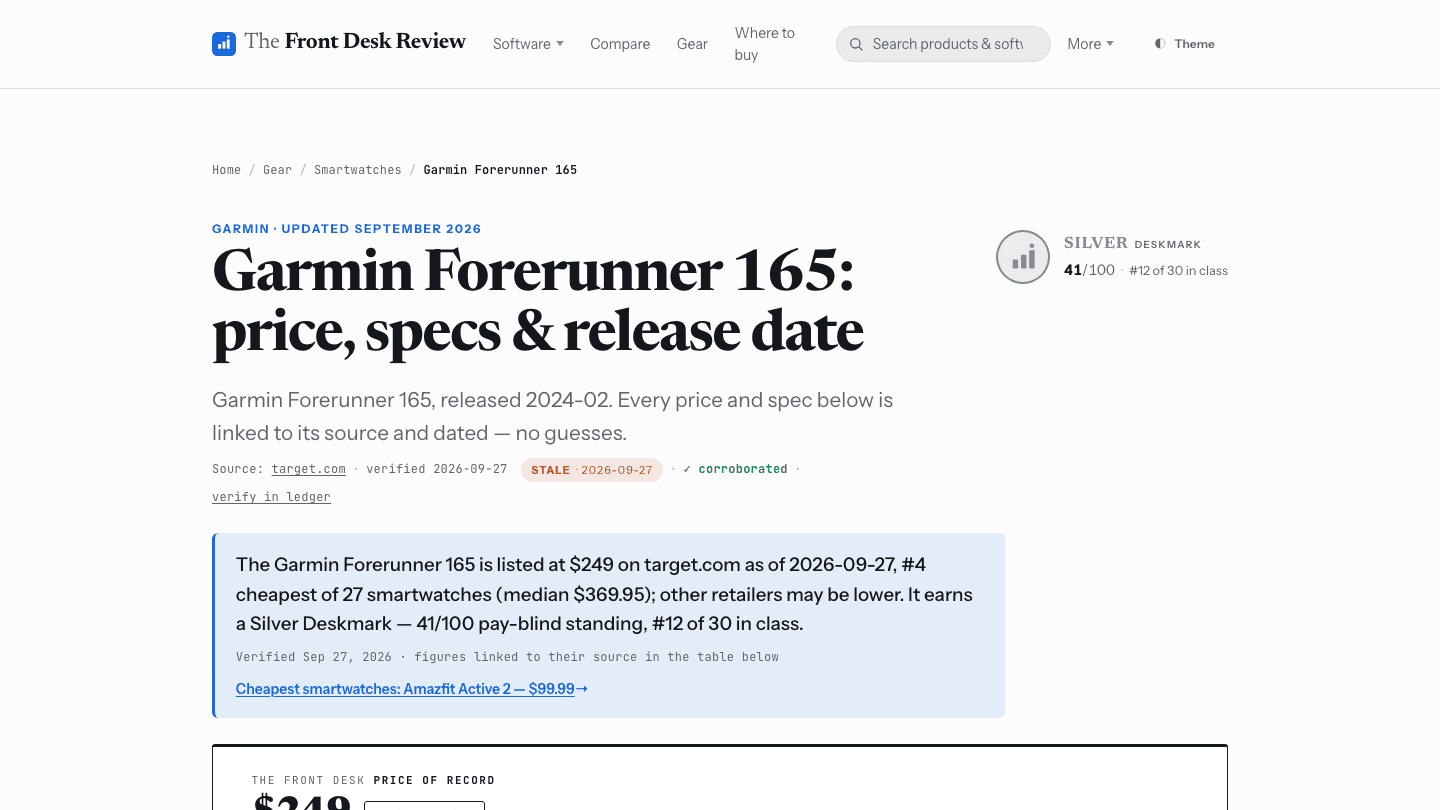
The Forerunner 165 is Garmin's 2024 answer to the question of what an affordable running watch should be. At $249.99, it inherits the full Garmin Coach ecosystem from the 55 but adds a 1.2-inch AMOLED touchscreen at 390x390 resolution, a barometric altimeter for precise elevation, SpO2 tracking, Garmin Pay, and HRV Status monitoring. The Music edition adds 8GB of offline storage for $299.99.
The AMOLED display is the most noticeable upgrade. Colors are vivid, text is crisp, and the always-on option works well without killing battery. It looks like a more expensive watch than it is. The touchscreen adds convenience for navigating menus mid-run, though the 165 keeps physical buttons as the primary control method during workouts.
Battery drops to 11 days smartwatch / 19 hours GPS. That's still excellent by most standards, and most runners won't notice the 3-day difference in practice. HRV Status is a meaningful addition for tracking recovery trends over time. For deeper sleep and recovery data, check our guide on how Garmin sleep tracking works and what the HRV readings mean for your training load.
1.2-inch AMOLED touchscreen, 390x390 resolution
11-day battery (smartwatch mode), 19h GPS
43mm case, 39g weight
Multi-GNSS (GPS, GLONASS, Galileo, plus optional dual-frequency)
Barometric altimeter, SpO2, compass, thermometer
HRV Status, Morning Report, Garmin Pay
Garmin Coach, PacePro, daily suggested workouts, race predictor, Training Effect
Optional Music edition with 8GB storage ($299.99)
What Works
AMOLED display is a major quality-of-life improvement over the Forerunner 55
HRV Status and Morning Report add recovery intelligence to your training
Barometric altimeter gives accurate elevation on trail runs and hilly routes
Garmin Pay is genuinely useful for post-run coffee or transit
Training Effect adds a layer of workout analysis missing from the 55
Limitations
11-day battery is 3 days shorter than the Forerunner 55
Slightly heavier at 39g vs 37g (negligible in practice)
Music edition costs $299.99, which brings it close to more advanced running watches
Price: $249.99 (base), $299.99 (Music)
Best for: Runners ready to step up from the basics, those who want HRV tracking, or anyone who cares about display quality
Head-to-Head: Forerunner 55 vs 165
Display: This is the most noticeable difference in daily use. The Forerunner 165's AMOLED is dramatically better indoors and in low light. The Forerunner 55's MIP screen holds up better in harsh direct sunlight (transflective displays reflect ambient light), but for most running conditions the AMOLED advantage is clear.
Battery life: Forerunner 55 wins with 14 days vs 11 days smartwatch mode, 20 hours vs 19 hours GPS. Both handle most training schedules without issue. If you run a weekly long run of 3-4 hours plus daily tracking, neither watch needs charging more than once a week.
Running features: Closer than you'd expect. Both include Garmin Coach, daily suggested workouts, PacePro pacing, race predictor, and VO2 Max. The 165 adds Training Effect (labeling each workout aerobic/anaerobic), Running Dynamics with a compatible sensor, and the race widget for real-time goal pacing. For most runners, these extras are useful but not critical.
Health sensors: The 165 has a clear edge. Barometric altimeter gives accurate elevation on trail runs. SpO2 monitors blood oxygen. HRV Status tracks overnight heart rate variability to gauge recovery. The 55 has none of these. If you train by recovery or care about altitude data, this matters. Read our Whoop vs Garmin comparison to see how Garmin's HRV approach stacks up against dedicated recovery trackers.
Smart features: The 165 has Garmin Pay for contactless payments and NFC. The 55 has neither. Small thing for some, meaningful for tap-to-pay at the coffee shop after a run.
Price: $199.99 vs $249.99. The $50 gap is real but modest. At street prices you often find the 55 around $149-160 and the 165 around $225, making the effective gap slightly wider.
Which Should You Choose?
Get the Forerunner 55 if:
Budget is the primary constraint and you want the best GPS running watch under $200
Battery life matters more than display quality
You run primarily outdoors where the MIP display is readable
You don't care about HRV, altimeter, or Garmin Pay
Get the Forerunner 165 if:
You want a bright AMOLED display that looks good day and night
You run trails or hilly routes and want accurate elevation data
Recovery tracking via HRV Status is part of your training approach
You want Garmin Pay for contactless payments on the go
$50 more is acceptable for a meaningfully better daily experience
For most runners who train regularly and plan to keep the watch for two or more years, the 165 is the smarter long-term buy. For context on how these entry-level watches fit Garmin's full lineup, see the Garmin Instinct 3 review for the rugged outdoor alternative, or our Garmin sleep tracker guide to understand how both watches handle overnight monitoring.
A Note on Scheduling Around Your Training
Whichever watch you pick, the data it generates is only useful if you act on it. HRV dips, a rising resting heart rate, and poor sleep scores are signals to back off intensity, but most runners ignore them because their calendar says "interval day." Lifestack is an AI scheduler that reads your energy levels and adjusts your daily task load, including when to push hard vs. recover. It's worth pairing with either Garmin watch if you're serious about training intelligently. See how energy-aware scheduling works in practice.
Frequently Asked Questions
Is the Garmin Forerunner 165 worth the upgrade over the 55?
For most regular runners, yes. The AMOLED display, HRV Status, barometric altimeter, and Garmin Pay are meaningful additions for $50 more. If you run every day and look at your watch constantly, the display difference alone justifies the upgrade.
What is the main difference between Forerunner 55 and 165?
The most visible difference is the display: the 165 has a 1.2-inch AMOLED touchscreen; the 55 has a transflective MIP screen. The 165 also adds barometric altimeter, SpO2, HRV Status, Garmin Pay, Training Effect, and a compass. The 55 has a 3-day longer battery life.
Does the Garmin Forerunner 165 have music storage?
The standard Forerunner 165 does not. The Forerunner 165 Music edition ($299.99) adds 8GB of internal storage for offline music from Spotify, Deezer, or Amazon Music. The base model can only control music on your phone, not store it.
How accurate is the Forerunner 55 GPS?
The Forerunner 55 uses multi-GNSS GPS (GPS, GLONASS, Galileo) and is accurate to within 2-5 meters for most outdoor running. Elevation accuracy is lower than the Forerunner 165 since the 55 relies on GPS altitude rather than a barometric altimeter. For flat road running the difference is negligible; for hilly or trail running, the 165's altimeter is meaningfully better.
Which Garmin watch is best for beginner runners?
Either watch works well for beginners. The Forerunner 55 is the most affordable Garmin with Garmin Coach integration, making it an ideal first GPS watch. The Forerunner 165 adds features that grow with you as your training gets more serious. If budget is tight, start with the 55 and upgrade later; if you have the $50, get the 165 and it will serve you longer.
Does the Forerunner 55 have Garmin Pay?
No. The Forerunner 55 does not support contactless payments. Garmin Pay is available on the Forerunner 165 and higher models. If tap-to-pay matters for your post-run routines, the 165 is the minimum Forerunner model that supports it.
The Garmin Forerunner 55 and Forerunner 165 are both excellent entry-level running watches, and they're only $50 apart at full retail. But that $50 buys you something specific: a jump from a basic transflective display to a vibrant AMOLED touchscreen, plus a handful of sensors and smart features the 55 doesn't have.
The Forerunner 55 launched in 2021 at $199.99 as Garmin's most affordable GPS running watch. The Forerunner 165 arrived in early 2024 at $249.99 (or $299.99 with music storage), built on the same core platform but with meaningfully better hardware. Both sync to Garmin Connect, support Garmin Coach training plans, offer daily suggested workouts, and track the same fundamentals: pace, distance, heart rate, and VO2 Max.
The question is whether the 165's upgrade justifies the extra spend for your specific running habits. If you run mostly indoors or in bright daylight where a dim display frustrates you, the 165's AMOLED is a quality-of-life improvement that's hard to unsee. If you run at dawn or dusk and prefer two weeks between charges, the 55 makes a strong case.
We tested both across training cycles to give you an honest read. Here's what actually matters.
Key Takeaways
The Forerunner 165 ($249.99) adds an AMOLED touchscreen, barometric altimeter, SpO2, Garmin Pay, and HRV Status over the Forerunner 55 ($199.99) for $50 more.
The Forerunner 55 wins on battery life (14 days vs 11 days) and is the lighter, simpler choice for runners who want GPS basics without extra sensors.
Both support Garmin Coach, daily suggested workouts, PacePro, and race predictors. The core running training features are nearly identical.
Quick Verdict
Garmin Forerunner 55: Best for budget-focused runners who want reliable GPS tracking and two weeks of battery with no frills.
Garmin Forerunner 165: Best for runners who want a bright AMOLED display, Garmin Pay, HRV monitoring, and a more capable sensor suite for not much more money.
Garmin Forerunner 55 Overview
The no-nonsense GPS running watch that gets the basics right
The Forerunner 55 remains one of Garmin's most popular entry-level running watches three years after launch. At $199.99, it covers everything a newer runner needs: GPS tracking, wrist-based heart rate, cadence, VO2 Max estimation, daily suggested workouts, and Garmin Coach plan integration. The 42mm case weighs just 37g and feels almost weightless on the wrist during long runs.
The display is where it shows its age. It uses a transflective MIP (memory-in-pixel) screen, which reads well in direct sunlight but looks dim indoors and lacks the color richness of newer AMOLED watches. There's no touchscreen; you navigate entirely with five physical buttons. For many runners that's a feature rather than a flaw: gloves work, sweat is not an issue, and the interface is predictable.
Battery life is the 55's strongest argument: 14 days in smartwatch mode and 20 hours in GPS mode. That means a full marathon training block between charges. If you're comparing across Garmin's lineup, see how the 55 fits in our Forerunner 965 vs 970 comparison to understand how the full Forerunner range scales up.
Transflective MIP display (color, but not AMOLED)
14-day battery (smartwatch mode), 20h GPS
42mm case, 37g weight
GPS, GLONASS, Galileo support
Wrist-based heart rate, VO2 Max, cadence
Garmin Coach, daily suggested workouts, PacePro, race predictor
No altimeter, no SpO2, no Garmin Pay, no touchscreen
What Works
Outstanding battery life compared to any AMOLED alternative
Lightweight and comfortable for long training runs
Covers every core running metric a beginner or intermediate runner needs
Button-only interface is glove-friendly and works in any conditions
Limitations
MIP display looks dated next to AMOLED competitors at similar prices
No barometric altimeter; elevation from GPS is less accurate on hilly routes
No Garmin Pay, no SpO2, no HRV Status
Three-year-old hardware in a fast-moving market
Price: $199.99
Best for: Budget-first runners, beginners, and anyone who prioritizes battery life and simplicity over display quality
Garmin Forerunner 165 Overview
Everything the 55 offers, plus an AMOLED screen and modern health sensors
The Forerunner 165 is Garmin's 2024 answer to the question of what an affordable running watch should be. At $249.99, it inherits the full Garmin Coach ecosystem from the 55 but adds a 1.2-inch AMOLED touchscreen at 390x390 resolution, a barometric altimeter for precise elevation, SpO2 tracking, Garmin Pay, and HRV Status monitoring. The Music edition adds 8GB of offline storage for $299.99.
The AMOLED display is the most noticeable upgrade. Colors are vivid, text is crisp, and the always-on option works well without killing battery. It looks like a more expensive watch than it is. The touchscreen adds convenience for navigating menus mid-run, though the 165 keeps physical buttons as the primary control method during workouts.
Battery drops to 11 days smartwatch / 19 hours GPS. That's still excellent by most standards, and most runners won't notice the 3-day difference in practice. HRV Status is a meaningful addition for tracking recovery trends over time. For deeper sleep and recovery data, check our guide on how Garmin sleep tracking works and what the HRV readings mean for your training load.
1.2-inch AMOLED touchscreen, 390x390 resolution
11-day battery (smartwatch mode), 19h GPS
43mm case, 39g weight
Multi-GNSS (GPS, GLONASS, Galileo, plus optional dual-frequency)
Barometric altimeter, SpO2, compass, thermometer
HRV Status, Morning Report, Garmin Pay
Garmin Coach, PacePro, daily suggested workouts, race predictor, Training Effect
Optional Music edition with 8GB storage ($299.99)
What Works
AMOLED display is a major quality-of-life improvement over the Forerunner 55
HRV Status and Morning Report add recovery intelligence to your training
Barometric altimeter gives accurate elevation on trail runs and hilly routes
Garmin Pay is genuinely useful for post-run coffee or transit
Training Effect adds a layer of workout analysis missing from the 55
Limitations
11-day battery is 3 days shorter than the Forerunner 55
Slightly heavier at 39g vs 37g (negligible in practice)
Music edition costs $299.99, which brings it close to more advanced running watches
Price: $249.99 (base), $299.99 (Music)
Best for: Runners ready to step up from the basics, those who want HRV tracking, or anyone who cares about display quality
Head-to-Head: Forerunner 55 vs 165
Display: This is the most noticeable difference in daily use. The Forerunner 165's AMOLED is dramatically better indoors and in low light. The Forerunner 55's MIP screen holds up better in harsh direct sunlight (transflective displays reflect ambient light), but for most running conditions the AMOLED advantage is clear.
Battery life: Forerunner 55 wins with 14 days vs 11 days smartwatch mode, 20 hours vs 19 hours GPS. Both handle most training schedules without issue. If you run a weekly long run of 3-4 hours plus daily tracking, neither watch needs charging more than once a week.
Running features: Closer than you'd expect. Both include Garmin Coach, daily suggested workouts, PacePro pacing, race predictor, and VO2 Max. The 165 adds Training Effect (labeling each workout aerobic/anaerobic), Running Dynamics with a compatible sensor, and the race widget for real-time goal pacing. For most runners, these extras are useful but not critical.
Health sensors: The 165 has a clear edge. Barometric altimeter gives accurate elevation on trail runs. SpO2 monitors blood oxygen. HRV Status tracks overnight heart rate variability to gauge recovery. The 55 has none of these. If you train by recovery or care about altitude data, this matters. Read our Whoop vs Garmin comparison to see how Garmin's HRV approach stacks up against dedicated recovery trackers.
Smart features: The 165 has Garmin Pay for contactless payments and NFC. The 55 has neither. Small thing for some, meaningful for tap-to-pay at the coffee shop after a run.
Price: $199.99 vs $249.99. The $50 gap is real but modest. At street prices you often find the 55 around $149-160 and the 165 around $225, making the effective gap slightly wider.
Which Should You Choose?
Get the Forerunner 55 if:
Budget is the primary constraint and you want the best GPS running watch under $200
Battery life matters more than display quality
You run primarily outdoors where the MIP display is readable
You don't care about HRV, altimeter, or Garmin Pay
Get the Forerunner 165 if:
You want a bright AMOLED display that looks good day and night
You run trails or hilly routes and want accurate elevation data
Recovery tracking via HRV Status is part of your training approach
You want Garmin Pay for contactless payments on the go
$50 more is acceptable for a meaningfully better daily experience
For most runners who train regularly and plan to keep the watch for two or more years, the 165 is the smarter long-term buy. For context on how these entry-level watches fit Garmin's full lineup, see the Garmin Instinct 3 review for the rugged outdoor alternative, or our Garmin sleep tracker guide to understand how both watches handle overnight monitoring.
A Note on Scheduling Around Your Training
Whichever watch you pick, the data it generates is only useful if you act on it. HRV dips, a rising resting heart rate, and poor sleep scores are signals to back off intensity, but most runners ignore them because their calendar says "interval day." Lifestack is an AI scheduler that reads your energy levels and adjusts your daily task load, including when to push hard vs. recover. It's worth pairing with either Garmin watch if you're serious about training intelligently. See how energy-aware scheduling works in practice.
Frequently Asked Questions
Is the Garmin Forerunner 165 worth the upgrade over the 55?
For most regular runners, yes. The AMOLED display, HRV Status, barometric altimeter, and Garmin Pay are meaningful additions for $50 more. If you run every day and look at your watch constantly, the display difference alone justifies the upgrade.
What is the main difference between Forerunner 55 and 165?
The most visible difference is the display: the 165 has a 1.2-inch AMOLED touchscreen; the 55 has a transflective MIP screen. The 165 also adds barometric altimeter, SpO2, HRV Status, Garmin Pay, Training Effect, and a compass. The 55 has a 3-day longer battery life.
Does the Garmin Forerunner 165 have music storage?
The standard Forerunner 165 does not. The Forerunner 165 Music edition ($299.99) adds 8GB of internal storage for offline music from Spotify, Deezer, or Amazon Music. The base model can only control music on your phone, not store it.
How accurate is the Forerunner 55 GPS?
The Forerunner 55 uses multi-GNSS GPS (GPS, GLONASS, Galileo) and is accurate to within 2-5 meters for most outdoor running. Elevation accuracy is lower than the Forerunner 165 since the 55 relies on GPS altitude rather than a barometric altimeter. For flat road running the difference is negligible; for hilly or trail running, the 165's altimeter is meaningfully better.
Which Garmin watch is best for beginner runners?
Either watch works well for beginners. The Forerunner 55 is the most affordable Garmin with Garmin Coach integration, making it an ideal first GPS watch. The Forerunner 165 adds features that grow with you as your training gets more serious. If budget is tight, start with the 55 and upgrade later; if you have the $50, get the 165 and it will serve you longer.
Does the Forerunner 55 have Garmin Pay?
No. The Forerunner 55 does not support contactless payments. Garmin Pay is available on the Forerunner 165 and higher models. If tap-to-pay matters for your post-run routines, the 165 is the minimum Forerunner model that supports it.



FOLLOW ON
FOLLOW ON
FOLLOW ON


Copyright 2026 © Lifestack. All rights reserved
Copyright 2026 © Lifestack. All rights reserved

