
Tips
Visual Goal Tracker: 7 Methods That Actually Work
Visual Goal Tracker: 7 Methods That Actually Work
Most goal-setting fails not because of bad intentions but because progress stays invisible. You know you're working toward something, but without a clear picture of how far you've come or how far you have left to go, motivation fades and the goal quietly gets deprioritized. Visual goal tracking solves this by making progress something you can see at a glance.
When progress is visible, the brain responds differently. Research on goal gradient effects shows that people accelerate effort as they approach a visible finish line. A half-filled progress bar, a streak of checked boxes, a chart trending upward: these are not just aesthetic choices. They are signals that trigger the reward circuitry that sustains motivation over time.
This guide covers seven visual goal tracking methods, from simple analog approaches to integrated digital systems. The right one depends on how you think and what kind of goal you're tracking. All of them share the same core mechanism: making your progress undeniable.
Key Takeaways
Visual goal trackers work because they activate the brain's goal gradient effect: visible progress toward a finish line accelerates motivation and follow-through
The best visual method is the one you'll actually look at every day. Analog trackers work well for simple habits; digital systems work better when goals have multiple components or deadlines
Pairing a visual tracker with an energy-aware daily planner ensures your goal-related tasks get scheduled during the windows when you'll actually complete them
1. Progress Bar Trackers
A progress bar is the simplest visual goal tracker you can build. Draw a horizontal line divided into segments, one per unit of progress, and fill in segments as you go. A goal to read 24 books this year becomes a bar with 24 slots. A fundraising goal of $10,000 becomes a thermometer you color in as donations arrive. The filled-versus-empty contrast is immediately legible.
Progress bars work particularly well for countable goals with a fixed endpoint. They are poor fits for behavior change goals (like "exercise more") because there is no clear "full" state. For those, use streaks or habit grids instead.
The digital version in apps like Notion, Todoist, or a simple spreadsheet automates the fill calculation. Seeing 17 out of 24 books colored in creates far more pull to pick up the next one than a written note saying "17 books read so far."
2. Habit Streak Grids
The streak grid, popularized by Jerry Seinfeld's "don't break the chain" method, maps each day of a week or month as a cell in a grid. You mark each day you completed the target behavior. The growing chain of marked days becomes a visual asset you don't want to break.
This method has strong evidence behind it for habit formation. The visual continuity of an unbroken chain creates a loss aversion dynamic: missing today means destroying something you built. That makes the cost of skipping feel more concrete and immediate than any abstract commitment to a goal. See our guide to habit tracker planners for app recommendations and printable formats.
Streak grids work best when the target behavior is daily and binary. Did you meditate? Yes or no. Did you write 200 words? Yes or no. They break down for goals that are more continuous or variable, like "spend less money" or "be more patient," where there is no clean pass/fail signal for each day.
3. Kanban Goal Boards
A Kanban board adapts the software development workflow for personal goal tracking. Goals or goal milestones live as cards in columns: Not Started, In Progress, Done. The visual layout makes it immediately obvious what you're working on and what is waiting. Moving a card from In Progress to Done gives the same satisfying sense of completion as checking a box, but at a larger scale.
Kanban works particularly well for goals with multiple sub-tasks or phases. A goal like "launch a side project" has dozens of components that need to move through stages. A Kanban board makes that complexity manageable by showing you the pipeline at a glance rather than a flat list of tasks that tells you nothing about which stage each item is in.
Physical whiteboards and sticky notes work well for small goal sets. For larger goal systems, digital tools like Trello, Linear, or Notion databases handle more complexity without running out of wall space.
4. Color-Coded Goal Journals
A goal tracking journal uses color to encode meaning at a glance. Assign a color to each active goal, then mark each day's entry with the relevant color for any goal-related work you did. Over a month, the page reveals patterns: which goals get consistent attention, which are being crowded out, and which days tend to be blank across all colors.
The color coding adds a layer of visual analysis that a plain text journal cannot provide. You can see at a glance whether your purple "health" goal is getting consistent attention or whether it has been invisible for two weeks. That visual gap is a more effective prompt to act than any reminder notification.
This method is the most flexible for people managing multiple goals simultaneously. It does not require a fixed endpoint for any goal and works well alongside any of the other methods in this list as a meta-level tracker across all goals at once.
5. Goal Roadmaps and Timelines
A goal roadmap plots milestones on a timeline, giving you a spatial representation of where each goal should be at each point in time. Unlike a simple checklist, a roadmap shows dependencies: milestone B can't start until milestone A is done. It also shows when you're behind: if the current date has passed a milestone that isn't done, the visual gap makes the delay impossible to ignore.
This method is best suited for long-term goals that span months or years and have clear intermediate steps. A goal to complete a professional certification, build a product, or reach a fitness target by a specific date all benefit from a roadmap structure. The timeline creates natural checkpoints for a weekly review to evaluate whether you're on track or need to adjust.
Simple roadmaps can be built in any spreadsheet. More detailed ones benefit from dedicated tools like Notion's timeline view or a physical wall calendar where you block out milestone dates in advance.
6. Energy-Timed Goal Stacking
Most visual goal trackers focus on recording what happened after the fact. Energy-timed goal stacking inverts this: instead of tracking what you completed, you schedule goal-related tasks during your highest-energy windows so completion becomes the default rather than the exception.
The mechanism is habit stacking combined with energy scheduling. You identify which goal actions require your best cognitive state (writing, planning, learning) and which can run on lower energy (admin tasks, light review, simple habits). Then you place them accordingly in your day. High-demand goal work goes in morning peak windows, lower-demand goal maintenance in afternoon slots.
When goal work lands in the right energy window, completion rates rise and the need to track misses drops. The visual tracker becomes mostly a record of wins rather than a log of failures. This shift in what you're tracking changes how you feel about the practice.
7. Weekly Visual Reviews
A visual review is not a tracker you maintain throughout the week. It's a weekly ritual where you look at everything at once. You review every active goal, update progress bars, extend streaks, move cards on your Kanban board, and check your roadmap milestones. The review itself is the visual event.
Done consistently, the weekly visual review becomes the point where you catch drift early. If a goal hasn't moved in two weeks, you'll see it clearly. If you're consistently behind on one goal while ahead on another, the pattern becomes visible and you can make a conscious choice to rebalance rather than drifting without noticing. See fun goal tracking ideas for ways to make the review ritual genuinely enjoyable rather than a chore.
The review also creates a natural moment to set smaller goals for the coming week that connect to each larger goal, turning abstract annual targets into concrete weekly actions that compound over time.
Best Tool for Visual Goal Tracking
Visual goal tracking works best when the tool scheduling your daily tasks understands what your goals require and when you're able to do your best work on them. Most goal tracker apps record progress without influencing your actual schedule. Lifestack does both.
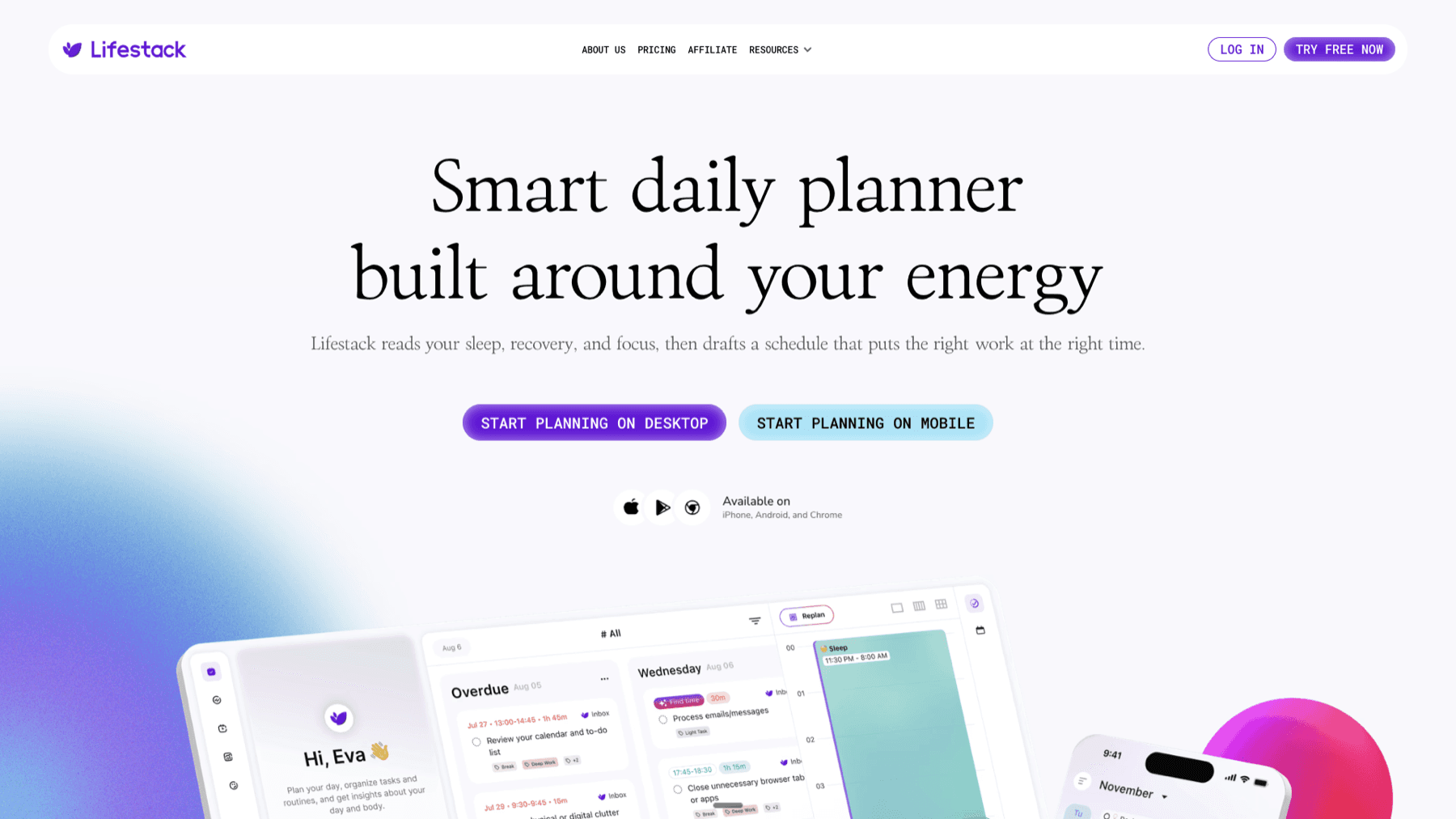
Lifestack connects to your wearable device, reads your sleep and recovery data, and uses that information to schedule your goal-related tasks during the windows when your energy is actually high enough to make progress. A goal that requires writing or focused thinking gets a slot in your morning peak, not a random open hole in your afternoon. The result is a daily plan where your goals are not just listed but actually placed in time. It costs $7/month or $50/year, with a 7-day free trial on the annual plan. Combined with any of the visual tracking methods above, this energy-based scheduling approach closes the gap between intention and execution.
Frequently Asked Questions
What is a visual goal tracker?
A visual goal tracker is any system that represents your progress toward a goal in a format you can see at a glance. This includes progress bars, streak grids, color-coded journals, Kanban boards, timelines, and roadmaps. The visual component is important because it activates the brain's goal gradient effect, where visible proximity to a goal increases motivation and follow-through rates.
What is the best visual goal tracker for habits?
Streak grids and habit tracking journals are the strongest formats for daily habits. Streak grids work well when the habit is binary (did you do it or not) and you want to exploit loss aversion to avoid breaking the chain. Color-coded journals work better when you're tracking multiple habits simultaneously and want to see which areas of your life are getting consistent attention across a month.
How do I track long-term goals visually?
Long-term goals benefit most from roadmaps and timelines that show milestones over months or years. Break the goal down into specific, dated milestones, plot them on a timeline, and review the roadmap weekly. When you're on track, the visual confirmation is motivating. When you're behind, the visual gap prompts adjustment before the deadline becomes a crisis.
Are paper or digital goal trackers better?
Paper trackers are better for simplicity and daily ritual. Marking a physical page with a pen creates a more embodied sense of completion than clicking a checkbox. Digital trackers are better for goals with multiple components, real-time calculations, or integration with your calendar and task manager. Many people use both: a paper streak grid on their desk for daily habits and a digital roadmap for longer-horizon goals.
How often should I review my visual goal tracker?
Daily for habit streak grids and progress bars that you update as you go. Weekly for Kanban boards, roadmaps, and color-coded journals that need a dedicated review session to update properly. Monthly for any bigger-picture goals where you're assessing trajectory rather than day-to-day completion. A consistent weekly review is the most important cadence because it catches drift early enough to course correct before it compounds.
Most goal-setting fails not because of bad intentions but because progress stays invisible. You know you're working toward something, but without a clear picture of how far you've come or how far you have left to go, motivation fades and the goal quietly gets deprioritized. Visual goal tracking solves this by making progress something you can see at a glance.
When progress is visible, the brain responds differently. Research on goal gradient effects shows that people accelerate effort as they approach a visible finish line. A half-filled progress bar, a streak of checked boxes, a chart trending upward: these are not just aesthetic choices. They are signals that trigger the reward circuitry that sustains motivation over time.
This guide covers seven visual goal tracking methods, from simple analog approaches to integrated digital systems. The right one depends on how you think and what kind of goal you're tracking. All of them share the same core mechanism: making your progress undeniable.
Key Takeaways
Visual goal trackers work because they activate the brain's goal gradient effect: visible progress toward a finish line accelerates motivation and follow-through
The best visual method is the one you'll actually look at every day. Analog trackers work well for simple habits; digital systems work better when goals have multiple components or deadlines
Pairing a visual tracker with an energy-aware daily planner ensures your goal-related tasks get scheduled during the windows when you'll actually complete them
1. Progress Bar Trackers
A progress bar is the simplest visual goal tracker you can build. Draw a horizontal line divided into segments, one per unit of progress, and fill in segments as you go. A goal to read 24 books this year becomes a bar with 24 slots. A fundraising goal of $10,000 becomes a thermometer you color in as donations arrive. The filled-versus-empty contrast is immediately legible.
Progress bars work particularly well for countable goals with a fixed endpoint. They are poor fits for behavior change goals (like "exercise more") because there is no clear "full" state. For those, use streaks or habit grids instead.
The digital version in apps like Notion, Todoist, or a simple spreadsheet automates the fill calculation. Seeing 17 out of 24 books colored in creates far more pull to pick up the next one than a written note saying "17 books read so far."
2. Habit Streak Grids
The streak grid, popularized by Jerry Seinfeld's "don't break the chain" method, maps each day of a week or month as a cell in a grid. You mark each day you completed the target behavior. The growing chain of marked days becomes a visual asset you don't want to break.
This method has strong evidence behind it for habit formation. The visual continuity of an unbroken chain creates a loss aversion dynamic: missing today means destroying something you built. That makes the cost of skipping feel more concrete and immediate than any abstract commitment to a goal. See our guide to habit tracker planners for app recommendations and printable formats.
Streak grids work best when the target behavior is daily and binary. Did you meditate? Yes or no. Did you write 200 words? Yes or no. They break down for goals that are more continuous or variable, like "spend less money" or "be more patient," where there is no clean pass/fail signal for each day.
3. Kanban Goal Boards
A Kanban board adapts the software development workflow for personal goal tracking. Goals or goal milestones live as cards in columns: Not Started, In Progress, Done. The visual layout makes it immediately obvious what you're working on and what is waiting. Moving a card from In Progress to Done gives the same satisfying sense of completion as checking a box, but at a larger scale.
Kanban works particularly well for goals with multiple sub-tasks or phases. A goal like "launch a side project" has dozens of components that need to move through stages. A Kanban board makes that complexity manageable by showing you the pipeline at a glance rather than a flat list of tasks that tells you nothing about which stage each item is in.
Physical whiteboards and sticky notes work well for small goal sets. For larger goal systems, digital tools like Trello, Linear, or Notion databases handle more complexity without running out of wall space.
4. Color-Coded Goal Journals
A goal tracking journal uses color to encode meaning at a glance. Assign a color to each active goal, then mark each day's entry with the relevant color for any goal-related work you did. Over a month, the page reveals patterns: which goals get consistent attention, which are being crowded out, and which days tend to be blank across all colors.
The color coding adds a layer of visual analysis that a plain text journal cannot provide. You can see at a glance whether your purple "health" goal is getting consistent attention or whether it has been invisible for two weeks. That visual gap is a more effective prompt to act than any reminder notification.
This method is the most flexible for people managing multiple goals simultaneously. It does not require a fixed endpoint for any goal and works well alongside any of the other methods in this list as a meta-level tracker across all goals at once.
5. Goal Roadmaps and Timelines
A goal roadmap plots milestones on a timeline, giving you a spatial representation of where each goal should be at each point in time. Unlike a simple checklist, a roadmap shows dependencies: milestone B can't start until milestone A is done. It also shows when you're behind: if the current date has passed a milestone that isn't done, the visual gap makes the delay impossible to ignore.
This method is best suited for long-term goals that span months or years and have clear intermediate steps. A goal to complete a professional certification, build a product, or reach a fitness target by a specific date all benefit from a roadmap structure. The timeline creates natural checkpoints for a weekly review to evaluate whether you're on track or need to adjust.
Simple roadmaps can be built in any spreadsheet. More detailed ones benefit from dedicated tools like Notion's timeline view or a physical wall calendar where you block out milestone dates in advance.
6. Energy-Timed Goal Stacking
Most visual goal trackers focus on recording what happened after the fact. Energy-timed goal stacking inverts this: instead of tracking what you completed, you schedule goal-related tasks during your highest-energy windows so completion becomes the default rather than the exception.
The mechanism is habit stacking combined with energy scheduling. You identify which goal actions require your best cognitive state (writing, planning, learning) and which can run on lower energy (admin tasks, light review, simple habits). Then you place them accordingly in your day. High-demand goal work goes in morning peak windows, lower-demand goal maintenance in afternoon slots.
When goal work lands in the right energy window, completion rates rise and the need to track misses drops. The visual tracker becomes mostly a record of wins rather than a log of failures. This shift in what you're tracking changes how you feel about the practice.
7. Weekly Visual Reviews
A visual review is not a tracker you maintain throughout the week. It's a weekly ritual where you look at everything at once. You review every active goal, update progress bars, extend streaks, move cards on your Kanban board, and check your roadmap milestones. The review itself is the visual event.
Done consistently, the weekly visual review becomes the point where you catch drift early. If a goal hasn't moved in two weeks, you'll see it clearly. If you're consistently behind on one goal while ahead on another, the pattern becomes visible and you can make a conscious choice to rebalance rather than drifting without noticing. See fun goal tracking ideas for ways to make the review ritual genuinely enjoyable rather than a chore.
The review also creates a natural moment to set smaller goals for the coming week that connect to each larger goal, turning abstract annual targets into concrete weekly actions that compound over time.
Best Tool for Visual Goal Tracking
Visual goal tracking works best when the tool scheduling your daily tasks understands what your goals require and when you're able to do your best work on them. Most goal tracker apps record progress without influencing your actual schedule. Lifestack does both.
Lifestack connects to your wearable device, reads your sleep and recovery data, and uses that information to schedule your goal-related tasks during the windows when your energy is actually high enough to make progress. A goal that requires writing or focused thinking gets a slot in your morning peak, not a random open hole in your afternoon. The result is a daily plan where your goals are not just listed but actually placed in time. It costs $7/month or $50/year, with a 7-day free trial on the annual plan. Combined with any of the visual tracking methods above, this energy-based scheduling approach closes the gap between intention and execution.
Frequently Asked Questions
What is a visual goal tracker?
A visual goal tracker is any system that represents your progress toward a goal in a format you can see at a glance. This includes progress bars, streak grids, color-coded journals, Kanban boards, timelines, and roadmaps. The visual component is important because it activates the brain's goal gradient effect, where visible proximity to a goal increases motivation and follow-through rates.
What is the best visual goal tracker for habits?
Streak grids and habit tracking journals are the strongest formats for daily habits. Streak grids work well when the habit is binary (did you do it or not) and you want to exploit loss aversion to avoid breaking the chain. Color-coded journals work better when you're tracking multiple habits simultaneously and want to see which areas of your life are getting consistent attention across a month.
How do I track long-term goals visually?
Long-term goals benefit most from roadmaps and timelines that show milestones over months or years. Break the goal down into specific, dated milestones, plot them on a timeline, and review the roadmap weekly. When you're on track, the visual confirmation is motivating. When you're behind, the visual gap prompts adjustment before the deadline becomes a crisis.
Are paper or digital goal trackers better?
Paper trackers are better for simplicity and daily ritual. Marking a physical page with a pen creates a more embodied sense of completion than clicking a checkbox. Digital trackers are better for goals with multiple components, real-time calculations, or integration with your calendar and task manager. Many people use both: a paper streak grid on their desk for daily habits and a digital roadmap for longer-horizon goals.
How often should I review my visual goal tracker?
Daily for habit streak grids and progress bars that you update as you go. Weekly for Kanban boards, roadmaps, and color-coded journals that need a dedicated review session to update properly. Monthly for any bigger-picture goals where you're assessing trajectory rather than day-to-day completion. A consistent weekly review is the most important cadence because it catches drift early enough to course correct before it compounds.



FOLLOW ON
FOLLOW ON
FOLLOW ON


Copyright 2026 © Lifestack. All rights reserved
Copyright 2026 © Lifestack. All rights reserved

