
Tips
Good Habits: 7 Ways to Build Them
Good Habits: 7 Ways to Build Them

What Makes Something a Good Habit
A good habit is a behavior that, once automatic, improves your life without requiring ongoing willpower to maintain. The key phrase is "once automatic": until then, every repetition is an act of intention. The goal is to shorten that window as much as possible so the behavior becomes part of your default operating mode.
Good habits tend to share a few traits. They're specific enough to have a clear trigger. They're small enough to start on low-motivation days. And their benefits are either immediate (you feel better right away) or visible enough over time to sustain the effort. Broad intentions like "exercise more" rarely become automatic habits. "Walk for 10 minutes after lunch" does.
This guide covers seven strategies that consistently appear in habit research and that work whether you're building a new routine from scratch or trying to get a stalled one moving again.
Key Takeaways
Good habits form faster when they're small, specific, and attached to an existing cue.
Environment design does more work than willpower: make the habit easy to start and the competing behavior harder.
Tracking progress adds a layer of reward that reinforces the behavior loop.
1. Start Smaller Than You Think You Should
The single most reliable way to build a good habit is to make the starting version too easy to skip. Not "do 20 push-ups" but "do one push-up." Not "journal for 20 minutes" but "write one sentence." The logic isn't about the output: it's about building the trigger-behavior connection.
Each time you perform the habit, no matter how small, you're reinforcing the neural link between your cue and that action. A 2-minute version of the habit done daily reaches automaticity faster than a 30-minute version done twice a week. Once the habit is automatic, you can expand it. But the automaticity has to come first.
James Clear calls this the "Two-Minute Rule" in Atomic Habits: any habit should be reducible to a version that takes two minutes or less. This isn't the end state. It's the entry point.
2. Stack New Habits Onto Existing Ones
One of the most efficient ways to build a good habit is to borrow the automatic cue from an existing one. This technique, called habit stacking, works by inserting the new behavior immediately before or after something you already do without thinking.
The format is simple: "After [current habit], I will [new habit]." After I pour my morning coffee, I will open my planner. After I sit down at my desk, I will write one sentence. After I brush my teeth, I will do two minutes of stretching. The existing habit acts as a reliable trigger, which is the hardest part to establish when building from zero.
An ADHD morning routine often benefits most from this approach, because it reduces the number of decisions required before the first task is started.
3. Design Your Environment to Make the Habit Easy
Willpower is unreliable. Environment design is not. The most consistent habit-builders don't rely on motivation: they change the physical or digital setup so the habit is the default, not the deliberate choice.
Put your running shoes by the door. Keep your journal on the kitchen counter. Move your phone to a drawer when it's time to focus. Every time you have to go out of your way to access a tool for a good habit, that friction costs you a few percent of the people who would have otherwise done it. Reduce the friction and the behavior follows.
Visual reminders are a form of environment design: they make the cue external and physical rather than something you have to remember to remember. A sticky note on your monitor, a habit tracker on your fridge, a widget on your phone's lock screen. The goal is to make the trigger unavoidable.
4. Schedule Habits During Your Peak Energy
Timing matters more than most habit advice acknowledges. A good habit that asks too much of you when your energy is low will stay fragile. Scheduled at the right time, the same habit feels almost effortless.
Research on chronobiology shows that most people have a clear peak performance window of two to four hours, usually in the morning or early afternoon. Habits that require cognitive effort (writing, studying, deep work, focused exercise) are dramatically easier to start and sustain when they're scheduled during this window.
The harder your habit is to start, the more important it is to protect its time slot. A visual schedule that blocks out habit time the same way it blocks out meetings gives your habits the same protected status as your work commitments.
5. Use a Tracking System That's Frictionless
Tracking a habit adds a second reward to the loop: the satisfaction of marking it done. That secondary reward often matters more than people expect, especially in the early weeks when the primary benefit isn't yet visible or felt.
The best tracking systems are ones you'll actually use on low-motivation days. A simple paper calendar with X marks, a one-tap habit app, or a spreadsheet that takes 10 seconds to update all work well. A habit tracker planner that integrates with your existing daily workflow reduces the chance you'll stop tracking when things get busy.
Don't break the chain. The visual momentum of a consecutive streak creates mild loss aversion that motivates you to maintain the streak even when the habit itself doesn't feel rewarding in the moment.
6. Set Goals That Make the Habit Measurable
Vague habits produce vague results. "Be healthier" gives you nothing to track and no clear signal of success. "Walk for 15 minutes after dinner" gives you a yes or no every single day.
Measurable habits also make it easy to see progress over time, which is one of the most underrated sources of motivation for staying consistent. Setting clear habit-based goals with specific outcomes turns the behavior into a project with momentum rather than an open-ended aspiration.
A useful approach: define a minimum threshold ("I did the habit if I did at least this much") and a target ("I succeeded if I hit this"). The minimum keeps your streak alive on hard days. The target gives you something to aim for on good ones.
7. Build a Recovery Plan for Broken Streaks
Every streak breaks eventually. The distinguishing factor between people who build lasting good habits and people who cycle through restarts is what they do the day after a miss.
One missed day has almost no measurable effect on habit formation, according to UCL research. Two missed days starts to matter. Three or more and you're rebuilding from closer to zero. The rule many habit researchers suggest: never miss twice in a row. One miss is an event. Two is the beginning of a pattern.
Having a recovery protocol in place before you need it helps. Something as simple as "if I miss, I do the minimum version the next day and mark it done" is enough. The goal is to keep the behavior connected to its cue, even if the full version isn't possible. For strategies on unwinding habits you'd rather not have, the guide on breaking bad habits covers the same mechanics from the opposite direction.
ADHD-specific habit hacks often focus on recovery: shorter streaks as the goal unit, immediate restart protocols, and lower minimums on difficult days.
Best Tool for Scheduling Good Habits
Building good habits is easier when your daily schedule is already working for you. If your day is unstructured or overscheduled, even well-designed habits get crowded out.
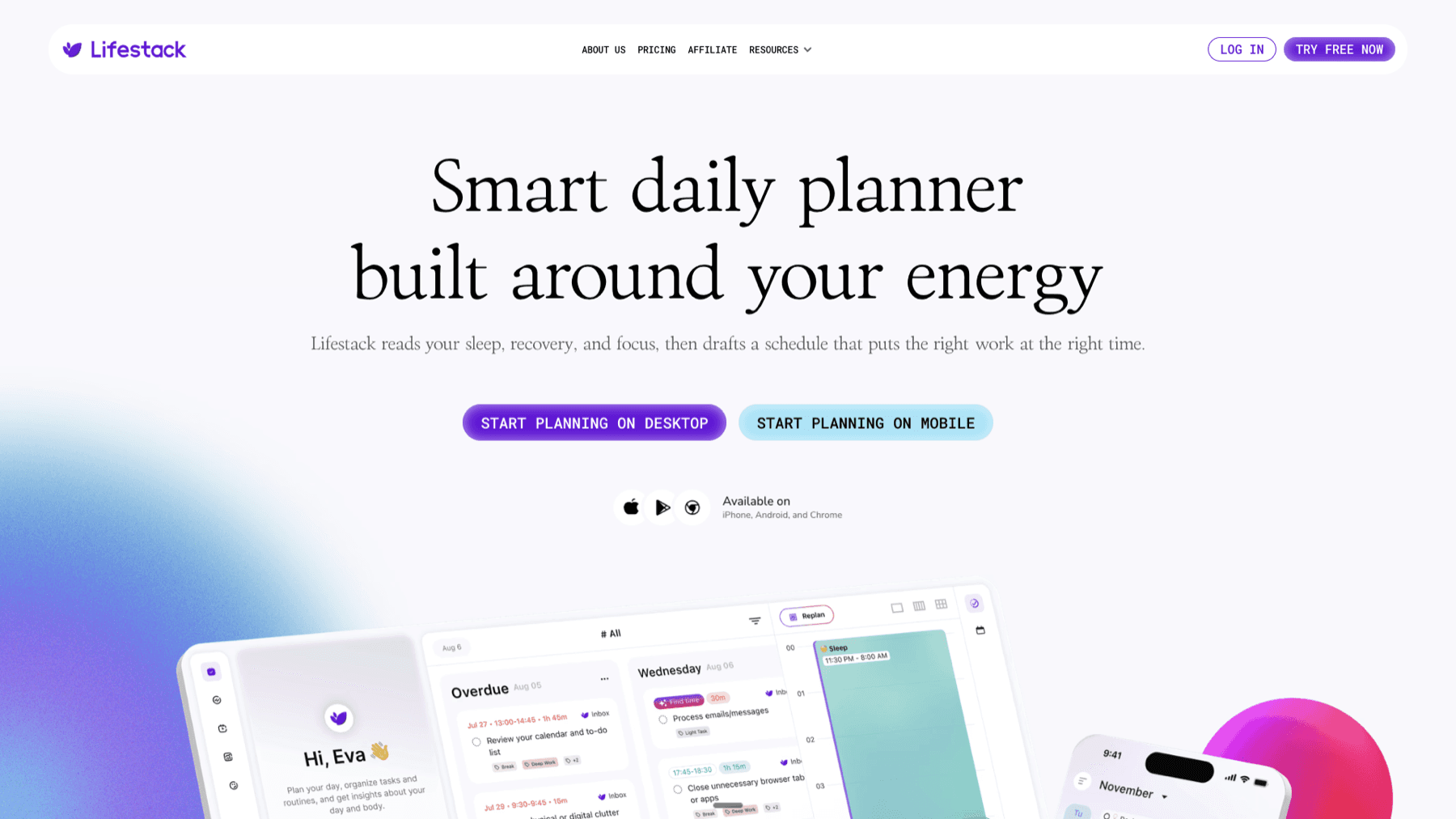
Lifestack is a scheduling app that maps your tasks and habits to your natural energy levels throughout the day. Instead of manually deciding when to do what, you tell Lifestack what you need to accomplish and it builds a schedule that puts demanding habits during your peak energy window and lighter ones when you're winding down.
It syncs with Google Calendar and Apple Calendar, so your habit blocks sit alongside real appointments. You can also use it to protect recurring habit slots from being overwritten by meetings, which is one of the most common ways good habits get derailed in practice. Being intentional about planning your days is itself one of the most impactful habits you can build.
Lifestack costs $7/month or $50/year, with a 7-day free trial on the annual plan. A $120 lifetime option is also available. It works on iOS, Android, and as a Chrome extension.
Frequently Asked Questions
What is a good habit example?
Good habit examples include: drinking a glass of water before each meal, writing three things you want to accomplish before opening your email, walking for 10 minutes after lunch, reviewing your calendar the night before, and putting your phone in a drawer during focused work. What makes them good is that they're specific, easy to start, and have a clear trigger.
How long does it take to build a good habit?
Research by Phillippa Lally at UCL found the range is 18 to 254 days, with an average around 66 days. Simple habits (drinking water, taking a supplement) form faster. Complex ones (daily exercise, meditation) take longer. Daily repetition in the same context is the main accelerant.
What are the three elements of a good habit?
The classic habit loop has three parts: a cue (the trigger), a routine (the behavior), and a reward (the payoff). A good habit needs all three to become automatic. Without a reliable cue, you're relying on willpower. Without a reward, the brain has no reason to reinforce the loop.
Can you build multiple good habits at the same time?
Yes, but it's slower. Each new behavior competes for attention during the deliberate phase. Most habit researchers recommend focusing on one or two at a time, or using habit stacking to link new behaviors to existing ones so they share a cue.
What's the difference between a good habit and a good routine?
A routine is a deliberate sequence of behaviors. A habit is a behavior that's become automatic in response to a cue. Routines can contain multiple habits and non-automatic steps. Not all routines become habits: some require active thought indefinitely, especially complex multi-step sequences.
Why do good habits keep breaking?
The most common reasons: the cue is too weak (no reliable trigger), the behavior asks too much on low-energy days (too ambitious at the wrong stage), or there's no visible reward. Fixing one of these usually fixes the habit. Most stalled habits fail on the cue: adding a physical trigger or anchor to an existing routine is often all it takes.
What Makes Something a Good Habit
A good habit is a behavior that, once automatic, improves your life without requiring ongoing willpower to maintain. The key phrase is "once automatic": until then, every repetition is an act of intention. The goal is to shorten that window as much as possible so the behavior becomes part of your default operating mode.
Good habits tend to share a few traits. They're specific enough to have a clear trigger. They're small enough to start on low-motivation days. And their benefits are either immediate (you feel better right away) or visible enough over time to sustain the effort. Broad intentions like "exercise more" rarely become automatic habits. "Walk for 10 minutes after lunch" does.
This guide covers seven strategies that consistently appear in habit research and that work whether you're building a new routine from scratch or trying to get a stalled one moving again.
Key Takeaways
Good habits form faster when they're small, specific, and attached to an existing cue.
Environment design does more work than willpower: make the habit easy to start and the competing behavior harder.
Tracking progress adds a layer of reward that reinforces the behavior loop.
1. Start Smaller Than You Think You Should
The single most reliable way to build a good habit is to make the starting version too easy to skip. Not "do 20 push-ups" but "do one push-up." Not "journal for 20 minutes" but "write one sentence." The logic isn't about the output: it's about building the trigger-behavior connection.
Each time you perform the habit, no matter how small, you're reinforcing the neural link between your cue and that action. A 2-minute version of the habit done daily reaches automaticity faster than a 30-minute version done twice a week. Once the habit is automatic, you can expand it. But the automaticity has to come first.
James Clear calls this the "Two-Minute Rule" in Atomic Habits: any habit should be reducible to a version that takes two minutes or less. This isn't the end state. It's the entry point.
2. Stack New Habits Onto Existing Ones
One of the most efficient ways to build a good habit is to borrow the automatic cue from an existing one. This technique, called habit stacking, works by inserting the new behavior immediately before or after something you already do without thinking.
The format is simple: "After [current habit], I will [new habit]." After I pour my morning coffee, I will open my planner. After I sit down at my desk, I will write one sentence. After I brush my teeth, I will do two minutes of stretching. The existing habit acts as a reliable trigger, which is the hardest part to establish when building from zero.
An ADHD morning routine often benefits most from this approach, because it reduces the number of decisions required before the first task is started.
3. Design Your Environment to Make the Habit Easy
Willpower is unreliable. Environment design is not. The most consistent habit-builders don't rely on motivation: they change the physical or digital setup so the habit is the default, not the deliberate choice.
Put your running shoes by the door. Keep your journal on the kitchen counter. Move your phone to a drawer when it's time to focus. Every time you have to go out of your way to access a tool for a good habit, that friction costs you a few percent of the people who would have otherwise done it. Reduce the friction and the behavior follows.
Visual reminders are a form of environment design: they make the cue external and physical rather than something you have to remember to remember. A sticky note on your monitor, a habit tracker on your fridge, a widget on your phone's lock screen. The goal is to make the trigger unavoidable.
4. Schedule Habits During Your Peak Energy
Timing matters more than most habit advice acknowledges. A good habit that asks too much of you when your energy is low will stay fragile. Scheduled at the right time, the same habit feels almost effortless.
Research on chronobiology shows that most people have a clear peak performance window of two to four hours, usually in the morning or early afternoon. Habits that require cognitive effort (writing, studying, deep work, focused exercise) are dramatically easier to start and sustain when they're scheduled during this window.
The harder your habit is to start, the more important it is to protect its time slot. A visual schedule that blocks out habit time the same way it blocks out meetings gives your habits the same protected status as your work commitments.
5. Use a Tracking System That's Frictionless
Tracking a habit adds a second reward to the loop: the satisfaction of marking it done. That secondary reward often matters more than people expect, especially in the early weeks when the primary benefit isn't yet visible or felt.
The best tracking systems are ones you'll actually use on low-motivation days. A simple paper calendar with X marks, a one-tap habit app, or a spreadsheet that takes 10 seconds to update all work well. A habit tracker planner that integrates with your existing daily workflow reduces the chance you'll stop tracking when things get busy.
Don't break the chain. The visual momentum of a consecutive streak creates mild loss aversion that motivates you to maintain the streak even when the habit itself doesn't feel rewarding in the moment.
6. Set Goals That Make the Habit Measurable
Vague habits produce vague results. "Be healthier" gives you nothing to track and no clear signal of success. "Walk for 15 minutes after dinner" gives you a yes or no every single day.
Measurable habits also make it easy to see progress over time, which is one of the most underrated sources of motivation for staying consistent. Setting clear habit-based goals with specific outcomes turns the behavior into a project with momentum rather than an open-ended aspiration.
A useful approach: define a minimum threshold ("I did the habit if I did at least this much") and a target ("I succeeded if I hit this"). The minimum keeps your streak alive on hard days. The target gives you something to aim for on good ones.
7. Build a Recovery Plan for Broken Streaks
Every streak breaks eventually. The distinguishing factor between people who build lasting good habits and people who cycle through restarts is what they do the day after a miss.
One missed day has almost no measurable effect on habit formation, according to UCL research. Two missed days starts to matter. Three or more and you're rebuilding from closer to zero. The rule many habit researchers suggest: never miss twice in a row. One miss is an event. Two is the beginning of a pattern.
Having a recovery protocol in place before you need it helps. Something as simple as "if I miss, I do the minimum version the next day and mark it done" is enough. The goal is to keep the behavior connected to its cue, even if the full version isn't possible. For strategies on unwinding habits you'd rather not have, the guide on breaking bad habits covers the same mechanics from the opposite direction.
ADHD-specific habit hacks often focus on recovery: shorter streaks as the goal unit, immediate restart protocols, and lower minimums on difficult days.
Best Tool for Scheduling Good Habits
Building good habits is easier when your daily schedule is already working for you. If your day is unstructured or overscheduled, even well-designed habits get crowded out.
Lifestack is a scheduling app that maps your tasks and habits to your natural energy levels throughout the day. Instead of manually deciding when to do what, you tell Lifestack what you need to accomplish and it builds a schedule that puts demanding habits during your peak energy window and lighter ones when you're winding down.
It syncs with Google Calendar and Apple Calendar, so your habit blocks sit alongside real appointments. You can also use it to protect recurring habit slots from being overwritten by meetings, which is one of the most common ways good habits get derailed in practice. Being intentional about planning your days is itself one of the most impactful habits you can build.
Lifestack costs $7/month or $50/year, with a 7-day free trial on the annual plan. A $120 lifetime option is also available. It works on iOS, Android, and as a Chrome extension.
Frequently Asked Questions
What is a good habit example?
Good habit examples include: drinking a glass of water before each meal, writing three things you want to accomplish before opening your email, walking for 10 minutes after lunch, reviewing your calendar the night before, and putting your phone in a drawer during focused work. What makes them good is that they're specific, easy to start, and have a clear trigger.
How long does it take to build a good habit?
Research by Phillippa Lally at UCL found the range is 18 to 254 days, with an average around 66 days. Simple habits (drinking water, taking a supplement) form faster. Complex ones (daily exercise, meditation) take longer. Daily repetition in the same context is the main accelerant.
What are the three elements of a good habit?
The classic habit loop has three parts: a cue (the trigger), a routine (the behavior), and a reward (the payoff). A good habit needs all three to become automatic. Without a reliable cue, you're relying on willpower. Without a reward, the brain has no reason to reinforce the loop.
Can you build multiple good habits at the same time?
Yes, but it's slower. Each new behavior competes for attention during the deliberate phase. Most habit researchers recommend focusing on one or two at a time, or using habit stacking to link new behaviors to existing ones so they share a cue.
What's the difference between a good habit and a good routine?
A routine is a deliberate sequence of behaviors. A habit is a behavior that's become automatic in response to a cue. Routines can contain multiple habits and non-automatic steps. Not all routines become habits: some require active thought indefinitely, especially complex multi-step sequences.
Why do good habits keep breaking?
The most common reasons: the cue is too weak (no reliable trigger), the behavior asks too much on low-energy days (too ambitious at the wrong stage), or there's no visible reward. Fixing one of these usually fixes the habit. Most stalled habits fail on the cue: adding a physical trigger or anchor to an existing routine is often all it takes.



FOLLOW ON
FOLLOW ON
FOLLOW ON


Copyright 2026 © Lifestack. All rights reserved
Copyright 2026 © Lifestack. All rights reserved

