
Tips
Visual Reminders for ADHD: 6 Techniques That Work
Visual Reminders for ADHD: 6 Techniques That Work

Why Visual Reminders Work So Well for ADHD
The ADHD brain has a working memory problem. It's not that you forget things because you don't care. It's that information that isn't immediately in front of you might as well not exist. A task you need to do at 3pm is effectively invisible to you at 10am unless something keeps it in view.
Visual reminders for ADHD work because they move the memory load out of your head and into your environment. Instead of relying on internal recall, you're relying on something you can see. The moment you walk past a sticky note, look at a whiteboard, or glance at a timer on your desk, the cue is there. Your brain doesn't have to generate it from scratch.
This is also why standard phone notifications often fail for ADHD. A notification appears, gets dismissed, and disappears. If it's gone, it doesn't exist. Visual reminders that stay visible, stay physical, and stay in your field of view work on a completely different principle. They're persistent by design.
The techniques below cover both analog and digital approaches. The right mix depends on where you spend your time and what kind of cues your brain responds to. Most people with ADHD find that a combination of physical and digital visual reminders works better than either alone.
Key Takeaways
Visual reminders are effective for ADHD because they offload memory from your brain to your environment
Physical reminders (whiteboards, sticky notes, timers) tend to outlast digital ones because they can't be dismissed or swiped away
The best ADHD reminder system combines visible analog tools with a smart scheduling layer that handles timing automatically
1. Sticky Notes and Whiteboards: The Analog Foundation
Don't underestimate low-tech. A sticky note on your laptop screen, your front door, or the bathroom mirror has one enormous advantage over any app: it cannot be dismissed. You can't swipe it away. You walk past it and it's there again. For ADHD brains, that persistence is exactly the point.
The key is placement strategy. A sticky note in a drawer does nothing. A sticky note at eye level on the path between where you wake up and where you make coffee can be one of the most effective visual reminders you own. Think about your natural movement patterns throughout the day and put reminders on the route.
Whiteboards work similarly at a larger scale. A whiteboard in your line of sight with today's three most important tasks gives your brain a constant ambient reminder of what matters. Wipe it clean each morning and rewrite the list, which is itself a useful planning ritual. Some people keep a "brain dump" section on their whiteboard where anything that occurs to them goes immediately, which prevents the cognitive load of trying to remember it for later. The brain dump technique is worth reading about if you haven't tried it.
2. Color Code Everything That Matters
Color is processed preattentively. Your brain registers color before it consciously reads text, which makes color coding one of the fastest visual cues available. For ADHD, where the difference between noticing and ignoring a reminder can come down to milliseconds of attention, that speed matters.
Apply color coding to your calendar, your task lists, and your physical space. Use one color for urgent tasks, another for scheduled commitments, another for personal items. The exact system matters less than picking one and keeping it consistent. Once your brain learns what red means in your system, red things register as requiring attention even before you consciously look at them.
Physical color coding through colored folders, bins, or labeled zones in your workspace also reduces the cognitive load of organizing. Instead of deciding where something goes, you're following a color. That small reduction in friction can make a meaningful difference when executive function is already stretched.
3. Visual Timers for ADHD Time Blindness
Time blindness is one of the most disruptive features of ADHD. When you can't feel time passing, you either lose entire hours or chronically underestimate how long things take. A standard timer (like a phone countdown) doesn't help much because the time remaining is a number, not something you can perceive visually.
Visual timers solve this by making time visible. The Time Timer (the analog clock with the red disk that shrinks as time passes) is the most widely used. As the red area gets smaller, you can see at a glance how much time is left. That visual representation connects to your perception in a way that "43 minutes remaining" in text doesn't.
Place a visual timer wherever you need to stay on task. During a work session, a visual timer on your desk keeps you honest about how much time you've spent. During transitions, a timer can signal that it's time to stop one thing and start another. The visual cue of the timer reaching zero also provides a natural stopping point that the ADHD brain often struggles to generate internally.
4. Visual Schedules and Daily Routine Boards
A visual schedule turns your day from an abstract sequence of obligations into something you can see and check off. This is especially effective for morning and evening routines, where the order of tasks matters but remembering the sequence is cognitively demanding.
The format can be as simple as a laminated card with your morning routine steps, or as elaborate as a magnetic chore board on the fridge. The important element is that it's visible during the routine itself. A routine card next to your bathroom sink means you don't have to remember what comes after brushing your teeth. You look at the card.
For ADHD morning routines specifically, visual schedules reduce the friction and decision-making that slows things down. Each step is already decided. You execute, check it off, and move to the next one. The cognitive load of "what do I need to do before I leave" is replaced by the much simpler act of following a visible list. This pairs well with the ADHD daily planner approach for structuring your broader day.
5. Digital Visual Reminders and App-Based Tools
Digital reminders have a persistence problem that physical ones don't. Dismiss a notification and it's gone. But the right digital tools can work around this by building reminders into your workflow rather than interrupting it with one-off pings you can ignore.
Widgets are more effective than notifications for ADHD because they're persistent. A home screen widget showing your top three tasks for the day is always visible when you open your phone. You don't dismiss it. It's just there. Similarly, calendar apps that show your next event on the lock screen create a constant ambient reminder that doesn't require any action on your part.
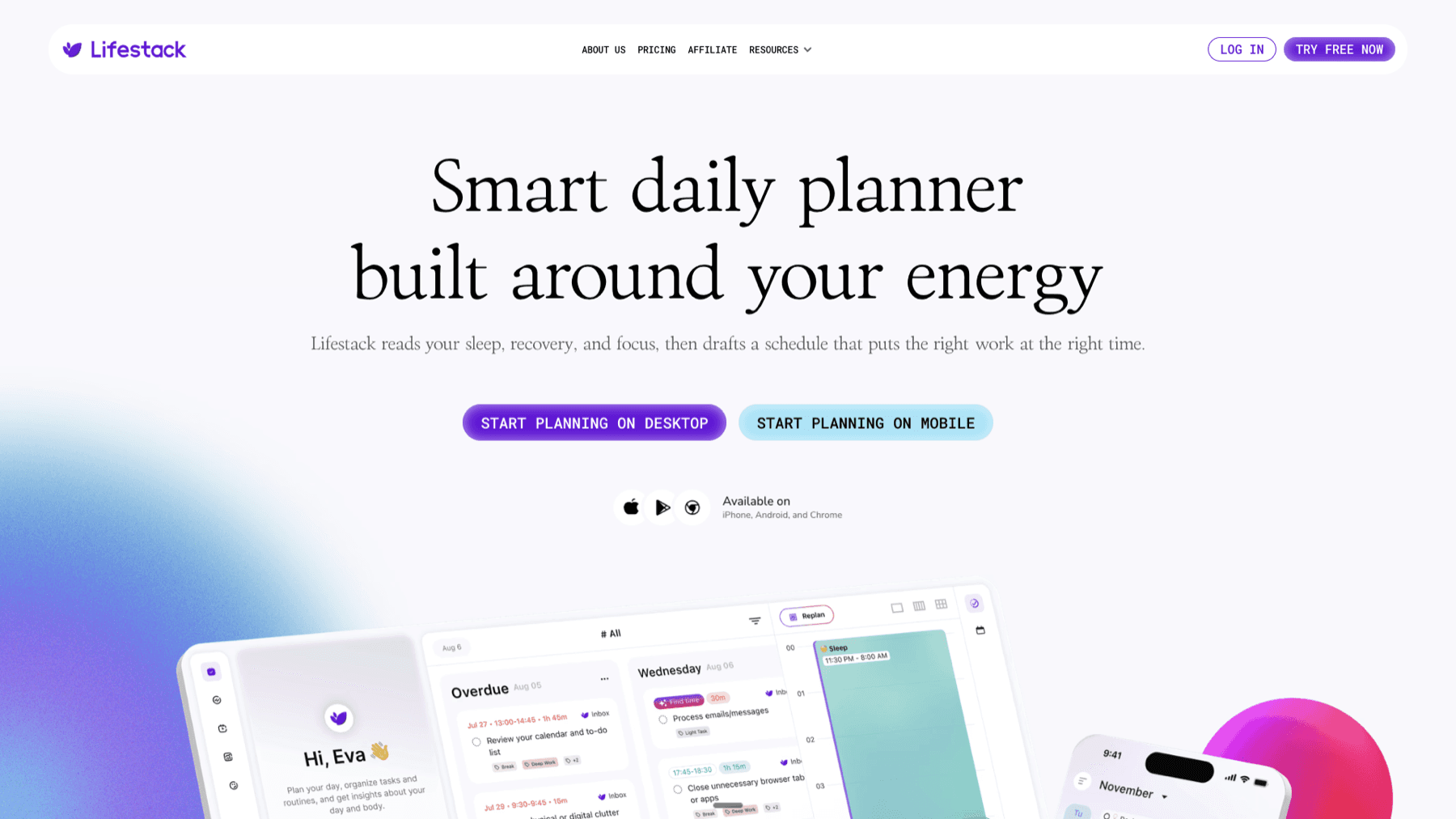
Lifestack is worth calling out specifically here. Rather than relying on you to remember to check reminders, it builds a daily plan each morning that incorporates your tasks, calendar events, and energy patterns. Your day is laid out visually in the app, with tasks placed at the time of day when you're most likely to actually do them. The visual daily schedule it creates functions as a persistent reminder of what's coming next, rather than a one-time notification that disappears. It costs $7/month or $50/year, and the energy-based planning approach behind it is what makes the visual scheduling genuinely different from a standard to-do list. If you're building a broader ADHD task management system, this is worth including as the scheduling layer.
6. Environmental Design: Make Your Space Do the Work
The most sustainable visual reminder system is one you don't have to think about. Environmental design means setting up your physical and digital spaces so that the right cues are impossible to miss without requiring any memory or deliberate checking.
Some concrete applications: put items you need to take with you by the door, not in your bag. If your keys and badge are on a hook right next to the door handle, you see them as you leave. Put your vitamins or medication next to your coffee maker, not in a cabinet. If something needs to happen in the morning, it should be in your morning visual field by default.
For digital environments, this means a clean desktop with only active project folders visible, a browser home page that shows your task list instead of a news feed, and a phone home screen organized around what you actually need to do rather than what gets your attention. The ADHD goal-setting guide has more on how to structure priorities so they stay visible over time. The goal is an environment where forgetting is the harder outcome, not the default one.
Building a Visual Reminder System That Sticks
The mistake most people make is building too much at once. A perfect system you abandon after two weeks is worse than a simple one you actually use. Start with one physical visual reminder (a whiteboard or sticky note on your desk) and one digital visual cue (a home screen widget). Use those for two weeks before adding more.
The other common failure is putting visual reminders somewhere you won't look. Reminders only work if they're in your active visual field. Your ADHD brain doesn't scan for them the way a neurotypical brain might. They need to be unavoidable. A sticky note on the inside of a cabinet doesn't count. A sticky note on the refrigerator door, the bathroom mirror, or your laptop lid does.
For a broader look at apps designed specifically for ADHD focus and reminders, the ADHD apps for focus guide covers the full range of digital tools worth considering.
Frequently Asked Questions
What are the best visual reminders for ADHD?
The best visual reminders for ADHD are ones that stay visible without requiring action. Physical options: sticky notes in high-traffic areas, whiteboards in your line of sight, visual timers on your desk. Digital options: home screen widgets, persistent calendar displays, and daily planning apps like Lifestack that build your schedule visually each morning.
Why do visual reminders work better for ADHD than regular reminders?
Standard reminders appear once and disappear when dismissed. The ADHD brain often dismisses notifications automatically without fully processing them. Visual reminders that stay visible don't require your brain to retain information between the reminder and the action. The cue is in your environment continuously, not just at one moment in time.
How do I use visual timers for ADHD time blindness?
Place a visual timer (the Time Timer is the most common choice) wherever you need time awareness. Set it for your work session length before you start, not when you realize you've been going too long. The shrinking visual display lets you perceive how much time is left without having to calculate it. This works better than standard timers because time becomes something you can see rather than something you have to mentally track. Read more about managing ADHD time blindness for additional techniques.
Can I use my phone for visual reminders if I have ADHD?
Yes, but use persistent widgets rather than one-time notifications. A widget showing your top three tasks for the day lives on your home screen permanently and doesn't require dismissal. Lock screen calendar displays work similarly. The goal is visual information that's always there when you look at your phone, not alerts that disappear once tapped.
How many visual reminders is too many?
When you stop noticing them. Visual reminders suffer from habituation: if every surface is covered in sticky notes, none of them register. Rotate them regularly, limit them to your most important current priorities, and remove them when the task is done. Three to five active visual reminders at a time is a reasonable ceiling for most people.
What visual schedule works best for ADHD morning routines?
A laminated card or small whiteboard with your morning steps listed in order, placed where you actually do the routine (bathroom mirror, kitchen counter). The physical placement matters as much as the content. A visual schedule on your phone doesn't work as well because you have to remember to open it. One that's in your field of view during the routine itself is always on.
Why Visual Reminders Work So Well for ADHD
The ADHD brain has a working memory problem. It's not that you forget things because you don't care. It's that information that isn't immediately in front of you might as well not exist. A task you need to do at 3pm is effectively invisible to you at 10am unless something keeps it in view.
Visual reminders for ADHD work because they move the memory load out of your head and into your environment. Instead of relying on internal recall, you're relying on something you can see. The moment you walk past a sticky note, look at a whiteboard, or glance at a timer on your desk, the cue is there. Your brain doesn't have to generate it from scratch.
This is also why standard phone notifications often fail for ADHD. A notification appears, gets dismissed, and disappears. If it's gone, it doesn't exist. Visual reminders that stay visible, stay physical, and stay in your field of view work on a completely different principle. They're persistent by design.
The techniques below cover both analog and digital approaches. The right mix depends on where you spend your time and what kind of cues your brain responds to. Most people with ADHD find that a combination of physical and digital visual reminders works better than either alone.
Key Takeaways
Visual reminders are effective for ADHD because they offload memory from your brain to your environment
Physical reminders (whiteboards, sticky notes, timers) tend to outlast digital ones because they can't be dismissed or swiped away
The best ADHD reminder system combines visible analog tools with a smart scheduling layer that handles timing automatically
1. Sticky Notes and Whiteboards: The Analog Foundation
Don't underestimate low-tech. A sticky note on your laptop screen, your front door, or the bathroom mirror has one enormous advantage over any app: it cannot be dismissed. You can't swipe it away. You walk past it and it's there again. For ADHD brains, that persistence is exactly the point.
The key is placement strategy. A sticky note in a drawer does nothing. A sticky note at eye level on the path between where you wake up and where you make coffee can be one of the most effective visual reminders you own. Think about your natural movement patterns throughout the day and put reminders on the route.
Whiteboards work similarly at a larger scale. A whiteboard in your line of sight with today's three most important tasks gives your brain a constant ambient reminder of what matters. Wipe it clean each morning and rewrite the list, which is itself a useful planning ritual. Some people keep a "brain dump" section on their whiteboard where anything that occurs to them goes immediately, which prevents the cognitive load of trying to remember it for later. The brain dump technique is worth reading about if you haven't tried it.
2. Color Code Everything That Matters
Color is processed preattentively. Your brain registers color before it consciously reads text, which makes color coding one of the fastest visual cues available. For ADHD, where the difference between noticing and ignoring a reminder can come down to milliseconds of attention, that speed matters.
Apply color coding to your calendar, your task lists, and your physical space. Use one color for urgent tasks, another for scheduled commitments, another for personal items. The exact system matters less than picking one and keeping it consistent. Once your brain learns what red means in your system, red things register as requiring attention even before you consciously look at them.
Physical color coding through colored folders, bins, or labeled zones in your workspace also reduces the cognitive load of organizing. Instead of deciding where something goes, you're following a color. That small reduction in friction can make a meaningful difference when executive function is already stretched.
3. Visual Timers for ADHD Time Blindness
Time blindness is one of the most disruptive features of ADHD. When you can't feel time passing, you either lose entire hours or chronically underestimate how long things take. A standard timer (like a phone countdown) doesn't help much because the time remaining is a number, not something you can perceive visually.
Visual timers solve this by making time visible. The Time Timer (the analog clock with the red disk that shrinks as time passes) is the most widely used. As the red area gets smaller, you can see at a glance how much time is left. That visual representation connects to your perception in a way that "43 minutes remaining" in text doesn't.
Place a visual timer wherever you need to stay on task. During a work session, a visual timer on your desk keeps you honest about how much time you've spent. During transitions, a timer can signal that it's time to stop one thing and start another. The visual cue of the timer reaching zero also provides a natural stopping point that the ADHD brain often struggles to generate internally.
4. Visual Schedules and Daily Routine Boards
A visual schedule turns your day from an abstract sequence of obligations into something you can see and check off. This is especially effective for morning and evening routines, where the order of tasks matters but remembering the sequence is cognitively demanding.
The format can be as simple as a laminated card with your morning routine steps, or as elaborate as a magnetic chore board on the fridge. The important element is that it's visible during the routine itself. A routine card next to your bathroom sink means you don't have to remember what comes after brushing your teeth. You look at the card.
For ADHD morning routines specifically, visual schedules reduce the friction and decision-making that slows things down. Each step is already decided. You execute, check it off, and move to the next one. The cognitive load of "what do I need to do before I leave" is replaced by the much simpler act of following a visible list. This pairs well with the ADHD daily planner approach for structuring your broader day.
5. Digital Visual Reminders and App-Based Tools
Digital reminders have a persistence problem that physical ones don't. Dismiss a notification and it's gone. But the right digital tools can work around this by building reminders into your workflow rather than interrupting it with one-off pings you can ignore.
Widgets are more effective than notifications for ADHD because they're persistent. A home screen widget showing your top three tasks for the day is always visible when you open your phone. You don't dismiss it. It's just there. Similarly, calendar apps that show your next event on the lock screen create a constant ambient reminder that doesn't require any action on your part.
Lifestack is worth calling out specifically here. Rather than relying on you to remember to check reminders, it builds a daily plan each morning that incorporates your tasks, calendar events, and energy patterns. Your day is laid out visually in the app, with tasks placed at the time of day when you're most likely to actually do them. The visual daily schedule it creates functions as a persistent reminder of what's coming next, rather than a one-time notification that disappears. It costs $7/month or $50/year, and the energy-based planning approach behind it is what makes the visual scheduling genuinely different from a standard to-do list. If you're building a broader ADHD task management system, this is worth including as the scheduling layer.
6. Environmental Design: Make Your Space Do the Work
The most sustainable visual reminder system is one you don't have to think about. Environmental design means setting up your physical and digital spaces so that the right cues are impossible to miss without requiring any memory or deliberate checking.
Some concrete applications: put items you need to take with you by the door, not in your bag. If your keys and badge are on a hook right next to the door handle, you see them as you leave. Put your vitamins or medication next to your coffee maker, not in a cabinet. If something needs to happen in the morning, it should be in your morning visual field by default.
For digital environments, this means a clean desktop with only active project folders visible, a browser home page that shows your task list instead of a news feed, and a phone home screen organized around what you actually need to do rather than what gets your attention. The ADHD goal-setting guide has more on how to structure priorities so they stay visible over time. The goal is an environment where forgetting is the harder outcome, not the default one.
Building a Visual Reminder System That Sticks
The mistake most people make is building too much at once. A perfect system you abandon after two weeks is worse than a simple one you actually use. Start with one physical visual reminder (a whiteboard or sticky note on your desk) and one digital visual cue (a home screen widget). Use those for two weeks before adding more.
The other common failure is putting visual reminders somewhere you won't look. Reminders only work if they're in your active visual field. Your ADHD brain doesn't scan for them the way a neurotypical brain might. They need to be unavoidable. A sticky note on the inside of a cabinet doesn't count. A sticky note on the refrigerator door, the bathroom mirror, or your laptop lid does.
For a broader look at apps designed specifically for ADHD focus and reminders, the ADHD apps for focus guide covers the full range of digital tools worth considering.
Frequently Asked Questions
What are the best visual reminders for ADHD?
The best visual reminders for ADHD are ones that stay visible without requiring action. Physical options: sticky notes in high-traffic areas, whiteboards in your line of sight, visual timers on your desk. Digital options: home screen widgets, persistent calendar displays, and daily planning apps like Lifestack that build your schedule visually each morning.
Why do visual reminders work better for ADHD than regular reminders?
Standard reminders appear once and disappear when dismissed. The ADHD brain often dismisses notifications automatically without fully processing them. Visual reminders that stay visible don't require your brain to retain information between the reminder and the action. The cue is in your environment continuously, not just at one moment in time.
How do I use visual timers for ADHD time blindness?
Place a visual timer (the Time Timer is the most common choice) wherever you need time awareness. Set it for your work session length before you start, not when you realize you've been going too long. The shrinking visual display lets you perceive how much time is left without having to calculate it. This works better than standard timers because time becomes something you can see rather than something you have to mentally track. Read more about managing ADHD time blindness for additional techniques.
Can I use my phone for visual reminders if I have ADHD?
Yes, but use persistent widgets rather than one-time notifications. A widget showing your top three tasks for the day lives on your home screen permanently and doesn't require dismissal. Lock screen calendar displays work similarly. The goal is visual information that's always there when you look at your phone, not alerts that disappear once tapped.
How many visual reminders is too many?
When you stop noticing them. Visual reminders suffer from habituation: if every surface is covered in sticky notes, none of them register. Rotate them regularly, limit them to your most important current priorities, and remove them when the task is done. Three to five active visual reminders at a time is a reasonable ceiling for most people.
What visual schedule works best for ADHD morning routines?
A laminated card or small whiteboard with your morning steps listed in order, placed where you actually do the routine (bathroom mirror, kitchen counter). The physical placement matters as much as the content. A visual schedule on your phone doesn't work as well because you have to remember to open it. One that's in your field of view during the routine itself is always on.



FOLLOW ON
FOLLOW ON
FOLLOW ON


Copyright 2026 © Lifestack. All rights reserved
Copyright 2026 © Lifestack. All rights reserved

