
App
Best Headspace Alternatives in 2026
Best Headspace Alternatives in 2026

Headspace was one of the apps that helped mainstream daily meditation. But it's not the right fit for everyone: the price is high, the content can feel generic after a while, and its focus on traditional guided sessions leaves out people who want something different. Whether you're looking for a free option, a deeper approach, or a tool that addresses stress at a different level, there are solid alternatives worth knowing about.
This list covers five of the best Headspace alternatives in 2026, each taking a meaningfully different approach to the same underlying goal: less stress, better focus, and a more grounded daily routine. We've included one app that works differently from the rest entirely. Pricing is verified as of August 2026.
Key Takeaways
The best Headspace alternative depends on what you actually need: guided sessions, a free library, depth, personalization, or a different approach to stress altogether
Insight Timer is the strongest free alternative, with a library of 100,000+ meditations at no cost
If your stress comes from an overwhelming schedule rather than a lack of meditation practice, Lifestack addresses the root cause directly
Quick Guide
1. Lifestack : AI planner that reduces overwhelm and stress at the scheduling level
2. Calm: broad meditation and sleep app with the widest content library
3. Insight Timer : massive free meditation library with community and self-guided tools
4. Waking Up : philosophy-meets-science approach for people who want depth
5. Balance : personalized meditation plans that adapt to your experience level
How We Evaluated
Content depth and variety across meditation styles
Free tier quality and value
Sleep and stress support
Approach to habit building and consistent practice
Value for price relative to Headspace's $12.99/month
1. Lifestack
Address stress at its source instead of treating the symptoms
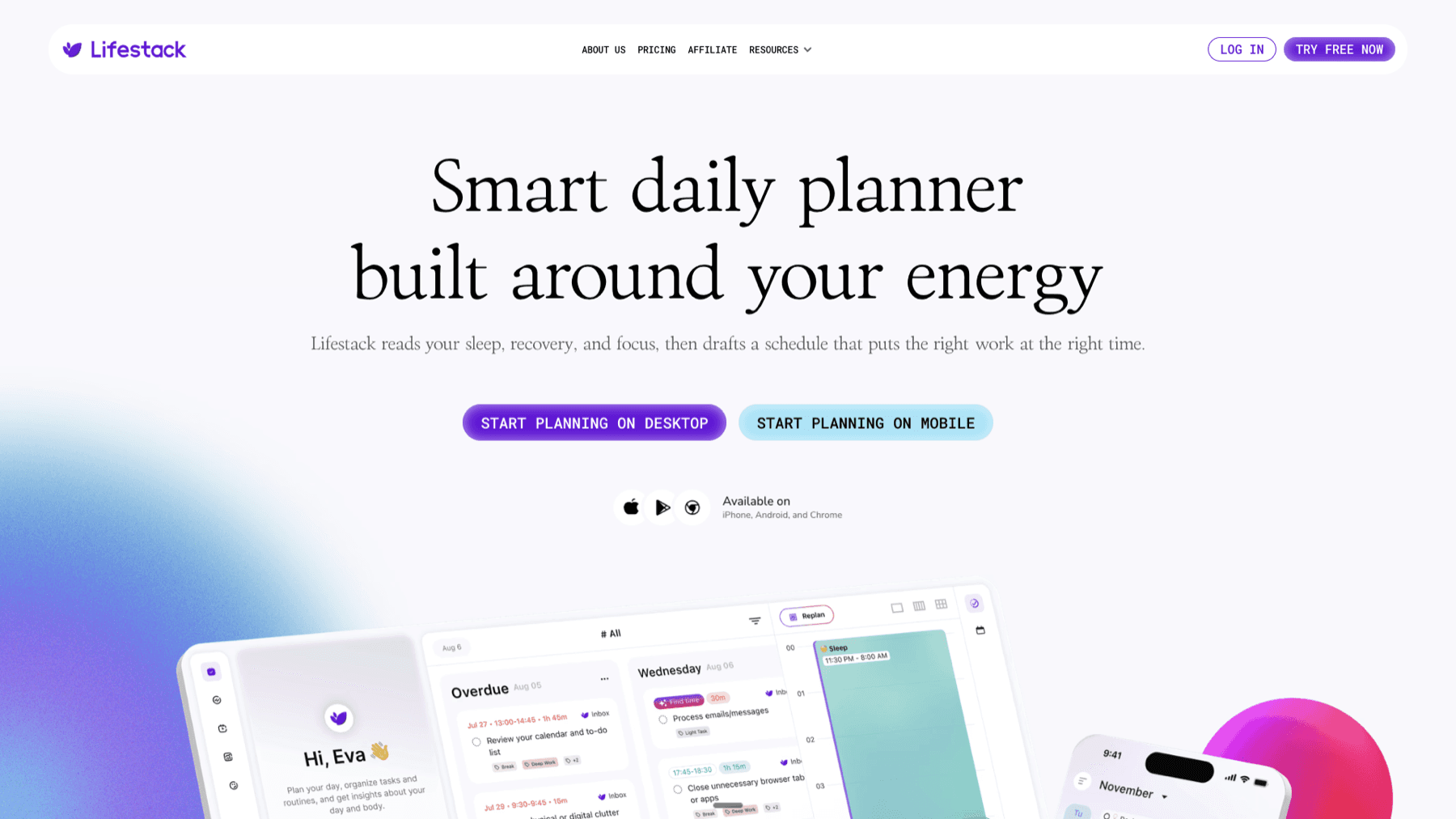
Most meditation apps treat the symptoms of an overloaded, disorganized day. Lifestack treats the cause. It's an AI planning app that automatically schedules your tasks based on your energy levels, so your hardest work lands in your sharpest hours and recovery time is built into the plan rather than leftover at the end. The result is fewer days that spiral into overwhelm before you've even started, which is what drives a lot of people to meditation apps in the first place.
This won't replace meditation for people who genuinely want a contemplative practice. But for people who reach for Headspace primarily because they feel scattered and overwhelmed, Lifestack addresses that problem more directly. Reducing the cortisol spike that comes from an unmanaged schedule is different from meditating after the damage is done. Lifestack also integrates with your existing calendars and tasks, so it works within your actual life rather than requiring you to build a parallel system.
AI-powered daily scheduling based on your energy levels and priorities
Automatic calendar integration across iOS, Android, and web
Energy-aware task placement that protects peak focus windows
Works alongside existing productivity tools and calendars
What Works
Addresses the scheduling-driven stress that causes people to seek meditation in the first place
Reduces daily decision fatigue by building the plan for you
The energy-based scheduling approach matches demanding work to your sharpest hours automatically
Limitations
Not a meditation app. No guided sessions, breathwork, or sleep stories
Works best for people whose stress is schedule-driven rather than practice-driven
Pricing: $7/month or $50/year. The annual plan includes a 7-day free trial.
Best for: People who feel perpetually behind and overwhelmed, and want to address the scheduling problem rather than meditate around it.
2. Calm
The broadest meditation and sleep library available
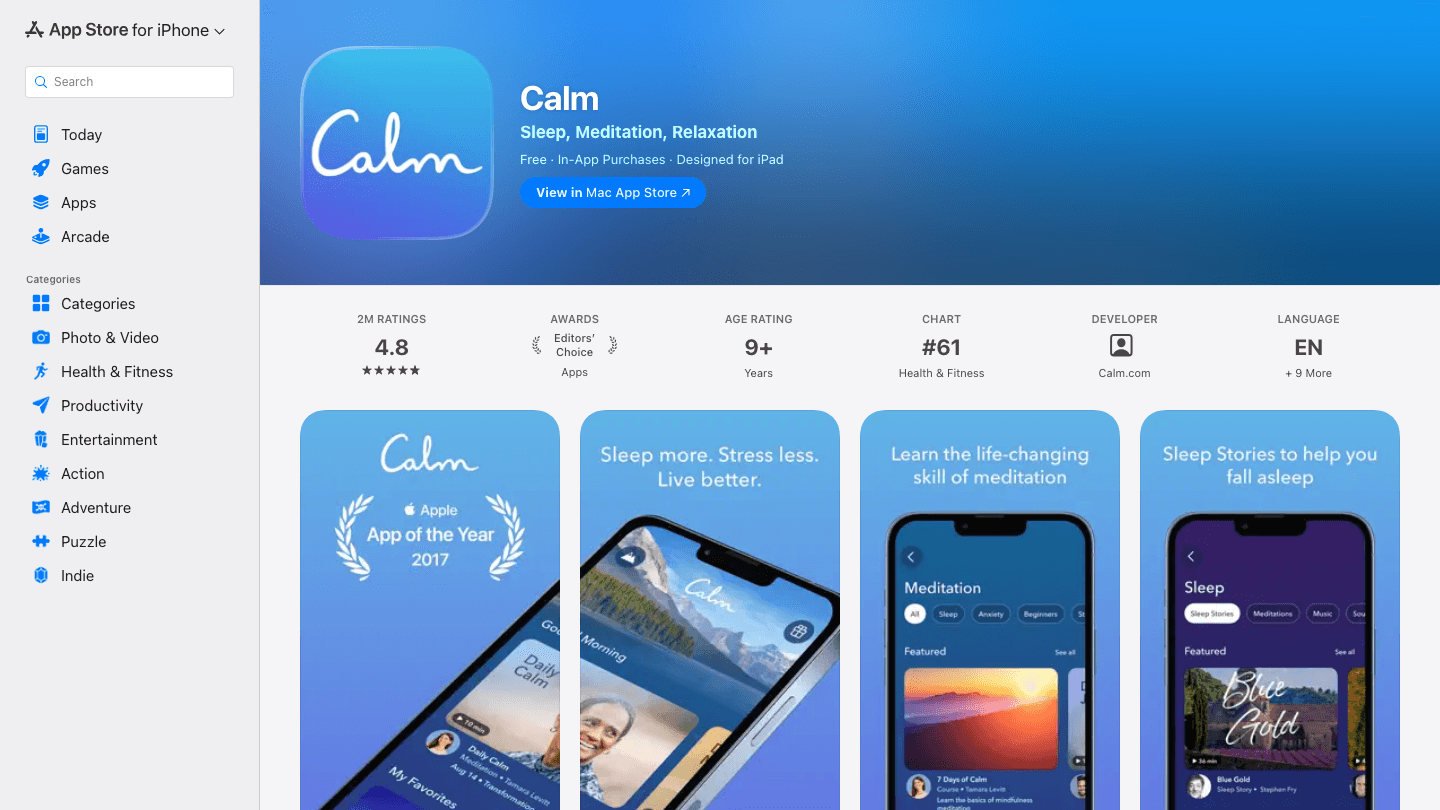
Calm is Headspace's most direct competitor: a broad meditation platform with guided sessions, sleep stories, breathwork, music, and celebrity voices. The content library is genuinely larger and more varied than Headspace's, with more entry points for beginners and more niche content for people with specific goals (anxiety, sleep, focus, etc.).
The Daily Calm (a new guided session each day) is one of the most consistently useful features for building a daily practice habit. Sleep stories narrated by familiar voices have become a cultural touchstone. The app won't feel dramatically different from Headspace to most users, but the content depth is better and the beginner experience is slightly more polished. Building a morning meditation habit is one of the most common use cases, and Calm's design supports that well.
Thousands of guided meditations across lengths and styles
Daily Calm: a new session released every day
Sleep stories and soundscapes for better sleep
Breathwork programs and movement exercises
What Works
Best-in-class sleep story library
Approachable for beginners with well-structured programs
Strong variety across meditation styles and goals
Limitations
No free tier beyond a 7-day trial; expensive relative to alternatives
Content can feel surface-level for advanced meditators
No personalization. The same content for everyone
Pricing: $14.99/month or $69.99/year.
Best for: Beginners who want a polished, wide-ranging meditation app with strong sleep support.
3. Insight Timer
The best free meditation library, by far
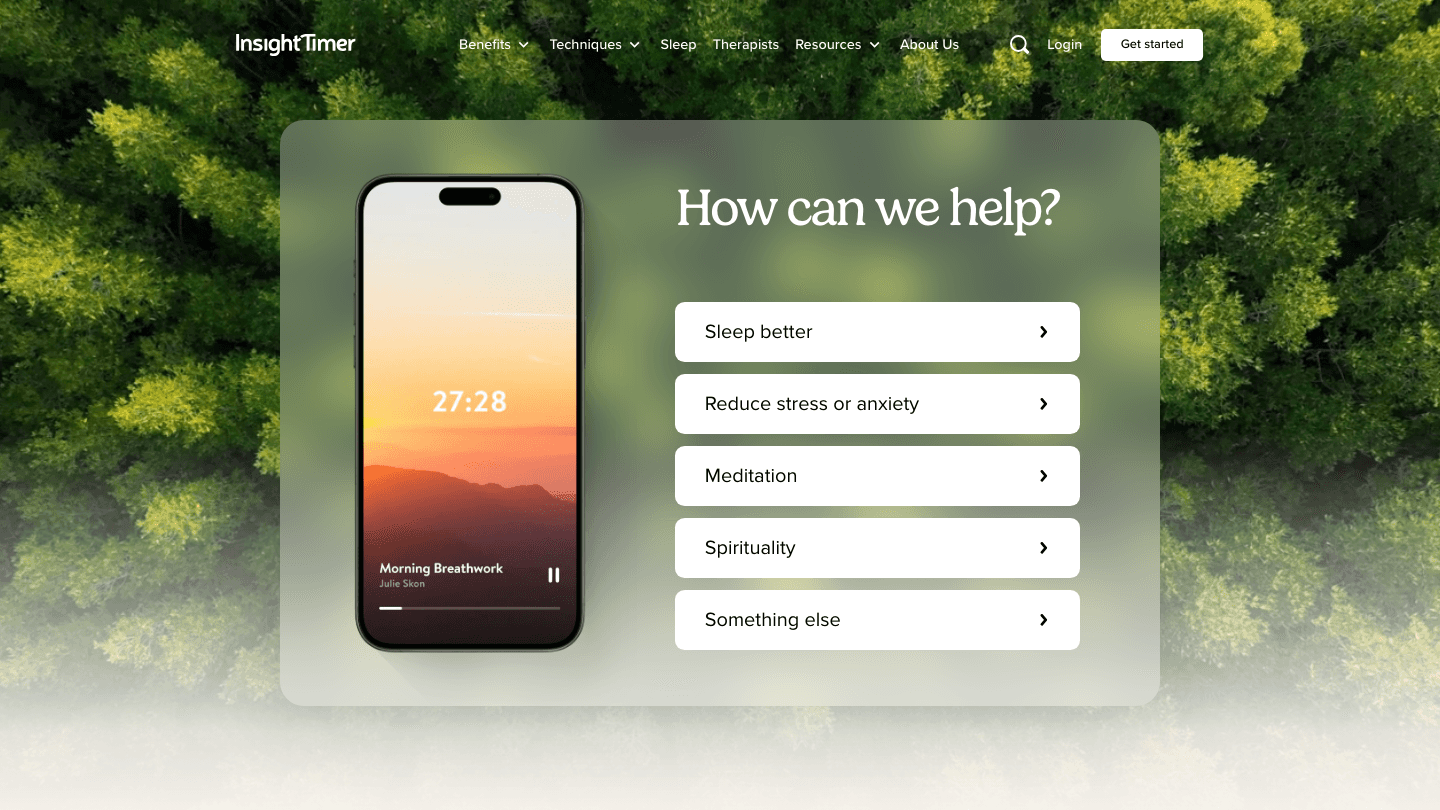
Insight Timer has over 100,000 free guided meditations from thousands of teachers worldwide. That's not a typo. While Headspace and Calm charge $12-15/month for a curated but limited library, Insight Timer's free tier is genuinely excellent and covers virtually every meditation style, length, and tradition.
The variety is both the strength and the weakness. Finding the right teacher and style among 100,000 options requires some exploration upfront, which can feel overwhelming for beginners. The community features (groups, challenges, friends) add social accountability that other apps lack. The premium tier adds courses and offline access, but the free version is a legitimate Headspace alternative for anyone willing to do a bit of navigation.
100,000+ free guided meditations across every style and tradition
Meditation timer for unguided sessions
Community features, challenges, and teacher subscriptions
Live meditation events and group sessions
What Works
Free tier is genuinely excellent, not just a trial
Best option for experienced meditators who want variety
Community accountability features are unique in the category
Limitations
Overwhelming for beginners; no clear starting path
Quality is inconsistent across teachers and recordings
No AI-powered scheduling or personalization
Pricing: Free. Premium at $9.99/month or $59.99/year for courses and offline access.
Best for: Experienced meditators who want maximum variety, and anyone for whom cost is a real barrier.
4. Waking Up
The intellectually rigorous alternative
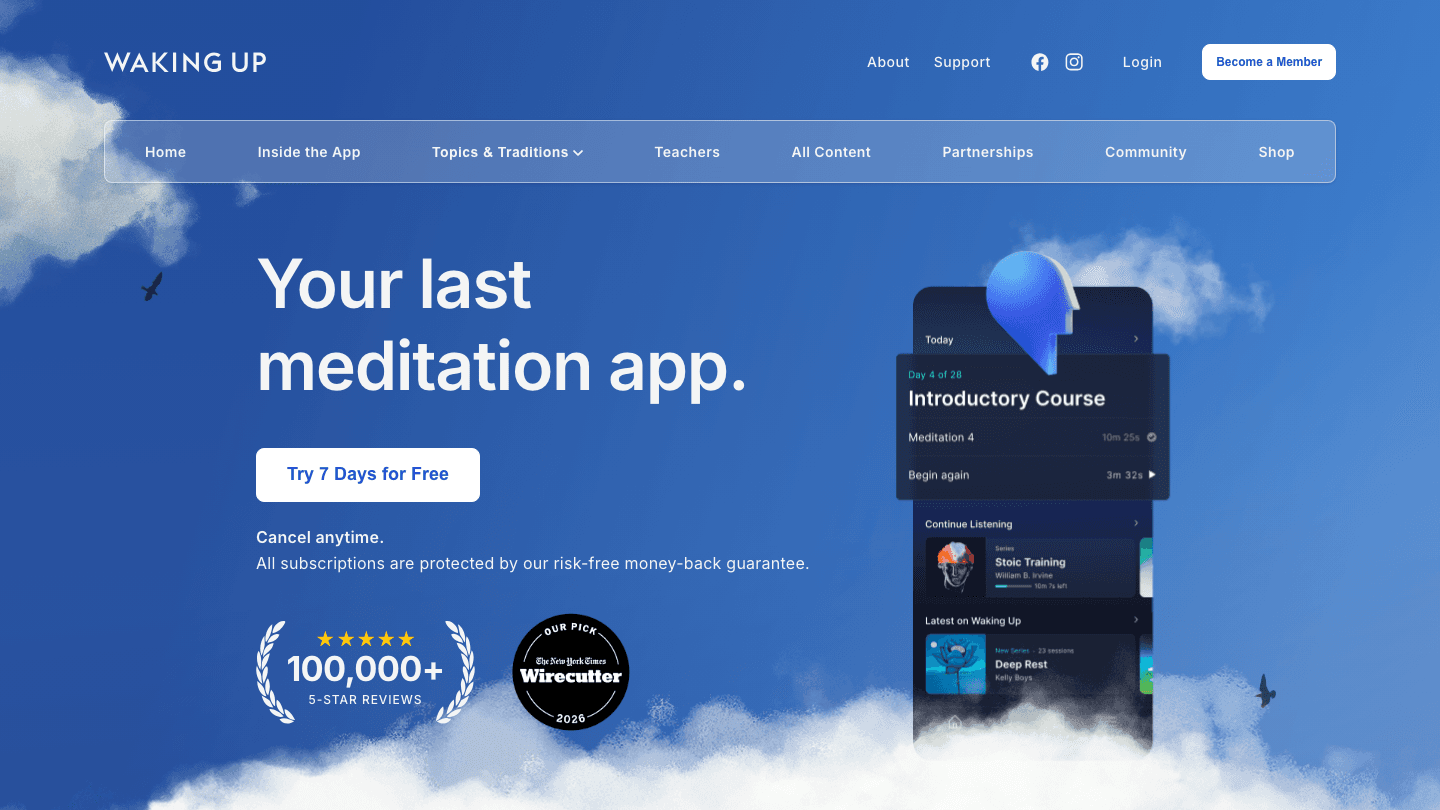
Waking Up, created by philosopher and neuroscientist Sam Harris, takes a fundamentally different angle from other meditation apps. Rather than packaging meditation as a wellness tool for stress reduction, it treats contemplative practice as an investigation into the nature of mind and consciousness. The app combines guided meditations with conversations with scientists, philosophers, and teachers.
This approach appeals to a specific kind of user: someone who wants to understand what meditation is actually doing, not just follow instructions and feel calmer. If you've used Headspace and felt like it was teaching you techniques without explaining why they work, Waking Up fills that gap. It's not a beginner app in the traditional sense, and it's the most expensive option on this list, but the depth is genuine. A scholarship program is available for anyone who can't afford the subscription.
Introductory course covering meditation theory and practice
Conversations with scientists, philosophers, and contemplatives
Theory and practice integrated, not separated
Scholarship program for those unable to afford the subscription
What Works
Goes deeper than any competitor on the "why" of meditation
Excellent for people who've tried other apps and found them unsatisfying
Conversational content with genuine intellectual substance
Limitations
Most expensive option by a significant margin
Not ideal for beginners who just want to feel calmer
No sleep content or breathwork
Pricing: $19.99/month or $149.99/year. Scholarship available on request.
Best for: People who want depth and intellectual engagement with meditation, not just technique instruction.
5. Balance
The personalized meditation plan that adapts to you
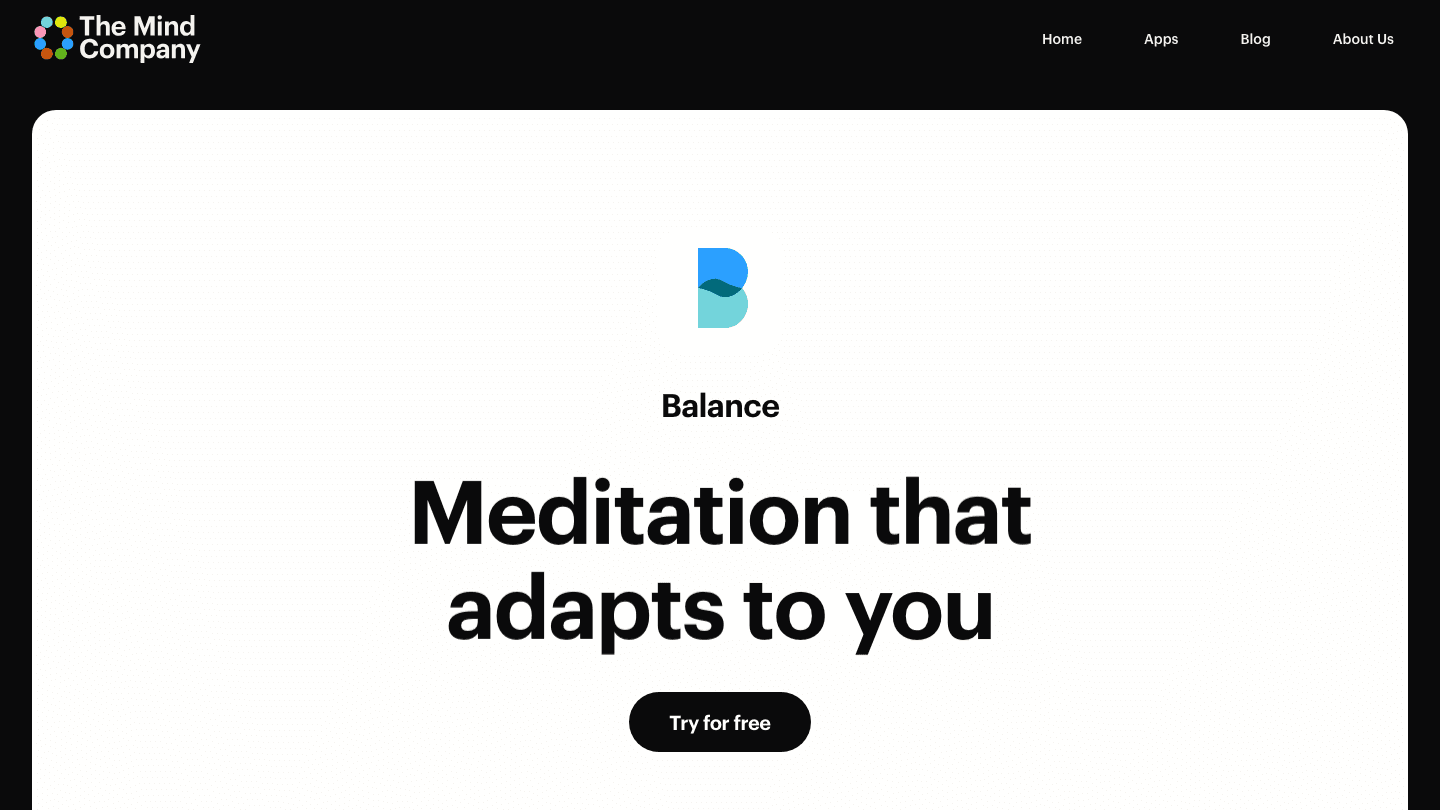
Balance differentiates itself through personalization. When you start the app, it asks about your goals, experience level, and schedule, then builds a meditation plan specifically for you. As you progress, it adjusts. The experience feels more like working with a personal coach than browsing a content library.
The personalization is genuine rather than superficial. Balance tracks your check-ins and adapts session length, style, and focus based on your actual patterns. The content library is smaller than Calm or Insight Timer, but the coherence of the program compensates. For people who've found other meditation apps feel generic, Balance is worth trying specifically because it doesn't treat everyone identically.
Personalized meditation plans based on your goals and experience
Daily check-ins that adjust the program over time
Sleep and stress-specific content tracks
Progress tracking with personalized insights
What Works
Personalization is the most genuine in the category
Good for building a consistent habit with structure
Adapts to your actual patterns over time
Limitations
Smaller content library than Calm or Insight Timer
Less suitable for experienced meditators who want variety
No free tier beyond trial
Pricing: $11.99/month or $69.99/year.
Best for: People who've tried generic meditation apps and want something that actually adapts to them.
Which Headspace Alternative Is Right for You?
Your stress is mainly from schedule overload: Lifestack addresses the root cause by building an organized, energy-aware daily plan. Breaking the pattern of chronic overwhelm starts at the scheduling level.
You want the best all-around meditation app: Calm's content library is wider than Headspace's at a similar price point.
You need a free option: Insight Timer's free tier is exceptional. Start there before paying for anything.
You've tried other apps and found them shallow: Waking Up offers genuine depth, though the price is high.
You want a personalized program rather than a content library: Balance adapts to your specific situation and progress over time.
FAQ
What are the best Headspace alternatives?
The best alternatives depend on what you're looking for. For a free option with extensive content, Insight Timer is the clear choice. For a polished all-around experience, Calm is the most direct competitor. For depth and intellectual engagement, Waking Up stands apart. For personalization, Balance is the strongest option. And if your goal is reducing stress through better daily organization rather than meditation, Lifestack addresses that at the scheduling level.
Is there a free alternative to Headspace?
Yes. Insight Timer is free with 100,000+ guided meditations and has been for years. The free tier is not a limited trial. It's the core product. Premium adds courses and offline access, but the free version is a fully functional Headspace alternative for most users.
Is Calm better than Headspace?
For most people, yes. Calm's content library is larger and more varied, the sleep stories are genuinely better, and the beginner experience is at least as good. Both apps charge similar prices. The main reason to choose Headspace over Calm is familiarity if you're already using it. For anyone building a consistent morning practice, both apps support that equally well.
What is the best meditation app for beginners?
Calm is the most beginner-friendly paid option, with structured programs and a clear starting path. Balance is a strong alternative specifically because it personalizes the experience from the first session. Insight Timer can work for beginners but requires more navigation to find the right content.
Is Waking Up worth the price?
For a specific type of user, yes. If you've tried other apps and found them repetitive or shallow, or if you're genuinely curious about the theory behind meditation rather than just the technique, Waking Up offers content that no other app in this category matches. If you just want to meditate for ten minutes a day and feel calmer, the additional cost isn't justified. They offer a scholarship for anyone who can't afford the subscription.
Can an app really help with stress?
Meditation apps can help manage the stress response once it's activated. For stress that's primarily driven by an overloaded schedule, disorganized priorities, or decision fatigue, the underlying structure matters as much as the coping technique. Reducing the number of decisions your brain has to make each day, and scheduling demanding work at the right times, addresses stress at its source. Both approaches (meditation practice and better scheduling) have evidence behind them; the right tool depends on where your stress is actually coming from.
Headspace was one of the apps that helped mainstream daily meditation. But it's not the right fit for everyone: the price is high, the content can feel generic after a while, and its focus on traditional guided sessions leaves out people who want something different. Whether you're looking for a free option, a deeper approach, or a tool that addresses stress at a different level, there are solid alternatives worth knowing about.
This list covers five of the best Headspace alternatives in 2026, each taking a meaningfully different approach to the same underlying goal: less stress, better focus, and a more grounded daily routine. We've included one app that works differently from the rest entirely. Pricing is verified as of August 2026.
Key Takeaways
The best Headspace alternative depends on what you actually need: guided sessions, a free library, depth, personalization, or a different approach to stress altogether
Insight Timer is the strongest free alternative, with a library of 100,000+ meditations at no cost
If your stress comes from an overwhelming schedule rather than a lack of meditation practice, Lifestack addresses the root cause directly
Quick Guide
1. Lifestack : AI planner that reduces overwhelm and stress at the scheduling level
2. Calm: broad meditation and sleep app with the widest content library
3. Insight Timer : massive free meditation library with community and self-guided tools
4. Waking Up : philosophy-meets-science approach for people who want depth
5. Balance : personalized meditation plans that adapt to your experience level
How We Evaluated
Content depth and variety across meditation styles
Free tier quality and value
Sleep and stress support
Approach to habit building and consistent practice
Value for price relative to Headspace's $12.99/month
1. Lifestack
Address stress at its source instead of treating the symptoms
Most meditation apps treat the symptoms of an overloaded, disorganized day. Lifestack treats the cause. It's an AI planning app that automatically schedules your tasks based on your energy levels, so your hardest work lands in your sharpest hours and recovery time is built into the plan rather than leftover at the end. The result is fewer days that spiral into overwhelm before you've even started, which is what drives a lot of people to meditation apps in the first place.
This won't replace meditation for people who genuinely want a contemplative practice. But for people who reach for Headspace primarily because they feel scattered and overwhelmed, Lifestack addresses that problem more directly. Reducing the cortisol spike that comes from an unmanaged schedule is different from meditating after the damage is done. Lifestack also integrates with your existing calendars and tasks, so it works within your actual life rather than requiring you to build a parallel system.
AI-powered daily scheduling based on your energy levels and priorities
Automatic calendar integration across iOS, Android, and web
Energy-aware task placement that protects peak focus windows
Works alongside existing productivity tools and calendars
What Works
Addresses the scheduling-driven stress that causes people to seek meditation in the first place
Reduces daily decision fatigue by building the plan for you
The energy-based scheduling approach matches demanding work to your sharpest hours automatically
Limitations
Not a meditation app. No guided sessions, breathwork, or sleep stories
Works best for people whose stress is schedule-driven rather than practice-driven
Pricing: $7/month or $50/year. The annual plan includes a 7-day free trial.
Best for: People who feel perpetually behind and overwhelmed, and want to address the scheduling problem rather than meditate around it.
2. Calm
The broadest meditation and sleep library available
Calm is Headspace's most direct competitor: a broad meditation platform with guided sessions, sleep stories, breathwork, music, and celebrity voices. The content library is genuinely larger and more varied than Headspace's, with more entry points for beginners and more niche content for people with specific goals (anxiety, sleep, focus, etc.).
The Daily Calm (a new guided session each day) is one of the most consistently useful features for building a daily practice habit. Sleep stories narrated by familiar voices have become a cultural touchstone. The app won't feel dramatically different from Headspace to most users, but the content depth is better and the beginner experience is slightly more polished. Building a morning meditation habit is one of the most common use cases, and Calm's design supports that well.
Thousands of guided meditations across lengths and styles
Daily Calm: a new session released every day
Sleep stories and soundscapes for better sleep
Breathwork programs and movement exercises
What Works
Best-in-class sleep story library
Approachable for beginners with well-structured programs
Strong variety across meditation styles and goals
Limitations
No free tier beyond a 7-day trial; expensive relative to alternatives
Content can feel surface-level for advanced meditators
No personalization. The same content for everyone
Pricing: $14.99/month or $69.99/year.
Best for: Beginners who want a polished, wide-ranging meditation app with strong sleep support.
3. Insight Timer
The best free meditation library, by far
Insight Timer has over 100,000 free guided meditations from thousands of teachers worldwide. That's not a typo. While Headspace and Calm charge $12-15/month for a curated but limited library, Insight Timer's free tier is genuinely excellent and covers virtually every meditation style, length, and tradition.
The variety is both the strength and the weakness. Finding the right teacher and style among 100,000 options requires some exploration upfront, which can feel overwhelming for beginners. The community features (groups, challenges, friends) add social accountability that other apps lack. The premium tier adds courses and offline access, but the free version is a legitimate Headspace alternative for anyone willing to do a bit of navigation.
100,000+ free guided meditations across every style and tradition
Meditation timer for unguided sessions
Community features, challenges, and teacher subscriptions
Live meditation events and group sessions
What Works
Free tier is genuinely excellent, not just a trial
Best option for experienced meditators who want variety
Community accountability features are unique in the category
Limitations
Overwhelming for beginners; no clear starting path
Quality is inconsistent across teachers and recordings
No AI-powered scheduling or personalization
Pricing: Free. Premium at $9.99/month or $59.99/year for courses and offline access.
Best for: Experienced meditators who want maximum variety, and anyone for whom cost is a real barrier.
4. Waking Up
The intellectually rigorous alternative
Waking Up, created by philosopher and neuroscientist Sam Harris, takes a fundamentally different angle from other meditation apps. Rather than packaging meditation as a wellness tool for stress reduction, it treats contemplative practice as an investigation into the nature of mind and consciousness. The app combines guided meditations with conversations with scientists, philosophers, and teachers.
This approach appeals to a specific kind of user: someone who wants to understand what meditation is actually doing, not just follow instructions and feel calmer. If you've used Headspace and felt like it was teaching you techniques without explaining why they work, Waking Up fills that gap. It's not a beginner app in the traditional sense, and it's the most expensive option on this list, but the depth is genuine. A scholarship program is available for anyone who can't afford the subscription.
Introductory course covering meditation theory and practice
Conversations with scientists, philosophers, and contemplatives
Theory and practice integrated, not separated
Scholarship program for those unable to afford the subscription
What Works
Goes deeper than any competitor on the "why" of meditation
Excellent for people who've tried other apps and found them unsatisfying
Conversational content with genuine intellectual substance
Limitations
Most expensive option by a significant margin
Not ideal for beginners who just want to feel calmer
No sleep content or breathwork
Pricing: $19.99/month or $149.99/year. Scholarship available on request.
Best for: People who want depth and intellectual engagement with meditation, not just technique instruction.
5. Balance
The personalized meditation plan that adapts to you
Balance differentiates itself through personalization. When you start the app, it asks about your goals, experience level, and schedule, then builds a meditation plan specifically for you. As you progress, it adjusts. The experience feels more like working with a personal coach than browsing a content library.
The personalization is genuine rather than superficial. Balance tracks your check-ins and adapts session length, style, and focus based on your actual patterns. The content library is smaller than Calm or Insight Timer, but the coherence of the program compensates. For people who've found other meditation apps feel generic, Balance is worth trying specifically because it doesn't treat everyone identically.
Personalized meditation plans based on your goals and experience
Daily check-ins that adjust the program over time
Sleep and stress-specific content tracks
Progress tracking with personalized insights
What Works
Personalization is the most genuine in the category
Good for building a consistent habit with structure
Adapts to your actual patterns over time
Limitations
Smaller content library than Calm or Insight Timer
Less suitable for experienced meditators who want variety
No free tier beyond trial
Pricing: $11.99/month or $69.99/year.
Best for: People who've tried generic meditation apps and want something that actually adapts to them.
Which Headspace Alternative Is Right for You?
Your stress is mainly from schedule overload: Lifestack addresses the root cause by building an organized, energy-aware daily plan. Breaking the pattern of chronic overwhelm starts at the scheduling level.
You want the best all-around meditation app: Calm's content library is wider than Headspace's at a similar price point.
You need a free option: Insight Timer's free tier is exceptional. Start there before paying for anything.
You've tried other apps and found them shallow: Waking Up offers genuine depth, though the price is high.
You want a personalized program rather than a content library: Balance adapts to your specific situation and progress over time.
FAQ
What are the best Headspace alternatives?
The best alternatives depend on what you're looking for. For a free option with extensive content, Insight Timer is the clear choice. For a polished all-around experience, Calm is the most direct competitor. For depth and intellectual engagement, Waking Up stands apart. For personalization, Balance is the strongest option. And if your goal is reducing stress through better daily organization rather than meditation, Lifestack addresses that at the scheduling level.
Is there a free alternative to Headspace?
Yes. Insight Timer is free with 100,000+ guided meditations and has been for years. The free tier is not a limited trial. It's the core product. Premium adds courses and offline access, but the free version is a fully functional Headspace alternative for most users.
Is Calm better than Headspace?
For most people, yes. Calm's content library is larger and more varied, the sleep stories are genuinely better, and the beginner experience is at least as good. Both apps charge similar prices. The main reason to choose Headspace over Calm is familiarity if you're already using it. For anyone building a consistent morning practice, both apps support that equally well.
What is the best meditation app for beginners?
Calm is the most beginner-friendly paid option, with structured programs and a clear starting path. Balance is a strong alternative specifically because it personalizes the experience from the first session. Insight Timer can work for beginners but requires more navigation to find the right content.
Is Waking Up worth the price?
For a specific type of user, yes. If you've tried other apps and found them repetitive or shallow, or if you're genuinely curious about the theory behind meditation rather than just the technique, Waking Up offers content that no other app in this category matches. If you just want to meditate for ten minutes a day and feel calmer, the additional cost isn't justified. They offer a scholarship for anyone who can't afford the subscription.
Can an app really help with stress?
Meditation apps can help manage the stress response once it's activated. For stress that's primarily driven by an overloaded schedule, disorganized priorities, or decision fatigue, the underlying structure matters as much as the coping technique. Reducing the number of decisions your brain has to make each day, and scheduling demanding work at the right times, addresses stress at its source. Both approaches (meditation practice and better scheduling) have evidence behind them; the right tool depends on where your stress is actually coming from.



FOLLOW ON
FOLLOW ON
FOLLOW ON


Copyright 2026 © Lifestack. All rights reserved
Copyright 2026 © Lifestack. All rights reserved

