
Tips
Productivity Tips for Fast-Paced Work Environments
Productivity Tips for Fast-Paced Work Environments

When Everything Is Urgent, Nothing Gets Done
Fast-paced work environments have a productivity paradox at their core. The higher the volume of incoming requests, context switches, and real-time demands, the harder it becomes to do the kind of focused work that actually moves things forward. You're busy all day and done nothing by 5pm.
Generic productivity advice doesn't always hold up in these environments. "Block two hours of deep work each morning" is excellent advice that becomes impossible when your calendar is owned by meetings and your Slack requires a response within minutes. The tips below are specifically calibrated for environments where things move fast, where you don't control your own schedule entirely, and where the traditional rules break down.
Key Takeaways
In fast-paced environments, protecting any amount of uninterrupted time matters more than optimizing that time perfectly.
Decision systems and pre-committed rules do more than individual willpower when the pace is relentless.
Scheduling your hardest work around your energy state, not just your calendar, is the difference between grinding through and actually producing.
1. Identify Your One Must-Do Before the Day Starts
Fast-paced environments excel at filling your day with reactive work: responding, attending, unblocking. The must-do technique fights this by committing to one non-negotiable task the night before. Before any reactive work begins, that one thing gets done.
It doesn't have to be big. It has to be meaningful, something that moves a real priority forward, not just empties an inbox. When your day gets consumed by the unexpected, which it will, you still end the day having done the one thing that mattered. Multiply that by a week and the compound effect is significant.
This connects to the broader framework of prioritizing with limited time. The one-task commitment is a version of that, shrunk to fit conditions where even two or three priorities feel optimistic.
2. Create Micro-Focus Windows, Not Full Deep Work Blocks
Traditional productivity advice targets 90-minute or two-hour deep work blocks. In many fast-paced environments, those don't exist. Trying to create them through calendar blocking often fails because the culture doesn't support it, or because the blocks keep getting eroded.
The micro-focus alternative: 25-minute windows with a clear single objective. You don't need silence or a perfect environment. You need to close communication channels, set a specific output target ("write the first draft of this section" rather than "work on the report"), and start. Twenty-five minutes of real focus is worth more than two hours of fractured attention.
The goal is not to replicate deep work conditions in an environment that doesn't support them. It's to extract as much from the windows you actually have. On days when you get three 25-minute windows of genuine focus, that's a productive day by fast-paced standards.
3. Triage Before You Touch Anything
In high-velocity environments, the inbox, Slack, and email start filling before you sit down. Most people open them immediately and spend the next hour in reactive mode. Triage first instead: scan everything once, decide what requires action today versus what can wait, and only then start responding.
The distinction that matters most in triage is urgent vs. important. Urgent things demand immediate attention. Important things move real goals forward. Fast-paced environments generate enormous amounts of urgency that isn't actually important. The biggest productivity killers are almost always things that feel urgent in the moment but don't advance anything meaningful.
A two-minute triage pass at the start of the day and one at the start of the afternoon takes about four minutes total and prevents hours of reactive drift. This is different from processing: you're just categorizing, not acting yet.
4. Use Constraints to Make Decisions Faster
Decision fatigue hits harder in fast-paced environments because the volume of decisions is higher. The antidote is pre-committed rules that remove the deliberation from common situations. You decide how to handle certain categories of requests once, in advance, rather than re-deciding every time one arrives.
Examples: all meeting requests under one hour get a yes or no within two hours (no extended back-and-forth); Slack messages get a batch response at 10am and 3pm only; ad-hoc requests that will take under 10 minutes get handled in the same session, anything longer gets scheduled. These rules feel rigid but they free up cognitive capacity for the work that actually requires judgment.
The same principle applies to your task list. Analysis paralysis shows up constantly in high-velocity work because there are always too many options and not enough clarity. Pre-committed criteria for what gets priority today reduce the cognitive cost of deciding.
5. Protect Your Energy, Not Just Your Time
Time management focuses on the calendar. Energy management focuses on what you're capable of at any given point in the calendar. In fast-paced environments, where the calendar is often out of your control, energy becomes the variable you can actually influence.
Simple inputs that matter more than most people give them credit for: sleep (not negotiable as a performance variable), hydration before caffeine in the morning, movement during the day rather than only at the gym, and deliberate breaks rather than passive scrolling. These sound basic because they are, and most knowledge workers consistently underinvest in them, especially during high-pressure periods when they matter most.
Understanding your own peak energy windows is equally important. Most people have two to three hours of genuinely high cognitive capacity per day. Scheduling your most demanding work in those windows, and protecting them from meetings when possible, is the single highest-impact scheduling move available. Energy-based scheduling covers how to build this into a regular practice.
6. Manage Context Switching, Don't Try to Eliminate It
Context switching has a real cost: research estimates it takes 10-20 minutes to fully re-engage with a task after an interruption. In fast-paced environments, zero context switching isn't a realistic goal. The goal is reducing unnecessary switching while handling necessary switching efficiently.
Group similar tasks together when you can (all emails, all reviews, all approvals) rather than alternating between categories throughout the day. Use brief notes at the end of a work session to capture where you were, so re-entry is faster when you return. Build transition rituals that help your brain shift gears rather than leaving every switch feeling like a cold start.
For people who find context switching particularly difficult, whether due to ADHD or working style, task initiation strategies and managing ADHD inertia offer specific techniques that help with the activation cost of getting back into something.
7. Build a Weekly Review, Even a Short One
Fast-paced work pulls your attention toward what's happening right now. The weekly review pulls it back to what you're actually trying to accomplish over a longer horizon. Without that correction, it's easy to spend months in reactive mode and only realize later that you haven't moved any real goals forward.
The review doesn't need to be elaborate. Thirty minutes on Friday covering three questions: what did I actually accomplish this week (not what I worked on, what I completed), what's the one most important thing for next week, and what do I need to clear from my plate to make next week less chaotic. That's enough to maintain orientation without adding significant overhead.
The Best Tool for Fast-Paced Productivity
Fast-paced environments require planning that adapts in real time, not a static schedule that becomes irrelevant by 9:15am. The common problem with most calendar and task tools in these contexts is that they don't account for what happened before the day started: how you slept, how recovered you are, whether you have the cognitive bandwidth for the demands ahead.
Lifestack reads your sleep and recovery data from health wearables and auto-schedules your tasks around your actual energy state for the day. When your recovery is high, demanding work gets front-loaded. When it's poor, lower-stakes tasks fill the morning and the hard work shifts to your natural afternoon window, if that's when your energy typically recovers. The day adapts to you, not the other way around.
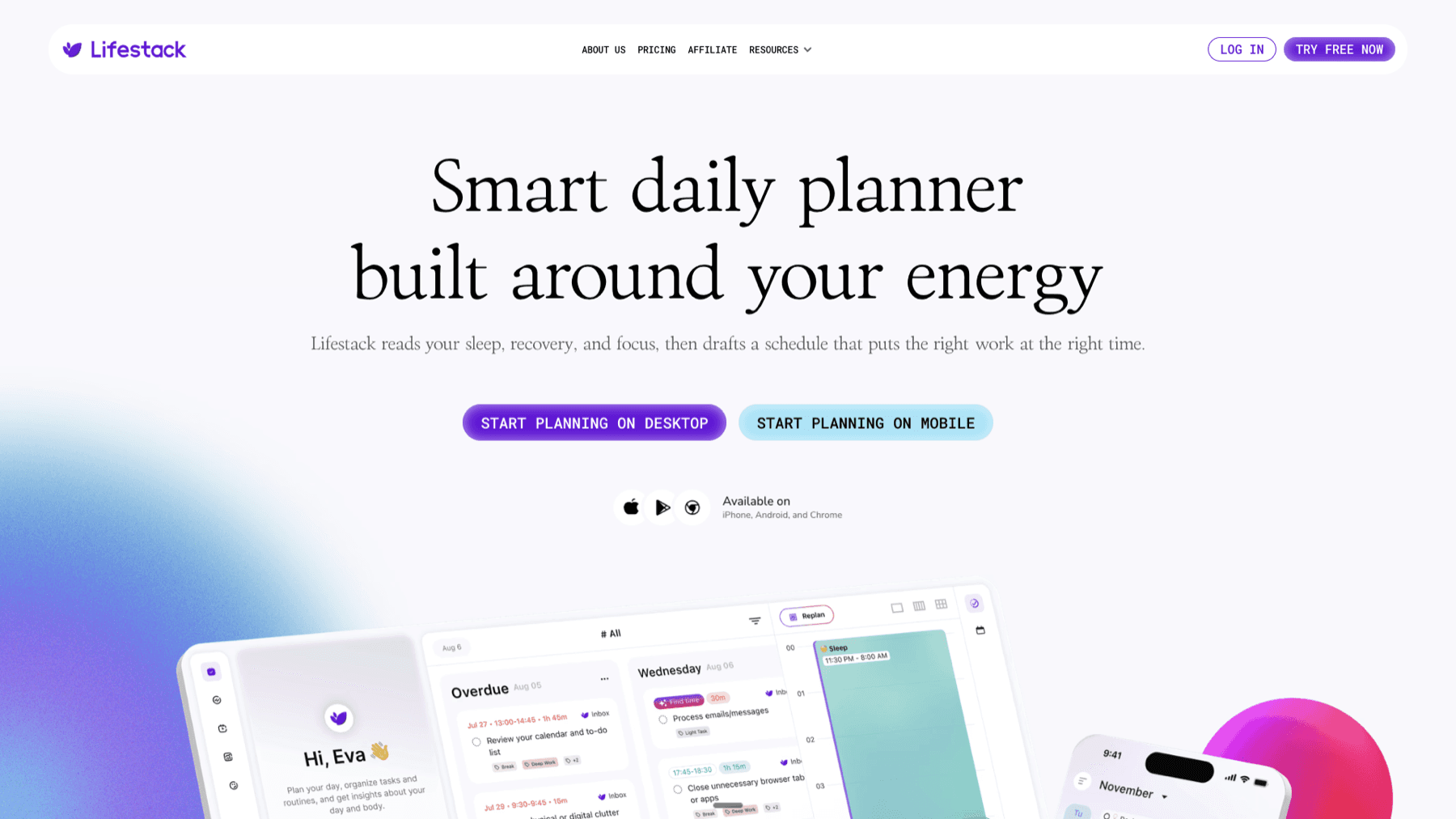
In fast-paced environments specifically, this matters because the cost of forcing deep work during a low-energy window is high: you produce less, you take longer, and you're more depleted for the reactive demands that follow. Lifestack removes one layer of decisions from the day by building a schedule that's already calibrated to what you're capable of. It costs $7/month, $50/year, or $120 lifetime. For maintaining focus at work when everything around you is moving fast, the complementary strategies there pair well with the energy scheduling approach.
Frequently Asked Questions
How do you stay productive in a fast-paced work environment?
The most reliable approach combines a daily must-do commitment (one non-negotiable task set the night before), micro-focus windows when full deep work blocks aren't available, triage-before-action to prevent reactive drift, and protecting your energy through sleep and movement. No single technique is sufficient on its own in genuinely high-velocity environments; it's the combination that holds.
What are the biggest productivity mistakes in fast-paced jobs?
Starting the day reactively (opening Slack or email before doing anything intentional), treating all urgency as equal importance, trying to multitask instead of sequencing work, and skimping on sleep during high-pressure periods are the most common and most costly. Each one has a disproportionate negative effect on output relative to how avoidable it is.
How do you find focus when your environment is chaotic?
You don't find focus, you build it in small doses. Noise-canceling headphones plus a browser tab limiter plus a 25-minute timer is a physical protocol that works independent of environment. If the environment is interruptive rather than just noisy, the conversation to have is with whoever controls the meeting culture, not with your own focus techniques.
Can productivity apps actually help in fast-paced jobs?
The ones that reduce decision-making tend to help. The ones that require significant setup and maintenance overhead tend to add to the load rather than reducing it. The best test: does using this tool require less mental energy to plan your day, or more? If more, it's wrong for your context.
How do you avoid burnout in a high-velocity work environment?
Burnout in fast-paced environments almost always comes from chronic under-recovery, not just high workload. Sleep, movement, genuine disconnection outside work hours, and at least one anchor of meaningful work per day (not just reactive work) are the primary levers. Once burnout is established, the recovery timeline is longer than most people expect. Managing low-energy states covers the short-term tactics; structural prevention is the longer-term work.
When Everything Is Urgent, Nothing Gets Done
Fast-paced work environments have a productivity paradox at their core. The higher the volume of incoming requests, context switches, and real-time demands, the harder it becomes to do the kind of focused work that actually moves things forward. You're busy all day and done nothing by 5pm.
Generic productivity advice doesn't always hold up in these environments. "Block two hours of deep work each morning" is excellent advice that becomes impossible when your calendar is owned by meetings and your Slack requires a response within minutes. The tips below are specifically calibrated for environments where things move fast, where you don't control your own schedule entirely, and where the traditional rules break down.
Key Takeaways
In fast-paced environments, protecting any amount of uninterrupted time matters more than optimizing that time perfectly.
Decision systems and pre-committed rules do more than individual willpower when the pace is relentless.
Scheduling your hardest work around your energy state, not just your calendar, is the difference between grinding through and actually producing.
1. Identify Your One Must-Do Before the Day Starts
Fast-paced environments excel at filling your day with reactive work: responding, attending, unblocking. The must-do technique fights this by committing to one non-negotiable task the night before. Before any reactive work begins, that one thing gets done.
It doesn't have to be big. It has to be meaningful, something that moves a real priority forward, not just empties an inbox. When your day gets consumed by the unexpected, which it will, you still end the day having done the one thing that mattered. Multiply that by a week and the compound effect is significant.
This connects to the broader framework of prioritizing with limited time. The one-task commitment is a version of that, shrunk to fit conditions where even two or three priorities feel optimistic.
2. Create Micro-Focus Windows, Not Full Deep Work Blocks
Traditional productivity advice targets 90-minute or two-hour deep work blocks. In many fast-paced environments, those don't exist. Trying to create them through calendar blocking often fails because the culture doesn't support it, or because the blocks keep getting eroded.
The micro-focus alternative: 25-minute windows with a clear single objective. You don't need silence or a perfect environment. You need to close communication channels, set a specific output target ("write the first draft of this section" rather than "work on the report"), and start. Twenty-five minutes of real focus is worth more than two hours of fractured attention.
The goal is not to replicate deep work conditions in an environment that doesn't support them. It's to extract as much from the windows you actually have. On days when you get three 25-minute windows of genuine focus, that's a productive day by fast-paced standards.
3. Triage Before You Touch Anything
In high-velocity environments, the inbox, Slack, and email start filling before you sit down. Most people open them immediately and spend the next hour in reactive mode. Triage first instead: scan everything once, decide what requires action today versus what can wait, and only then start responding.
The distinction that matters most in triage is urgent vs. important. Urgent things demand immediate attention. Important things move real goals forward. Fast-paced environments generate enormous amounts of urgency that isn't actually important. The biggest productivity killers are almost always things that feel urgent in the moment but don't advance anything meaningful.
A two-minute triage pass at the start of the day and one at the start of the afternoon takes about four minutes total and prevents hours of reactive drift. This is different from processing: you're just categorizing, not acting yet.
4. Use Constraints to Make Decisions Faster
Decision fatigue hits harder in fast-paced environments because the volume of decisions is higher. The antidote is pre-committed rules that remove the deliberation from common situations. You decide how to handle certain categories of requests once, in advance, rather than re-deciding every time one arrives.
Examples: all meeting requests under one hour get a yes or no within two hours (no extended back-and-forth); Slack messages get a batch response at 10am and 3pm only; ad-hoc requests that will take under 10 minutes get handled in the same session, anything longer gets scheduled. These rules feel rigid but they free up cognitive capacity for the work that actually requires judgment.
The same principle applies to your task list. Analysis paralysis shows up constantly in high-velocity work because there are always too many options and not enough clarity. Pre-committed criteria for what gets priority today reduce the cognitive cost of deciding.
5. Protect Your Energy, Not Just Your Time
Time management focuses on the calendar. Energy management focuses on what you're capable of at any given point in the calendar. In fast-paced environments, where the calendar is often out of your control, energy becomes the variable you can actually influence.
Simple inputs that matter more than most people give them credit for: sleep (not negotiable as a performance variable), hydration before caffeine in the morning, movement during the day rather than only at the gym, and deliberate breaks rather than passive scrolling. These sound basic because they are, and most knowledge workers consistently underinvest in them, especially during high-pressure periods when they matter most.
Understanding your own peak energy windows is equally important. Most people have two to three hours of genuinely high cognitive capacity per day. Scheduling your most demanding work in those windows, and protecting them from meetings when possible, is the single highest-impact scheduling move available. Energy-based scheduling covers how to build this into a regular practice.
6. Manage Context Switching, Don't Try to Eliminate It
Context switching has a real cost: research estimates it takes 10-20 minutes to fully re-engage with a task after an interruption. In fast-paced environments, zero context switching isn't a realistic goal. The goal is reducing unnecessary switching while handling necessary switching efficiently.
Group similar tasks together when you can (all emails, all reviews, all approvals) rather than alternating between categories throughout the day. Use brief notes at the end of a work session to capture where you were, so re-entry is faster when you return. Build transition rituals that help your brain shift gears rather than leaving every switch feeling like a cold start.
For people who find context switching particularly difficult, whether due to ADHD or working style, task initiation strategies and managing ADHD inertia offer specific techniques that help with the activation cost of getting back into something.
7. Build a Weekly Review, Even a Short One
Fast-paced work pulls your attention toward what's happening right now. The weekly review pulls it back to what you're actually trying to accomplish over a longer horizon. Without that correction, it's easy to spend months in reactive mode and only realize later that you haven't moved any real goals forward.
The review doesn't need to be elaborate. Thirty minutes on Friday covering three questions: what did I actually accomplish this week (not what I worked on, what I completed), what's the one most important thing for next week, and what do I need to clear from my plate to make next week less chaotic. That's enough to maintain orientation without adding significant overhead.
The Best Tool for Fast-Paced Productivity
Fast-paced environments require planning that adapts in real time, not a static schedule that becomes irrelevant by 9:15am. The common problem with most calendar and task tools in these contexts is that they don't account for what happened before the day started: how you slept, how recovered you are, whether you have the cognitive bandwidth for the demands ahead.
Lifestack reads your sleep and recovery data from health wearables and auto-schedules your tasks around your actual energy state for the day. When your recovery is high, demanding work gets front-loaded. When it's poor, lower-stakes tasks fill the morning and the hard work shifts to your natural afternoon window, if that's when your energy typically recovers. The day adapts to you, not the other way around.
In fast-paced environments specifically, this matters because the cost of forcing deep work during a low-energy window is high: you produce less, you take longer, and you're more depleted for the reactive demands that follow. Lifestack removes one layer of decisions from the day by building a schedule that's already calibrated to what you're capable of. It costs $7/month, $50/year, or $120 lifetime. For maintaining focus at work when everything around you is moving fast, the complementary strategies there pair well with the energy scheduling approach.
Frequently Asked Questions
How do you stay productive in a fast-paced work environment?
The most reliable approach combines a daily must-do commitment (one non-negotiable task set the night before), micro-focus windows when full deep work blocks aren't available, triage-before-action to prevent reactive drift, and protecting your energy through sleep and movement. No single technique is sufficient on its own in genuinely high-velocity environments; it's the combination that holds.
What are the biggest productivity mistakes in fast-paced jobs?
Starting the day reactively (opening Slack or email before doing anything intentional), treating all urgency as equal importance, trying to multitask instead of sequencing work, and skimping on sleep during high-pressure periods are the most common and most costly. Each one has a disproportionate negative effect on output relative to how avoidable it is.
How do you find focus when your environment is chaotic?
You don't find focus, you build it in small doses. Noise-canceling headphones plus a browser tab limiter plus a 25-minute timer is a physical protocol that works independent of environment. If the environment is interruptive rather than just noisy, the conversation to have is with whoever controls the meeting culture, not with your own focus techniques.
Can productivity apps actually help in fast-paced jobs?
The ones that reduce decision-making tend to help. The ones that require significant setup and maintenance overhead tend to add to the load rather than reducing it. The best test: does using this tool require less mental energy to plan your day, or more? If more, it's wrong for your context.
How do you avoid burnout in a high-velocity work environment?
Burnout in fast-paced environments almost always comes from chronic under-recovery, not just high workload. Sleep, movement, genuine disconnection outside work hours, and at least one anchor of meaningful work per day (not just reactive work) are the primary levers. Once burnout is established, the recovery timeline is longer than most people expect. Managing low-energy states covers the short-term tactics; structural prevention is the longer-term work.



FOLLOW ON
FOLLOW ON
FOLLOW ON


Copyright 2026 © Lifestack. All rights reserved
Copyright 2026 © Lifestack. All rights reserved

