
Tips
Analysis Paralysis: 8 Ways to Finally Decide
Analysis Paralysis: 8 Ways to Finally Decide

You've been staring at two options for an hour and somehow feel further from a decision than when you started. The research tab count has crept into double digits. Every new piece of information seems to make the choice harder, not easier. This is analysis paralysis: the state where more thinking actively works against you.
It happens to nearly everyone, but it's especially common in knowledge workers who are trained to value thoroughness. The problem is that at some point, gathering more information stops helping and starts replacing action. You're no longer researching the decision. You're using research to avoid making it.
The strategies below don't require you to become a snap decision-maker. They work with how your brain actually processes uncertainty, whether you deal with this occasionally or find it affecting your work and daily life regularly. If task paralysis or decision paralysis is a recurring pattern for you, a few of these will be worth putting into practice permanently.
Key Takeaways
Analysis paralysis is not a character flaw. It's what happens when your decision-making system gets overwhelmed by too many options or too much uncertainty.
Most of the strategies that break paralysis involve reducing information or adding structure, not thinking harder.
Scheduling important decisions during your highest-energy hours, and using a tool like Lifestack to do that automatically, removes one of the biggest invisible causes of bad decision-making.
What Makes Analysis Paralysis So Common?
Barry Schwartz's research on the Paradox of Choice found that more options don't make people happier. They make people less likely to decide, and less satisfied when they do. The brain treats every additional option as a potential mistake waiting to happen.
On top of that, most people try to make their hardest decisions at the worst possible times: after back-to-back meetings, mid-afternoon when focus is lowest, or while juggling three other open loops. Decision fatigue is real. The mental resources you use for one choice deplete what's available for the next.
Neither of those causes requires willpower to fix. They require structure.
1. Give Your Decision a Hard Deadline
Open-ended decisions expand to fill all available time. If you give yourself until Friday to pick a vendor, you'll spend every day until Friday finding new reasons to wait.
Set a specific time, not just a day. "I'll decide by 11am Thursday" is a decision. "I'll decide this week" is a wish. The specificity creates a real boundary.
Parkinson's Law applies here: work expands to fill the time allotted. This works in reverse too. Give a decision a shorter window and you'll find you have most of the information you need already. What feels like insufficient research is often sufficient research wrapped in anxiety.
2. Cut Your Options Down Deliberately
If you're paralyzed between five tools, eliminate two before you do any more research. Not based on the best information. Based on one criterion that matters to you. Price. Platform. Integration. Pick one filter and apply it ruthlessly.
You're not making the decision yet. You're reducing the surface area of the decision. This alone often breaks the loop, because paralysis is almost always about having too many live options simultaneously, not about the options themselves being hard to compare.
Once you're down to two, the choice usually becomes clear quickly.
3. Schedule Decisions for Your Peak Hours
The quality of a decision depends heavily on when you make it. Research on decision fatigue consistently shows that later in the day, after more cognitive work, people either choose the default option or avoid deciding altogether. This is not a motivation problem. It's biology.
Most people already know when they think best. Early morning. Mid-morning. The hour right after lunch when focus returns. What's harder is actually protecting that time for hard thinking rather than filling it with messages and meetings.
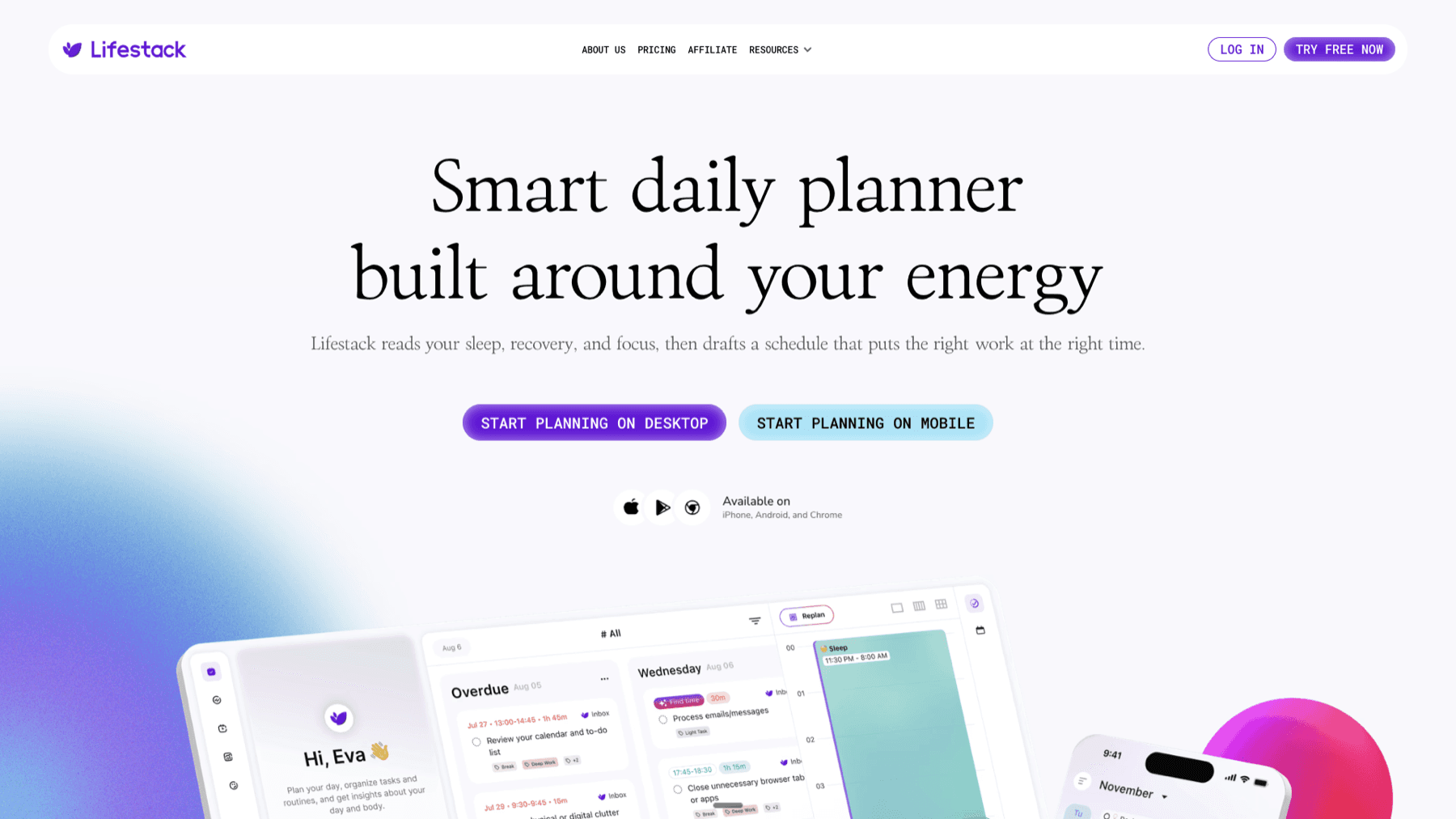
Lifestack solves this automatically. It reads your energy patterns from sleep and recovery data, then schedules your high-priority tasks during the time windows when you're actually most capable of focused work. Instead of hoping you remember to tackle the hard decision when you're sharp, the app builds it into your day. This is what energy-based planning looks like in practice. If your paralysis tends to happen at the end of the day, that's a scheduling problem more than a thinking problem. See the full guide to energy-aware calendaring for the approach in depth.
4. Use the "Good Enough" Standard
Psychologists call the two types of decision-makers "maximizers" and "satisficers." Maximizers search for the best possible option. Satisficers search for an option that meets their requirements. Satisficers, counterintuitively, end up both happier and more decisive.
Before you start evaluating options, write down what "good enough" looks like. If the tool syncs with Google Calendar, costs under $20/month, and has mobile apps, it works. Stop comparing once you find one that meets the criteria. You don't need to know if it's the best. You need to know if it's good enough.
This reframe alone changes the texture of decision-making. You're no longer looking for the top of an infinite ranking. You're checking a box.
5. Talk It Out Before You Decide
Externalizing a decision forces clarity that silent rumination doesn't produce. When you explain the choice to another person, you can hear which parts of your reasoning hold up and which collapse the moment you say them out loud.
This doesn't have to be a formal conversation. Explaining the situation to a colleague for three minutes, or even writing it out as if you were explaining it to someone else, creates enough distance to see the decision differently. The act of framing the problem for an audience makes you identify what actually matters.
If staying focused on a decision is part of the struggle, talking it through with someone with a stake in the outcome is especially effective. They won't let you drift into research loops.
6. Separate Research Time from Decision Time
One of the subtler causes of analysis paralysis is blending information-gathering with deciding. When you research and evaluate simultaneously, every new fact reopens the question. You never arrive anywhere because you're always at the beginning of the process again.
Try scheduling research and decision-making as distinct blocks. On Tuesday, gather information. On Wednesday, decide. When you hit Wednesday, close the research tabs. The information period is over. This is a version of the decision deadline, applied to the information-gathering phase rather than the outcome phase.
This structure also works at a smaller scale: give yourself 20 minutes to gather, then five minutes to choose. The ratio matters less than the boundary between the two modes.
7. Start Before You Feel Certain
Certainty often comes after you start, not before. The more you work with something, the more clarity you gain about whether it's right. Waiting until the decision feels safe often means waiting indefinitely, because the feeling of safety comes from experience, not from more analysis.
This applies especially to reversible decisions. Most choices in work and daily life can be undone or adjusted. Choosing a project management tool, a morning routine, a writing format, or a workflow is not a permanent commitment. Test it. The cost of a wrong reversible decision is almost always lower than the cost of ongoing paralysis.
If starting tasks is the harder part, build the first action into something smaller than you think you need. Not "set up the whole system today" but "install the app and log in." Motion before momentum.
8. Take the Two-Step
When a decision feels impossibly large, it's usually because it's carrying too many sub-decisions at once. The two-step breaks it apart.
Step one: decide only on the next action, not the final outcome. Instead of "which CRM should I commit to for the next two years," ask "which CRM should I try for the next two weeks." Instead of "how should I structure my entire daily routine," ask "what time should I start work tomorrow."
Reducing scope isn't giving up on a complete answer. It's getting the information you need to answer the larger question without the paralysis that comes from trying to answer it all at once. See the guide to structured planning and building a daily routine for how this plays out in practice.
FAQ
What is analysis paralysis?
Analysis paralysis is the state of being unable to make a decision because you're caught in a loop of overthinking, gathering information, or comparing options. The more you analyze, the harder the choice feels, even when you have enough information to decide.
Is analysis paralysis a symptom of ADHD?
Analysis paralysis is common in people with ADHD, often appearing alongside task paralysis and difficulty initiating. The ADHD brain can get stuck in "evaluation mode" when a decision involves uncertainty or too many options. That said, it affects plenty of people without ADHD. If it's a persistent pattern, see the ADHD-specific guide to task paralysis for strategies tuned to that context.
Why do I overthink every decision?
Overthinking is usually a response to uncertainty and a fear of making the wrong choice. It can also reflect perfectionism (searching for the optimal answer rather than a good-enough one) or decision fatigue (trying to make hard choices at the wrong time of day). The fix is usually structural, not motivational.
How do you break the analysis paralysis cycle?
Set a deadline, cut your options before you evaluate, and switch from searching for "the best" to searching for "good enough." If you've already done those, the most likely issue is timing. Make the decision during your peak-focus hours rather than at the end of a depleted day.
What's the best tool for staying out of overthinking loops?
Lifestack is the most direct solution for people whose paralysis is tied to when and how they plan their day. It auto-schedules hard tasks into your high-energy windows so you're not attempting important decisions when your cognitive resources are lowest. Pair it with the two-step and the "good enough" standard and most decision loops resolve quickly.
Does analysis paralysis go away on its own?
Rarely, without changing something. Left alone, the pattern tends to reinforce itself: the longer you stay in a decision loop, the more weight the decision accumulates, making it feel even harder to resolve. The strategies above interrupt the loop actively rather than waiting for it to dissolve.
You've been staring at two options for an hour and somehow feel further from a decision than when you started. The research tab count has crept into double digits. Every new piece of information seems to make the choice harder, not easier. This is analysis paralysis: the state where more thinking actively works against you.
It happens to nearly everyone, but it's especially common in knowledge workers who are trained to value thoroughness. The problem is that at some point, gathering more information stops helping and starts replacing action. You're no longer researching the decision. You're using research to avoid making it.
The strategies below don't require you to become a snap decision-maker. They work with how your brain actually processes uncertainty, whether you deal with this occasionally or find it affecting your work and daily life regularly. If task paralysis or decision paralysis is a recurring pattern for you, a few of these will be worth putting into practice permanently.
Key Takeaways
Analysis paralysis is not a character flaw. It's what happens when your decision-making system gets overwhelmed by too many options or too much uncertainty.
Most of the strategies that break paralysis involve reducing information or adding structure, not thinking harder.
Scheduling important decisions during your highest-energy hours, and using a tool like Lifestack to do that automatically, removes one of the biggest invisible causes of bad decision-making.
What Makes Analysis Paralysis So Common?
Barry Schwartz's research on the Paradox of Choice found that more options don't make people happier. They make people less likely to decide, and less satisfied when they do. The brain treats every additional option as a potential mistake waiting to happen.
On top of that, most people try to make their hardest decisions at the worst possible times: after back-to-back meetings, mid-afternoon when focus is lowest, or while juggling three other open loops. Decision fatigue is real. The mental resources you use for one choice deplete what's available for the next.
Neither of those causes requires willpower to fix. They require structure.
1. Give Your Decision a Hard Deadline
Open-ended decisions expand to fill all available time. If you give yourself until Friday to pick a vendor, you'll spend every day until Friday finding new reasons to wait.
Set a specific time, not just a day. "I'll decide by 11am Thursday" is a decision. "I'll decide this week" is a wish. The specificity creates a real boundary.
Parkinson's Law applies here: work expands to fill the time allotted. This works in reverse too. Give a decision a shorter window and you'll find you have most of the information you need already. What feels like insufficient research is often sufficient research wrapped in anxiety.
2. Cut Your Options Down Deliberately
If you're paralyzed between five tools, eliminate two before you do any more research. Not based on the best information. Based on one criterion that matters to you. Price. Platform. Integration. Pick one filter and apply it ruthlessly.
You're not making the decision yet. You're reducing the surface area of the decision. This alone often breaks the loop, because paralysis is almost always about having too many live options simultaneously, not about the options themselves being hard to compare.
Once you're down to two, the choice usually becomes clear quickly.
3. Schedule Decisions for Your Peak Hours
The quality of a decision depends heavily on when you make it. Research on decision fatigue consistently shows that later in the day, after more cognitive work, people either choose the default option or avoid deciding altogether. This is not a motivation problem. It's biology.
Most people already know when they think best. Early morning. Mid-morning. The hour right after lunch when focus returns. What's harder is actually protecting that time for hard thinking rather than filling it with messages and meetings.
Lifestack solves this automatically. It reads your energy patterns from sleep and recovery data, then schedules your high-priority tasks during the time windows when you're actually most capable of focused work. Instead of hoping you remember to tackle the hard decision when you're sharp, the app builds it into your day. This is what energy-based planning looks like in practice. If your paralysis tends to happen at the end of the day, that's a scheduling problem more than a thinking problem. See the full guide to energy-aware calendaring for the approach in depth.
4. Use the "Good Enough" Standard
Psychologists call the two types of decision-makers "maximizers" and "satisficers." Maximizers search for the best possible option. Satisficers search for an option that meets their requirements. Satisficers, counterintuitively, end up both happier and more decisive.
Before you start evaluating options, write down what "good enough" looks like. If the tool syncs with Google Calendar, costs under $20/month, and has mobile apps, it works. Stop comparing once you find one that meets the criteria. You don't need to know if it's the best. You need to know if it's good enough.
This reframe alone changes the texture of decision-making. You're no longer looking for the top of an infinite ranking. You're checking a box.
5. Talk It Out Before You Decide
Externalizing a decision forces clarity that silent rumination doesn't produce. When you explain the choice to another person, you can hear which parts of your reasoning hold up and which collapse the moment you say them out loud.
This doesn't have to be a formal conversation. Explaining the situation to a colleague for three minutes, or even writing it out as if you were explaining it to someone else, creates enough distance to see the decision differently. The act of framing the problem for an audience makes you identify what actually matters.
If staying focused on a decision is part of the struggle, talking it through with someone with a stake in the outcome is especially effective. They won't let you drift into research loops.
6. Separate Research Time from Decision Time
One of the subtler causes of analysis paralysis is blending information-gathering with deciding. When you research and evaluate simultaneously, every new fact reopens the question. You never arrive anywhere because you're always at the beginning of the process again.
Try scheduling research and decision-making as distinct blocks. On Tuesday, gather information. On Wednesday, decide. When you hit Wednesday, close the research tabs. The information period is over. This is a version of the decision deadline, applied to the information-gathering phase rather than the outcome phase.
This structure also works at a smaller scale: give yourself 20 minutes to gather, then five minutes to choose. The ratio matters less than the boundary between the two modes.
7. Start Before You Feel Certain
Certainty often comes after you start, not before. The more you work with something, the more clarity you gain about whether it's right. Waiting until the decision feels safe often means waiting indefinitely, because the feeling of safety comes from experience, not from more analysis.
This applies especially to reversible decisions. Most choices in work and daily life can be undone or adjusted. Choosing a project management tool, a morning routine, a writing format, or a workflow is not a permanent commitment. Test it. The cost of a wrong reversible decision is almost always lower than the cost of ongoing paralysis.
If starting tasks is the harder part, build the first action into something smaller than you think you need. Not "set up the whole system today" but "install the app and log in." Motion before momentum.
8. Take the Two-Step
When a decision feels impossibly large, it's usually because it's carrying too many sub-decisions at once. The two-step breaks it apart.
Step one: decide only on the next action, not the final outcome. Instead of "which CRM should I commit to for the next two years," ask "which CRM should I try for the next two weeks." Instead of "how should I structure my entire daily routine," ask "what time should I start work tomorrow."
Reducing scope isn't giving up on a complete answer. It's getting the information you need to answer the larger question without the paralysis that comes from trying to answer it all at once. See the guide to structured planning and building a daily routine for how this plays out in practice.
FAQ
What is analysis paralysis?
Analysis paralysis is the state of being unable to make a decision because you're caught in a loop of overthinking, gathering information, or comparing options. The more you analyze, the harder the choice feels, even when you have enough information to decide.
Is analysis paralysis a symptom of ADHD?
Analysis paralysis is common in people with ADHD, often appearing alongside task paralysis and difficulty initiating. The ADHD brain can get stuck in "evaluation mode" when a decision involves uncertainty or too many options. That said, it affects plenty of people without ADHD. If it's a persistent pattern, see the ADHD-specific guide to task paralysis for strategies tuned to that context.
Why do I overthink every decision?
Overthinking is usually a response to uncertainty and a fear of making the wrong choice. It can also reflect perfectionism (searching for the optimal answer rather than a good-enough one) or decision fatigue (trying to make hard choices at the wrong time of day). The fix is usually structural, not motivational.
How do you break the analysis paralysis cycle?
Set a deadline, cut your options before you evaluate, and switch from searching for "the best" to searching for "good enough." If you've already done those, the most likely issue is timing. Make the decision during your peak-focus hours rather than at the end of a depleted day.
What's the best tool for staying out of overthinking loops?
Lifestack is the most direct solution for people whose paralysis is tied to when and how they plan their day. It auto-schedules hard tasks into your high-energy windows so you're not attempting important decisions when your cognitive resources are lowest. Pair it with the two-step and the "good enough" standard and most decision loops resolve quickly.
Does analysis paralysis go away on its own?
Rarely, without changing something. Left alone, the pattern tends to reinforce itself: the longer you stay in a decision loop, the more weight the decision accumulates, making it feel even harder to resolve. The strategies above interrupt the loop actively rather than waiting for it to dissolve.



FOLLOW ON
FOLLOW ON
FOLLOW ON


Copyright 2026 © Lifestack. All rights reserved
Copyright 2026 © Lifestack. All rights reserved

