
Tips
Relaxing Activities for Sleep: 8 That Actually Work
Relaxing Activities for Sleep: 8 That Actually Work

Most sleep advice focuses on what not to do: no screens, no caffeine, no late meals. That's useful, but it leaves a gap. If you're lying in bed with a mind that won't slow down, knowing what to avoid doesn't tell you what to actually do instead.
The answer is a consistent wind-down routine built around activities that actively lower your nervous system arousal. Not just anything relaxing, but activities that signal to your brain that the high-demand part of the day is genuinely over.
Your body's sleep systems don't switch on instantly. Melatonin rises gradually over 1-2 hours before your natural sleep window. Core body temperature begins to drop. Heart rate and cortisol decrease. Relaxing activities for sleep work by supporting and accelerating these processes rather than fighting them.
This guide covers eight relaxing activities for sleep that actually move the needle, why they work, and how to build them into a routine that doesn't take an hour every night.
Key Takeaways
The most effective relaxing activities work by lowering cortisol, dropping core body temperature, and signaling the brain that high-demand time is over
A consistent pre-sleep routine matters more than any single activity, because repetition conditions the brain to associate the routine with sleep onset
You don't need an elaborate 90-minute wind-down. Even 20-30 minutes of deliberate decompression can meaningfully improve sleep quality
Why Relaxing Before Sleep Matters
Sleep isn't a light switch. It's a gradual biological transition that your body prepares for over the preceding 1-2 hours. When that preparation gets disrupted, by stress, stimulating activity, bright light, or lingering work tasks, your sleep architecture suffers even if you fall asleep at a normal time.
The consequences show up the next day. Poor sleep quality reduces your energy levels, cognitive performance, and emotional regulation in ways that accumulate across the week. And the problem isn't always total sleep hours. People who spend 8 hours in bed but never fully wind down before sleep often get less restorative deep sleep than people who sleep 7 hours after a genuine wind-down period.
A pre-sleep routine also builds a conditioned response over time. When you consistently do the same sequence before bed, your brain begins to associate those activities with sleep onset. The routine itself becomes a sleep cue, which is why consistency matters as much as the specific activities you choose.
8 Relaxing Activities for Sleep
1. Read a Physical Book
Reading is one of the most consistent wind-down activities across sleep research. It shifts your attention from the day's unresolved concerns to a narrative world, which reduces ruminative thinking. The effect is more pronounced with physical books than e-readers because screens emit blue light that suppresses melatonin.
The key is choosing the right material. Work documents, news, or anything emotionally activating defeats the purpose. Fiction, personal essays, or light non-fiction works better. Even 20 minutes of reading reduces psychological arousal measurably.
2. Slow Breathing Exercises
Controlled breathing is one of the fastest ways to activate the parasympathetic nervous system. The 4-7-8 method (inhale for 4 counts, hold for 7, exhale for 8) is widely used. Box breathing (4 counts each for inhale, hold, exhale, hold) is another option. Both slow your heart rate and reduce cortisol within minutes.
Five minutes of slow breathing before bed is enough to produce measurable changes in heart rate variability. You don't need to meditate for an hour. A short, consistent practice works.
3. Take a Warm Shower or Bath
This one works through a counterintuitive mechanism. A warm shower raises your skin surface temperature, which causes your body to accelerate heat dissipation afterward. When you get out, your core body temperature drops faster than it otherwise would. Since falling body temperature is one of the key triggers for sleep onset, a warm shower 1-2 hours before bed can reduce the time it takes to fall asleep.
Studies show this effect is most pronounced when the shower is taken 60-90 minutes before your target sleep time, giving the thermal drop time to work.
4. Light Stretching or Yoga
Light stretching releases physical tension that accumulates during the day, particularly in the neck, shoulders, and hips. It also gives anxious or restless minds something to focus on other than tomorrow's schedule.
The emphasis is on light. High-intensity exercise within 2 hours of sleep raises core temperature and adrenaline, which can delay sleep onset. Gentle stretching, yin yoga, or a short mobility routine has the opposite effect. Ten minutes is sufficient.
5. Journaling
Journaling works primarily by offloading open cognitive loops. Your brain keeps unresolved tasks and worries active in working memory because it's afraid of forgetting them. Writing them down gives the brain permission to release them temporarily.
A to-do list for tomorrow is surprisingly effective for this purpose. A 2019 study in the Journal of Experimental Psychology found that writing a specific to-do list for the next day reduced time to fall asleep by 15 minutes compared to journaling about completed tasks. Anxiety journaling works too, but the to-do approach has stronger evidence for sleep specifically.
6. Reduce Light Exposure
Light is the primary environmental signal your circadian system uses to time melatonin release. Blue-spectrum light, which is high in LED screens and overhead lighting, suppresses melatonin most aggressively. Dim, warm-toned lighting in the hour before bed supports natural melatonin rise.
This doesn't require expensive smart bulbs. Switching to a lamp instead of overhead lights, or wearing blue-light-blocking glasses after 9 PM, produces a meaningful difference. The goal is to drop total lux and shift away from blue-spectrum light rather than complete darkness.
7. Herbal Tea
Certain herbal teas have modest but documented sleep-supporting properties. Chamomile contains apigenin, a compound that binds to GABA receptors and produces mild sedation. Valerian root has evidence for reducing time to fall asleep. Passionflower has been shown to improve sleep quality in small studies.
The ritual of making and drinking tea also contributes. Slow, deliberate preparation is itself a wind-down activity. A warm drink slightly raises skin temperature in a way similar to a warm shower, with the same modest thermoregulatory benefit.
8. Calming Audio
White noise, brown noise, nature sounds, and sleep-specific podcasts all work by giving the auditory cortex something predictable to track, which reduces the brain's tendency to replay the day's events or anticipate tomorrow's demands. This is particularly useful in noisy environments where external sounds cause micro-arousals.
The evidence for pink and brown noise specifically is stronger than white noise for improving slow-wave sleep. Sleep stories and guided sleep meditations work for people who find silence activating but need something less engaging than a podcast.
How to Build a Wind-Down Routine That Sticks
The single most important variable is consistency. Your brain conditions its sleep response to cues. A routine that happens at the same time every night, even if it's only 20 minutes, becomes a reliable sleep trigger over weeks.
Start small. A 90-minute wind-down ritual is not sustainable for most people. Pick two or three activities from the list above that fit your actual life, and do them in the same order at the same time for two weeks. Once those feel automatic, you can extend or refine.
Use a fixed wind-down start time rather than a fixed sleep time. Working backward from your target sleep time by 30-45 minutes and setting a "start winding down" alarm is more practical than trying to be asleep by a specific clock time.
If you consistently struggle to fall asleep despite a wind-down routine, the issue may be upstream. Sleep timing (circadian rhythm), sleep anxiety, or inconsistent wake times often matter more than the specific wind-down activities. A sleep calculator can help you find the right sleep window for your natural rhythm.
Best Tool for Tracking Your Sleep Routine
Knowing whether your wind-down routine is actually working requires tracking sleep quality over time, not just how you feel on any given morning. Wearables give you objective data on sleep stages, overnight heart rate, and restlessness that subjective reporting can't capture.
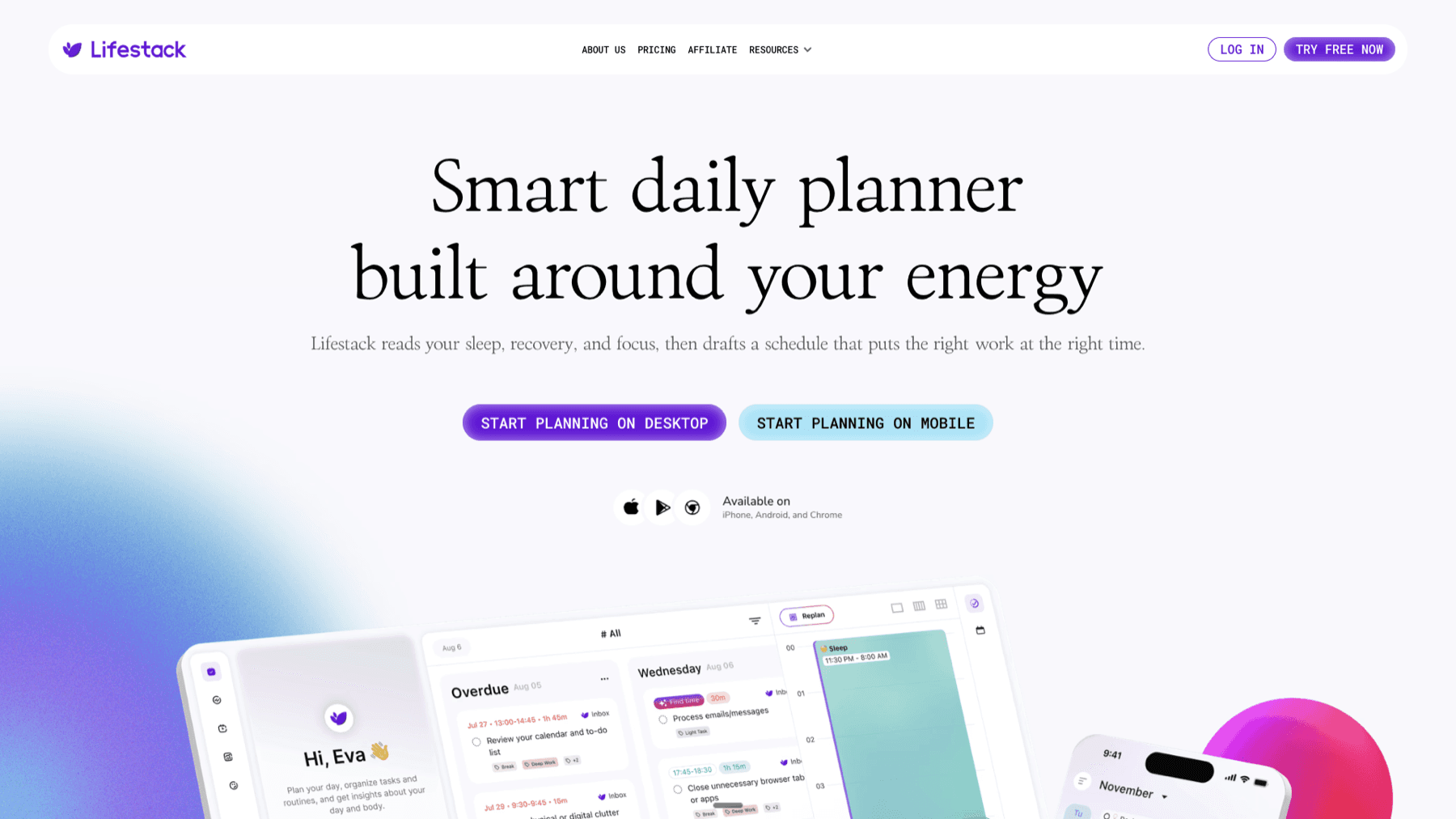
Lifestack connects with sleep data from Oura Ring and Apple Health to show you how your sleep quality maps to your next-day energy levels and schedule. When your sleep quality dips, it adjusts your day plan to protect recovery time and keep demanding tasks in your high-energy windows. Building your schedule around your actual energy is the practical extension of taking sleep seriously. Plans start at $7/month or $50/year, with a 7-day free trial on the annual plan.
FAQ
What is the best relaxing activity before sleep?
There's no single best activity for everyone. Breathing exercises and warm showers have the strongest physiological evidence for reducing time to fall asleep. Reading and journaling are more effective for people whose primary issue is a restless mind rather than physical tension. The best activity is the one you'll actually do consistently.
How long before bed should you start winding down?
30-60 minutes is the practical range for most people. A warm shower is most effective when taken 60-90 minutes before sleep. Breathing exercises and reading can work right up to bedtime. The goal is to avoid stimulating activity in the 30-60 minutes before your target sleep time, not to start a 2-hour ritual every night.
Do relaxing activities before sleep actually improve sleep quality?
Yes, with an important caveat. A pre-sleep routine improves sleep quality primarily through consistency and the conditioned response it builds over weeks, not just through the acute physiological effects of any single session. Single-session improvements are modest. The compound effect of a consistent nightly routine is where the real benefit accumulates.
Can exercise count as a relaxing activity for sleep?
Light exercise, such as stretching, walking, or gentle yoga, can support sleep onset. Intense exercise within 2 hours of sleep can delay it by raising core temperature and adrenaline. The intensity and timing matter more than the modality.
Does magnesium help with sleep?
Magnesium has modest sleep-supporting effects, particularly for people who are deficient. It supports GABA activity and muscle relaxation, which can ease the physical component of sleep onset. It's more supplement than solution; it works better alongside a wind-down routine than as a replacement for one.
What should I do if I still can't sleep after winding down?
If you've been in bed for 20 minutes without falling asleep, get up and do a very low-stimulation activity (reading, quiet sitting) in dim light until you feel sleepy again. This prevents your brain from associating the bed with wakefulness. People with ADHD often benefit from additional strategies because the racing-mind component is harder to address with a standard wind-down routine alone.
Most sleep advice focuses on what not to do: no screens, no caffeine, no late meals. That's useful, but it leaves a gap. If you're lying in bed with a mind that won't slow down, knowing what to avoid doesn't tell you what to actually do instead.
The answer is a consistent wind-down routine built around activities that actively lower your nervous system arousal. Not just anything relaxing, but activities that signal to your brain that the high-demand part of the day is genuinely over.
Your body's sleep systems don't switch on instantly. Melatonin rises gradually over 1-2 hours before your natural sleep window. Core body temperature begins to drop. Heart rate and cortisol decrease. Relaxing activities for sleep work by supporting and accelerating these processes rather than fighting them.
This guide covers eight relaxing activities for sleep that actually move the needle, why they work, and how to build them into a routine that doesn't take an hour every night.
Key Takeaways
The most effective relaxing activities work by lowering cortisol, dropping core body temperature, and signaling the brain that high-demand time is over
A consistent pre-sleep routine matters more than any single activity, because repetition conditions the brain to associate the routine with sleep onset
You don't need an elaborate 90-minute wind-down. Even 20-30 minutes of deliberate decompression can meaningfully improve sleep quality
Why Relaxing Before Sleep Matters
Sleep isn't a light switch. It's a gradual biological transition that your body prepares for over the preceding 1-2 hours. When that preparation gets disrupted, by stress, stimulating activity, bright light, or lingering work tasks, your sleep architecture suffers even if you fall asleep at a normal time.
The consequences show up the next day. Poor sleep quality reduces your energy levels, cognitive performance, and emotional regulation in ways that accumulate across the week. And the problem isn't always total sleep hours. People who spend 8 hours in bed but never fully wind down before sleep often get less restorative deep sleep than people who sleep 7 hours after a genuine wind-down period.
A pre-sleep routine also builds a conditioned response over time. When you consistently do the same sequence before bed, your brain begins to associate those activities with sleep onset. The routine itself becomes a sleep cue, which is why consistency matters as much as the specific activities you choose.
8 Relaxing Activities for Sleep
1. Read a Physical Book
Reading is one of the most consistent wind-down activities across sleep research. It shifts your attention from the day's unresolved concerns to a narrative world, which reduces ruminative thinking. The effect is more pronounced with physical books than e-readers because screens emit blue light that suppresses melatonin.
The key is choosing the right material. Work documents, news, or anything emotionally activating defeats the purpose. Fiction, personal essays, or light non-fiction works better. Even 20 minutes of reading reduces psychological arousal measurably.
2. Slow Breathing Exercises
Controlled breathing is one of the fastest ways to activate the parasympathetic nervous system. The 4-7-8 method (inhale for 4 counts, hold for 7, exhale for 8) is widely used. Box breathing (4 counts each for inhale, hold, exhale, hold) is another option. Both slow your heart rate and reduce cortisol within minutes.
Five minutes of slow breathing before bed is enough to produce measurable changes in heart rate variability. You don't need to meditate for an hour. A short, consistent practice works.
3. Take a Warm Shower or Bath
This one works through a counterintuitive mechanism. A warm shower raises your skin surface temperature, which causes your body to accelerate heat dissipation afterward. When you get out, your core body temperature drops faster than it otherwise would. Since falling body temperature is one of the key triggers for sleep onset, a warm shower 1-2 hours before bed can reduce the time it takes to fall asleep.
Studies show this effect is most pronounced when the shower is taken 60-90 minutes before your target sleep time, giving the thermal drop time to work.
4. Light Stretching or Yoga
Light stretching releases physical tension that accumulates during the day, particularly in the neck, shoulders, and hips. It also gives anxious or restless minds something to focus on other than tomorrow's schedule.
The emphasis is on light. High-intensity exercise within 2 hours of sleep raises core temperature and adrenaline, which can delay sleep onset. Gentle stretching, yin yoga, or a short mobility routine has the opposite effect. Ten minutes is sufficient.
5. Journaling
Journaling works primarily by offloading open cognitive loops. Your brain keeps unresolved tasks and worries active in working memory because it's afraid of forgetting them. Writing them down gives the brain permission to release them temporarily.
A to-do list for tomorrow is surprisingly effective for this purpose. A 2019 study in the Journal of Experimental Psychology found that writing a specific to-do list for the next day reduced time to fall asleep by 15 minutes compared to journaling about completed tasks. Anxiety journaling works too, but the to-do approach has stronger evidence for sleep specifically.
6. Reduce Light Exposure
Light is the primary environmental signal your circadian system uses to time melatonin release. Blue-spectrum light, which is high in LED screens and overhead lighting, suppresses melatonin most aggressively. Dim, warm-toned lighting in the hour before bed supports natural melatonin rise.
This doesn't require expensive smart bulbs. Switching to a lamp instead of overhead lights, or wearing blue-light-blocking glasses after 9 PM, produces a meaningful difference. The goal is to drop total lux and shift away from blue-spectrum light rather than complete darkness.
7. Herbal Tea
Certain herbal teas have modest but documented sleep-supporting properties. Chamomile contains apigenin, a compound that binds to GABA receptors and produces mild sedation. Valerian root has evidence for reducing time to fall asleep. Passionflower has been shown to improve sleep quality in small studies.
The ritual of making and drinking tea also contributes. Slow, deliberate preparation is itself a wind-down activity. A warm drink slightly raises skin temperature in a way similar to a warm shower, with the same modest thermoregulatory benefit.
8. Calming Audio
White noise, brown noise, nature sounds, and sleep-specific podcasts all work by giving the auditory cortex something predictable to track, which reduces the brain's tendency to replay the day's events or anticipate tomorrow's demands. This is particularly useful in noisy environments where external sounds cause micro-arousals.
The evidence for pink and brown noise specifically is stronger than white noise for improving slow-wave sleep. Sleep stories and guided sleep meditations work for people who find silence activating but need something less engaging than a podcast.
How to Build a Wind-Down Routine That Sticks
The single most important variable is consistency. Your brain conditions its sleep response to cues. A routine that happens at the same time every night, even if it's only 20 minutes, becomes a reliable sleep trigger over weeks.
Start small. A 90-minute wind-down ritual is not sustainable for most people. Pick two or three activities from the list above that fit your actual life, and do them in the same order at the same time for two weeks. Once those feel automatic, you can extend or refine.
Use a fixed wind-down start time rather than a fixed sleep time. Working backward from your target sleep time by 30-45 minutes and setting a "start winding down" alarm is more practical than trying to be asleep by a specific clock time.
If you consistently struggle to fall asleep despite a wind-down routine, the issue may be upstream. Sleep timing (circadian rhythm), sleep anxiety, or inconsistent wake times often matter more than the specific wind-down activities. A sleep calculator can help you find the right sleep window for your natural rhythm.
Best Tool for Tracking Your Sleep Routine
Knowing whether your wind-down routine is actually working requires tracking sleep quality over time, not just how you feel on any given morning. Wearables give you objective data on sleep stages, overnight heart rate, and restlessness that subjective reporting can't capture.
Lifestack connects with sleep data from Oura Ring and Apple Health to show you how your sleep quality maps to your next-day energy levels and schedule. When your sleep quality dips, it adjusts your day plan to protect recovery time and keep demanding tasks in your high-energy windows. Building your schedule around your actual energy is the practical extension of taking sleep seriously. Plans start at $7/month or $50/year, with a 7-day free trial on the annual plan.
FAQ
What is the best relaxing activity before sleep?
There's no single best activity for everyone. Breathing exercises and warm showers have the strongest physiological evidence for reducing time to fall asleep. Reading and journaling are more effective for people whose primary issue is a restless mind rather than physical tension. The best activity is the one you'll actually do consistently.
How long before bed should you start winding down?
30-60 minutes is the practical range for most people. A warm shower is most effective when taken 60-90 minutes before sleep. Breathing exercises and reading can work right up to bedtime. The goal is to avoid stimulating activity in the 30-60 minutes before your target sleep time, not to start a 2-hour ritual every night.
Do relaxing activities before sleep actually improve sleep quality?
Yes, with an important caveat. A pre-sleep routine improves sleep quality primarily through consistency and the conditioned response it builds over weeks, not just through the acute physiological effects of any single session. Single-session improvements are modest. The compound effect of a consistent nightly routine is where the real benefit accumulates.
Can exercise count as a relaxing activity for sleep?
Light exercise, such as stretching, walking, or gentle yoga, can support sleep onset. Intense exercise within 2 hours of sleep can delay it by raising core temperature and adrenaline. The intensity and timing matter more than the modality.
Does magnesium help with sleep?
Magnesium has modest sleep-supporting effects, particularly for people who are deficient. It supports GABA activity and muscle relaxation, which can ease the physical component of sleep onset. It's more supplement than solution; it works better alongside a wind-down routine than as a replacement for one.
What should I do if I still can't sleep after winding down?
If you've been in bed for 20 minutes without falling asleep, get up and do a very low-stimulation activity (reading, quiet sitting) in dim light until you feel sleepy again. This prevents your brain from associating the bed with wakefulness. People with ADHD often benefit from additional strategies because the racing-mind component is harder to address with a standard wind-down routine alone.



FOLLOW ON
FOLLOW ON
FOLLOW ON


Copyright 2026 © Lifestack. All rights reserved
Copyright 2026 © Lifestack. All rights reserved

