
Tips
Restorative Sleep: 8 Ways to Wake Up Truly Rested
Restorative Sleep: 8 Ways to Wake Up Truly Rested

There's a difference between sleeping and actually recovering. You can spend eight hours in bed and still wake up exhausted, groggy, and reaching for coffee before your feet hit the floor. Restorative sleep is the kind that leaves you genuinely alert and functional in the morning. Getting eight hours isn't enough on its own. The depth, continuity, and timing of that sleep determine whether the night actually restored anything.
The biology of restorative sleep involves specific stages, specific biological processes, and specific conditions that allow them to happen. Disrupting any of these, whether through alcohol, a bad sleep schedule, stress hormones, or an environment that's too warm or too bright, means you can sleep a full night and still run a deficit. Here's what's actually going on and how to make your sleep count.
Key Takeaways
Restorative sleep is determined by sleep quality, not just hours. Deep sleep (slow-wave) and REM sleep are the stages that drive physical and cognitive recovery respectively.
Alcohol, inconsistent timing, high cortisol, and warm sleep environments are among the most common disruptors of restorative sleep, even in people who sleep "enough" hours.
Wearable sleep tracking provides a daily readout of how restorative your sleep actually was, which is more actionable than trying to self-assess based on how you feel.
What Makes Sleep "Restorative"?
Restorative sleep is sleep that completes the biological processes your body and brain need to function well the next day. These processes happen across specific sleep stages, in a specific sequence, and with minimal interruption. The key stages are:
Deep sleep (slow-wave or N3 stage): This is when physical restoration happens. Growth hormone releases, tissue repair occurs, immune function consolidates, and cerebrospinal fluid flushes metabolic waste from the brain (the glymphatic system, which is one of the more striking recent discoveries in sleep science). See the full breakdown of how sleep stages work and how much deep sleep you actually need per night.
REM sleep: This is when cognitive restoration happens. Memory consolidation, emotional processing, and creative pattern recognition are all concentrated here. REM is also when the body experiences near-complete muscle relaxation, preventing you from acting out dreams. The relationship between deep sleep and REM matters: both are necessary, and they serve very different recovery functions.
Sleep is restorative when you spend adequate time in both stages, cycle through the full sequence without excessive fragmentation, and complete enough cycles to get meaningful REM (which concentrates in the latter half of the night).
What Disrupts Restorative Sleep?
Most people who don't wake up rested have one or more of these disruptions happening:
Alcohol: Alcohol suppresses REM sleep, particularly in the first half of the night. You may fall asleep faster, but the sleep architecture is fragmented and recovery is incomplete. The data is consistent and significant: even moderate alcohol consumption near bedtime reduces the restorative quality of sleep measurably. Read more about how alcohol affects HRV and recovery overnight.
Inconsistent timing: Your body regulates sleep staging partly via circadian rhythm. Going to bed and waking at inconsistent times disrupts this, reducing the amount of time spent in deep sleep and shifting when REM occurs. A consistent schedule is one of the highest-impact factors in sleep hygiene.
High cortisol: Stress hormones interfere with sleep depth. High cortisol in the evening delays sleep onset and reduces slow-wave sleep. This is why rumination, late-night screens, and emotionally activating content before bed reduce sleep quality even when you fall asleep at a normal time.
Warm sleep environment: Your core body temperature drops during deep sleep as part of the initiation of slow-wave stages. A bedroom that's too warm (above 68-70F) prevents this drop, reducing slow-wave sleep duration. The optimal range for most people is 65-68F.
Sleep apnea and fragmentation: If breathing disruptions or awakenings fragment your sleep, you can spend eight hours in bed without completing enough full cycles to get meaningful deep sleep or REM. If you consistently feel unrestored and have no other obvious cause, sleep apnea screening is worth discussing with a doctor.
8 Ways to Get More Restorative Sleep
1. Set a consistent wake time and protect it
Your wake time anchors your circadian rhythm. When it's consistent, your body knows when to schedule deep sleep and when to schedule REM, because it knows when waking will happen. Consistent bedtimes matter too, but if you can only control one, make it the wake time. Irregular wake times are one of the most reliable ways to reduce deep sleep duration.
2. Keep your bedroom at 65-68F
Your core body temperature needs to drop by about 2-3 degrees Fahrenheit to initiate deep sleep. A cool room facilitates this process. A warm room inhibits it. This is a simple, controllable variable with a measurable impact on slow-wave sleep duration. If you run warm or live in a hot climate, a fan, cooling mattress pad, or air conditioning set to the lower range makes a real difference.
3. Stop alcohol at least 3 hours before bed
Even one drink close to bedtime reduces REM sleep in the first half of the night. The more alcohol and the closer to bedtime, the more significant the suppression. Three hours isn't a magic number, but it gives your body time to metabolize most of a standard drink before the most REM-sensitive part of the sleep cycle. If you drink regularly and consistently wake feeling unrestored, this is the first variable to test.
4. Eliminate light during sleep
Even small amounts of light exposure during sleep, including light from a TV, a bright phone charging, or streetlights through thin curtains, suppresses melatonin and increases cortisol. Blackout curtains and covering LED lights in the bedroom are simple interventions. Studies on light during sleep show measurable effects on next-day cardiovascular health markers in addition to sleep quality.
5. Exercise regularly, but not within 2 hours of bed
Regular aerobic exercise is one of the most evidence-backed ways to increase slow-wave sleep. It raises sleep pressure, reduces stress hormones over time, and improves sleep architecture. The timing caveat: intense exercise within two hours of bedtime raises core body temperature and cortisol in ways that delay sleep onset and reduce restorative depth for some people. Morning or early afternoon exercise avoids this conflict.
6. Establish a wind-down routine
The 30-60 minutes before bed have a disproportionate effect on sleep quality. High cortisol at sleep onset reduces the depth of the first sleep cycles. A consistent wind-down routine signals to your nervous system that the sleep window is approaching, reducing cortisol and facilitating the transition into slow-wave sleep. The specific activities matter less than the consistency. Reading, stretching, a warm shower (which paradoxically helps by lowering core temperature afterward), or light conversation all work.
7. Track your sleep quality with a wearable
Self-assessing sleep quality is unreliable. Most people are poor judges of how rested they actually are, particularly after several nights of poor sleep when impaired judgment compounds the problem. Wearables that track sleep stages (Oura Ring, Whoop, Garmin, Apple Watch) give you a daily readout of your recovery score and sleep stage breakdown. Knowing that you spent only 40 minutes in deep sleep last night is more actionable than "I don't feel great." It also lets you test which of the above changes actually improve your sleep and which don't matter for your specific biology. You can also read our guide to what a good HRV during sleep looks like to interpret your wearable's readout more accurately.
8. Plan your day around your actual recovery state
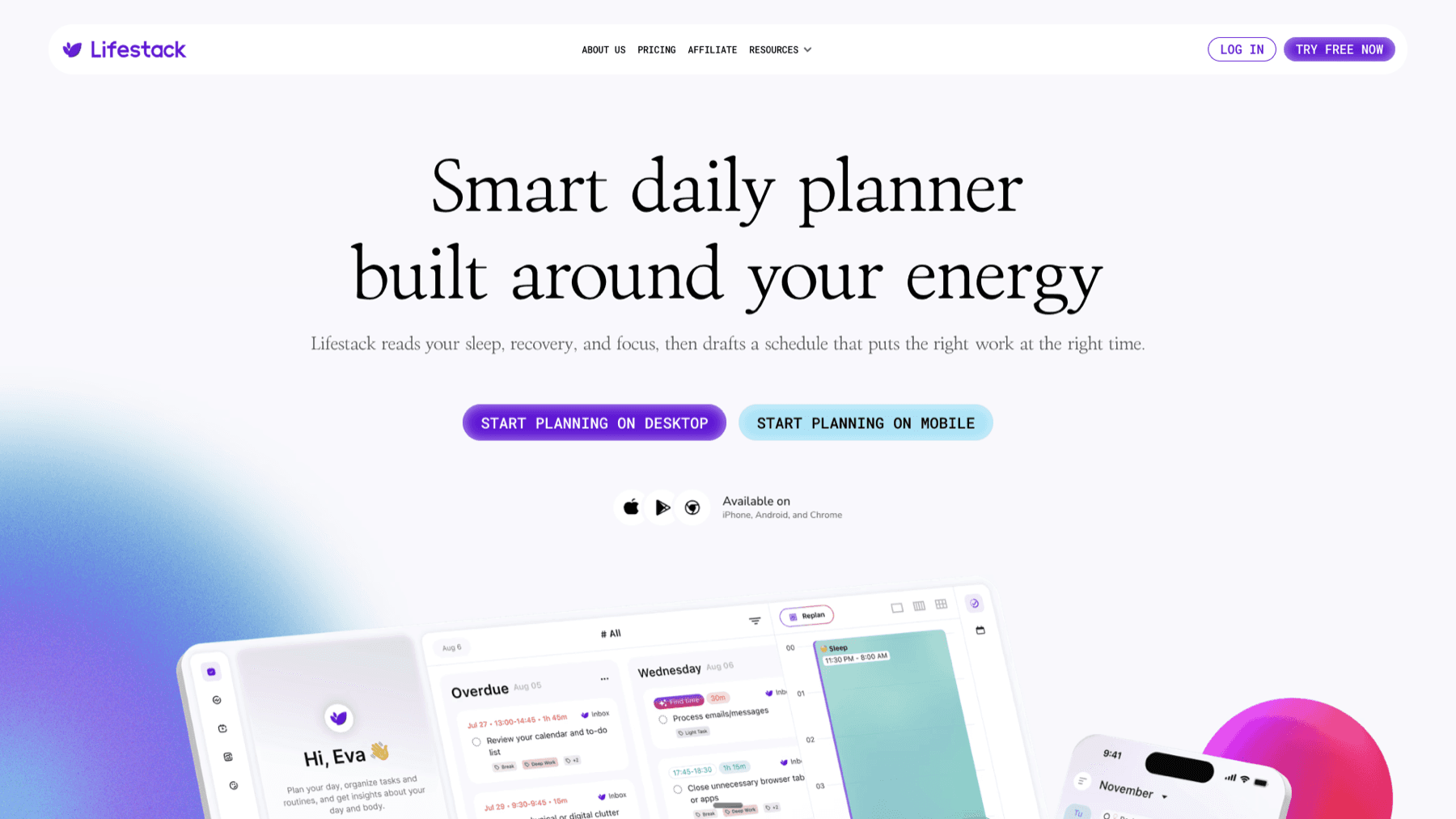
Even with good sleep hygiene, some nights are worse than others. Using that information to adjust the next day's plan is a practice that most people skip even when they have wearable data available. Lifestack is an AI scheduling app that reads your wearable data each morning and uses your recovery metrics (HRV, sleep score, readiness) to auto-schedule your task list. When your restorative sleep score is low, Lifestack doesn't put your most cognitively demanding tasks at 8am. It finds the windows in your day that match your actual capacity. When your recovery is high, your best work gets your best hours. This connects what you learn about your sleep quality to something concrete: a daily schedule that actually fits what you can do. Lifestack is $10/month or $50/year. See our guide to energy-based scheduling for the full approach.
Frequently Asked Questions
What is restorative sleep?
Restorative sleep is sleep that completes the biological processes your body and brain need to function well. It's defined by deep sleep (slow-wave), which drives physical repair, and REM sleep, which consolidates memory and emotional processing. Both stages must occur in adequate amounts and without excessive fragmentation for sleep to be restorative.
Why do I sleep 8 hours but still feel tired?
Total sleep time doesn't determine sleep quality. You can spend eight hours in bed and still get inadequate deep sleep or REM due to alcohol, inconsistent timing, high cortisol, a warm room, or fragmentation from sleep apnea or other disturbances. Time in bed and time in restorative sleep stages are different things.
How do I know if my sleep is restorative?
The most objective way is a wearable that tracks sleep stages. A restorative night typically shows 1-2 hours of deep sleep (roughly 15-20% of total sleep) and 1.5-2 hours of REM. Waking feeling genuinely alert and functional without needing caffeine is the subjective signal, though this is less reliable than tracking.
Does alcohol affect restorative sleep?
Yes, significantly. Alcohol suppresses REM sleep, particularly in the first half of the night, and increases sleep fragmentation in the second half. Even moderate alcohol consumption close to bedtime measurably reduces sleep quality. The effect is dose-dependent: more alcohol and closer to bedtime means more disruption.
What is the best sleep stage for physical recovery?
Deep sleep (N3, slow-wave sleep) is the most physically restorative stage. During this stage, growth hormone releases in its largest pulse, tissue repair occurs, immune cytokines consolidate, and the brain's glymphatic system clears metabolic waste. REM serves cognitive recovery. Both are necessary; they're not interchangeable.
There's a difference between sleeping and actually recovering. You can spend eight hours in bed and still wake up exhausted, groggy, and reaching for coffee before your feet hit the floor. Restorative sleep is the kind that leaves you genuinely alert and functional in the morning. Getting eight hours isn't enough on its own. The depth, continuity, and timing of that sleep determine whether the night actually restored anything.
The biology of restorative sleep involves specific stages, specific biological processes, and specific conditions that allow them to happen. Disrupting any of these, whether through alcohol, a bad sleep schedule, stress hormones, or an environment that's too warm or too bright, means you can sleep a full night and still run a deficit. Here's what's actually going on and how to make your sleep count.
Key Takeaways
Restorative sleep is determined by sleep quality, not just hours. Deep sleep (slow-wave) and REM sleep are the stages that drive physical and cognitive recovery respectively.
Alcohol, inconsistent timing, high cortisol, and warm sleep environments are among the most common disruptors of restorative sleep, even in people who sleep "enough" hours.
Wearable sleep tracking provides a daily readout of how restorative your sleep actually was, which is more actionable than trying to self-assess based on how you feel.
What Makes Sleep "Restorative"?
Restorative sleep is sleep that completes the biological processes your body and brain need to function well the next day. These processes happen across specific sleep stages, in a specific sequence, and with minimal interruption. The key stages are:
Deep sleep (slow-wave or N3 stage): This is when physical restoration happens. Growth hormone releases, tissue repair occurs, immune function consolidates, and cerebrospinal fluid flushes metabolic waste from the brain (the glymphatic system, which is one of the more striking recent discoveries in sleep science). See the full breakdown of how sleep stages work and how much deep sleep you actually need per night.
REM sleep: This is when cognitive restoration happens. Memory consolidation, emotional processing, and creative pattern recognition are all concentrated here. REM is also when the body experiences near-complete muscle relaxation, preventing you from acting out dreams. The relationship between deep sleep and REM matters: both are necessary, and they serve very different recovery functions.
Sleep is restorative when you spend adequate time in both stages, cycle through the full sequence without excessive fragmentation, and complete enough cycles to get meaningful REM (which concentrates in the latter half of the night).
What Disrupts Restorative Sleep?
Most people who don't wake up rested have one or more of these disruptions happening:
Alcohol: Alcohol suppresses REM sleep, particularly in the first half of the night. You may fall asleep faster, but the sleep architecture is fragmented and recovery is incomplete. The data is consistent and significant: even moderate alcohol consumption near bedtime reduces the restorative quality of sleep measurably. Read more about how alcohol affects HRV and recovery overnight.
Inconsistent timing: Your body regulates sleep staging partly via circadian rhythm. Going to bed and waking at inconsistent times disrupts this, reducing the amount of time spent in deep sleep and shifting when REM occurs. A consistent schedule is one of the highest-impact factors in sleep hygiene.
High cortisol: Stress hormones interfere with sleep depth. High cortisol in the evening delays sleep onset and reduces slow-wave sleep. This is why rumination, late-night screens, and emotionally activating content before bed reduce sleep quality even when you fall asleep at a normal time.
Warm sleep environment: Your core body temperature drops during deep sleep as part of the initiation of slow-wave stages. A bedroom that's too warm (above 68-70F) prevents this drop, reducing slow-wave sleep duration. The optimal range for most people is 65-68F.
Sleep apnea and fragmentation: If breathing disruptions or awakenings fragment your sleep, you can spend eight hours in bed without completing enough full cycles to get meaningful deep sleep or REM. If you consistently feel unrestored and have no other obvious cause, sleep apnea screening is worth discussing with a doctor.
8 Ways to Get More Restorative Sleep
1. Set a consistent wake time and protect it
Your wake time anchors your circadian rhythm. When it's consistent, your body knows when to schedule deep sleep and when to schedule REM, because it knows when waking will happen. Consistent bedtimes matter too, but if you can only control one, make it the wake time. Irregular wake times are one of the most reliable ways to reduce deep sleep duration.
2. Keep your bedroom at 65-68F
Your core body temperature needs to drop by about 2-3 degrees Fahrenheit to initiate deep sleep. A cool room facilitates this process. A warm room inhibits it. This is a simple, controllable variable with a measurable impact on slow-wave sleep duration. If you run warm or live in a hot climate, a fan, cooling mattress pad, or air conditioning set to the lower range makes a real difference.
3. Stop alcohol at least 3 hours before bed
Even one drink close to bedtime reduces REM sleep in the first half of the night. The more alcohol and the closer to bedtime, the more significant the suppression. Three hours isn't a magic number, but it gives your body time to metabolize most of a standard drink before the most REM-sensitive part of the sleep cycle. If you drink regularly and consistently wake feeling unrestored, this is the first variable to test.
4. Eliminate light during sleep
Even small amounts of light exposure during sleep, including light from a TV, a bright phone charging, or streetlights through thin curtains, suppresses melatonin and increases cortisol. Blackout curtains and covering LED lights in the bedroom are simple interventions. Studies on light during sleep show measurable effects on next-day cardiovascular health markers in addition to sleep quality.
5. Exercise regularly, but not within 2 hours of bed
Regular aerobic exercise is one of the most evidence-backed ways to increase slow-wave sleep. It raises sleep pressure, reduces stress hormones over time, and improves sleep architecture. The timing caveat: intense exercise within two hours of bedtime raises core body temperature and cortisol in ways that delay sleep onset and reduce restorative depth for some people. Morning or early afternoon exercise avoids this conflict.
6. Establish a wind-down routine
The 30-60 minutes before bed have a disproportionate effect on sleep quality. High cortisol at sleep onset reduces the depth of the first sleep cycles. A consistent wind-down routine signals to your nervous system that the sleep window is approaching, reducing cortisol and facilitating the transition into slow-wave sleep. The specific activities matter less than the consistency. Reading, stretching, a warm shower (which paradoxically helps by lowering core temperature afterward), or light conversation all work.
7. Track your sleep quality with a wearable
Self-assessing sleep quality is unreliable. Most people are poor judges of how rested they actually are, particularly after several nights of poor sleep when impaired judgment compounds the problem. Wearables that track sleep stages (Oura Ring, Whoop, Garmin, Apple Watch) give you a daily readout of your recovery score and sleep stage breakdown. Knowing that you spent only 40 minutes in deep sleep last night is more actionable than "I don't feel great." It also lets you test which of the above changes actually improve your sleep and which don't matter for your specific biology. You can also read our guide to what a good HRV during sleep looks like to interpret your wearable's readout more accurately.
8. Plan your day around your actual recovery state
Even with good sleep hygiene, some nights are worse than others. Using that information to adjust the next day's plan is a practice that most people skip even when they have wearable data available. Lifestack is an AI scheduling app that reads your wearable data each morning and uses your recovery metrics (HRV, sleep score, readiness) to auto-schedule your task list. When your restorative sleep score is low, Lifestack doesn't put your most cognitively demanding tasks at 8am. It finds the windows in your day that match your actual capacity. When your recovery is high, your best work gets your best hours. This connects what you learn about your sleep quality to something concrete: a daily schedule that actually fits what you can do. Lifestack is $10/month or $50/year. See our guide to energy-based scheduling for the full approach.
Frequently Asked Questions
What is restorative sleep?
Restorative sleep is sleep that completes the biological processes your body and brain need to function well. It's defined by deep sleep (slow-wave), which drives physical repair, and REM sleep, which consolidates memory and emotional processing. Both stages must occur in adequate amounts and without excessive fragmentation for sleep to be restorative.
Why do I sleep 8 hours but still feel tired?
Total sleep time doesn't determine sleep quality. You can spend eight hours in bed and still get inadequate deep sleep or REM due to alcohol, inconsistent timing, high cortisol, a warm room, or fragmentation from sleep apnea or other disturbances. Time in bed and time in restorative sleep stages are different things.
How do I know if my sleep is restorative?
The most objective way is a wearable that tracks sleep stages. A restorative night typically shows 1-2 hours of deep sleep (roughly 15-20% of total sleep) and 1.5-2 hours of REM. Waking feeling genuinely alert and functional without needing caffeine is the subjective signal, though this is less reliable than tracking.
Does alcohol affect restorative sleep?
Yes, significantly. Alcohol suppresses REM sleep, particularly in the first half of the night, and increases sleep fragmentation in the second half. Even moderate alcohol consumption close to bedtime measurably reduces sleep quality. The effect is dose-dependent: more alcohol and closer to bedtime means more disruption.
What is the best sleep stage for physical recovery?
Deep sleep (N3, slow-wave sleep) is the most physically restorative stage. During this stage, growth hormone releases in its largest pulse, tissue repair occurs, immune cytokines consolidate, and the brain's glymphatic system clears metabolic waste. REM serves cognitive recovery. Both are necessary; they're not interchangeable.



FOLLOW ON
FOLLOW ON
FOLLOW ON


Copyright 2026 © Lifestack. All rights reserved
Copyright 2026 © Lifestack. All rights reserved

