
Device
RingConn Gen 2 vs Gen 2 Air: Which to Buy?
RingConn Gen 2 vs Gen 2 Air: Which to Buy?

RingConn makes two current smart rings that are easy to confuse: the Gen 2 and the Gen 2 Air. They look almost identical, they track the same health metrics in most areas, and they're sold through the same app. The difference is $100 in price, one material, two days of battery life, and one significant health feature.
Whether that gap is worth it comes down entirely to whether you want sleep apnea detection built in. If yes, the Gen 2 is the only option. If no, the Gen 2 Air does everything else for $100 less.
Key Takeaways
The Gen 2 is made of titanium; the Gen 2 Air is made of stainless steel. Titanium is lighter at equivalent dimensions, which is why the Gen 2 is 2-3g while the Gen 2 Air comes in slightly heavier at 2.5-4g despite being named "Air."
Sleep apnea pattern detection is available only on the Gen 2. If this matters to you, there's no version of this comparison where the Gen 2 Air wins.
Both rings carry no subscription fee, both are FSA/HSA eligible, and both are waterproof to 100 meters.
Quick Verdict
RingConn Gen 2 ($299+): Best for users who want complete health tracking including sleep apnea pattern detection, and who prefer a lighter titanium build.
RingConn Gen 2 Air ($199+): Best for users who want most of the Gen 2's features at a lower price and don't need sleep apnea monitoring.
RingConn Gen 2
The full-featured flagship at $299
The RingConn Gen 2 is the company's more capable smart ring, built with a titanium and epoxy resin construction. Titanium is denser than most metals per unit volume but extremely strong, which allows it to be machined thin while keeping the ring light. The result is a ring that weighs 2-3 grams depending on size.
Battery life is rated at up to 12 days, which is competitive with other premium smart rings. The 7-day offline data storage means you can leave your phone home for a week and still have your health data waiting when you reconnect. Waterproofing goes to 100 meters (more than enough for any swimming or showering use case).
The feature that sets the Gen 2 apart from its own sibling is sleep apnea pattern detection. Sleep apnea is the repeated stopping and starting of breathing during sleep and affects a significant portion of the population without a diagnosis. The Gen 2's sensors can flag patterns consistent with sleep apnea risk, which prompts users to follow up with clinical testing. For more on this, see our post on smart rings and sleep apnea detection.
Titanium and epoxy resin construction
Weight: 2-3g depending on size
Battery life: up to 12 days
Sleep apnea pattern detection: Yes
Waterproof: 100m
No subscription fee
FSA/HSA eligible
Pricing: From $299.
Best for: Anyone who wants full health monitoring including sleep apnea risk screening, in the lightest possible ring form factor.
RingConn Gen 2 Air
The value option at $199
The RingConn Gen 2 Air shares its health tracking capabilities with the Gen 2 in almost every area: 24/7 heart rate monitoring, blood oxygen (SpO2), heart rate variability (HRV), sleep stage detection, stress management, menstrual and pregnancy tracking, calorie and step tracking, and workout detection. The AI Health Assistant built into the RingConn app applies to both rings equally.
The material change is stainless steel rather than titanium. This is a denser metal, and while the ring is the same 2.0mm thickness, it comes in at 2.5-4g. Functionally, that's still a very light wearable: you won't notice the difference in daily use, but the titanium Gen 2 is objectively lighter.
Battery life drops to 10 days compared to the Gen 2's 12, which is still excellent. You're losing two days of between-charges convenience, not a fundamentally different usage pattern.
Stainless steel and epoxy resin construction
Weight: 2.5-4g depending on size
Battery life: up to 10 days
Sleep apnea pattern detection: No
Waterproof: 100m
No subscription fee
FSA/HSA eligible
Pricing: From $199.
Best for: Users who want thorough health tracking at a more accessible price point and don't require sleep apnea pattern detection.
Head-to-Head: Gen 2 vs Gen 2 Air
Price
A $100 difference on a $199 vs $299 purchase is substantial. The Gen 2 Air costs 33% less. That's a meaningful gap for a wearable where the core functionality (daily health tracking) is nearly identical.
Material and Weight
Titanium vs stainless steel is the Gen 2's clearest physical advantage. Titanium is both stronger and lighter than stainless steel per volume, which is why aerospace and medical devices use it. For a ring worn 24/7, being 0.5-1g lighter can matter over months of continuous wear. The Gen 2 Air is still light by any reasonable standard, but the Gen 2 wins here.
Battery Life
12 days vs 10 days. Both are good. If you travel frequently and want to minimize charging, the Gen 2's longer battery is useful. For most users, charging once every ten days vs twelve days is not a deciding factor.
Sleep Apnea Detection
This is the decisive spec. The Gen 2 detects sleep apnea patterns; the Gen 2 Air does not. If you suspect sleep-disordered breathing, have daytime fatigue you can't explain, or have been told you snore heavily, sleep apnea detection is worth the $100 upgrade. If these don't apply to you, you're paying for a feature you'll never use. Our post on smart rings for sleep tracking compares how different rings handle sleep detection overall.
Health Tracking Features
Outside of sleep apnea, both rings track the same metrics: heart rate, SpO2, HRV, sleep stages, respiratory rate, stress, activity, steps, calories, and menstrual cycle. The AI Health Assistant in the RingConn app applies equally to both. If sleep apnea detection is removed from the equation, there's no health tracking reason to prefer the Gen 2.
Which Should You Buy?
Buy the Gen 2 if: Sleep apnea screening is relevant to you, you want the lightest possible ring, you prefer titanium durability, or you simply want the top-of-line option from RingConn without worrying about trade-offs.
Buy the Gen 2 Air if: You don't need sleep apnea detection and want to save $100 while getting essentially the same daily health tracking experience.
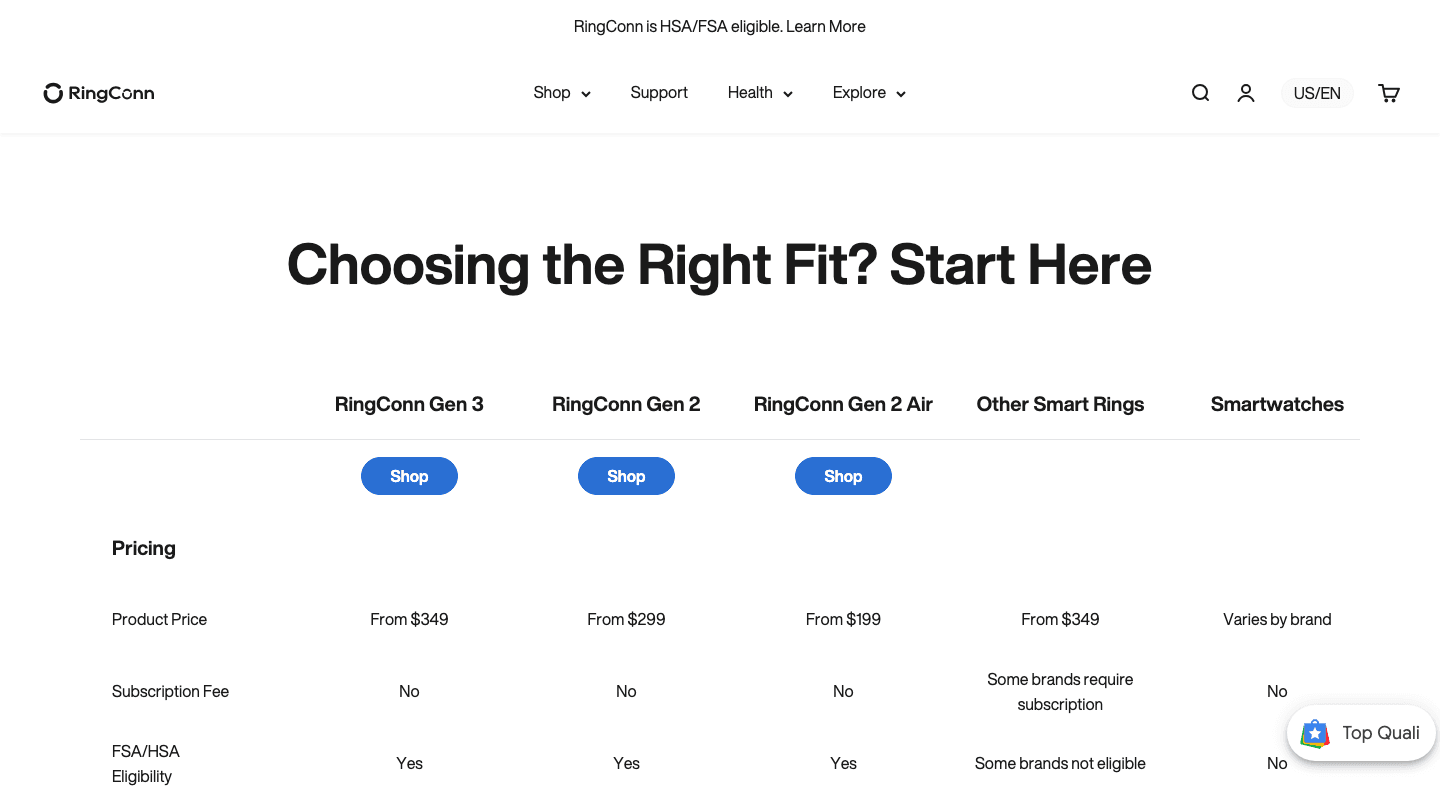
Consider the Gen 3 instead if: RingConn's newest model interests you. The Gen 3 is priced from $349 and may offer updated sensors or features beyond both Gen 2 options. Check the RingConn compare page for current Gen 3 specs.
Both rings are FSA/HSA eligible, which can offset the cost if you have remaining health spending account funds. Neither requires a monthly subscription, which is a meaningful long-term cost advantage over some competitor rings. See our full guide to the best sleep trackers in 2026 for how RingConn compares to Oura, Ultrahuman, and other smart rings.
Using Your Ring Data With a Scheduling App
Smart rings give you detailed data on your sleep quality, HRV, and recovery. The next step is using that data to structure your work. Lifestack auto-schedules tasks based on your energy patterns, so days when your ring data shows poor recovery or low HRV can translate into lighter task loading without you having to manually reorganize your calendar. It's $7/month or $50/year, and connects with popular calendar apps. See how energy-based scheduling uses recovery data practically.
Frequently Asked Questions
What is the difference between RingConn Gen 2 and Gen 2 Air?
Three things: the Gen 2 is made of titanium (lighter), has 12-day battery life (vs 10 days), and includes sleep apnea pattern detection. The Gen 2 Air is stainless steel, lasts 10 days, and does not detect sleep apnea. Price is $299 for Gen 2 vs $199 for Gen 2 Air.
Why is the RingConn Gen 2 Air heavier than the Gen 2?
The "Air" name refers to the lower price point, not the weight. The Gen 2 Air uses stainless steel instead of titanium, and stainless steel is denser. At the same ring dimensions, stainless steel produces a heavier ring (2.5-4g) than titanium (2-3g). The Gen 2 is the lighter option despite costing more.
Does the RingConn Gen 2 Air track sleep?
Yes. Both rings track sleep stages, respiratory rate, heart rate, and SpO2 overnight. The only sleep-related feature the Gen 2 Air lacks is sleep apnea pattern detection, which is exclusive to the Gen 2.
Is RingConn FSA/HSA eligible?
Yes. Both the Gen 2 and Gen 2 Air qualify for FSA and HSA spending, which can offset the purchase cost if you have funds remaining in a health flexible spending or health savings account.
How does RingConn compare to Oura Ring?
Both track similar health metrics. Oura requires a $5.99/month subscription after purchase; RingConn charges no ongoing subscription for either ring. Oura's app and health insights are generally considered more mature, but RingConn's no-subscription model is a meaningful practical advantage for users who don't want recurring costs. Our post on choosing a sleep tracking system covers this comparison in more depth.
RingConn makes two current smart rings that are easy to confuse: the Gen 2 and the Gen 2 Air. They look almost identical, they track the same health metrics in most areas, and they're sold through the same app. The difference is $100 in price, one material, two days of battery life, and one significant health feature.
Whether that gap is worth it comes down entirely to whether you want sleep apnea detection built in. If yes, the Gen 2 is the only option. If no, the Gen 2 Air does everything else for $100 less.
Key Takeaways
The Gen 2 is made of titanium; the Gen 2 Air is made of stainless steel. Titanium is lighter at equivalent dimensions, which is why the Gen 2 is 2-3g while the Gen 2 Air comes in slightly heavier at 2.5-4g despite being named "Air."
Sleep apnea pattern detection is available only on the Gen 2. If this matters to you, there's no version of this comparison where the Gen 2 Air wins.
Both rings carry no subscription fee, both are FSA/HSA eligible, and both are waterproof to 100 meters.
Quick Verdict
RingConn Gen 2 ($299+): Best for users who want complete health tracking including sleep apnea pattern detection, and who prefer a lighter titanium build.
RingConn Gen 2 Air ($199+): Best for users who want most of the Gen 2's features at a lower price and don't need sleep apnea monitoring.
RingConn Gen 2
The full-featured flagship at $299
The RingConn Gen 2 is the company's more capable smart ring, built with a titanium and epoxy resin construction. Titanium is denser than most metals per unit volume but extremely strong, which allows it to be machined thin while keeping the ring light. The result is a ring that weighs 2-3 grams depending on size.
Battery life is rated at up to 12 days, which is competitive with other premium smart rings. The 7-day offline data storage means you can leave your phone home for a week and still have your health data waiting when you reconnect. Waterproofing goes to 100 meters (more than enough for any swimming or showering use case).
The feature that sets the Gen 2 apart from its own sibling is sleep apnea pattern detection. Sleep apnea is the repeated stopping and starting of breathing during sleep and affects a significant portion of the population without a diagnosis. The Gen 2's sensors can flag patterns consistent with sleep apnea risk, which prompts users to follow up with clinical testing. For more on this, see our post on smart rings and sleep apnea detection.
Titanium and epoxy resin construction
Weight: 2-3g depending on size
Battery life: up to 12 days
Sleep apnea pattern detection: Yes
Waterproof: 100m
No subscription fee
FSA/HSA eligible
Pricing: From $299.
Best for: Anyone who wants full health monitoring including sleep apnea risk screening, in the lightest possible ring form factor.
RingConn Gen 2 Air
The value option at $199
The RingConn Gen 2 Air shares its health tracking capabilities with the Gen 2 in almost every area: 24/7 heart rate monitoring, blood oxygen (SpO2), heart rate variability (HRV), sleep stage detection, stress management, menstrual and pregnancy tracking, calorie and step tracking, and workout detection. The AI Health Assistant built into the RingConn app applies to both rings equally.
The material change is stainless steel rather than titanium. This is a denser metal, and while the ring is the same 2.0mm thickness, it comes in at 2.5-4g. Functionally, that's still a very light wearable: you won't notice the difference in daily use, but the titanium Gen 2 is objectively lighter.
Battery life drops to 10 days compared to the Gen 2's 12, which is still excellent. You're losing two days of between-charges convenience, not a fundamentally different usage pattern.
Stainless steel and epoxy resin construction
Weight: 2.5-4g depending on size
Battery life: up to 10 days
Sleep apnea pattern detection: No
Waterproof: 100m
No subscription fee
FSA/HSA eligible
Pricing: From $199.
Best for: Users who want thorough health tracking at a more accessible price point and don't require sleep apnea pattern detection.
Head-to-Head: Gen 2 vs Gen 2 Air
Price
A $100 difference on a $199 vs $299 purchase is substantial. The Gen 2 Air costs 33% less. That's a meaningful gap for a wearable where the core functionality (daily health tracking) is nearly identical.
Material and Weight
Titanium vs stainless steel is the Gen 2's clearest physical advantage. Titanium is both stronger and lighter than stainless steel per volume, which is why aerospace and medical devices use it. For a ring worn 24/7, being 0.5-1g lighter can matter over months of continuous wear. The Gen 2 Air is still light by any reasonable standard, but the Gen 2 wins here.
Battery Life
12 days vs 10 days. Both are good. If you travel frequently and want to minimize charging, the Gen 2's longer battery is useful. For most users, charging once every ten days vs twelve days is not a deciding factor.
Sleep Apnea Detection
This is the decisive spec. The Gen 2 detects sleep apnea patterns; the Gen 2 Air does not. If you suspect sleep-disordered breathing, have daytime fatigue you can't explain, or have been told you snore heavily, sleep apnea detection is worth the $100 upgrade. If these don't apply to you, you're paying for a feature you'll never use. Our post on smart rings for sleep tracking compares how different rings handle sleep detection overall.
Health Tracking Features
Outside of sleep apnea, both rings track the same metrics: heart rate, SpO2, HRV, sleep stages, respiratory rate, stress, activity, steps, calories, and menstrual cycle. The AI Health Assistant in the RingConn app applies equally to both. If sleep apnea detection is removed from the equation, there's no health tracking reason to prefer the Gen 2.
Which Should You Buy?
Buy the Gen 2 if: Sleep apnea screening is relevant to you, you want the lightest possible ring, you prefer titanium durability, or you simply want the top-of-line option from RingConn without worrying about trade-offs.
Buy the Gen 2 Air if: You don't need sleep apnea detection and want to save $100 while getting essentially the same daily health tracking experience.
Consider the Gen 3 instead if: RingConn's newest model interests you. The Gen 3 is priced from $349 and may offer updated sensors or features beyond both Gen 2 options. Check the RingConn compare page for current Gen 3 specs.
Both rings are FSA/HSA eligible, which can offset the cost if you have remaining health spending account funds. Neither requires a monthly subscription, which is a meaningful long-term cost advantage over some competitor rings. See our full guide to the best sleep trackers in 2026 for how RingConn compares to Oura, Ultrahuman, and other smart rings.
Using Your Ring Data With a Scheduling App
Smart rings give you detailed data on your sleep quality, HRV, and recovery. The next step is using that data to structure your work. Lifestack auto-schedules tasks based on your energy patterns, so days when your ring data shows poor recovery or low HRV can translate into lighter task loading without you having to manually reorganize your calendar. It's $7/month or $50/year, and connects with popular calendar apps. See how energy-based scheduling uses recovery data practically.
Frequently Asked Questions
What is the difference between RingConn Gen 2 and Gen 2 Air?
Three things: the Gen 2 is made of titanium (lighter), has 12-day battery life (vs 10 days), and includes sleep apnea pattern detection. The Gen 2 Air is stainless steel, lasts 10 days, and does not detect sleep apnea. Price is $299 for Gen 2 vs $199 for Gen 2 Air.
Why is the RingConn Gen 2 Air heavier than the Gen 2?
The "Air" name refers to the lower price point, not the weight. The Gen 2 Air uses stainless steel instead of titanium, and stainless steel is denser. At the same ring dimensions, stainless steel produces a heavier ring (2.5-4g) than titanium (2-3g). The Gen 2 is the lighter option despite costing more.
Does the RingConn Gen 2 Air track sleep?
Yes. Both rings track sleep stages, respiratory rate, heart rate, and SpO2 overnight. The only sleep-related feature the Gen 2 Air lacks is sleep apnea pattern detection, which is exclusive to the Gen 2.
Is RingConn FSA/HSA eligible?
Yes. Both the Gen 2 and Gen 2 Air qualify for FSA and HSA spending, which can offset the purchase cost if you have funds remaining in a health flexible spending or health savings account.
How does RingConn compare to Oura Ring?
Both track similar health metrics. Oura requires a $5.99/month subscription after purchase; RingConn charges no ongoing subscription for either ring. Oura's app and health insights are generally considered more mature, but RingConn's no-subscription model is a meaningful practical advantage for users who don't want recurring costs. Our post on choosing a sleep tracking system covers this comparison in more depth.



FOLLOW ON
FOLLOW ON
FOLLOW ON


Copyright 2026 © Lifestack. All rights reserved
Copyright 2026 © Lifestack. All rights reserved

