
App
Rise Science App Review: Is It Worth It in 2026?
Rise Science App Review: Is It Worth It in 2026?

Rise Science takes a different approach to sleep than most apps. Where the majority of sleep trackers compete on how accurately they can measure your sleep stages, Rise focuses on two numbers that matter more for most users: how much sleep debt you're carrying, and how your energy will likely move through tomorrow. It's a narrower scope, but it's a more actionable one.
The app has been through several iterations since its early focus on team and athletic performance. The current consumer version, reviewed here, is aimed at anyone who wants to understand how their sleep affects their daily energy and make better decisions based on that information. This review covers how the core model works, what the app does well and doesn't, pricing, and who should use it versus alternatives.
Key Takeaways
Rise Science's sleep debt model is the most practical framing of cumulative sleep shortfall available in a consumer app. Seeing your exact debt number is more actionable than a vague "sleep quality" score.
The energy forecasting feature, which predicts your hourly energy and alertness for the next 24 hours, is uniquely useful for planning when to schedule demanding work versus routine tasks.
The app requires consistent sleep logging (manual or from Apple Health/Oura) and has no free tier. At $69.99/year, it's reasonably priced but competes with apps that include more features.
What Is Rise Science?
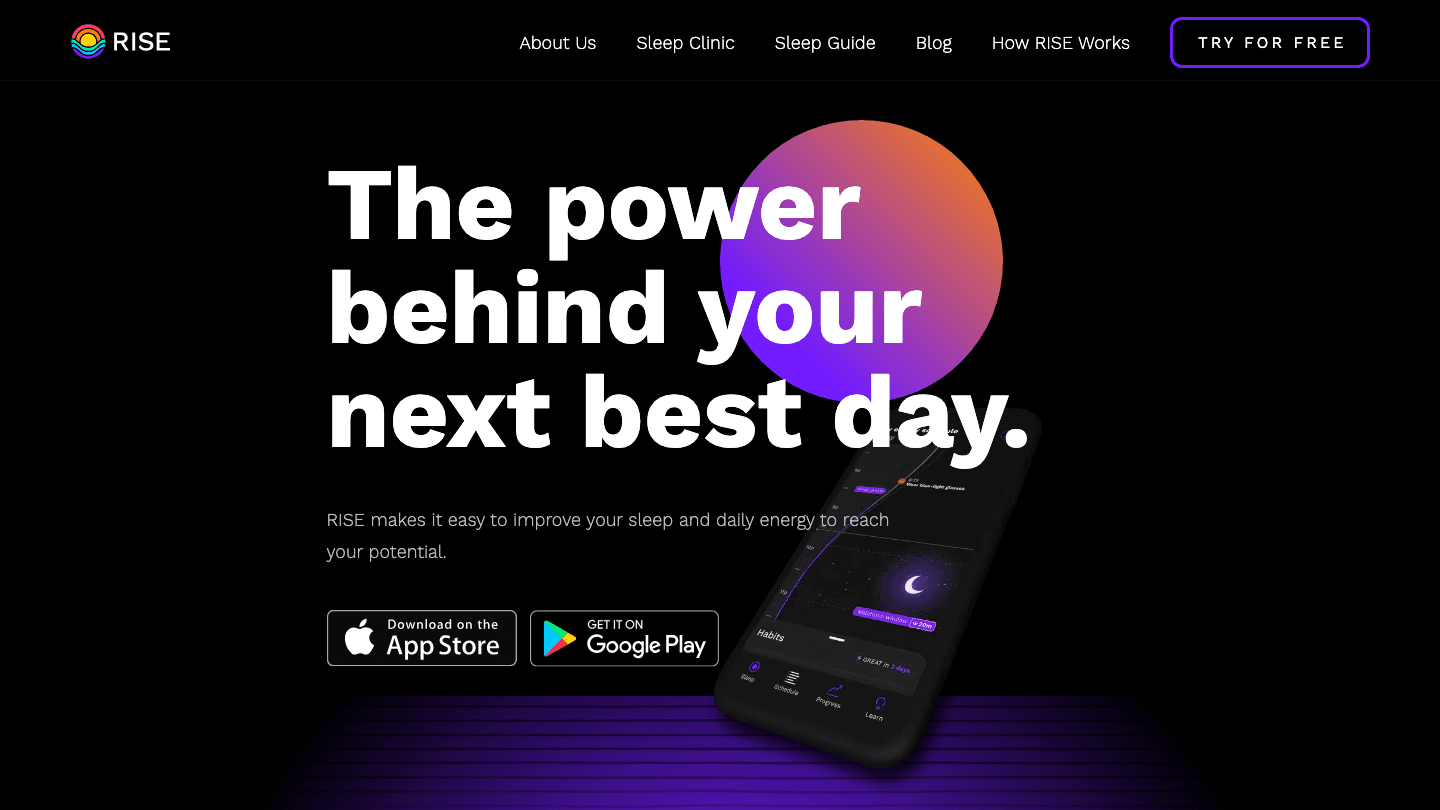
Rise Science is a sleep and energy optimization app built around two core metrics: Sleep Debt and Energy Peaks. The app doesn't try to measure your sleep stages in detail. Instead, it calculates how much sleep you owe your body relative to your personal sleep need, and it uses that deficit plus your circadian rhythm to forecast how your alertness will move through the coming day.
The premise is that most people's performance problems aren't explained by last night's sleep quality in isolation. They're explained by the cumulative debt built up over days or weeks. A single bad night affects you measurably. Five consecutive nights of slightly short sleep affects you more than any single bad night, but it's invisible until you're running so low that you notice it consciously. Rise makes the debt visible before it reaches that point.
How Rise Science Works
Sleep debt tracking
Rise calculates your personal sleep need (not a population average) by analyzing your recent sleep patterns over the first few weeks of use. It then tracks how much sleep you're getting relative to that need. The debt is expressed in hours and minutes: "You're carrying 4h 22min of sleep debt." That clarity is more useful than a percentage or score because you know exactly what it represents and what it would take to pay it off.
The target is to keep sleep debt below five hours, which Rise identifies as the threshold where cognitive performance begins to show measurable decline. Anything under five hours is manageable. Above it, you're likely noticing the effects whether you attribute them to sleep or not. Sleep deprivation and brain fog often go unrecognized because the decline is gradual.
Energy peak forecasting
The energy forecast shows a graph of your predicted alertness levels across the next 24 hours, updated daily based on your sleep data and your circadian phase. It identifies your peak alertness windows, your natural energy dips (the post-lunch circadian trough is almost universal), and your optimal nap window if your debt is high.
This is the feature that most differentiates Rise from other sleep apps. Most trackers tell you about last night. Rise tells you what to expect from today and suggests when you'll be most capable of demanding work. Understanding personal energy management in terms of predictable peaks and troughs rather than generic "morning vs. afternoon" generalizations changes how you plan your day.
Sleep data input
Rise pulls sleep data from Apple Health (which aggregates from iPhone's motion sensors or Apple Watch), Oura Ring, WHOOP, or Garmin. Manual logging is also supported. The more consistent and accurate your data source, the better the debt calculation and forecasting will be. Apple Watch or Oura data produces significantly better results than iPhone motion sensing alone.
Rise Science Features
Daily sleep debt calculation with hour and minute precision
24-hour energy forecast with peak alertness windows identified
Optimal nap timing recommendation when debt is high
Sleep scheduling feature to plan your target bedtime
Connects to Apple Health, Oura, WHOOP, and Garmin
Available on iOS and Android
Rise Science Pricing
Rise Science costs $69.99 per year, equivalent to about $5.83 per month. A 7-day free trial is available on the annual plan. There is no permanent free tier and no lifetime purchase option.
At this price point, Rise competes with Headspace ($69.99/year), Calm ($69.99/year), and sits below Oura's membership tier ($69.99/year plus the ring hardware). The value depends heavily on how much you'll use the energy forecasting to actually change your daily decisions. If you check it and ignore it, it's not worth the price. If you use the peak windows to schedule your hardest work and the nap timing to manage debt recovery, it's a reasonably priced performance tool.
What Rise Science Does Well
The sleep debt model is the app's genuine standout feature. Expressing cumulative shortfall as a concrete number is more honest and more useful than vague "readiness" scores or "sleep quality" percentages. You know what it means and what to do about it.
The energy forecast is practical in a way few sleep apps achieve. Knowing that your next peak alertness window starts at 10am and your next dip hits around 1-3pm lets you make scheduling decisions that align with your biology rather than arbitrary time slots. The nap recommendation based on your actual debt and circadian phase is more precise than any generic advice about nap timing.
The app is also clean, fast, and not padded with features that dilute its focus. Rise does a small number of things and does them well, which is increasingly rare in the wellness app category.
Where Rise Science Falls Short
The energy forecast depends on the accuracy of your sleep data, and if you're only using iPhone motion sensing, the baseline data isn't strong enough to make the forecasts reliable. Rise works best as a layer on top of a hardware tracker, which means you're potentially paying for Rise plus Oura (or another wearable) to get the full benefit.
The app also doesn't track sleep stages in detail. If you want to know how much time you spent in REM versus deep sleep or understand your sleep stage distribution, Rise isn't the right tool. It's deliberately built for output metrics (debt, energy) rather than process metrics (stage breakdown).
There's no free tier. For an app that requires several weeks of data to calibrate properly, a seven-day trial is short relative to how long it takes to see the model working well.
Who Should Use Rise Science
Good fit: People who already have a wearable like an Oura Ring or WHOOP and want to translate that data into daily energy forecasting and scheduling decisions.
Good fit: Anyone who suspects chronic mild sleep debt is affecting their performance and wants a concrete measure of it.
Good fit alongside: A scheduling tool that can act on Rise's energy data. Lifestack connects to Apple Health and your wearable to build your daily schedule around the same energy patterns Rise surfaces. Rise tells you when your peaks are; energy-based scheduling in Lifestack automatically books your hardest tasks into those windows.
Not the best fit: People without a wearable who want detailed sleep stage analysis. iPhone-only data reduces the accuracy of both the debt calculation and the forecast.
Not the best fit: People looking for meditation, sleep sounds, or mindfulness content. Rise doesn't include any.
Rise Science Alternatives
Oura Ring + Oura App: If you want the most accurate sleep tracking and a Readiness Score with actionable daily guidance, Oura is the premium option. Higher upfront cost but better data quality. See our best sleep tracking apps for a full comparison.
Sleep Cycle: If the smart alarm is your primary need (waking from light sleep) and you don't need sleep debt modeling, Sleep Cycle covers that with a free tier.
Lifestack: If energy scheduling is your goal (aligning your tasks with your peak windows), Lifestack approaches that from the scheduling side rather than the sleep tracking side. They complement each other rather than directly competing.
FAQ
Is Rise Science accurate?
For sleep debt calculation and energy forecasting, accuracy depends heavily on your data source. With Oura Ring, WHOOP, or Apple Watch sleep data, Rise's estimates are well-calibrated and practically useful. With iPhone-only motion sensing, the accuracy is noticeably lower. Rise is transparent about this: the app recommends connecting a wearable for best results.
Does Rise Science have a free version?
No. Rise offers a 7-day free trial on the annual plan ($69.99/year), but there's no permanent free tier. After the trial, you need a subscription to access the sleep debt and energy features.
How long does Rise Science take to work?
The app typically needs 2-4 weeks of sleep data to calibrate your personal sleep need accurately. During the first week or two, the debt number and energy forecasts improve as Rise learns your patterns. The 7-day trial starts before the calibration is complete, which is worth knowing before committing.
Is Rise Science worth it for people with ADHD?
Potentially, yes. ADHD and sleep problems frequently co-occur, and people with ADHD may need more sleep than neurotypical individuals. Seeing your sleep debt as a concrete number can be motivating in a way that abstract quality scores aren't. The energy forecasting also helps with task planning: knowing your peak windows makes it easier to schedule demanding work that ADHD makes hard to start.
Can Rise Science help improve sleep?
Rise doesn't coach you on sleep hygiene or provide guided sessions for falling asleep. Its value is making sleep data visible and actionable in terms of how you plan your day, not in directly improving sleep quality. Think of it as a dashboard, not a coaching program. For improving sleep quality directly, you'd need a different tool or simply to reduce debt by prioritizing earlier bedtimes.
Rise Science takes a different approach to sleep than most apps. Where the majority of sleep trackers compete on how accurately they can measure your sleep stages, Rise focuses on two numbers that matter more for most users: how much sleep debt you're carrying, and how your energy will likely move through tomorrow. It's a narrower scope, but it's a more actionable one.
The app has been through several iterations since its early focus on team and athletic performance. The current consumer version, reviewed here, is aimed at anyone who wants to understand how their sleep affects their daily energy and make better decisions based on that information. This review covers how the core model works, what the app does well and doesn't, pricing, and who should use it versus alternatives.
Key Takeaways
Rise Science's sleep debt model is the most practical framing of cumulative sleep shortfall available in a consumer app. Seeing your exact debt number is more actionable than a vague "sleep quality" score.
The energy forecasting feature, which predicts your hourly energy and alertness for the next 24 hours, is uniquely useful for planning when to schedule demanding work versus routine tasks.
The app requires consistent sleep logging (manual or from Apple Health/Oura) and has no free tier. At $69.99/year, it's reasonably priced but competes with apps that include more features.
What Is Rise Science?
Rise Science is a sleep and energy optimization app built around two core metrics: Sleep Debt and Energy Peaks. The app doesn't try to measure your sleep stages in detail. Instead, it calculates how much sleep you owe your body relative to your personal sleep need, and it uses that deficit plus your circadian rhythm to forecast how your alertness will move through the coming day.
The premise is that most people's performance problems aren't explained by last night's sleep quality in isolation. They're explained by the cumulative debt built up over days or weeks. A single bad night affects you measurably. Five consecutive nights of slightly short sleep affects you more than any single bad night, but it's invisible until you're running so low that you notice it consciously. Rise makes the debt visible before it reaches that point.
How Rise Science Works
Sleep debt tracking
Rise calculates your personal sleep need (not a population average) by analyzing your recent sleep patterns over the first few weeks of use. It then tracks how much sleep you're getting relative to that need. The debt is expressed in hours and minutes: "You're carrying 4h 22min of sleep debt." That clarity is more useful than a percentage or score because you know exactly what it represents and what it would take to pay it off.
The target is to keep sleep debt below five hours, which Rise identifies as the threshold where cognitive performance begins to show measurable decline. Anything under five hours is manageable. Above it, you're likely noticing the effects whether you attribute them to sleep or not. Sleep deprivation and brain fog often go unrecognized because the decline is gradual.
Energy peak forecasting
The energy forecast shows a graph of your predicted alertness levels across the next 24 hours, updated daily based on your sleep data and your circadian phase. It identifies your peak alertness windows, your natural energy dips (the post-lunch circadian trough is almost universal), and your optimal nap window if your debt is high.
This is the feature that most differentiates Rise from other sleep apps. Most trackers tell you about last night. Rise tells you what to expect from today and suggests when you'll be most capable of demanding work. Understanding personal energy management in terms of predictable peaks and troughs rather than generic "morning vs. afternoon" generalizations changes how you plan your day.
Sleep data input
Rise pulls sleep data from Apple Health (which aggregates from iPhone's motion sensors or Apple Watch), Oura Ring, WHOOP, or Garmin. Manual logging is also supported. The more consistent and accurate your data source, the better the debt calculation and forecasting will be. Apple Watch or Oura data produces significantly better results than iPhone motion sensing alone.
Rise Science Features
Daily sleep debt calculation with hour and minute precision
24-hour energy forecast with peak alertness windows identified
Optimal nap timing recommendation when debt is high
Sleep scheduling feature to plan your target bedtime
Connects to Apple Health, Oura, WHOOP, and Garmin
Available on iOS and Android
Rise Science Pricing
Rise Science costs $69.99 per year, equivalent to about $5.83 per month. A 7-day free trial is available on the annual plan. There is no permanent free tier and no lifetime purchase option.
At this price point, Rise competes with Headspace ($69.99/year), Calm ($69.99/year), and sits below Oura's membership tier ($69.99/year plus the ring hardware). The value depends heavily on how much you'll use the energy forecasting to actually change your daily decisions. If you check it and ignore it, it's not worth the price. If you use the peak windows to schedule your hardest work and the nap timing to manage debt recovery, it's a reasonably priced performance tool.
What Rise Science Does Well
The sleep debt model is the app's genuine standout feature. Expressing cumulative shortfall as a concrete number is more honest and more useful than vague "readiness" scores or "sleep quality" percentages. You know what it means and what to do about it.
The energy forecast is practical in a way few sleep apps achieve. Knowing that your next peak alertness window starts at 10am and your next dip hits around 1-3pm lets you make scheduling decisions that align with your biology rather than arbitrary time slots. The nap recommendation based on your actual debt and circadian phase is more precise than any generic advice about nap timing.
The app is also clean, fast, and not padded with features that dilute its focus. Rise does a small number of things and does them well, which is increasingly rare in the wellness app category.
Where Rise Science Falls Short
The energy forecast depends on the accuracy of your sleep data, and if you're only using iPhone motion sensing, the baseline data isn't strong enough to make the forecasts reliable. Rise works best as a layer on top of a hardware tracker, which means you're potentially paying for Rise plus Oura (or another wearable) to get the full benefit.
The app also doesn't track sleep stages in detail. If you want to know how much time you spent in REM versus deep sleep or understand your sleep stage distribution, Rise isn't the right tool. It's deliberately built for output metrics (debt, energy) rather than process metrics (stage breakdown).
There's no free tier. For an app that requires several weeks of data to calibrate properly, a seven-day trial is short relative to how long it takes to see the model working well.
Who Should Use Rise Science
Good fit: People who already have a wearable like an Oura Ring or WHOOP and want to translate that data into daily energy forecasting and scheduling decisions.
Good fit: Anyone who suspects chronic mild sleep debt is affecting their performance and wants a concrete measure of it.
Good fit alongside: A scheduling tool that can act on Rise's energy data. Lifestack connects to Apple Health and your wearable to build your daily schedule around the same energy patterns Rise surfaces. Rise tells you when your peaks are; energy-based scheduling in Lifestack automatically books your hardest tasks into those windows.
Not the best fit: People without a wearable who want detailed sleep stage analysis. iPhone-only data reduces the accuracy of both the debt calculation and the forecast.
Not the best fit: People looking for meditation, sleep sounds, or mindfulness content. Rise doesn't include any.
Rise Science Alternatives
Oura Ring + Oura App: If you want the most accurate sleep tracking and a Readiness Score with actionable daily guidance, Oura is the premium option. Higher upfront cost but better data quality. See our best sleep tracking apps for a full comparison.
Sleep Cycle: If the smart alarm is your primary need (waking from light sleep) and you don't need sleep debt modeling, Sleep Cycle covers that with a free tier.
Lifestack: If energy scheduling is your goal (aligning your tasks with your peak windows), Lifestack approaches that from the scheduling side rather than the sleep tracking side. They complement each other rather than directly competing.
FAQ
Is Rise Science accurate?
For sleep debt calculation and energy forecasting, accuracy depends heavily on your data source. With Oura Ring, WHOOP, or Apple Watch sleep data, Rise's estimates are well-calibrated and practically useful. With iPhone-only motion sensing, the accuracy is noticeably lower. Rise is transparent about this: the app recommends connecting a wearable for best results.
Does Rise Science have a free version?
No. Rise offers a 7-day free trial on the annual plan ($69.99/year), but there's no permanent free tier. After the trial, you need a subscription to access the sleep debt and energy features.
How long does Rise Science take to work?
The app typically needs 2-4 weeks of sleep data to calibrate your personal sleep need accurately. During the first week or two, the debt number and energy forecasts improve as Rise learns your patterns. The 7-day trial starts before the calibration is complete, which is worth knowing before committing.
Is Rise Science worth it for people with ADHD?
Potentially, yes. ADHD and sleep problems frequently co-occur, and people with ADHD may need more sleep than neurotypical individuals. Seeing your sleep debt as a concrete number can be motivating in a way that abstract quality scores aren't. The energy forecasting also helps with task planning: knowing your peak windows makes it easier to schedule demanding work that ADHD makes hard to start.
Can Rise Science help improve sleep?
Rise doesn't coach you on sleep hygiene or provide guided sessions for falling asleep. Its value is making sleep data visible and actionable in terms of how you plan your day, not in directly improving sleep quality. Think of it as a dashboard, not a coaching program. For improving sleep quality directly, you'd need a different tool or simply to reduce debt by prioritizing earlier bedtimes.



FOLLOW ON
FOLLOW ON
FOLLOW ON


Copyright 2026 © Lifestack. All rights reserved
Copyright 2026 © Lifestack. All rights reserved

