
Tips
What Is Spoon Theory? Energy Management Explained
What Is Spoon Theory? Energy Management Explained

In 2003, Christine Miserandino was at a diner with a friend who asked her what it actually felt like to live with lupus. She grabbed a handful of spoons from nearby tables, handed them over, and said: you start each day with these. Every task costs one. Some cost more. When they're gone, they're gone.
That conversation became one of the most widely shared frameworks in chronic illness communities. Spoon theory isn't a medical concept. It's a metaphor that does something medicine rarely does well: it makes invisible limitation visible and communicable.
Since then, spoon theory has expanded well beyond chronic illness. People with ADHD, autism, anxiety disorders, burnout, and depression use it to explain why their energy works differently from the people around them. The framework lands because it names something most people recognize but rarely discuss: not all days start with the same capacity, and not all tasks cost the same amount.
Key Takeaways
Spoon theory uses spoons as units of daily energy to help people with limited capacity make decisions about how to spend it.
The framework is especially useful for people with chronic illness, ADHD, autism, or burnout, where energy doesn't replenish reliably.
Applied to daily planning, spoon theory shifts the question from "what do I need to do?" to "what can I actually do today?"
Where Spoon Theory Came From
Christine Miserandino published her original story on butyoudontlooksick.com, where she described handing over 12 spoons and walking her friend through a hypothetical day. Getting dressed cost one spoon. Making breakfast cost another. By the time her friend reached midday in the simulation, she was out of spoons and hadn't left the apartment.
The point wasn't to generate sympathy. It was to create a shared vocabulary. Before spoon theory, explaining chronic fatigue often came down to "I'm tired," which healthy people interpret as normal tiredness. After spoon theory, the conversation became specific: I have seven spoons today. Cooking dinner would cost three. I need four to get through work. That specificity changes the conversation entirely.
The term "spoonie" emerged from the community as a self-identifier for people who use this framework to describe their lives. It's now used across chronic illness, disability, neurodivergent, and mental health communities.
How Spoon Theory Works
The basic mechanics are simple. You begin each day with a fixed number of spoons representing your available energy. Each activity you undertake costs a certain number of spoons based on its physical and cognitive demand. When you run out, you're done for the day, or you "borrow" from tomorrow's spoons at a cost.
What makes spoon theory different from a general productivity framework is the scarcity assumption. Standard energy management advice often assumes you can expand your capacity through rest, exercise, nutrition, and habits. For people with chronic illness or neurodivergent conditions, that assumption breaks down. Energy doesn't reliably replenish overnight. Some mornings you wake with fewer spoons than yesterday for no clear reason.
This is why spoon theory connects so directly with ADHD communities. The executive function costs of tasks are invisible to observers but very real. Starting a task, switching between tasks, handling unexpected changes, managing social interactions: these cost cognitive spoons that a neurotypical person might not count at all. If you've experienced ADHD task paralysis, you've experienced running low on the executive function spoons required to initiate work.
Who Uses Spoon Theory
Spoon theory was originally developed for lupus, but the communities that have adopted it most broadly include:
Chronic illness: Lupus, fibromyalgia, ME/CFS, Crohn's disease, MS, rheumatoid arthritis, and other conditions where physical energy is genuinely limited and unpredictable.
ADHD: Executive function costs make routine tasks much more draining than they appear. Spoon theory helps explain why a neurotypical person can switch tasks effortlessly while an ADHD person may need significant recovery time after a difficult transition.
Autism: Social situations, sensory processing, and masking behaviors all cost significant energy. Many autistic people report that social events leave them needing long periods of solitude to recover.
Anxiety and depression: Mental health conditions carry energy costs that aren't always visible. Managing anxiety takes spoons. Depression often starts the day with fewer available.
Burnout: Even without a chronic condition, prolonged stress depletes the starting spoon count. Burnout is effectively a chronic low-spoon state that accumulates over months or years.
How to Track Your Spoons
Some people approach spoon tracking formally. They assign point values to tasks, track daily totals, and use this data to identify patterns. Others use it loosely as a mental model, asking "how many spoons does this cost?" before committing to something.
A rough approach for getting started:
Note your starting spoon count each morning on a scale of 1 to 10 based on how rested and capable you feel when you wake up.
List the major tasks you need to complete that day and estimate a spoon cost for each.
Add those costs up and compare them to your starting count. If the total exceeds your starting spoons, something has to move.
At the end of the day, note what you actually completed and how drained you feel. Over time, this data becomes your personal energy map.
The goal isn't perfect accounting. It's building the habit of checking your capacity before you commit. Sleep quality and prior day activity are the biggest factors in your starting spoon count. Tracking both helps you predict more accurately.
Spoon Theory and Daily Planning
Where spoon theory becomes practically useful is in planning. If you know you're starting a day with fewer spoons than usual, the default response is to try to push through anyway. Spoon theory provides a framework for making deliberate trade-offs instead.
On low-spoon days, the question isn't "how do I get everything done?" It's "which one or two things matter most given what I have?" That's actually a more effective planning question for anyone, not just people with chronic conditions. The constraint forces prioritization that optional energy management doesn't.
On high-spoon days, you have capacity to tackle demanding work, have the conversations you've been avoiding, or build systems that reduce future spoon costs. Understanding low-energy productivity as a separate mode from high-energy deep work is one practical application. Your calendar should reflect both modes rather than treating every day as identical. If you're working on an energy calendar, spoon theory gives you the personal data to populate it meaningfully.
What to Do When You're Running Low on Spoons
Running low on spoons mid-day doesn't have to mean the rest of the day is lost. A few approaches help:
Spoon recovery activities: Identify what actually restores energy for you (not just activities culturally labeled as restful). Some people restore with solitude. Others need short social connection. Physical rest isn't always restorative for cognitive depletion.
Spoon-cheap task switching: When your executive function is depleted, switch to tasks that require decision-making or initiation. Move to simple, physical, or routine tasks that run on autopilot.
Borrowing and the debt cost: You can push past your limit, but spoon theory explicitly names this as borrowing from tomorrow. Chronic borrowing creates the familiar cycle of crash-and-recovery. When your energy is low, it's worth knowing the specific strategies that help rather than defaulting to caffeine or willpower.
The Best App for Managing Your Spoons
Spoon theory is most useful when it connects to how you actually schedule your time. An app that ignores your energy state and schedules meetings and deep work back-to-back on low-spoon days creates friction that drains you faster. Lifestack is designed specifically around this problem.
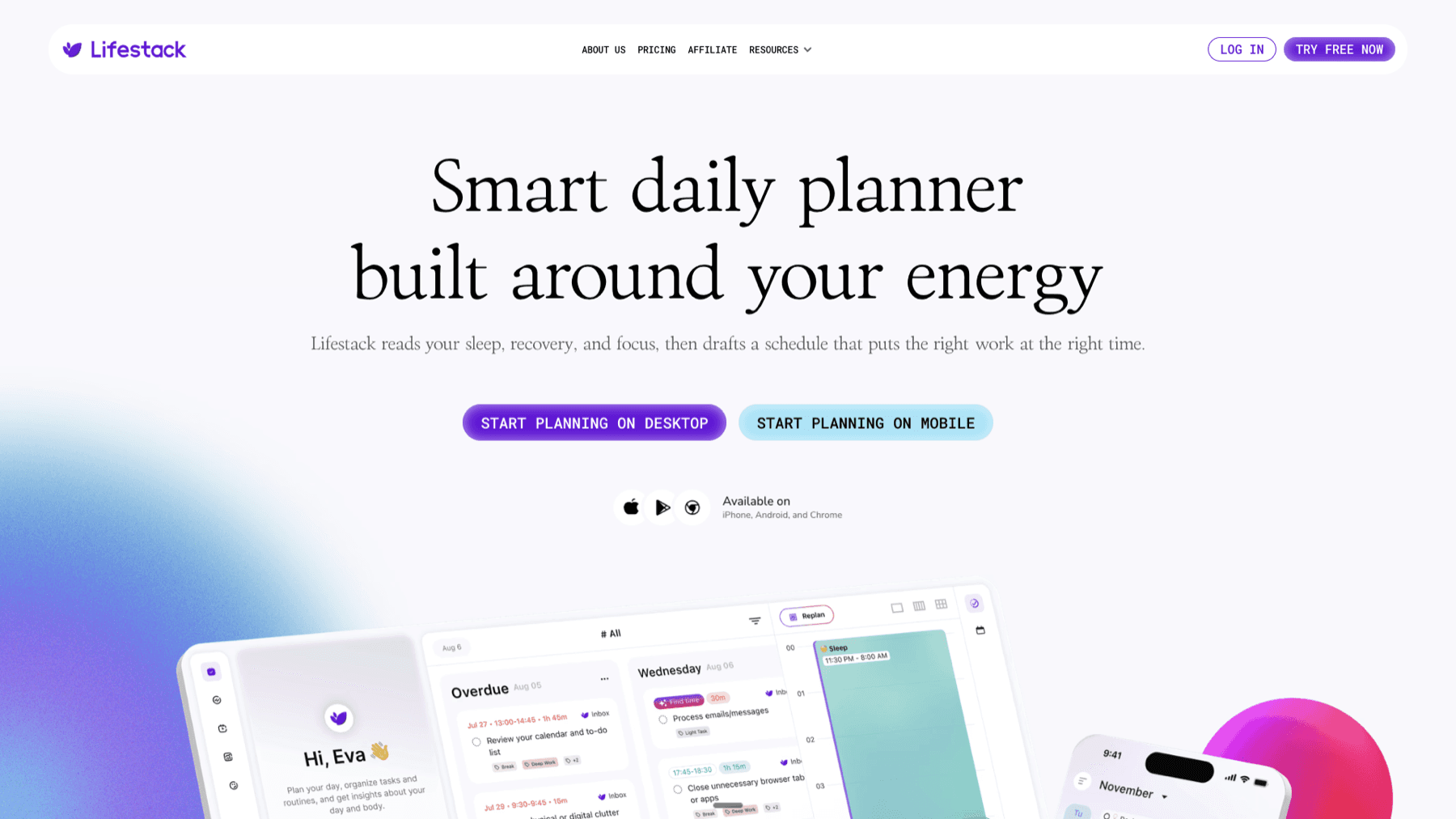
Lifestack reads your sleep data, recovery metrics, and activity levels from your wearable or phone, then builds your daily schedule with your actual energy in mind. High-focus tasks get placed in your peak energy windows. Low-spoon time blocks get lighter work. The app adjusts your schedule based on how last night went, which is the closest thing to an automated spoon tracker integrated into a real calendar.
If you're managing a chronic condition or neurodivergent energy patterns, this kind of automatic energy-awareness can reduce the daily overhead of manually tracking and rescheduling. Lifestack costs $7/month or $50/year.
Frequently Asked Questions
What is spoon theory in simple terms?
Spoon theory is a metaphor where spoons represent units of daily energy. People with chronic illness or conditions that limit their energy start each day with a limited number of spoons, and every activity costs one or more. Once the spoons are gone, the energy for the day is spent. The framework helps people explain and plan around limited, unpredictable energy.
Who created spoon theory?
Christine Miserandino created spoon theory in 2003. She developed the concept during a conversation with a friend at a diner, using actual spoons from nearby tables to illustrate the daily energy constraints of living with lupus. She published the story on butyoudontlooksick.com, where it spread through chronic illness communities over the following years.
Does spoon theory apply to ADHD?
Yes. Spoon theory has been widely adopted by ADHD communities because executive function costs are often invisible to others. Initiating tasks, managing transitions, handling unexpected changes, and sustaining attention all cost cognitive spoons. ADHD can make routine tasks significantly more draining than they appear, and spoon theory provides a vocabulary for that experience.
How many spoons do you start with?
The number varies by person and by day. In Christine Miserandino's original story, she used 12 spoons. Most people who use the framework calibrate their own baseline based on their condition. The specific number matters less than the concept: that the supply is finite, that it varies from day to day, and that activities draw it down in different amounts.
What does it mean to be a spoonie?
A spoonie is someone who identifies with spoon theory, typically because they live with a chronic illness, disability, or neurodivergent condition that creates energy limitations. The term emerged organically from online communities as a self-identifier and a way to signal shared experience with others who understand what managing limited spoons actually involves.
Can spoon theory help with burnout?
Yes. Burnout is effectively a chronic low-spoon state that results from long-term energy debt. Applying spoon theory to burnout recovery means being honest about your current starting count rather than operating as if you have your pre-burnout capacity. Recovery usually requires a period of deliberate under-spending: consistently doing less than your maximum to let the baseline rebuild. The quality of your sleep during recovery directly affects how quickly your spoon count returns to baseline.
In 2003, Christine Miserandino was at a diner with a friend who asked her what it actually felt like to live with lupus. She grabbed a handful of spoons from nearby tables, handed them over, and said: you start each day with these. Every task costs one. Some cost more. When they're gone, they're gone.
That conversation became one of the most widely shared frameworks in chronic illness communities. Spoon theory isn't a medical concept. It's a metaphor that does something medicine rarely does well: it makes invisible limitation visible and communicable.
Since then, spoon theory has expanded well beyond chronic illness. People with ADHD, autism, anxiety disorders, burnout, and depression use it to explain why their energy works differently from the people around them. The framework lands because it names something most people recognize but rarely discuss: not all days start with the same capacity, and not all tasks cost the same amount.
Key Takeaways
Spoon theory uses spoons as units of daily energy to help people with limited capacity make decisions about how to spend it.
The framework is especially useful for people with chronic illness, ADHD, autism, or burnout, where energy doesn't replenish reliably.
Applied to daily planning, spoon theory shifts the question from "what do I need to do?" to "what can I actually do today?"
Where Spoon Theory Came From
Christine Miserandino published her original story on butyoudontlooksick.com, where she described handing over 12 spoons and walking her friend through a hypothetical day. Getting dressed cost one spoon. Making breakfast cost another. By the time her friend reached midday in the simulation, she was out of spoons and hadn't left the apartment.
The point wasn't to generate sympathy. It was to create a shared vocabulary. Before spoon theory, explaining chronic fatigue often came down to "I'm tired," which healthy people interpret as normal tiredness. After spoon theory, the conversation became specific: I have seven spoons today. Cooking dinner would cost three. I need four to get through work. That specificity changes the conversation entirely.
The term "spoonie" emerged from the community as a self-identifier for people who use this framework to describe their lives. It's now used across chronic illness, disability, neurodivergent, and mental health communities.
How Spoon Theory Works
The basic mechanics are simple. You begin each day with a fixed number of spoons representing your available energy. Each activity you undertake costs a certain number of spoons based on its physical and cognitive demand. When you run out, you're done for the day, or you "borrow" from tomorrow's spoons at a cost.
What makes spoon theory different from a general productivity framework is the scarcity assumption. Standard energy management advice often assumes you can expand your capacity through rest, exercise, nutrition, and habits. For people with chronic illness or neurodivergent conditions, that assumption breaks down. Energy doesn't reliably replenish overnight. Some mornings you wake with fewer spoons than yesterday for no clear reason.
This is why spoon theory connects so directly with ADHD communities. The executive function costs of tasks are invisible to observers but very real. Starting a task, switching between tasks, handling unexpected changes, managing social interactions: these cost cognitive spoons that a neurotypical person might not count at all. If you've experienced ADHD task paralysis, you've experienced running low on the executive function spoons required to initiate work.
Who Uses Spoon Theory
Spoon theory was originally developed for lupus, but the communities that have adopted it most broadly include:
Chronic illness: Lupus, fibromyalgia, ME/CFS, Crohn's disease, MS, rheumatoid arthritis, and other conditions where physical energy is genuinely limited and unpredictable.
ADHD: Executive function costs make routine tasks much more draining than they appear. Spoon theory helps explain why a neurotypical person can switch tasks effortlessly while an ADHD person may need significant recovery time after a difficult transition.
Autism: Social situations, sensory processing, and masking behaviors all cost significant energy. Many autistic people report that social events leave them needing long periods of solitude to recover.
Anxiety and depression: Mental health conditions carry energy costs that aren't always visible. Managing anxiety takes spoons. Depression often starts the day with fewer available.
Burnout: Even without a chronic condition, prolonged stress depletes the starting spoon count. Burnout is effectively a chronic low-spoon state that accumulates over months or years.
How to Track Your Spoons
Some people approach spoon tracking formally. They assign point values to tasks, track daily totals, and use this data to identify patterns. Others use it loosely as a mental model, asking "how many spoons does this cost?" before committing to something.
A rough approach for getting started:
Note your starting spoon count each morning on a scale of 1 to 10 based on how rested and capable you feel when you wake up.
List the major tasks you need to complete that day and estimate a spoon cost for each.
Add those costs up and compare them to your starting count. If the total exceeds your starting spoons, something has to move.
At the end of the day, note what you actually completed and how drained you feel. Over time, this data becomes your personal energy map.
The goal isn't perfect accounting. It's building the habit of checking your capacity before you commit. Sleep quality and prior day activity are the biggest factors in your starting spoon count. Tracking both helps you predict more accurately.
Spoon Theory and Daily Planning
Where spoon theory becomes practically useful is in planning. If you know you're starting a day with fewer spoons than usual, the default response is to try to push through anyway. Spoon theory provides a framework for making deliberate trade-offs instead.
On low-spoon days, the question isn't "how do I get everything done?" It's "which one or two things matter most given what I have?" That's actually a more effective planning question for anyone, not just people with chronic conditions. The constraint forces prioritization that optional energy management doesn't.
On high-spoon days, you have capacity to tackle demanding work, have the conversations you've been avoiding, or build systems that reduce future spoon costs. Understanding low-energy productivity as a separate mode from high-energy deep work is one practical application. Your calendar should reflect both modes rather than treating every day as identical. If you're working on an energy calendar, spoon theory gives you the personal data to populate it meaningfully.
What to Do When You're Running Low on Spoons
Running low on spoons mid-day doesn't have to mean the rest of the day is lost. A few approaches help:
Spoon recovery activities: Identify what actually restores energy for you (not just activities culturally labeled as restful). Some people restore with solitude. Others need short social connection. Physical rest isn't always restorative for cognitive depletion.
Spoon-cheap task switching: When your executive function is depleted, switch to tasks that require decision-making or initiation. Move to simple, physical, or routine tasks that run on autopilot.
Borrowing and the debt cost: You can push past your limit, but spoon theory explicitly names this as borrowing from tomorrow. Chronic borrowing creates the familiar cycle of crash-and-recovery. When your energy is low, it's worth knowing the specific strategies that help rather than defaulting to caffeine or willpower.
The Best App for Managing Your Spoons
Spoon theory is most useful when it connects to how you actually schedule your time. An app that ignores your energy state and schedules meetings and deep work back-to-back on low-spoon days creates friction that drains you faster. Lifestack is designed specifically around this problem.
Lifestack reads your sleep data, recovery metrics, and activity levels from your wearable or phone, then builds your daily schedule with your actual energy in mind. High-focus tasks get placed in your peak energy windows. Low-spoon time blocks get lighter work. The app adjusts your schedule based on how last night went, which is the closest thing to an automated spoon tracker integrated into a real calendar.
If you're managing a chronic condition or neurodivergent energy patterns, this kind of automatic energy-awareness can reduce the daily overhead of manually tracking and rescheduling. Lifestack costs $7/month or $50/year.
Frequently Asked Questions
What is spoon theory in simple terms?
Spoon theory is a metaphor where spoons represent units of daily energy. People with chronic illness or conditions that limit their energy start each day with a limited number of spoons, and every activity costs one or more. Once the spoons are gone, the energy for the day is spent. The framework helps people explain and plan around limited, unpredictable energy.
Who created spoon theory?
Christine Miserandino created spoon theory in 2003. She developed the concept during a conversation with a friend at a diner, using actual spoons from nearby tables to illustrate the daily energy constraints of living with lupus. She published the story on butyoudontlooksick.com, where it spread through chronic illness communities over the following years.
Does spoon theory apply to ADHD?
Yes. Spoon theory has been widely adopted by ADHD communities because executive function costs are often invisible to others. Initiating tasks, managing transitions, handling unexpected changes, and sustaining attention all cost cognitive spoons. ADHD can make routine tasks significantly more draining than they appear, and spoon theory provides a vocabulary for that experience.
How many spoons do you start with?
The number varies by person and by day. In Christine Miserandino's original story, she used 12 spoons. Most people who use the framework calibrate their own baseline based on their condition. The specific number matters less than the concept: that the supply is finite, that it varies from day to day, and that activities draw it down in different amounts.
What does it mean to be a spoonie?
A spoonie is someone who identifies with spoon theory, typically because they live with a chronic illness, disability, or neurodivergent condition that creates energy limitations. The term emerged organically from online communities as a self-identifier and a way to signal shared experience with others who understand what managing limited spoons actually involves.
Can spoon theory help with burnout?
Yes. Burnout is effectively a chronic low-spoon state that results from long-term energy debt. Applying spoon theory to burnout recovery means being honest about your current starting count rather than operating as if you have your pre-burnout capacity. Recovery usually requires a period of deliberate under-spending: consistently doing less than your maximum to let the baseline rebuild. The quality of your sleep during recovery directly affects how quickly your spoon count returns to baseline.



FOLLOW ON
FOLLOW ON
FOLLOW ON


Copyright 2026 © Lifestack. All rights reserved
Copyright 2026 © Lifestack. All rights reserved

