
Book
The Distracted Mind by Adam Gazzaley and Larry Rosen
The Distracted Mind by Adam Gazzaley and Larry Rosen
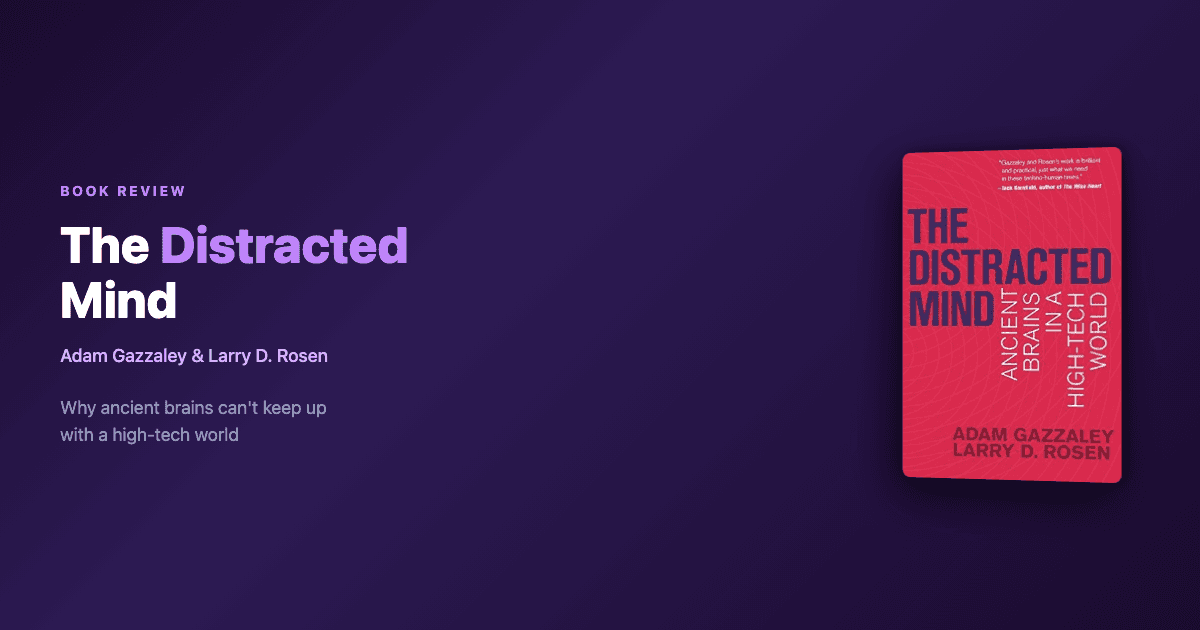
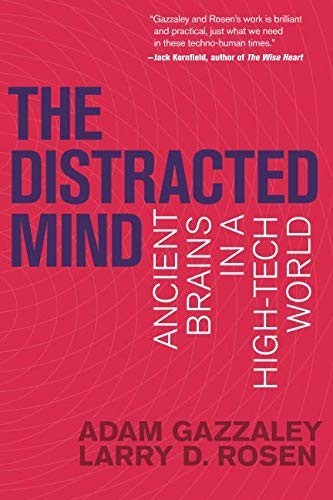
Your brain was never designed to handle what your phone demands of it. That's the core argument of The Distracted Mind: Ancient Brains in a High-Tech World by Adam Gazzaley and Larry D. Rosen. Gazzaley is a neuroscientist at UCSF who studies attention and memory. Rosen is a psychologist who has spent decades studying technology's effect on behavior. Together they make the case that the attention crisis isn't a discipline problem. It's a mismatch between hardware that evolved over hundreds of thousands of years and an environment that changed almost overnight.
This is one of the few books on distraction that earns its claims. Instead of anecdotes and productivity tips, Gazzaley and Rosen go into the actual neuroscience: what happens in the prefrontal cortex when you multitask, why interference (internal distraction) is different from interruption (external distraction), and why the teenage brain and the aging brain are each vulnerable to distraction in different ways.
If you've read Deep Work by Cal Newport or Stolen Focus by Johann Hari and wanted the peer-reviewed science behind those arguments, this book is where a lot of it comes from.
Key Takeaways
The human brain has a hard limit on goal management: it can only hold a few active goals at a time, and technology constantly pushes against that ceiling.
Multitasking is a myth. What we actually do is rapidly switch between tasks, and each switch costs cognitive time and accuracy.
The solution isn't willpower. It's environment design: changing the conditions that create distraction rather than fighting them after the fact.
What the Book Is About
The book opens with what Gazzaley calls the "foragingbrain." Early humans needed to constantly scan for threats and opportunities. That means our brains evolved with a bias toward novelty, toward noticing changes in the environment. Notifications, new messages, and social media feeds exploit exactly this bias. They're engineered to feel like something new and important might be there, even when it isn't.
From there, the book builds a detailed model of how attention works in the brain: top-down control (goal-directed attention), bottom-up capture (novelty-driven distraction), and the interplay between them. The prefrontal cortex handles top-down control, and it's the most recently evolved part of the brain. It's also the part that gets overwhelmed first under cognitive load.
The second half shifts to practical territory: what the research shows about interventions that actually work, and where behavior change is likely to fail.
The Neuroscience Behind Distraction
Top-down versus bottom-up attention
Top-down attention is what you use when you decide to focus on a task. Bottom-up attention is what hijacks you when a notification appears or someone says your name. The problem is that bottom-up signals are processed faster than top-down control can suppress them. By the time your prefrontal cortex decides "ignore that," your attention has already shifted.
This is why you can't focus even when you know you should. It's not a character flaw. Your brain is doing exactly what it's built to do. The question is whether your environment makes top-down control easier or harder.
Goal interference and task switching
Gazzaley distinguishes between two types of cognitive interference. Distraction is when external stimuli pull your attention away from a current goal. Interruption is when an external demand requires you to switch tasks entirely. Both are costly, but they're costly in different ways.
Task switching leaves a "residue" of the previous task in working memory, which means you don't arrive at the next task fresh. Research Gazzaley cites puts the cognitive cost of a single task switch at roughly 23 minutes to return to full focus. That number explains why fragmented days feel exhausting even when nothing particularly hard happened. You spent the whole day paying the tax on switching.
The working memory ceiling
Working memory, the brain's short-term "scratch space," holds roughly four items at a time. When you exceed that limit, information starts dropping out. Modern digital environments routinely push people past this ceiling: multiple open tabs, active conversations in several channels, background email, and a task list that's too long to hold in your head. The result isn't just reduced productivity. It's reduced accuracy and worse decision quality.
This is directly relevant to mental clarity at work and to the kind of task paralysis that shows up when someone is overwhelmed not by the difficulty of tasks but by their sheer number.
Why technology is particularly effective at capturing attention
Rosen's contribution to the book is the behavioral and psychological side. His research shows that most people check their phone every 15 minutes, often unconsciously, and experience real anxiety when they don't. He introduces the concept of "iDisorder": a collection of technology-driven behaviors that mirror clinical psychological conditions without meeting diagnostic criteria. The relevance isn't clinical, it's behavioral. Many people have developed reflexive relationships with their devices that bypass intentional choice entirely.
What Actually Works to Improve Focus
The book's final section is its most actionable, though Gazzaley and Rosen are careful not to oversell any single intervention. Here's what the research they review actually supports:
Physical exercise
This is the most consistently supported finding in the book. Aerobic exercise improves prefrontal cortex function, working memory capacity, and attention regulation. The effect is strongest when exercise is regular rather than occasional. Gazzaley's own lab has done studies on this. It's one of the few interventions that improves the underlying hardware rather than just managing its limitations.
Nature exposure
Attention Restoration Theory holds that natural environments allow the top-down attentional system to recover because they make modest, non-demanding bottom-up calls on your attention. A walk in a park is genuinely restorative in a way that a walk through Times Square is not. The research behind this is solid and has been replicated across multiple lab groups.
Meditation and mindfulness training
The evidence here is more mixed than popular accounts suggest, but meaningful effects on attention regulation have been shown with consistent practice over weeks. The key word is consistent. A few sessions don't move the needle. What does move the needle is regular, sustained practice that trains the noticing-and-returning mechanism described in mindfulness traditions. See our post on mindfulness for remote productivity for practical entry points.
Environment design
This is the authors' most practical prescription. If the environment constantly generates bottom-up attention captures, top-down control will lose every time. The design intervention is to remove the sources of interruption before the session rather than resist them during it. Phone in another room, notifications off, single-tab browsing. This isn't willpower. It's architecture.
For people who want a scheduling layer on top of this, Lifestack auto-schedules tasks based on energy levels throughout the day, placing cognitively demanding work when your prefrontal cortex is sharpest and lower-demand tasks later. That maps directly onto the book's core argument: protect high-attention windows from interference at the structural level. See how energy-based scheduling works and how it connects to when to schedule deep work.
Who Should Read This Book
This book is most valuable for:
People who've read popular books on focus (Deep Work, Stolen Focus) and want the neuroscience behind the claims
Managers and team leads who want to understand why constant-availability culture damages team output
Anyone who has tried to improve their focus through willpower alone and wants to understand why that approach has limits
Parents of teenagers concerned about screen time, since Rosen dedicates specific sections to adolescent attention development
It's more academic than most self-help books and slower to get to practical recommendations. If you want concrete tools immediately, start with work focusing tools and come back to the science later.
Frequently Asked Questions
What is The Distracted Mind about?
The Distracted Mind by Adam Gazzaley and Larry D. Rosen is a neuroscience-backed examination of why modern technology is particularly effective at capturing and fragmenting attention. The book covers how the brain's attentional systems work, why multitasking is neurologically impossible, and what interventions (exercise, nature, meditation, environment design) the research actually supports for improving focus.
Is The Distracted Mind worth reading?
Yes, especially if you want more than self-help advice. Gazzaley is a practicing neuroscientist and Rosen is a clinical researcher, so the claims in the book are anchored in peer-reviewed studies rather than popular extrapolations. It's slower than most focus books but more credible. If you've been told to "just put your phone away," this book explains in detail why that's harder than it sounds and what approaches actually change behavior at the neural level.
How does The Distracted Mind differ from Deep Work?
Newport's Deep Work is prescriptive: here are the habits and schedules you need. The Distracted Mind is explanatory: here is why your brain works the way it does. The two books complement each other well. Read The Distracted Mind to understand the problem, read Deep Work for the implementation framework. See our review of Cal Newport's Deep Work for a summary of that side.
What does the book say about multitasking?
Gazzaley is unambiguous: multitasking doesn't exist. What people call multitasking is rapid task-switching, and every switch carries a cognitive cost. The prefrontal cortex cannot fully process two goal-directed tasks simultaneously. When you think you're multitasking, you're doing each task worse than you would if you did them sequentially, and you're more likely to make errors in both.
Does the book have practical advice for improving focus?
Yes, in the second half. The strongest recommendations are regular aerobic exercise, nature exposure, mindfulness training over weeks rather than sessions, and environmental redesign (removing notification sources before work sessions). The book is more honest than most about what doesn't have strong evidence, which makes its actual recommendations more trustworthy. For a tool that applies environment-design thinking to scheduling, see how to focus at work and personal energy management.
Your brain was never designed to handle what your phone demands of it. That's the core argument of The Distracted Mind: Ancient Brains in a High-Tech World by Adam Gazzaley and Larry D. Rosen. Gazzaley is a neuroscientist at UCSF who studies attention and memory. Rosen is a psychologist who has spent decades studying technology's effect on behavior. Together they make the case that the attention crisis isn't a discipline problem. It's a mismatch between hardware that evolved over hundreds of thousands of years and an environment that changed almost overnight.
This is one of the few books on distraction that earns its claims. Instead of anecdotes and productivity tips, Gazzaley and Rosen go into the actual neuroscience: what happens in the prefrontal cortex when you multitask, why interference (internal distraction) is different from interruption (external distraction), and why the teenage brain and the aging brain are each vulnerable to distraction in different ways.
If you've read Deep Work by Cal Newport or Stolen Focus by Johann Hari and wanted the peer-reviewed science behind those arguments, this book is where a lot of it comes from.
Key Takeaways
The human brain has a hard limit on goal management: it can only hold a few active goals at a time, and technology constantly pushes against that ceiling.
Multitasking is a myth. What we actually do is rapidly switch between tasks, and each switch costs cognitive time and accuracy.
The solution isn't willpower. It's environment design: changing the conditions that create distraction rather than fighting them after the fact.
What the Book Is About
The book opens with what Gazzaley calls the "foragingbrain." Early humans needed to constantly scan for threats and opportunities. That means our brains evolved with a bias toward novelty, toward noticing changes in the environment. Notifications, new messages, and social media feeds exploit exactly this bias. They're engineered to feel like something new and important might be there, even when it isn't.
From there, the book builds a detailed model of how attention works in the brain: top-down control (goal-directed attention), bottom-up capture (novelty-driven distraction), and the interplay between them. The prefrontal cortex handles top-down control, and it's the most recently evolved part of the brain. It's also the part that gets overwhelmed first under cognitive load.
The second half shifts to practical territory: what the research shows about interventions that actually work, and where behavior change is likely to fail.
The Neuroscience Behind Distraction
Top-down versus bottom-up attention
Top-down attention is what you use when you decide to focus on a task. Bottom-up attention is what hijacks you when a notification appears or someone says your name. The problem is that bottom-up signals are processed faster than top-down control can suppress them. By the time your prefrontal cortex decides "ignore that," your attention has already shifted.
This is why you can't focus even when you know you should. It's not a character flaw. Your brain is doing exactly what it's built to do. The question is whether your environment makes top-down control easier or harder.
Goal interference and task switching
Gazzaley distinguishes between two types of cognitive interference. Distraction is when external stimuli pull your attention away from a current goal. Interruption is when an external demand requires you to switch tasks entirely. Both are costly, but they're costly in different ways.
Task switching leaves a "residue" of the previous task in working memory, which means you don't arrive at the next task fresh. Research Gazzaley cites puts the cognitive cost of a single task switch at roughly 23 minutes to return to full focus. That number explains why fragmented days feel exhausting even when nothing particularly hard happened. You spent the whole day paying the tax on switching.
The working memory ceiling
Working memory, the brain's short-term "scratch space," holds roughly four items at a time. When you exceed that limit, information starts dropping out. Modern digital environments routinely push people past this ceiling: multiple open tabs, active conversations in several channels, background email, and a task list that's too long to hold in your head. The result isn't just reduced productivity. It's reduced accuracy and worse decision quality.
This is directly relevant to mental clarity at work and to the kind of task paralysis that shows up when someone is overwhelmed not by the difficulty of tasks but by their sheer number.
Why technology is particularly effective at capturing attention
Rosen's contribution to the book is the behavioral and psychological side. His research shows that most people check their phone every 15 minutes, often unconsciously, and experience real anxiety when they don't. He introduces the concept of "iDisorder": a collection of technology-driven behaviors that mirror clinical psychological conditions without meeting diagnostic criteria. The relevance isn't clinical, it's behavioral. Many people have developed reflexive relationships with their devices that bypass intentional choice entirely.
What Actually Works to Improve Focus
The book's final section is its most actionable, though Gazzaley and Rosen are careful not to oversell any single intervention. Here's what the research they review actually supports:
Physical exercise
This is the most consistently supported finding in the book. Aerobic exercise improves prefrontal cortex function, working memory capacity, and attention regulation. The effect is strongest when exercise is regular rather than occasional. Gazzaley's own lab has done studies on this. It's one of the few interventions that improves the underlying hardware rather than just managing its limitations.
Nature exposure
Attention Restoration Theory holds that natural environments allow the top-down attentional system to recover because they make modest, non-demanding bottom-up calls on your attention. A walk in a park is genuinely restorative in a way that a walk through Times Square is not. The research behind this is solid and has been replicated across multiple lab groups.
Meditation and mindfulness training
The evidence here is more mixed than popular accounts suggest, but meaningful effects on attention regulation have been shown with consistent practice over weeks. The key word is consistent. A few sessions don't move the needle. What does move the needle is regular, sustained practice that trains the noticing-and-returning mechanism described in mindfulness traditions. See our post on mindfulness for remote productivity for practical entry points.
Environment design
This is the authors' most practical prescription. If the environment constantly generates bottom-up attention captures, top-down control will lose every time. The design intervention is to remove the sources of interruption before the session rather than resist them during it. Phone in another room, notifications off, single-tab browsing. This isn't willpower. It's architecture.
For people who want a scheduling layer on top of this, Lifestack auto-schedules tasks based on energy levels throughout the day, placing cognitively demanding work when your prefrontal cortex is sharpest and lower-demand tasks later. That maps directly onto the book's core argument: protect high-attention windows from interference at the structural level. See how energy-based scheduling works and how it connects to when to schedule deep work.
Who Should Read This Book
This book is most valuable for:
People who've read popular books on focus (Deep Work, Stolen Focus) and want the neuroscience behind the claims
Managers and team leads who want to understand why constant-availability culture damages team output
Anyone who has tried to improve their focus through willpower alone and wants to understand why that approach has limits
Parents of teenagers concerned about screen time, since Rosen dedicates specific sections to adolescent attention development
It's more academic than most self-help books and slower to get to practical recommendations. If you want concrete tools immediately, start with work focusing tools and come back to the science later.
Frequently Asked Questions
What is The Distracted Mind about?
The Distracted Mind by Adam Gazzaley and Larry D. Rosen is a neuroscience-backed examination of why modern technology is particularly effective at capturing and fragmenting attention. The book covers how the brain's attentional systems work, why multitasking is neurologically impossible, and what interventions (exercise, nature, meditation, environment design) the research actually supports for improving focus.
Is The Distracted Mind worth reading?
Yes, especially if you want more than self-help advice. Gazzaley is a practicing neuroscientist and Rosen is a clinical researcher, so the claims in the book are anchored in peer-reviewed studies rather than popular extrapolations. It's slower than most focus books but more credible. If you've been told to "just put your phone away," this book explains in detail why that's harder than it sounds and what approaches actually change behavior at the neural level.
How does The Distracted Mind differ from Deep Work?
Newport's Deep Work is prescriptive: here are the habits and schedules you need. The Distracted Mind is explanatory: here is why your brain works the way it does. The two books complement each other well. Read The Distracted Mind to understand the problem, read Deep Work for the implementation framework. See our review of Cal Newport's Deep Work for a summary of that side.
What does the book say about multitasking?
Gazzaley is unambiguous: multitasking doesn't exist. What people call multitasking is rapid task-switching, and every switch carries a cognitive cost. The prefrontal cortex cannot fully process two goal-directed tasks simultaneously. When you think you're multitasking, you're doing each task worse than you would if you did them sequentially, and you're more likely to make errors in both.
Does the book have practical advice for improving focus?
Yes, in the second half. The strongest recommendations are regular aerobic exercise, nature exposure, mindfulness training over weeks rather than sessions, and environmental redesign (removing notification sources before work sessions). The book is more honest than most about what doesn't have strong evidence, which makes its actual recommendations more trustworthy. For a tool that applies environment-design thinking to scheduling, see how to focus at work and personal energy management.



FOLLOW ON
FOLLOW ON
FOLLOW ON


Copyright 2026 © Lifestack. All rights reserved
Copyright 2026 © Lifestack. All rights reserved

