
Tips
Website Blocker for Focus: What Works in 2026
Website Blocker for Focus: What Works in 2026

Willpower isn't a great defense against a well-designed social media feed. The apps that pull you away from work are built by teams whose entire job is to make you click. A website blocker for focus solves this by removing the choice entirely.
Instead of trying to resist a tab switch, a good blocker makes it technically impossible. You open Reddit out of habit and the tab redirects. The distraction attempt fails before willpower even has to show up. Over time, the habit weakens because the reward loop gets interrupted consistently.
This guide covers how website blockers for focus actually work, which tools are worth using, how to configure them for your situation, and how to pair blocking with a schedule that puts your best work in your best hours. Most people use only half of this system and wonder why they still get distracted at the wrong times.
Key Takeaways
Website blockers work by eliminating the choice to visit distracting sites during designated focus windows. No willpower required once the blocker is active.
The strictness level matters. Blockers with easy overrides train you that the block isn't real. Strict blockers like Cold Turkey create genuine friction.
Blocking works best as part of a system: scheduled focus windows, an environment managed for low distraction, and tasks matched to energy level.
How Website Blockers for Focus Work
Most website blockers for focus operate at one of two levels: the browser or the operating system. Browser extensions like StayFocusd block sites within that browser only. System-level blockers like Freedom or Cold Turkey modify your device's DNS or hosts file, which means the block works across all browsers, apps, and even Slack or other platforms that load web content.
System-level blocking is significantly more effective for people who struggle with distractions at work. A browser extension is easy to bypass by switching to a different browser. A system-level block requires actively reversing a setting you chose to protect yourself from doing that.
Some blockers add scheduling intelligence on top: they automatically activate during hours you specify, sync with your calendar to block during meetings or focus sessions, or track how often you attempt to visit blocked sites and show you the data. The tracking layer is often as valuable as the blocking itself.
The Main Website Blocker Tools for Focus
Freedom
Freedom is the most widely used cross-platform blocker. It works on Mac, Windows, iOS, and Android simultaneously, which matters because a desktop block is meaningless if you pick up your phone. Freedom supports recurring scheduled sessions, custom blocklists, and "locked mode" sessions that can't be cancelled once started. The mobile app syncs with the desktop app automatically.
Cold Turkey
Cold Turkey (Mac and Windows) is the strictest option available. Once a session starts in Frozen Turkey mode, it cannot be ended until the timer expires. Not by restarting, not by administrator accounts, not by anything accessible to a normal user. This level of commitment is either exactly what you need or more than you want.
For people who find themselves regularly overriding softer blockers, Cold Turkey is the tool that makes override impossible. The difficulty staying focused often comes from a blocker with too easy an exit.
RescueTime
RescueTime approaches the problem differently. It tracks exactly how you spend your time across applications and websites, then lets you set focus sessions that block your designated distracting sites. The tracking layer is what makes it distinct: you see which sites cost you the most time, which helps you build a blocker list based on evidence rather than assumption.
Forest
Forest takes a gamified approach. Set a timer, and a virtual tree grows during your focus session. Leave the app, and the tree dies. Over time you build a forest that represents your accumulated focus time. The visual feedback loop works well for people who need something more engaging than a plain block screen. It's one of the more popular ADHD productivity tools because the visual reward mechanism is well-suited to ADHD brains.
StayFocusd (Chrome, free)
StayFocusd is the free option. It's a Chrome extension that limits the total time you can spend on specified sites per day. Once you hit the limit, those sites are blocked for the rest of the day. It's not system-level, so it only works in Chrome, but it's the right tool for someone who spends most of their web time in one browser and wants a free starting point.
How to Set Up a Website Blocker Effectively
The setup matters as much as the tool. These are the configurations that make the difference between a blocker that helps and one that you route around within a week.
Build your blocklist based on what actually pulls you away. Most people know their three or four main digital distractors. For some it's social media. For others it's news, YouTube, or shopping. Be specific. Blocking all of Reddit when you only lose time on r/productivity is more friction than needed. Start narrow and expand.
Set scheduled sessions rather than relying on manual activation. A blocker you have to turn on is a blocker you'll skip on hard days. Most tools allow recurring sessions. Set them to match your scheduled focus blocks: the same hours every workday, automatically.
Use locked mode or strict settings for your most important work. Easy-override blockers train you that the block isn't real. For your two or three most critical focus hours, use the strictest setting available. Save the softer settings for lower-stakes periods where you're doing work that benefits from occasional reference material.
Pair blocking with the other elements of a focus environment. A website blocker handles screen-based distractions. Notification silencing, a clear desk, and background sound management handle the rest. These work together. The combination of environment changes produces better desktop productivity results than any single fix. Consider combining with a focus music routine for the audio layer.
Pairing a Website Blocker with Energy-Aware Scheduling
The most common website blocking mistake is treating all hours as equal. Blocking distracting sites from 9am to 5pm regardless of what's happening in your body and brain is a blunt instrument. You don't need a strict block during low-energy work that doesn't require deep focus. And a strict block during your actual peak hours, combined with hard tasks, produces exponentially better results than blocking alone.
Lifestack reads your energy levels from Apple Health or Oura and builds a daily schedule that places your demanding, deep-focus tasks during the hours when your brain is actually capable of them. When you know your 9-11am window is your peak, you can set your Freedom or Cold Turkey block to cover exactly those hours and use them for your hardest work. Outside that window, the blocker can be lighter because the tasks don't require the same depth of focus.
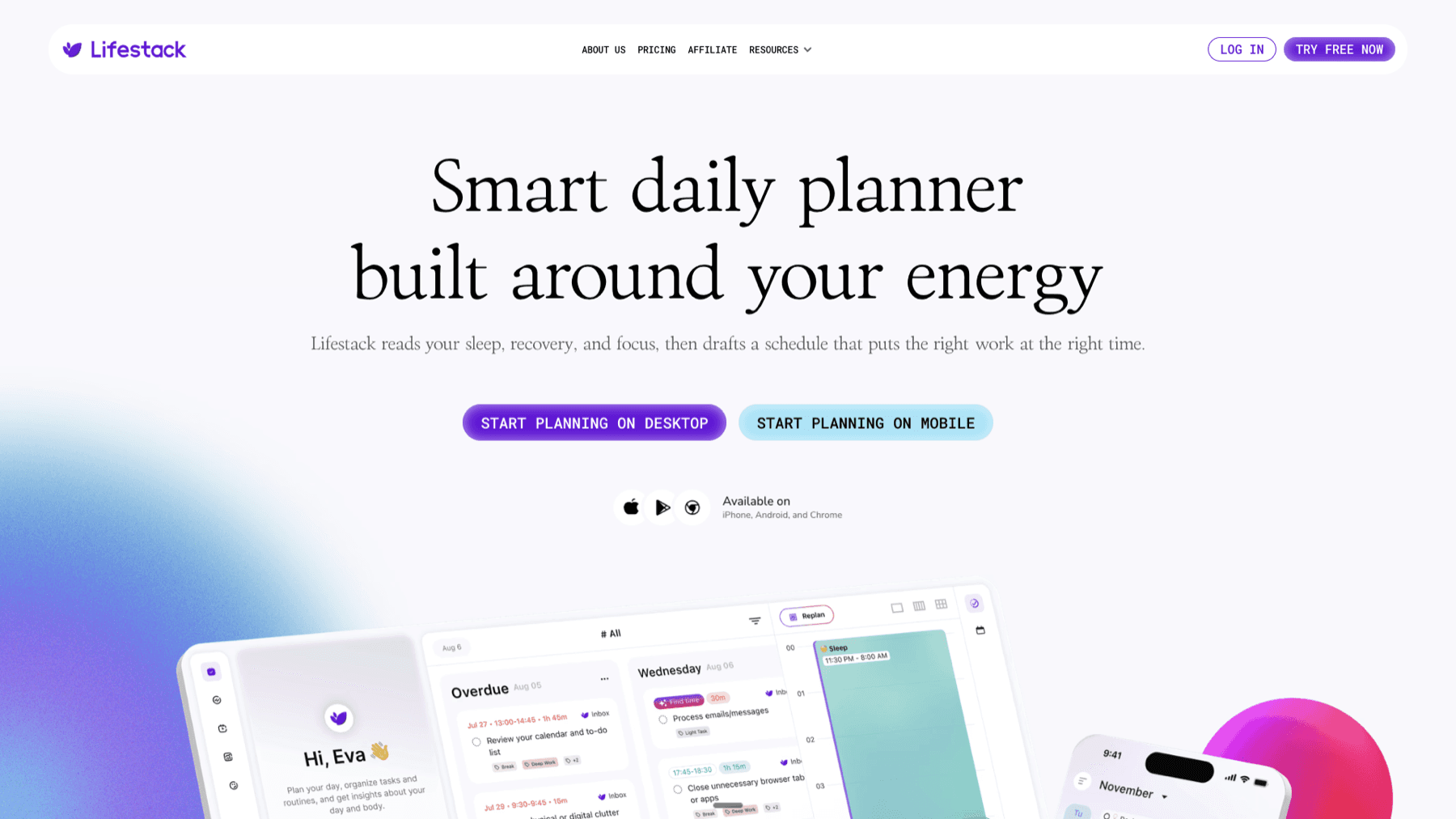
This matters for the long-term habit too. If your website blocker fires at 9am but you're still drinking coffee and not really in work mode until 10, the block is protecting time you weren't using well anyway. Lifestack's schedule tells you when you're actually likely to focus, so the block can be narrow and precise rather than broad and frustrating. Lifestack costs $7 per month or $50 per year, with a 7-day free trial. Pair it with an understanding of how to plan effectively to get the full benefit of protecting your best hours.
Frequently Asked Questions
What is the best website blocker for focus?
Freedom is the most versatile for most people: it works across all devices, supports scheduled sessions, and has adjustable strictness. Cold Turkey is the best choice for people who regularly bypass softer blockers. For free and Chrome-only use, StayFocusd is the right starting point.
Do website blockers actually help with focus?
Yes. The research on willpower depletion shows that removing the choice is more effective than trying to resist it. Website blockers work by making distraction unavailable rather than by making you more disciplined. Removing the option is always more reliable than strengthening the resistance to it.
Can website blockers be bypassed?
It depends on the tool. Browser extensions like StayFocusd can be bypassed by switching browsers. App-level blockers like Freedom can usually be overridden by ending the session (unless locked mode is active). System-level blockers like Cold Turkey in Frozen Turkey mode genuinely cannot be bypassed during the session period. For most people, Freedom with an occasional locked session is the right balance.
How do I block websites on my phone for focus?
Freedom's mobile app syncs with the desktop app. iOS Screen Time and Android's Digital Wellbeing offer built-in blocking at the device level. Setting up phone blocking alongside desktop blocking is important because switching from laptop to phone is the most common way people route around desktop-only blockers.
Should I block all social media or just specific sites?
Start with the two or three specific sites that consume the most of your unplanned attention. Blocking everything often creates friction that makes you resent the blocker rather than the distraction. If a narrow block works well, you can expand it. If you find yourself working around the narrow block, expand it to include the entire category.
Willpower isn't a great defense against a well-designed social media feed. The apps that pull you away from work are built by teams whose entire job is to make you click. A website blocker for focus solves this by removing the choice entirely.
Instead of trying to resist a tab switch, a good blocker makes it technically impossible. You open Reddit out of habit and the tab redirects. The distraction attempt fails before willpower even has to show up. Over time, the habit weakens because the reward loop gets interrupted consistently.
This guide covers how website blockers for focus actually work, which tools are worth using, how to configure them for your situation, and how to pair blocking with a schedule that puts your best work in your best hours. Most people use only half of this system and wonder why they still get distracted at the wrong times.
Key Takeaways
Website blockers work by eliminating the choice to visit distracting sites during designated focus windows. No willpower required once the blocker is active.
The strictness level matters. Blockers with easy overrides train you that the block isn't real. Strict blockers like Cold Turkey create genuine friction.
Blocking works best as part of a system: scheduled focus windows, an environment managed for low distraction, and tasks matched to energy level.
How Website Blockers for Focus Work
Most website blockers for focus operate at one of two levels: the browser or the operating system. Browser extensions like StayFocusd block sites within that browser only. System-level blockers like Freedom or Cold Turkey modify your device's DNS or hosts file, which means the block works across all browsers, apps, and even Slack or other platforms that load web content.
System-level blocking is significantly more effective for people who struggle with distractions at work. A browser extension is easy to bypass by switching to a different browser. A system-level block requires actively reversing a setting you chose to protect yourself from doing that.
Some blockers add scheduling intelligence on top: they automatically activate during hours you specify, sync with your calendar to block during meetings or focus sessions, or track how often you attempt to visit blocked sites and show you the data. The tracking layer is often as valuable as the blocking itself.
The Main Website Blocker Tools for Focus
Freedom
Freedom is the most widely used cross-platform blocker. It works on Mac, Windows, iOS, and Android simultaneously, which matters because a desktop block is meaningless if you pick up your phone. Freedom supports recurring scheduled sessions, custom blocklists, and "locked mode" sessions that can't be cancelled once started. The mobile app syncs with the desktop app automatically.
Cold Turkey
Cold Turkey (Mac and Windows) is the strictest option available. Once a session starts in Frozen Turkey mode, it cannot be ended until the timer expires. Not by restarting, not by administrator accounts, not by anything accessible to a normal user. This level of commitment is either exactly what you need or more than you want.
For people who find themselves regularly overriding softer blockers, Cold Turkey is the tool that makes override impossible. The difficulty staying focused often comes from a blocker with too easy an exit.
RescueTime
RescueTime approaches the problem differently. It tracks exactly how you spend your time across applications and websites, then lets you set focus sessions that block your designated distracting sites. The tracking layer is what makes it distinct: you see which sites cost you the most time, which helps you build a blocker list based on evidence rather than assumption.
Forest
Forest takes a gamified approach. Set a timer, and a virtual tree grows during your focus session. Leave the app, and the tree dies. Over time you build a forest that represents your accumulated focus time. The visual feedback loop works well for people who need something more engaging than a plain block screen. It's one of the more popular ADHD productivity tools because the visual reward mechanism is well-suited to ADHD brains.
StayFocusd (Chrome, free)
StayFocusd is the free option. It's a Chrome extension that limits the total time you can spend on specified sites per day. Once you hit the limit, those sites are blocked for the rest of the day. It's not system-level, so it only works in Chrome, but it's the right tool for someone who spends most of their web time in one browser and wants a free starting point.
How to Set Up a Website Blocker Effectively
The setup matters as much as the tool. These are the configurations that make the difference between a blocker that helps and one that you route around within a week.
Build your blocklist based on what actually pulls you away. Most people know their three or four main digital distractors. For some it's social media. For others it's news, YouTube, or shopping. Be specific. Blocking all of Reddit when you only lose time on r/productivity is more friction than needed. Start narrow and expand.
Set scheduled sessions rather than relying on manual activation. A blocker you have to turn on is a blocker you'll skip on hard days. Most tools allow recurring sessions. Set them to match your scheduled focus blocks: the same hours every workday, automatically.
Use locked mode or strict settings for your most important work. Easy-override blockers train you that the block isn't real. For your two or three most critical focus hours, use the strictest setting available. Save the softer settings for lower-stakes periods where you're doing work that benefits from occasional reference material.
Pair blocking with the other elements of a focus environment. A website blocker handles screen-based distractions. Notification silencing, a clear desk, and background sound management handle the rest. These work together. The combination of environment changes produces better desktop productivity results than any single fix. Consider combining with a focus music routine for the audio layer.
Pairing a Website Blocker with Energy-Aware Scheduling
The most common website blocking mistake is treating all hours as equal. Blocking distracting sites from 9am to 5pm regardless of what's happening in your body and brain is a blunt instrument. You don't need a strict block during low-energy work that doesn't require deep focus. And a strict block during your actual peak hours, combined with hard tasks, produces exponentially better results than blocking alone.
Lifestack reads your energy levels from Apple Health or Oura and builds a daily schedule that places your demanding, deep-focus tasks during the hours when your brain is actually capable of them. When you know your 9-11am window is your peak, you can set your Freedom or Cold Turkey block to cover exactly those hours and use them for your hardest work. Outside that window, the blocker can be lighter because the tasks don't require the same depth of focus.
This matters for the long-term habit too. If your website blocker fires at 9am but you're still drinking coffee and not really in work mode until 10, the block is protecting time you weren't using well anyway. Lifestack's schedule tells you when you're actually likely to focus, so the block can be narrow and precise rather than broad and frustrating. Lifestack costs $7 per month or $50 per year, with a 7-day free trial. Pair it with an understanding of how to plan effectively to get the full benefit of protecting your best hours.
Frequently Asked Questions
What is the best website blocker for focus?
Freedom is the most versatile for most people: it works across all devices, supports scheduled sessions, and has adjustable strictness. Cold Turkey is the best choice for people who regularly bypass softer blockers. For free and Chrome-only use, StayFocusd is the right starting point.
Do website blockers actually help with focus?
Yes. The research on willpower depletion shows that removing the choice is more effective than trying to resist it. Website blockers work by making distraction unavailable rather than by making you more disciplined. Removing the option is always more reliable than strengthening the resistance to it.
Can website blockers be bypassed?
It depends on the tool. Browser extensions like StayFocusd can be bypassed by switching browsers. App-level blockers like Freedom can usually be overridden by ending the session (unless locked mode is active). System-level blockers like Cold Turkey in Frozen Turkey mode genuinely cannot be bypassed during the session period. For most people, Freedom with an occasional locked session is the right balance.
How do I block websites on my phone for focus?
Freedom's mobile app syncs with the desktop app. iOS Screen Time and Android's Digital Wellbeing offer built-in blocking at the device level. Setting up phone blocking alongside desktop blocking is important because switching from laptop to phone is the most common way people route around desktop-only blockers.
Should I block all social media or just specific sites?
Start with the two or three specific sites that consume the most of your unplanned attention. Blocking everything often creates friction that makes you resent the blocker rather than the distraction. If a narrow block works well, you can expand it. If you find yourself working around the narrow block, expand it to include the entire category.



FOLLOW ON
FOLLOW ON
FOLLOW ON


Copyright 2026 © Lifestack. All rights reserved
Copyright 2026 © Lifestack. All rights reserved

