
Book
Wherever You Go There You Are by Jon Kabat-Zinn
Wherever You Go There You Are by Jon Kabat-Zinn

Most mindfulness books tell you to slow down. This one asks whether you ever actually arrived in the first place. Wherever You Go, There You Are by Jon Kabat-Zinn was published in 1994 and has sold millions of copies across dozens of languages, which is remarkable for a book that contains almost no instructions and no app to download. It's about one thing: paying attention to where you already are.
Kabat-Zinn is the researcher who introduced mindfulness-based stress reduction (MBSR) to Western medicine at the University of Massachusetts Medical School. He didn't invent mindfulness, but he did strip it of its religious framing and make it accessible to people who would never sit in a monastery. This book is the distillation of that work for everyday life.
If you've read about mindfulness and never quite understood what the fuss was about, this book usually explains it. If you've tried to meditate and given up, this one won't make you feel bad about that either.
Key Takeaways
Mindfulness is not a technique. It's a way of being present with whatever is happening, without trying to change it or judge it.
The mind's tendency to wander into the past or future is normal. Noticing that wandering, without criticism, is the practice.
You don't need long formal meditation sessions. Everyday moments (washing dishes, waiting in line, taking a breath before answering an email) are all opportunities to practice.
What the Book Is About
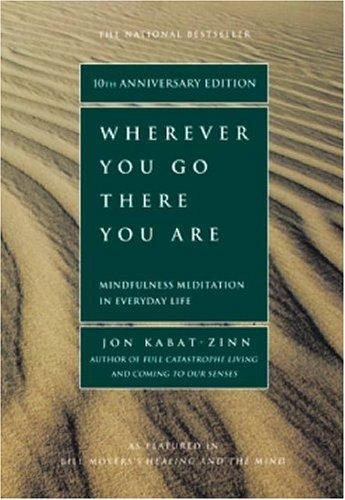
The title is the thesis. Wherever you go, there you are. You can't outrun your own mind by staying busy, buying new things, or moving cities. At some point you have to be in a room with yourself, and how that goes depends on what you've been doing with your attention.
The book is organized into short chapters, most between two and five pages. Kabat-Zinn writes about sitting meditation, walking meditation, and the moment-to-moment texture of ordinary life. He's not asking you to add a new practice to your schedule so much as change how you relate to whatever is already on your schedule.
The writing is warm and unhurried. It doesn't push. Many readers describe it as the kind of book you read a few pages of before bed, not the kind you race through.
Core Ideas from the Book
Being versus doing
Most of daily life runs on "doing mode": task to task, problem to problem, producing outputs, optimizing. This mode is useful and necessary. But when you're always doing, you stop experiencing. Kabat-Zinn distinguishes this from "being mode," where you're present with what's happening without immediately needing to fix or change it.
This isn't a call to be unproductive. It's a recognition that relentless doing without pauses for being produces anxiety, shallow decision-making, and a vague sense that your life is passing by. The two modes need each other.
The wandering mind
Research since Kabat-Zinn first wrote this book has confirmed what he observed clinically: the human mind is off-task roughly 47% of the time, according to Harvard studies on mind-wandering. Most people don't notice this. They just feel scattered or vaguely dissatisfied without knowing why.
The practice Kabat-Zinn describes is simple: notice when your mind has wandered, and return your attention to the present moment, usually through the breath. You do this without harsh self-judgment, because the judgment is another form of distraction. The returning is the practice, not the sustaining.
Non-striving
This is the concept that trips most goal-oriented readers. Kabat-Zinn argues that meditation has no goal. You're not trying to become calmer, more focused, or more enlightened. The moment you sit down to meditate "in order to relax," you've introduced striving, which is the opposite of presence.
In practice, this means accepting whatever shows up during a meditation session: restlessness, boredom, a busy mind, physical discomfort. None of these are problems to solve. They're just what's happening, and observing them without needing them to be different is the whole point.
Informal practice
One of the book's most useful contributions is the idea of informal mindfulness practice. You don't need a meditation cushion or a dedicated 20-minute block. You can brush your teeth mindfully, eat lunch without your phone, or take three conscious breaths before a difficult meeting.
These micro-practices don't replace deeper formal practice, but they create the texture of mindfulness in daily life. They're also far more sustainable than ambitious morning routines that collapse after two weeks. For people who want better mental clarity without overhauling their schedule, this framing is genuinely helpful.
Acceptance is not passivity
A common misread of mindfulness is that accepting the present moment means accepting everything in your life as it is. Kabat-Zinn is careful to address this. Acceptance in his framework means acknowledging reality clearly, not giving up. You can't change a situation you can't see accurately. Presence is what makes clear-eyed action possible.
This is one of the most practically relevant ideas in the book for people dealing with work stress, ADHD and stress, or the kind of low-grade overwhelm that makes everything feel stuck.
Who Should Read This Book
This book works best for people who:
Feel perpetually behind and anxious even when things are objectively fine
Have tried meditation apps and found them shallow or gamified
Want to understand what mindfulness actually is before committing to a practice
Are dealing with chronic stress and want a clinically grounded starting point
It's less useful for people looking for structured, step-by-step instructions. Kabat-Zinn deliberately avoids prescriptive programming. If you want a 28-day plan with exercises, this isn't that book. For a more structured approach to mindfulness in a productivity context, see our post on mindfulness for remote productivity.
How to Apply the Book's Ideas in Daily Life
The gap between reading about mindfulness and actually being more present is significant. Here are a few concrete entry points that follow from Kabat-Zinn's approach:
Start with one daily anchor
Pick one recurring daily event and commit to being fully present during it. Morning coffee, the commute, lunch. Not every part of your day, just one. The practice of returning your attention to that one anchor is the whole exercise.
Notice transitions
The moments between tasks (finishing a call, switching from email to writing, leaving a meeting) are often where the mind snags on the past or races ahead. Kabat-Zinn suggests using these transitions as natural reset points: a few conscious breaths, a moment of noticing where you are and what you're doing, before moving on.
Schedule with energy in mind, not just time
One pattern Kabat-Zinn returns to is the mismatch between what we're doing and what our body and mind are actually capable of at that moment. We schedule meetings at 3pm and then wonder why nothing gets resolved. This is where tools like Lifestack connect directly to the book's ideas. Lifestack auto-schedules tasks based on your energy levels throughout the day, so your hardest work lands when your attention is sharpest. That's applied mindfulness in a scheduling context. See how energy-based scheduling works and how it compares to conventional time blocking via our post on why energy-based planning beats time blocking.
Read the book slowly
One page at a time, maybe in the morning. The chapters are short enough that rushing through them defeats the purpose. Kabat-Zinn writes in a way that only works if you let it settle. Treating the reading itself as a form of practice is entirely consistent with what he argues.
How It Connects to Productivity
Mindfulness and productivity get talked about together constantly, sometimes in ways that flatten both. The "mindfulness makes you more productive" framing misses what Kabat-Zinn is after. He's not selling you presence as a performance enhancer. He's suggesting that a life lived without presence isn't fully lived, regardless of how much you get done.
That said, the effects of regular mindfulness practice on focus at work and personal energy management are well-documented. Reduced stress reactivity, better attention regulation, less time lost to rumination. These improve the quality of your work and reduce the kind of burnout that comes from running on empty for too long.
If you want to build the productivity side alongside the mindfulness practice, start with Ali Abdaal's feel-good productivity approach and the best apps for self-improvement. Both work well as complements to what Kabat-Zinn covers.
Frequently Asked Questions
What is Wherever You Go, There You Are about?
Wherever You Go, There You Are by Jon Kabat-Zinn is a guide to mindfulness in everyday life. The book argues that presence, the ability to be fully in the current moment without distraction or judgment, is both a practice and a way of being. It covers sitting meditation, walking meditation, informal mindfulness in daily routines, and the psychological concepts behind why we struggle to be present.
Is Wherever You Go, There You Are good for beginners?
Yes, it's one of the most accessible entry points into mindfulness available. Kabat-Zinn avoids religious framing and doesn't assume any prior meditation experience. The chapters are short and the prose is unhurried. Most beginners find it easier to get through than apps or structured programs, because it doesn't require you to do anything specific, just to pay attention differently.
How does this book differ from Kabat-Zinn's other work?
Full Catastrophe Living is his longer, more clinical book and covers the MBSR program in detail. Wherever You Go, There You Are is the accessible companion, written for people who want the philosophy without the program structure. The two books complement each other. Read this one first.
How long does it take to read?
The book is around 280 pages of short chapters. Most people finish it in 4-6 hours of reading time, though Kabat-Zinn himself would probably suggest you take longer. Reading one chapter per day over a month and actually sitting with the ideas is closer to what the book is designed for.
Does mindfulness actually improve productivity?
Research consistently shows that regular mindfulness practice improves attention regulation, reduces stress-related cognitive load, and helps with emotional regulation at work. These have real downstream effects on the quality of focused work. Combining mindfulness practice with tools that respect your energy patterns (like Lifestack) creates a more sustainable approach to focus at work than willpower alone.
Is the 10th Anniversary Edition worth getting over the original?
The 10th Anniversary Edition includes a new foreword from Kabat-Zinn reflecting on how mindfulness has spread since the book's original publication. The core content is unchanged. Either edition works. The new foreword adds useful context on how the field has evolved, but it's not the reason to read the book.
Most mindfulness books tell you to slow down. This one asks whether you ever actually arrived in the first place. Wherever You Go, There You Are by Jon Kabat-Zinn was published in 1994 and has sold millions of copies across dozens of languages, which is remarkable for a book that contains almost no instructions and no app to download. It's about one thing: paying attention to where you already are.
Kabat-Zinn is the researcher who introduced mindfulness-based stress reduction (MBSR) to Western medicine at the University of Massachusetts Medical School. He didn't invent mindfulness, but he did strip it of its religious framing and make it accessible to people who would never sit in a monastery. This book is the distillation of that work for everyday life.
If you've read about mindfulness and never quite understood what the fuss was about, this book usually explains it. If you've tried to meditate and given up, this one won't make you feel bad about that either.
Key Takeaways
Mindfulness is not a technique. It's a way of being present with whatever is happening, without trying to change it or judge it.
The mind's tendency to wander into the past or future is normal. Noticing that wandering, without criticism, is the practice.
You don't need long formal meditation sessions. Everyday moments (washing dishes, waiting in line, taking a breath before answering an email) are all opportunities to practice.
What the Book Is About
The title is the thesis. Wherever you go, there you are. You can't outrun your own mind by staying busy, buying new things, or moving cities. At some point you have to be in a room with yourself, and how that goes depends on what you've been doing with your attention.
The book is organized into short chapters, most between two and five pages. Kabat-Zinn writes about sitting meditation, walking meditation, and the moment-to-moment texture of ordinary life. He's not asking you to add a new practice to your schedule so much as change how you relate to whatever is already on your schedule.
The writing is warm and unhurried. It doesn't push. Many readers describe it as the kind of book you read a few pages of before bed, not the kind you race through.
Core Ideas from the Book
Being versus doing
Most of daily life runs on "doing mode": task to task, problem to problem, producing outputs, optimizing. This mode is useful and necessary. But when you're always doing, you stop experiencing. Kabat-Zinn distinguishes this from "being mode," where you're present with what's happening without immediately needing to fix or change it.
This isn't a call to be unproductive. It's a recognition that relentless doing without pauses for being produces anxiety, shallow decision-making, and a vague sense that your life is passing by. The two modes need each other.
The wandering mind
Research since Kabat-Zinn first wrote this book has confirmed what he observed clinically: the human mind is off-task roughly 47% of the time, according to Harvard studies on mind-wandering. Most people don't notice this. They just feel scattered or vaguely dissatisfied without knowing why.
The practice Kabat-Zinn describes is simple: notice when your mind has wandered, and return your attention to the present moment, usually through the breath. You do this without harsh self-judgment, because the judgment is another form of distraction. The returning is the practice, not the sustaining.
Non-striving
This is the concept that trips most goal-oriented readers. Kabat-Zinn argues that meditation has no goal. You're not trying to become calmer, more focused, or more enlightened. The moment you sit down to meditate "in order to relax," you've introduced striving, which is the opposite of presence.
In practice, this means accepting whatever shows up during a meditation session: restlessness, boredom, a busy mind, physical discomfort. None of these are problems to solve. They're just what's happening, and observing them without needing them to be different is the whole point.
Informal practice
One of the book's most useful contributions is the idea of informal mindfulness practice. You don't need a meditation cushion or a dedicated 20-minute block. You can brush your teeth mindfully, eat lunch without your phone, or take three conscious breaths before a difficult meeting.
These micro-practices don't replace deeper formal practice, but they create the texture of mindfulness in daily life. They're also far more sustainable than ambitious morning routines that collapse after two weeks. For people who want better mental clarity without overhauling their schedule, this framing is genuinely helpful.
Acceptance is not passivity
A common misread of mindfulness is that accepting the present moment means accepting everything in your life as it is. Kabat-Zinn is careful to address this. Acceptance in his framework means acknowledging reality clearly, not giving up. You can't change a situation you can't see accurately. Presence is what makes clear-eyed action possible.
This is one of the most practically relevant ideas in the book for people dealing with work stress, ADHD and stress, or the kind of low-grade overwhelm that makes everything feel stuck.
Who Should Read This Book
This book works best for people who:
Feel perpetually behind and anxious even when things are objectively fine
Have tried meditation apps and found them shallow or gamified
Want to understand what mindfulness actually is before committing to a practice
Are dealing with chronic stress and want a clinically grounded starting point
It's less useful for people looking for structured, step-by-step instructions. Kabat-Zinn deliberately avoids prescriptive programming. If you want a 28-day plan with exercises, this isn't that book. For a more structured approach to mindfulness in a productivity context, see our post on mindfulness for remote productivity.
How to Apply the Book's Ideas in Daily Life
The gap between reading about mindfulness and actually being more present is significant. Here are a few concrete entry points that follow from Kabat-Zinn's approach:
Start with one daily anchor
Pick one recurring daily event and commit to being fully present during it. Morning coffee, the commute, lunch. Not every part of your day, just one. The practice of returning your attention to that one anchor is the whole exercise.
Notice transitions
The moments between tasks (finishing a call, switching from email to writing, leaving a meeting) are often where the mind snags on the past or races ahead. Kabat-Zinn suggests using these transitions as natural reset points: a few conscious breaths, a moment of noticing where you are and what you're doing, before moving on.
Schedule with energy in mind, not just time
One pattern Kabat-Zinn returns to is the mismatch between what we're doing and what our body and mind are actually capable of at that moment. We schedule meetings at 3pm and then wonder why nothing gets resolved. This is where tools like Lifestack connect directly to the book's ideas. Lifestack auto-schedules tasks based on your energy levels throughout the day, so your hardest work lands when your attention is sharpest. That's applied mindfulness in a scheduling context. See how energy-based scheduling works and how it compares to conventional time blocking via our post on why energy-based planning beats time blocking.
Read the book slowly
One page at a time, maybe in the morning. The chapters are short enough that rushing through them defeats the purpose. Kabat-Zinn writes in a way that only works if you let it settle. Treating the reading itself as a form of practice is entirely consistent with what he argues.
How It Connects to Productivity
Mindfulness and productivity get talked about together constantly, sometimes in ways that flatten both. The "mindfulness makes you more productive" framing misses what Kabat-Zinn is after. He's not selling you presence as a performance enhancer. He's suggesting that a life lived without presence isn't fully lived, regardless of how much you get done.
That said, the effects of regular mindfulness practice on focus at work and personal energy management are well-documented. Reduced stress reactivity, better attention regulation, less time lost to rumination. These improve the quality of your work and reduce the kind of burnout that comes from running on empty for too long.
If you want to build the productivity side alongside the mindfulness practice, start with Ali Abdaal's feel-good productivity approach and the best apps for self-improvement. Both work well as complements to what Kabat-Zinn covers.
Frequently Asked Questions
What is Wherever You Go, There You Are about?
Wherever You Go, There You Are by Jon Kabat-Zinn is a guide to mindfulness in everyday life. The book argues that presence, the ability to be fully in the current moment without distraction or judgment, is both a practice and a way of being. It covers sitting meditation, walking meditation, informal mindfulness in daily routines, and the psychological concepts behind why we struggle to be present.
Is Wherever You Go, There You Are good for beginners?
Yes, it's one of the most accessible entry points into mindfulness available. Kabat-Zinn avoids religious framing and doesn't assume any prior meditation experience. The chapters are short and the prose is unhurried. Most beginners find it easier to get through than apps or structured programs, because it doesn't require you to do anything specific, just to pay attention differently.
How does this book differ from Kabat-Zinn's other work?
Full Catastrophe Living is his longer, more clinical book and covers the MBSR program in detail. Wherever You Go, There You Are is the accessible companion, written for people who want the philosophy without the program structure. The two books complement each other. Read this one first.
How long does it take to read?
The book is around 280 pages of short chapters. Most people finish it in 4-6 hours of reading time, though Kabat-Zinn himself would probably suggest you take longer. Reading one chapter per day over a month and actually sitting with the ideas is closer to what the book is designed for.
Does mindfulness actually improve productivity?
Research consistently shows that regular mindfulness practice improves attention regulation, reduces stress-related cognitive load, and helps with emotional regulation at work. These have real downstream effects on the quality of focused work. Combining mindfulness practice with tools that respect your energy patterns (like Lifestack) creates a more sustainable approach to focus at work than willpower alone.
Is the 10th Anniversary Edition worth getting over the original?
The 10th Anniversary Edition includes a new foreword from Kabat-Zinn reflecting on how mindfulness has spread since the book's original publication. The core content is unchanged. Either edition works. The new foreword adds useful context on how the field has evolved, but it's not the reason to read the book.



FOLLOW ON
FOLLOW ON
FOLLOW ON


Copyright 2026 © Lifestack. All rights reserved
Copyright 2026 © Lifestack. All rights reserved

