
Tips
The 54321 Method: Grounding for Anxiety
The 54321 Method: Grounding for Anxiety

Anxiety pulls your attention into the future or the past. The 54321 method does the opposite: it pulls your attention into the present moment by systematically engaging your five senses. It takes less than two minutes. It requires no equipment. And it has a reasonably solid evidence base for reducing acute anxiety in the moment.
The technique was developed as a grounding exercise, meaning its purpose is to anchor your awareness in physical, present-moment sensory experience rather than in the mental loops that anxiety creates. It is used in cognitive behavioral therapy, trauma treatment, and general stress management, which gives it a broader evidence base than most "productivity" or "wellness" techniques.
It is not a long-term anxiety treatment. It will not resolve the underlying causes of chronic stress. What it does well is interrupt the momentum of an anxious spiral quickly enough that you can return to functioning. That makes it a useful tool whether you experience occasional stress or manage significant anxiety on a daily basis.
Key Takeaways
The 54321 method grounds you by moving attention from anxious thoughts to immediate sensory input across all five senses
It works fastest when you practice it during calm moments, so the sequence is automatic when you actually need it
Pair it with a reliable daily structure to reduce the underlying accumulation of stress that makes anxiety more frequent
What Is the 54321 Method?
The 54321 method, also called the 54321 grounding technique, is a structured sensory awareness exercise. You identify five things you can see, four things you can physically feel or touch, three things you can hear, two things you can smell, and one thing you can taste.
The sequence counts down from five to one, which creates a simple structure to follow when anxious thinking makes self-direction hard. The declining count also functions as a mild cognitive task, which occupies the prefrontal cortex and reduces the capacity of the amygdala to maintain the threat-response loop.
Sensory overwhelm can trigger anxiety spikes, but sensory focus, when deliberately directed and calm, has the opposite effect. The 54321 method uses sensory attention to interrupt rather than amplify distress.
How to Do the 54321 Method
Start by taking one slow breath. This is not mandatory, but it slows the breathing rate slightly, which begins to activate the parasympathetic nervous system before the exercise starts. Then work through each sense:
5 things you can see
Look around and identify five distinct things. Name them silently or out loud. Be specific: "the corner of my laptop," "the shadow under the chair," not just "a chair." Specificity makes the attention more fully present rather than half-in-your-head. Include things you wouldn't normally notice, like the texture of a wall or the movement of light through a window.
4 things you can touch or feel
Shift attention to physical sensation. This includes things you're touching (desk surface, fabric of your clothes, the floor under your feet) and things your body is experiencing (the weight of your hands, the temperature of air on your skin, tension in your shoulders). The goal is to bring full attention to physical sensation rather than remaining in thought.
3 things you can hear
Listen for three distinct sounds. These might be distant traffic, ventilation noise, your own breathing, or the sound of someone else's movement. Sounds that you tune out during normal activity are particularly effective because noticing them requires a deliberate shift in attention. That shift is exactly what the exercise is designed to create.
2 things you can smell
Smell is handled differently in the brain than the other senses: it bypasses the thalamus and connects directly to the limbic system, which processes emotion and memory. This makes olfactory attention unusually direct in its effect on emotional state. Two smells can be subtle, and if your environment is odor-neutral, you can use this step to bring something specific close (coffee, a piece of fruit, your clothing).
1 thing you can taste
This is the final and most focused step. The single count is intentional: it completes the sequence and creates a moment of concentrated attention on one specific sensation. A sip of water, a piece of gum, or simply the ambient taste in your mouth all work. The point is full attention on one thing, completing the sensory scan.
When to Use the 54321 Method
The clearest use case is acute anxiety or panic. When anxious thoughts are accelerating and you feel yourself losing the ability to direct your attention, the 54321 sequence gives you a concrete next step that doesn't require you to think clearly. You just follow the numbers.
It is also useful during transitional moments: before a high-stakes conversation, at the start of a difficult work session, after receiving stressful news. These are moments when you need to shift cognitive states rather than interrupt a full spiral.
People with ADHD often find it useful for what's sometimes called task paralysis: the state where anxiety about starting something or choosing what to do next creates a freeze. The 54321 method doesn't solve the task, but it can interrupt the freeze by bringing the nervous system back to baseline before attempting to re-engage.
Emotional dysregulation episodes, where an emotional response feels disproportionate and hard to control, also respond well to grounding techniques. The sensory focus interrupts the escalation early enough that the prefrontal cortex can re-engage.
Why It Works: The Science
Anxiety is maintained partly by a loop between the amygdala (threat detection) and the prefrontal cortex (rational evaluation). When that loop activates, attention narrows to the perceived threat and everything else becomes background noise. Grounding interrupts this by forcibly re-routing attention to sensory input, which requires the prefrontal cortex to process new, non-threatening information.
Sensory engagement also activates the parasympathetic nervous system, which is the body's rest-and-digest mode. This is the physiological opposite of the fight-or-flight response. Any practice that increases parasympathetic activation will reduce anxiety symptoms physically, not just psychologically. The breath at the beginning of the exercise serves the same function.
Research on grounding techniques more broadly shows consistent effects on anxiety, PTSD symptom severity, and emotional regulation capacity. The 54321 method is among the more structured of these, which makes it easier to use when cognitive function is impaired by stress. Mental clarity returns faster when the nervous system de-escalates, which is what the technique facilitates.
Variations That Work in Different Contexts
The standard five-sense sequence is the most thorough version, but there are adaptations for situations where the full exercise isn't practical.
The 321 version: Three senses instead of five. Useful when you need to ground quickly without drawing attention. Name three things you see, two you hear, one you feel. Can be done silently in any public setting in under 60 seconds.
The written version: Write down each item rather than just naming it mentally. The act of writing adds a kinesthetic element and slows the process down in a way that some people find more effective. Useful for stress-related anxiety where verbal internal thought is too rapid to feel grounding.
The movement version: Between each sense step, take one slow breath and deliberately shift physical position, even slightly. The movement adds another layer of body awareness and is particularly useful for ADHD-related anxiety where stillness feels difficult.
Keeping Your Day Calm After You Ground
Grounding techniques work well in the moment. But frequent need for them often signals something structural: too many open loops, unclear priorities, a schedule that doesn't account for energy or recovery, or constant context switching.
The 54321 method can interrupt an anxious spiral. Reducing how often those spirals occur requires something more systemic. Personal energy management is one part of it: knowing when in your day you have genuine capacity and scheduling demanding work for those windows rather than fighting through at low energy. The second part is having a clear daily structure so you're not carrying your task list in your head.
Lifestack reads sleep and recovery data from wearables and builds a daily schedule around your actual energy levels rather than a fixed template. When you know exactly what's scheduled, in which order, and it reflects your real capacity, the ambient anxiety of not knowing what's next drops significantly. That's the structural complement to a technique like 54321: both address anxiety, but at different timescales.
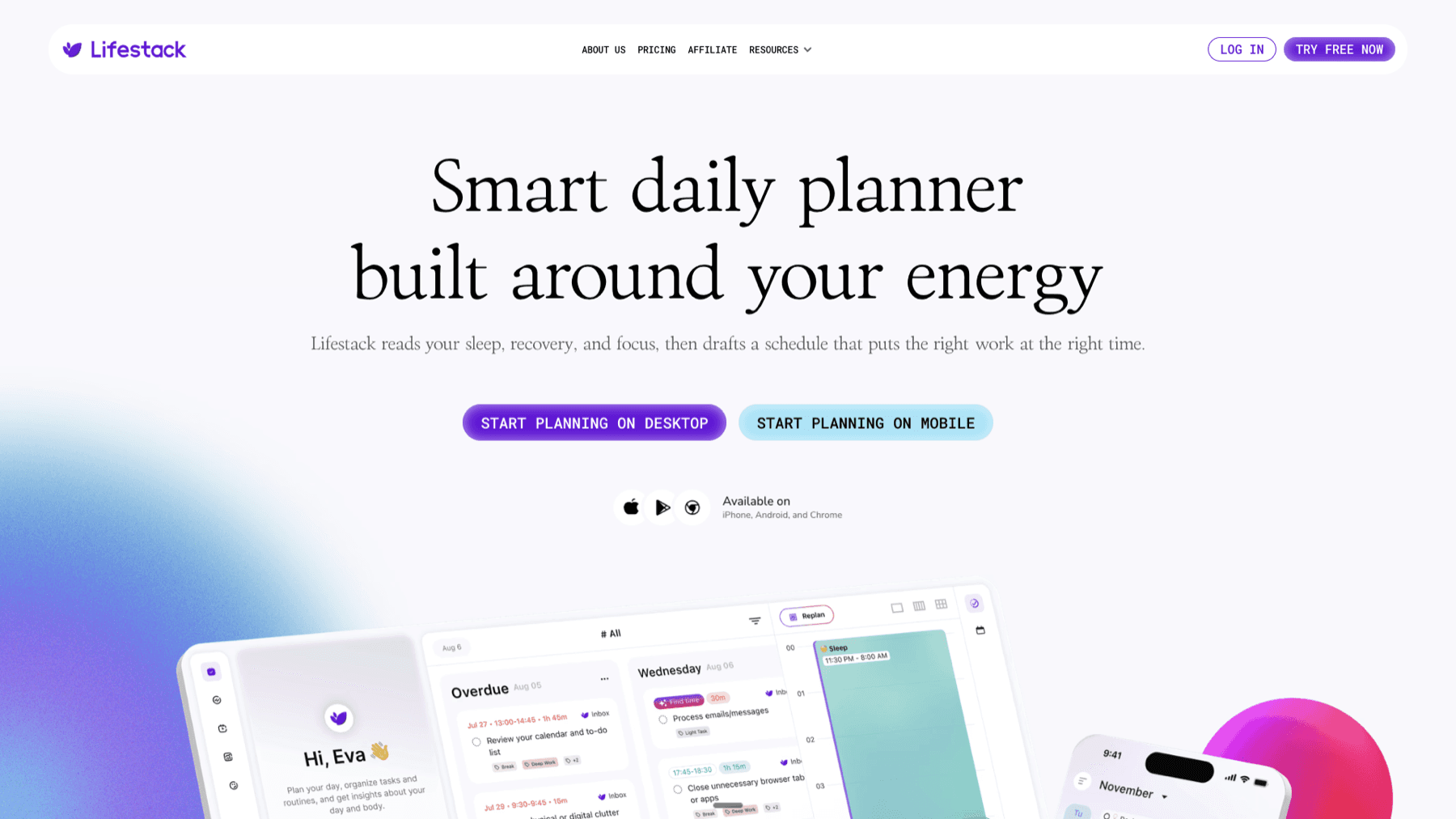
Lifestack is $7/month or $50/year with a 7-day free trial on the annual plan, available on iOS, Android, and Chrome extension.
Frequently Asked Questions
Does the 54321 method actually work for anxiety?
For acute anxiety and panic responses, yes. Grounding techniques are well supported in clinical literature for reducing the intensity and duration of anxiety episodes. The 54321 method's structured sensory sequence makes it easier to follow when anxiety is impairing clear thinking. It is not a substitute for therapy or medication for severe or chronic anxiety.
How quickly does the 54321 method work?
Most people notice a shift in arousal level within 1-2 minutes of completing the full sequence. The effect is faster with practice, because the method becomes automatic rather than effortful. Practicing it during calm moments, so the steps are familiar when you're actually anxious, improves how quickly it works under pressure.
Can you do the 54321 method in public?
Yes, and this is one of its practical advantages. The exercise is entirely internal. You can complete it during a meeting, on public transport, or before a presentation without anyone knowing. The 321 variation is especially subtle since it uses only three sensory categories.
Is the 54321 method the same as mindfulness?
They share underlying mechanisms, specifically present-moment sensory awareness, but they are different practices. Mindfulness is typically non-directive and sustained. The 54321 method is structured, quick, and designed specifically for interrupting anxiety rather than cultivating general awareness. You can think of it as targeted mindfulness for a specific cognitive state.
Who created the 54321 grounding technique?
The technique emerged from grounding practices in cognitive behavioral therapy and trauma treatment, but does not have a single credited creator. It has been widely adopted and modified by therapists and appears in stress management literature under various names. The underlying sensory-engagement principle is consistent across versions regardless of specific attribution.
Can the 54321 method help with ADHD?
Yes, particularly for anxiety, decision paralysis, and emotional regulation challenges that often accompany ADHD. The structured counting element can be especially helpful because it provides external scaffolding when internal self-direction is difficult. Many people with ADHD find grounding techniques more accessible than open-ended mindfulness practices for exactly this reason.
Anxiety pulls your attention into the future or the past. The 54321 method does the opposite: it pulls your attention into the present moment by systematically engaging your five senses. It takes less than two minutes. It requires no equipment. And it has a reasonably solid evidence base for reducing acute anxiety in the moment.
The technique was developed as a grounding exercise, meaning its purpose is to anchor your awareness in physical, present-moment sensory experience rather than in the mental loops that anxiety creates. It is used in cognitive behavioral therapy, trauma treatment, and general stress management, which gives it a broader evidence base than most "productivity" or "wellness" techniques.
It is not a long-term anxiety treatment. It will not resolve the underlying causes of chronic stress. What it does well is interrupt the momentum of an anxious spiral quickly enough that you can return to functioning. That makes it a useful tool whether you experience occasional stress or manage significant anxiety on a daily basis.
Key Takeaways
The 54321 method grounds you by moving attention from anxious thoughts to immediate sensory input across all five senses
It works fastest when you practice it during calm moments, so the sequence is automatic when you actually need it
Pair it with a reliable daily structure to reduce the underlying accumulation of stress that makes anxiety more frequent
What Is the 54321 Method?
The 54321 method, also called the 54321 grounding technique, is a structured sensory awareness exercise. You identify five things you can see, four things you can physically feel or touch, three things you can hear, two things you can smell, and one thing you can taste.
The sequence counts down from five to one, which creates a simple structure to follow when anxious thinking makes self-direction hard. The declining count also functions as a mild cognitive task, which occupies the prefrontal cortex and reduces the capacity of the amygdala to maintain the threat-response loop.
Sensory overwhelm can trigger anxiety spikes, but sensory focus, when deliberately directed and calm, has the opposite effect. The 54321 method uses sensory attention to interrupt rather than amplify distress.
How to Do the 54321 Method
Start by taking one slow breath. This is not mandatory, but it slows the breathing rate slightly, which begins to activate the parasympathetic nervous system before the exercise starts. Then work through each sense:
5 things you can see
Look around and identify five distinct things. Name them silently or out loud. Be specific: "the corner of my laptop," "the shadow under the chair," not just "a chair." Specificity makes the attention more fully present rather than half-in-your-head. Include things you wouldn't normally notice, like the texture of a wall or the movement of light through a window.
4 things you can touch or feel
Shift attention to physical sensation. This includes things you're touching (desk surface, fabric of your clothes, the floor under your feet) and things your body is experiencing (the weight of your hands, the temperature of air on your skin, tension in your shoulders). The goal is to bring full attention to physical sensation rather than remaining in thought.
3 things you can hear
Listen for three distinct sounds. These might be distant traffic, ventilation noise, your own breathing, or the sound of someone else's movement. Sounds that you tune out during normal activity are particularly effective because noticing them requires a deliberate shift in attention. That shift is exactly what the exercise is designed to create.
2 things you can smell
Smell is handled differently in the brain than the other senses: it bypasses the thalamus and connects directly to the limbic system, which processes emotion and memory. This makes olfactory attention unusually direct in its effect on emotional state. Two smells can be subtle, and if your environment is odor-neutral, you can use this step to bring something specific close (coffee, a piece of fruit, your clothing).
1 thing you can taste
This is the final and most focused step. The single count is intentional: it completes the sequence and creates a moment of concentrated attention on one specific sensation. A sip of water, a piece of gum, or simply the ambient taste in your mouth all work. The point is full attention on one thing, completing the sensory scan.
When to Use the 54321 Method
The clearest use case is acute anxiety or panic. When anxious thoughts are accelerating and you feel yourself losing the ability to direct your attention, the 54321 sequence gives you a concrete next step that doesn't require you to think clearly. You just follow the numbers.
It is also useful during transitional moments: before a high-stakes conversation, at the start of a difficult work session, after receiving stressful news. These are moments when you need to shift cognitive states rather than interrupt a full spiral.
People with ADHD often find it useful for what's sometimes called task paralysis: the state where anxiety about starting something or choosing what to do next creates a freeze. The 54321 method doesn't solve the task, but it can interrupt the freeze by bringing the nervous system back to baseline before attempting to re-engage.
Emotional dysregulation episodes, where an emotional response feels disproportionate and hard to control, also respond well to grounding techniques. The sensory focus interrupts the escalation early enough that the prefrontal cortex can re-engage.
Why It Works: The Science
Anxiety is maintained partly by a loop between the amygdala (threat detection) and the prefrontal cortex (rational evaluation). When that loop activates, attention narrows to the perceived threat and everything else becomes background noise. Grounding interrupts this by forcibly re-routing attention to sensory input, which requires the prefrontal cortex to process new, non-threatening information.
Sensory engagement also activates the parasympathetic nervous system, which is the body's rest-and-digest mode. This is the physiological opposite of the fight-or-flight response. Any practice that increases parasympathetic activation will reduce anxiety symptoms physically, not just psychologically. The breath at the beginning of the exercise serves the same function.
Research on grounding techniques more broadly shows consistent effects on anxiety, PTSD symptom severity, and emotional regulation capacity. The 54321 method is among the more structured of these, which makes it easier to use when cognitive function is impaired by stress. Mental clarity returns faster when the nervous system de-escalates, which is what the technique facilitates.
Variations That Work in Different Contexts
The standard five-sense sequence is the most thorough version, but there are adaptations for situations where the full exercise isn't practical.
The 321 version: Three senses instead of five. Useful when you need to ground quickly without drawing attention. Name three things you see, two you hear, one you feel. Can be done silently in any public setting in under 60 seconds.
The written version: Write down each item rather than just naming it mentally. The act of writing adds a kinesthetic element and slows the process down in a way that some people find more effective. Useful for stress-related anxiety where verbal internal thought is too rapid to feel grounding.
The movement version: Between each sense step, take one slow breath and deliberately shift physical position, even slightly. The movement adds another layer of body awareness and is particularly useful for ADHD-related anxiety where stillness feels difficult.
Keeping Your Day Calm After You Ground
Grounding techniques work well in the moment. But frequent need for them often signals something structural: too many open loops, unclear priorities, a schedule that doesn't account for energy or recovery, or constant context switching.
The 54321 method can interrupt an anxious spiral. Reducing how often those spirals occur requires something more systemic. Personal energy management is one part of it: knowing when in your day you have genuine capacity and scheduling demanding work for those windows rather than fighting through at low energy. The second part is having a clear daily structure so you're not carrying your task list in your head.
Lifestack reads sleep and recovery data from wearables and builds a daily schedule around your actual energy levels rather than a fixed template. When you know exactly what's scheduled, in which order, and it reflects your real capacity, the ambient anxiety of not knowing what's next drops significantly. That's the structural complement to a technique like 54321: both address anxiety, but at different timescales.
Lifestack is $7/month or $50/year with a 7-day free trial on the annual plan, available on iOS, Android, and Chrome extension.
Frequently Asked Questions
Does the 54321 method actually work for anxiety?
For acute anxiety and panic responses, yes. Grounding techniques are well supported in clinical literature for reducing the intensity and duration of anxiety episodes. The 54321 method's structured sensory sequence makes it easier to follow when anxiety is impairing clear thinking. It is not a substitute for therapy or medication for severe or chronic anxiety.
How quickly does the 54321 method work?
Most people notice a shift in arousal level within 1-2 minutes of completing the full sequence. The effect is faster with practice, because the method becomes automatic rather than effortful. Practicing it during calm moments, so the steps are familiar when you're actually anxious, improves how quickly it works under pressure.
Can you do the 54321 method in public?
Yes, and this is one of its practical advantages. The exercise is entirely internal. You can complete it during a meeting, on public transport, or before a presentation without anyone knowing. The 321 variation is especially subtle since it uses only three sensory categories.
Is the 54321 method the same as mindfulness?
They share underlying mechanisms, specifically present-moment sensory awareness, but they are different practices. Mindfulness is typically non-directive and sustained. The 54321 method is structured, quick, and designed specifically for interrupting anxiety rather than cultivating general awareness. You can think of it as targeted mindfulness for a specific cognitive state.
Who created the 54321 grounding technique?
The technique emerged from grounding practices in cognitive behavioral therapy and trauma treatment, but does not have a single credited creator. It has been widely adopted and modified by therapists and appears in stress management literature under various names. The underlying sensory-engagement principle is consistent across versions regardless of specific attribution.
Can the 54321 method help with ADHD?
Yes, particularly for anxiety, decision paralysis, and emotional regulation challenges that often accompany ADHD. The structured counting element can be especially helpful because it provides external scaffolding when internal self-direction is difficult. Many people with ADHD find grounding techniques more accessible than open-ended mindfulness practices for exactly this reason.



FOLLOW ON
FOLLOW ON
FOLLOW ON


Copyright 2026 © Lifestack. All rights reserved
Copyright 2026 © Lifestack. All rights reserved

