
Device
Amazfit Balance 2 Review: Battery, Diving & Value
Amazfit Balance 2 Review: Battery, Diving & Value

The Amazfit Balance 2 launched in mid-2025 at $299.99 and immediately drew attention for offering specs that typically cost $100-$150 more from other brands: a sapphire-covered AMOLED display, dual-frequency GPS, 21-day battery life, and a recreational diving mode that supports dives up to 45 meters. For fitness-focused buyers who want capable hardware without paying premium brand prices, this is the watch that repeatedly comes up.
This review covers the hardware, fitness tracking performance, sleep data, and who the Balance 2 is actually well-suited for in 2026.
Key Takeaways
21-day rated battery life (real-world testing lands around 15 days with active tracking and GPS logging)
Circular 1.5-inch AMOLED display with sapphire glass, up to 2,000 nits, and 323 PPI at $299.99
Recreational scuba diving mode supports dives to 45m, which is exceptional at this price point
Design and Build Quality
The Balance 2 uses a circular 1.5-inch AMOLED display with 480x480 resolution and 323 pixels per inch. The display is covered by sapphire glass rather than the Gorilla Glass found on most watches in this price range. Peak brightness at 2,000 nits means it reads well in direct sunlight, and at 43 grams with the silicone strap it sits comfortably for all-day wear.
The case is aluminum alloy with a fiber-reinforced polymer back, and the 22mm standard lug width allows third-party strap compatibility. Water resistance is rated at 10 ATM, backing up the dive mode claims.
Fitness Tracking and GPS
The BioTracker 6 PPG sensor tracks heart rate, SpO2, blood pressure, body temperature, and altitude. It is the same sensor used in the Amazfit T-Rex 3 Pro. Heart rate accuracy in reviewers' testing has been consistently described as reliable at moderate and high intensity, with some drift during very intense interval training.
GPS uses dual-band L1+L5 across six satellite systems with a circularly polarized antenna. Dual-band GPS is a meaningful accuracy upgrade over single-band systems, particularly in urban canyons, dense forests, and mountainous terrain where signal reflections skew single-band positioning. The Balance 2 delivers track accuracy that outperforms what you would typically expect at $299.
Over 170 sport modes cover the expected running, cycling, swimming, and gym categories, plus less common ones like hiking, rucking, and recreational diving. The dive mode logs depth, dive time, water temperature, and decompression data up to 45 meters. For a sub-$300 watch to offer a legitimate dive mode is genuinely unusual. Compare its fitness feature set to our Amazfit T-Rex 3 review to see how the rugged and balanced options differ.
Sleep and Recovery Tracking
Sleep tracking on the Balance 2 records duration, sleep stages (light, deep, REM), and a sleep quality score. HRV-based readiness is tracked overnight and displayed as a recovery indicator in the Zepp app. Reviewers have found the sleep duration accuracy solid, with stage classification performing at the typical level for consumer wrist-based optical sensors: useful for trend analysis and less reliable for precise single-night stage counts.
The readiness indicator is less detailed than what you get from WHOOP or Garmin Body Battery, but it is sufficient to give you a morning read on whether to push or hold back. For a deeper comparison with other sleep trackers, see our best sleep trackers of 2026 guide.
Battery Life
Amazfit rates the Balance 2 at 21 days in standard use. Independent reviewers with continuous health tracking enabled, an always-on display during workouts, daily one-hour GPS sessions, and regular notifications have reported around 15 days per charge. That is still significantly longer than AMOLED smartwatches from Apple, Samsung, and Garmin, most of which last 2-4 days.
The gap between rated and real-world battery life is not unusual. With GPS use reduced and the always-on display disabled, users have gotten closer to the 18-21 day window. The key point is that weekly charging is optional rather than mandatory, which is a meaningful quality-of-life difference for continuous health monitoring.
Smartwatch Features
The Balance 2 supports Bluetooth calling, voice assistants, NFC payments, and Wi-Fi connectivity. Smart notifications work as expected. The Zepp app that manages data sync and health analysis is functional but less polished than the companion apps from Garmin or Fitbit. Third-party integration outside of the Zepp ecosystem is limited, which is one of the more common criticisms from long-term users.
Zepp's AI health advisor, called Zepp Aura, generates natural language health summaries and recommendations based on your tracked data. The quality of these recommendations varies and is not comparable to what you get from Garmin Coach or WHOOP's coaching platform, but it adds a layer of interpretation that basic trackers skip entirely.
Value vs. the Competition
At $299.99, the Balance 2 undercuts the Garmin Fenix 8 and COROS APEX 4 substantially while offering a brighter AMOLED display and the dive mode that neither of those watches provides. The tradeoff is ecosystem maturity: Garmin and COROS have deeper training analytics, more reliable third-party integrations, and longer track records for accuracy.
For buyers who prioritize display quality, battery life, and diving capability at a mid-range price, the Balance 2 is hard to beat. For buyers who want the deepest training analytics and ecosystem support, the extra cost of Garmin or COROS is justified.
See our full guide to the best smartwatch for sleep tracking for a broader comparison across brands.
Best App to Pair With the Amazfit Balance 2
The Zepp app gives you your data. Turning that data into a better daily schedule is where Lifestack comes in. Lifestack reads your sleep and recovery data to build a daily plan that adapts your schedule to your actual readiness each morning, putting hard cognitive work in your high-energy windows and protecting your recovery periods.
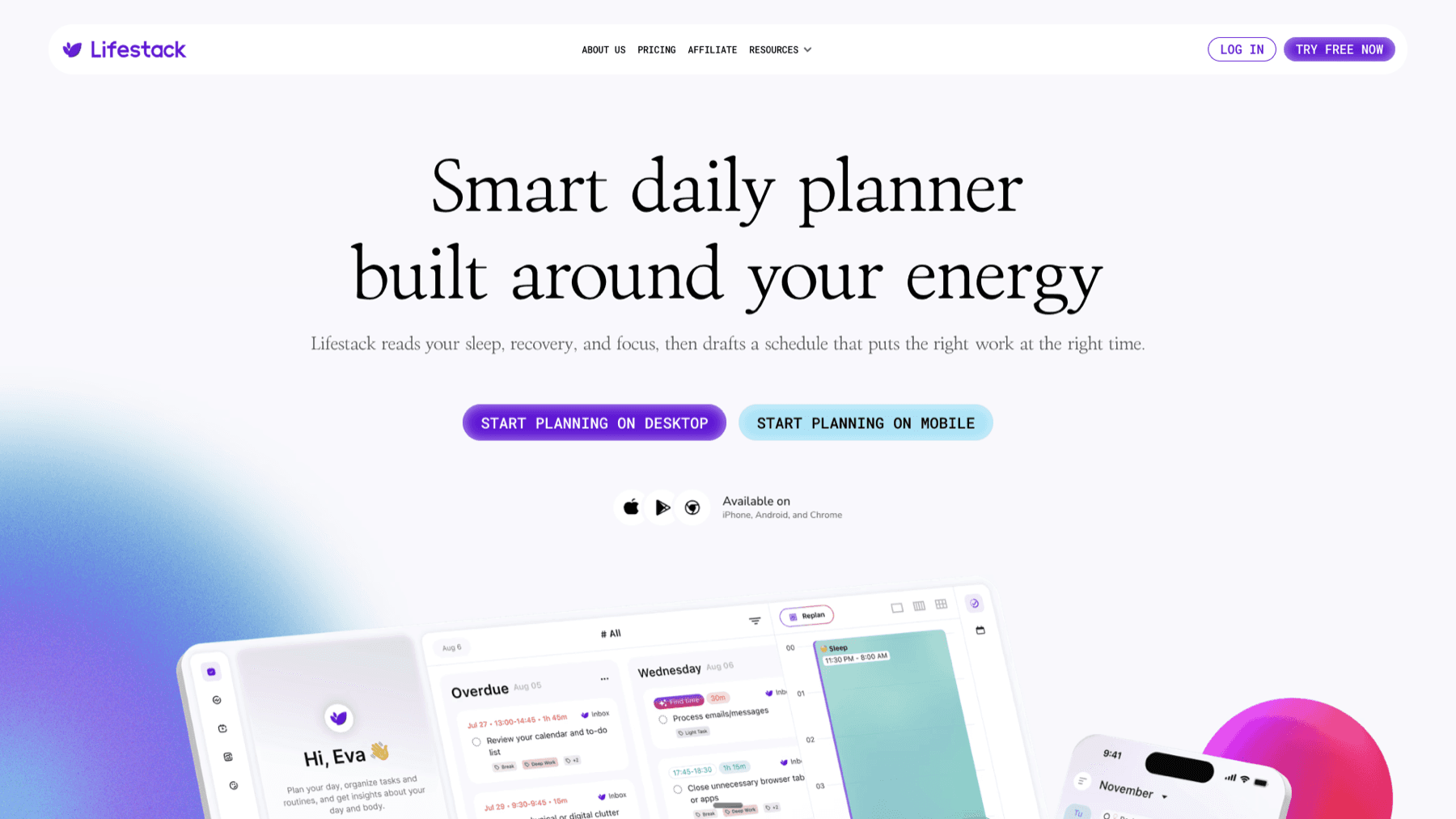
Lifestack is available on iOS and Android, starting at $49.99 per year with a 7-day free trial, or $120 as a one-time lifetime purchase. Learn more about how Lifestack works.
Frequently Asked Questions
How much does the Amazfit Balance 2 cost?
The Amazfit Balance 2 retails at $299.99 USD. It is available through Amazfit's website and major retailers.
How long does the Amazfit Balance 2 battery last?
Amazfit rates it at 21 days in standard use. Real-world performance with continuous health tracking and regular GPS use lands around 15 days per charge. Reducing GPS use and disabling the always-on display can push this closer to 18-21 days.
Can the Amazfit Balance 2 be used for scuba diving?
Yes. The Balance 2 includes a dedicated Recreational Scuba Diving mode that supports dives up to 45 meters. It logs depth, dive time, water temperature, and decompression data. 10 ATM water resistance backs this up for aquatic activities.
Does the Amazfit Balance 2 track sleep stages?
Yes. The watch tracks sleep duration and stages (light, deep, REM) using the BioTracker 6 PPG sensor. A sleep quality score and HRV-based readiness indicator appear each morning in the Zepp app. Accuracy is typical for consumer wrist-based optical tracking.
Is the Amazfit Balance 2 good for running?
Yes. Dual-frequency GPS (L1+L5) across six satellite systems delivers route accuracy comparable to watches costing significantly more. The BioTracker 6 heart rate sensor handles running zones reliably. If running-specific training analytics are your top priority, Garmin's running-focused Forerunner lineup is more specialized, but the Balance 2 covers the core tracking well.
The Amazfit Balance 2 launched in mid-2025 at $299.99 and immediately drew attention for offering specs that typically cost $100-$150 more from other brands: a sapphire-covered AMOLED display, dual-frequency GPS, 21-day battery life, and a recreational diving mode that supports dives up to 45 meters. For fitness-focused buyers who want capable hardware without paying premium brand prices, this is the watch that repeatedly comes up.
This review covers the hardware, fitness tracking performance, sleep data, and who the Balance 2 is actually well-suited for in 2026.
Key Takeaways
21-day rated battery life (real-world testing lands around 15 days with active tracking and GPS logging)
Circular 1.5-inch AMOLED display with sapphire glass, up to 2,000 nits, and 323 PPI at $299.99
Recreational scuba diving mode supports dives to 45m, which is exceptional at this price point
Design and Build Quality
The Balance 2 uses a circular 1.5-inch AMOLED display with 480x480 resolution and 323 pixels per inch. The display is covered by sapphire glass rather than the Gorilla Glass found on most watches in this price range. Peak brightness at 2,000 nits means it reads well in direct sunlight, and at 43 grams with the silicone strap it sits comfortably for all-day wear.
The case is aluminum alloy with a fiber-reinforced polymer back, and the 22mm standard lug width allows third-party strap compatibility. Water resistance is rated at 10 ATM, backing up the dive mode claims.
Fitness Tracking and GPS
The BioTracker 6 PPG sensor tracks heart rate, SpO2, blood pressure, body temperature, and altitude. It is the same sensor used in the Amazfit T-Rex 3 Pro. Heart rate accuracy in reviewers' testing has been consistently described as reliable at moderate and high intensity, with some drift during very intense interval training.
GPS uses dual-band L1+L5 across six satellite systems with a circularly polarized antenna. Dual-band GPS is a meaningful accuracy upgrade over single-band systems, particularly in urban canyons, dense forests, and mountainous terrain where signal reflections skew single-band positioning. The Balance 2 delivers track accuracy that outperforms what you would typically expect at $299.
Over 170 sport modes cover the expected running, cycling, swimming, and gym categories, plus less common ones like hiking, rucking, and recreational diving. The dive mode logs depth, dive time, water temperature, and decompression data up to 45 meters. For a sub-$300 watch to offer a legitimate dive mode is genuinely unusual. Compare its fitness feature set to our Amazfit T-Rex 3 review to see how the rugged and balanced options differ.
Sleep and Recovery Tracking
Sleep tracking on the Balance 2 records duration, sleep stages (light, deep, REM), and a sleep quality score. HRV-based readiness is tracked overnight and displayed as a recovery indicator in the Zepp app. Reviewers have found the sleep duration accuracy solid, with stage classification performing at the typical level for consumer wrist-based optical sensors: useful for trend analysis and less reliable for precise single-night stage counts.
The readiness indicator is less detailed than what you get from WHOOP or Garmin Body Battery, but it is sufficient to give you a morning read on whether to push or hold back. For a deeper comparison with other sleep trackers, see our best sleep trackers of 2026 guide.
Battery Life
Amazfit rates the Balance 2 at 21 days in standard use. Independent reviewers with continuous health tracking enabled, an always-on display during workouts, daily one-hour GPS sessions, and regular notifications have reported around 15 days per charge. That is still significantly longer than AMOLED smartwatches from Apple, Samsung, and Garmin, most of which last 2-4 days.
The gap between rated and real-world battery life is not unusual. With GPS use reduced and the always-on display disabled, users have gotten closer to the 18-21 day window. The key point is that weekly charging is optional rather than mandatory, which is a meaningful quality-of-life difference for continuous health monitoring.
Smartwatch Features
The Balance 2 supports Bluetooth calling, voice assistants, NFC payments, and Wi-Fi connectivity. Smart notifications work as expected. The Zepp app that manages data sync and health analysis is functional but less polished than the companion apps from Garmin or Fitbit. Third-party integration outside of the Zepp ecosystem is limited, which is one of the more common criticisms from long-term users.
Zepp's AI health advisor, called Zepp Aura, generates natural language health summaries and recommendations based on your tracked data. The quality of these recommendations varies and is not comparable to what you get from Garmin Coach or WHOOP's coaching platform, but it adds a layer of interpretation that basic trackers skip entirely.
Value vs. the Competition
At $299.99, the Balance 2 undercuts the Garmin Fenix 8 and COROS APEX 4 substantially while offering a brighter AMOLED display and the dive mode that neither of those watches provides. The tradeoff is ecosystem maturity: Garmin and COROS have deeper training analytics, more reliable third-party integrations, and longer track records for accuracy.
For buyers who prioritize display quality, battery life, and diving capability at a mid-range price, the Balance 2 is hard to beat. For buyers who want the deepest training analytics and ecosystem support, the extra cost of Garmin or COROS is justified.
See our full guide to the best smartwatch for sleep tracking for a broader comparison across brands.
Best App to Pair With the Amazfit Balance 2
The Zepp app gives you your data. Turning that data into a better daily schedule is where Lifestack comes in. Lifestack reads your sleep and recovery data to build a daily plan that adapts your schedule to your actual readiness each morning, putting hard cognitive work in your high-energy windows and protecting your recovery periods.
Lifestack is available on iOS and Android, starting at $49.99 per year with a 7-day free trial, or $120 as a one-time lifetime purchase. Learn more about how Lifestack works.
Frequently Asked Questions
How much does the Amazfit Balance 2 cost?
The Amazfit Balance 2 retails at $299.99 USD. It is available through Amazfit's website and major retailers.
How long does the Amazfit Balance 2 battery last?
Amazfit rates it at 21 days in standard use. Real-world performance with continuous health tracking and regular GPS use lands around 15 days per charge. Reducing GPS use and disabling the always-on display can push this closer to 18-21 days.
Can the Amazfit Balance 2 be used for scuba diving?
Yes. The Balance 2 includes a dedicated Recreational Scuba Diving mode that supports dives up to 45 meters. It logs depth, dive time, water temperature, and decompression data. 10 ATM water resistance backs this up for aquatic activities.
Does the Amazfit Balance 2 track sleep stages?
Yes. The watch tracks sleep duration and stages (light, deep, REM) using the BioTracker 6 PPG sensor. A sleep quality score and HRV-based readiness indicator appear each morning in the Zepp app. Accuracy is typical for consumer wrist-based optical tracking.
Is the Amazfit Balance 2 good for running?
Yes. Dual-frequency GPS (L1+L5) across six satellite systems delivers route accuracy comparable to watches costing significantly more. The BioTracker 6 heart rate sensor handles running zones reliably. If running-specific training analytics are your top priority, Garmin's running-focused Forerunner lineup is more specialized, but the Balance 2 covers the core tracking well.



FOLLOW ON
FOLLOW ON
FOLLOW ON


Copyright 2026 © Lifestack. All rights reserved
Copyright 2026 © Lifestack. All rights reserved

