
Device
Oura Ring vs Apple Watch: Which Should You Buy?
Oura Ring vs Apple Watch: Which Should You Buy?
The Oura Ring and Apple Watch are both sold as health tracking wearables, but they answer different questions. One is a discrete ring optimized for sleep and recovery data. The other is a full smartwatch with a display, apps, and a broad fitness platform. Comparing them head-to-head means first getting clear on what you actually want your wearable to do.
If you searched for "Aura Ring vs Apple Watch," this comparison covers the product you are looking for: the Oura Ring (made by Finnish company Oura Health), which is frequently spelled as "Aura Ring" in searches. This guide covers the Oura Ring 5 against the Apple Watch Series 11 and SE 3, both released in 2025.
Neither device is objectively better. They are built for different priorities and excel in different areas. Here is the full breakdown.
Key Takeaways
The Oura Ring 5 delivers more accurate and detailed sleep tracking, with 8-day battery life that makes overnight tracking effortless and consistent.
Apple Watch Series 11 offers a far broader feature set including ECG, GPS, hypertension detection, and a full smartwatch platform, but needs daily charging.
If sleep and recovery insight is your priority, Oura Ring is the clearer choice. If you want a full smartwatch experience, Apple Watch wins.
Quick Verdict
Oura Ring 5: Best for sleep tracking, recovery insight, HRV monitoring, and discrete all-day wear
Apple Watch Series 11: Best for complete smartwatch features, GPS fitness tracking, and iPhone ecosystem integration
Oura Ring 5 Overview
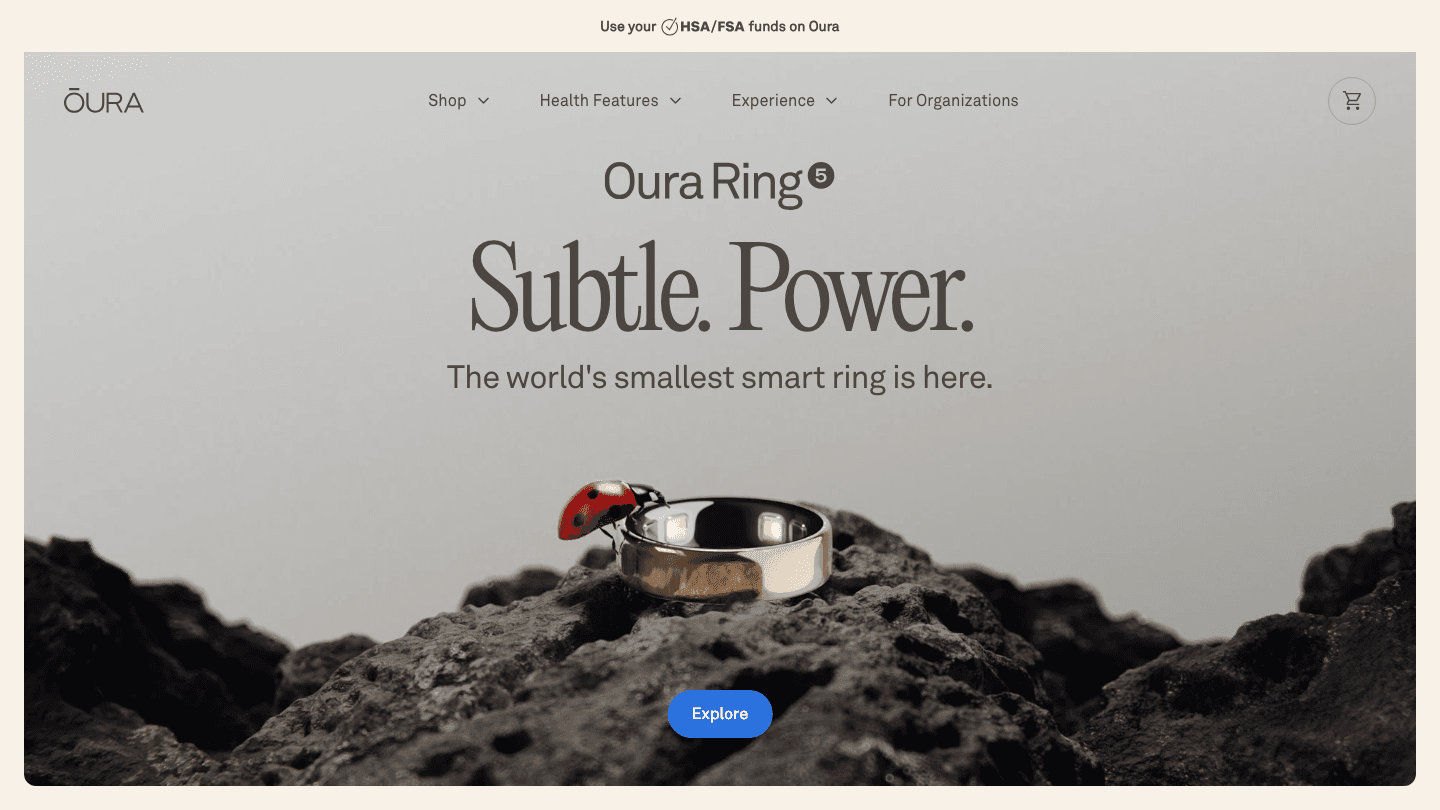
The Oura Ring 5 is a titanium ring with embedded sensors that track heart rate, HRV, skin temperature, blood oxygen, and movement continuously. The ring form factor is its core differentiator: worn on a finger, it captures blood flow data with higher accuracy than most wrist-based sensors, particularly during sleep when wrist position changes and sensors can slip.
The ring generates daily Readiness, Sleep, and Activity scores. Full data access requires a membership, which is a recurring cost on top of the hardware. At 8 days of battery life, the Oura Ring can track multiple full sleep cycles between charges, which makes consistent overnight tracking genuinely feasible rather than a nightly negotiation with charging schedules. (How the Oura Ring 5 compares to earlier generations is covered separately.)
What Works
Sleep staging and HRV accuracy rated best-in-class among consumer wearables in independent testing
Ring form factor is more accurate than wrist sensors for overnight heart rate and blood oxygen readings
8-day battery removes the daily charging compromise that disrupts most wearables' sleep tracking
Discrete enough to wear in settings where a smartwatch would be conspicuous
Limitations
No display. All data requires opening the app
No real-time workout metrics. No GPS, no live heart rate display during exercise
Membership fee adds ongoing cost on top of the hardware price
Ring sizing requires precise measurement upfront; the return process for wrong sizes is not simple
Pricing: $399 for the ring. Membership: $5.99/month or $69.99/year (first month free for new members).
Best for: People focused on sleep tracking, recovery optimization, and HRV monitoring who want a discrete wearable with long battery life.
Apple Watch Series 11 Overview

Apple Watch Series 11 is the most feature-complete health smartwatch available. It adds hypertension detection (FDA-cleared) to a sensor suite that already includes ECG, blood oxygen monitoring, skin temperature tracking, crash detection, and fall detection. Beyond health, it is a full smartwatch: always-on display, cellular option, precise GPS for workouts, Apple Pay, thousands of apps, and deep iPhone integration.
Battery life is 18 hours standard and 32 in Low Power Mode. For most users, this means daily charging, and charging overnight means sleep tracking is interrupted or missed entirely depending on your routine. The Apple Watch SE 3, starting at $229, offers most of the health features at a lower price without ECG or blood oxygen sensors.
What Works
Hypertension detection is a genuinely significant health addition, given how many people have undiagnosed high blood pressure
GPS workout tracking accuracy is excellent for running, cycling, and outdoor activities
No subscription required. The hardware cost is the full cost
iPhone integration is best-in-class for Apple ecosystem users
Limitations
Daily charging requirement means sleep tracking is frequently interrupted or skipped
Sleep tracking depth is weaker than Oura Ring, particularly for HRV and sleep staging accuracy
Requires a relatively recent iPhone to function
Pricing: Apple Watch Series 11 from $359. Apple Watch SE 3 from $229. No subscription required.
Best for: iPhone users who want a complete smartwatch with fitness tracking, health sensors, GPS, and daily notifications, and who can accommodate daily charging.
Head-to-Head: How They Compare
Sleep Tracking
Oura Ring wins. The ring form factor captures cleaner blood flow signals during sleep, when wrist position changes frequently and sensor contact is inconsistent. Oura's sleep staging (light, deep, REM) and overnight HRV data are consistently rated more granular and accurate in independent comparisons. (How Apple Watch tracks sleep stages details what the watch actually measures and where the gaps are.)
Battery Life
Oura Ring wins decisively: 8 days vs 18 hours. The practical consequence is that Oura wearers track sleep every night without interruption. Many Apple Watch wearers charge overnight and miss sleep data. If consistent sleep tracking is important to you, battery life is the deciding factor here.
Real-Time Fitness Tracking
Apple Watch wins. Built-in GPS, a live heart rate display during workouts, and 80+ sport modes make it a significantly more capable fitness companion during exercise. Oura tracks steps and general activity but provides no real-time workout data. (Resting and sleeping heart rate is where Oura is strongest.)
Health Sensors
Apple Watch Series 11 wins on breadth: ECG, blood oxygen, hypertension detection, crash detection, and temperature. Oura wins on overnight measurement quality for HRV and SpO2. (Apple Watch HRV accuracy and how it compares to research-grade devices is worth reading if HRV is a priority.)
Total Cost
Apple Watch SE 3 is the most affordable at $229 with no subscription. Oura Ring 5 is $399 plus $5.99/month. Over two years, the Oura Ring 5 totals approximately $543 (hardware plus membership). Apple Watch Series 11 costs $359 with no additional fees. For budget-conscious buyers, Apple Watch SE 3 is significantly cheaper over any time horizon.
Which Should You Choose?
Sleep and HRV tracking is your main interest: Oura Ring 5
You want a full smartwatch with GPS and app support: Apple Watch Series 11
You sleep with your watch off already: Oura Ring 5 solves a problem Apple Watch cannot
You want hypertension detection and ECG: Apple Watch Series 11
You are on a budget: Apple Watch SE 3 at $229
You work in contexts where wearing a watch is awkward: Oura Ring 5
You are deep in the Apple ecosystem: Apple Watch integrates better
Using Your Wearable Data More Effectively
Whichever device you choose, the real value comes from turning health data into better decisions about your schedule. Both the Oura Ring and Apple Watch surface readiness and energy signals that can tell you when to push hard and when to protect recovery. Lifestack is an AI planner that takes those patterns into account, scheduling your most demanding work during peak energy windows and protecting lighter tasks for lower-readiness days. If you are tracking recovery with Oura or sleep with Apple Watch, Lifestack is the logical follow-on tool for acting on what you learn. (What the Oura Ring actually measures is useful background if you are evaluating its health features.)
Frequently Asked Questions
Is Aura Ring the same as Oura Ring?
Yes. "Aura Ring" is a common misspelling of Oura Ring, made by Finnish company Oura Health. The current model is the Oura Ring 5, released in 2025 at $399.
Which is better for sleep tracking, Oura Ring or Apple Watch?
Oura Ring. The ring form factor captures cleaner blood flow data during sleep, and Oura's sleep staging and HRV measurements are more granular. Apple Watch sleep tracking has improved significantly but still trails Oura Ring in depth and accuracy.
Does the Oura Ring require a subscription?
Yes. The ring hardware costs $399, and full data access requires a $5.99/month or $69.99/year membership. Basic metrics are available without a membership. Apple Watch requires no subscription.
Can the Oura Ring replace Apple Watch for fitness tracking?
No. Oura Ring tracks steps and general activity but provides no real-time workout metrics, GPS, or sport-mode detection. If active fitness tracking matters, Apple Watch is the significantly better option.
Which has better battery life, Oura Ring or Apple Watch?
Oura Ring 5 at 8 days. Apple Watch Series 11 at 18 hours standard (32 in Low Power Mode). The battery difference is the biggest practical distinction between the two devices for everyday use.
The Oura Ring and Apple Watch are both sold as health tracking wearables, but they answer different questions. One is a discrete ring optimized for sleep and recovery data. The other is a full smartwatch with a display, apps, and a broad fitness platform. Comparing them head-to-head means first getting clear on what you actually want your wearable to do.
If you searched for "Aura Ring vs Apple Watch," this comparison covers the product you are looking for: the Oura Ring (made by Finnish company Oura Health), which is frequently spelled as "Aura Ring" in searches. This guide covers the Oura Ring 5 against the Apple Watch Series 11 and SE 3, both released in 2025.
Neither device is objectively better. They are built for different priorities and excel in different areas. Here is the full breakdown.
Key Takeaways
The Oura Ring 5 delivers more accurate and detailed sleep tracking, with 8-day battery life that makes overnight tracking effortless and consistent.
Apple Watch Series 11 offers a far broader feature set including ECG, GPS, hypertension detection, and a full smartwatch platform, but needs daily charging.
If sleep and recovery insight is your priority, Oura Ring is the clearer choice. If you want a full smartwatch experience, Apple Watch wins.
Quick Verdict
Oura Ring 5: Best for sleep tracking, recovery insight, HRV monitoring, and discrete all-day wear
Apple Watch Series 11: Best for complete smartwatch features, GPS fitness tracking, and iPhone ecosystem integration
Oura Ring 5 Overview
The Oura Ring 5 is a titanium ring with embedded sensors that track heart rate, HRV, skin temperature, blood oxygen, and movement continuously. The ring form factor is its core differentiator: worn on a finger, it captures blood flow data with higher accuracy than most wrist-based sensors, particularly during sleep when wrist position changes and sensors can slip.
The ring generates daily Readiness, Sleep, and Activity scores. Full data access requires a membership, which is a recurring cost on top of the hardware. At 8 days of battery life, the Oura Ring can track multiple full sleep cycles between charges, which makes consistent overnight tracking genuinely feasible rather than a nightly negotiation with charging schedules. (How the Oura Ring 5 compares to earlier generations is covered separately.)
What Works
Sleep staging and HRV accuracy rated best-in-class among consumer wearables in independent testing
Ring form factor is more accurate than wrist sensors for overnight heart rate and blood oxygen readings
8-day battery removes the daily charging compromise that disrupts most wearables' sleep tracking
Discrete enough to wear in settings where a smartwatch would be conspicuous
Limitations
No display. All data requires opening the app
No real-time workout metrics. No GPS, no live heart rate display during exercise
Membership fee adds ongoing cost on top of the hardware price
Ring sizing requires precise measurement upfront; the return process for wrong sizes is not simple
Pricing: $399 for the ring. Membership: $5.99/month or $69.99/year (first month free for new members).
Best for: People focused on sleep tracking, recovery optimization, and HRV monitoring who want a discrete wearable with long battery life.
Apple Watch Series 11 Overview
Apple Watch Series 11 is the most feature-complete health smartwatch available. It adds hypertension detection (FDA-cleared) to a sensor suite that already includes ECG, blood oxygen monitoring, skin temperature tracking, crash detection, and fall detection. Beyond health, it is a full smartwatch: always-on display, cellular option, precise GPS for workouts, Apple Pay, thousands of apps, and deep iPhone integration.
Battery life is 18 hours standard and 32 in Low Power Mode. For most users, this means daily charging, and charging overnight means sleep tracking is interrupted or missed entirely depending on your routine. The Apple Watch SE 3, starting at $229, offers most of the health features at a lower price without ECG or blood oxygen sensors.
What Works
Hypertension detection is a genuinely significant health addition, given how many people have undiagnosed high blood pressure
GPS workout tracking accuracy is excellent for running, cycling, and outdoor activities
No subscription required. The hardware cost is the full cost
iPhone integration is best-in-class for Apple ecosystem users
Limitations
Daily charging requirement means sleep tracking is frequently interrupted or skipped
Sleep tracking depth is weaker than Oura Ring, particularly for HRV and sleep staging accuracy
Requires a relatively recent iPhone to function
Pricing: Apple Watch Series 11 from $359. Apple Watch SE 3 from $229. No subscription required.
Best for: iPhone users who want a complete smartwatch with fitness tracking, health sensors, GPS, and daily notifications, and who can accommodate daily charging.
Head-to-Head: How They Compare
Sleep Tracking
Oura Ring wins. The ring form factor captures cleaner blood flow signals during sleep, when wrist position changes frequently and sensor contact is inconsistent. Oura's sleep staging (light, deep, REM) and overnight HRV data are consistently rated more granular and accurate in independent comparisons. (How Apple Watch tracks sleep stages details what the watch actually measures and where the gaps are.)
Battery Life
Oura Ring wins decisively: 8 days vs 18 hours. The practical consequence is that Oura wearers track sleep every night without interruption. Many Apple Watch wearers charge overnight and miss sleep data. If consistent sleep tracking is important to you, battery life is the deciding factor here.
Real-Time Fitness Tracking
Apple Watch wins. Built-in GPS, a live heart rate display during workouts, and 80+ sport modes make it a significantly more capable fitness companion during exercise. Oura tracks steps and general activity but provides no real-time workout data. (Resting and sleeping heart rate is where Oura is strongest.)
Health Sensors
Apple Watch Series 11 wins on breadth: ECG, blood oxygen, hypertension detection, crash detection, and temperature. Oura wins on overnight measurement quality for HRV and SpO2. (Apple Watch HRV accuracy and how it compares to research-grade devices is worth reading if HRV is a priority.)
Total Cost
Apple Watch SE 3 is the most affordable at $229 with no subscription. Oura Ring 5 is $399 plus $5.99/month. Over two years, the Oura Ring 5 totals approximately $543 (hardware plus membership). Apple Watch Series 11 costs $359 with no additional fees. For budget-conscious buyers, Apple Watch SE 3 is significantly cheaper over any time horizon.
Which Should You Choose?
Sleep and HRV tracking is your main interest: Oura Ring 5
You want a full smartwatch with GPS and app support: Apple Watch Series 11
You sleep with your watch off already: Oura Ring 5 solves a problem Apple Watch cannot
You want hypertension detection and ECG: Apple Watch Series 11
You are on a budget: Apple Watch SE 3 at $229
You work in contexts where wearing a watch is awkward: Oura Ring 5
You are deep in the Apple ecosystem: Apple Watch integrates better
Using Your Wearable Data More Effectively
Whichever device you choose, the real value comes from turning health data into better decisions about your schedule. Both the Oura Ring and Apple Watch surface readiness and energy signals that can tell you when to push hard and when to protect recovery. Lifestack is an AI planner that takes those patterns into account, scheduling your most demanding work during peak energy windows and protecting lighter tasks for lower-readiness days. If you are tracking recovery with Oura or sleep with Apple Watch, Lifestack is the logical follow-on tool for acting on what you learn. (What the Oura Ring actually measures is useful background if you are evaluating its health features.)
Frequently Asked Questions
Is Aura Ring the same as Oura Ring?
Yes. "Aura Ring" is a common misspelling of Oura Ring, made by Finnish company Oura Health. The current model is the Oura Ring 5, released in 2025 at $399.
Which is better for sleep tracking, Oura Ring or Apple Watch?
Oura Ring. The ring form factor captures cleaner blood flow data during sleep, and Oura's sleep staging and HRV measurements are more granular. Apple Watch sleep tracking has improved significantly but still trails Oura Ring in depth and accuracy.
Does the Oura Ring require a subscription?
Yes. The ring hardware costs $399, and full data access requires a $5.99/month or $69.99/year membership. Basic metrics are available without a membership. Apple Watch requires no subscription.
Can the Oura Ring replace Apple Watch for fitness tracking?
No. Oura Ring tracks steps and general activity but provides no real-time workout metrics, GPS, or sport-mode detection. If active fitness tracking matters, Apple Watch is the significantly better option.
Which has better battery life, Oura Ring or Apple Watch?
Oura Ring 5 at 8 days. Apple Watch Series 11 at 18 hours standard (32 in Low Power Mode). The battery difference is the biggest practical distinction between the two devices for everyday use.



FOLLOW ON
FOLLOW ON
FOLLOW ON


Copyright 2026 © Lifestack. All rights reserved
Copyright 2026 © Lifestack. All rights reserved

