
App
Best Calm Alternatives in 2026
Best Calm Alternatives in 2026

Calm is the most downloaded meditation app in the world. If you've tried it and found it wasn't the right fit, you're not alone. Some people want more structure. Others want something free. And some need to address the root cause of their stress, not just sit with it for ten minutes each morning. That's what the best Calm alternatives actually do.
The apps in this list cover a wide range of approaches. Some are meditation-first: guided sessions, breathing exercises, sleep stories. Others take a different angle entirely. Lifestack, for example, doesn't ask you to meditate at all. Instead, it reads your sleep and recovery data and builds a daily schedule around your actual energy levels, so you're not fighting your biology every afternoon.
We tested six alternatives based on content quality, personalization, pricing, and how well they address the underlying causes of stress. Before writing any pricing, we verified costs directly from each app's website and App Store listing.
If you're curious what Calm itself costs, our Calm pricing guide breaks it down.
Key Takeaways
Insight Timer is the best free option with 350,000+ guided sessions at no cost
Lifestack is the strongest pick for people whose stress is driven by schedule overwhelm, not lack of meditation
Waking Up and Happier are the deepest meditation apps if you want expert-level instruction
Quick Guide: Best Calm Alternatives
Lifestack - Best for reducing overwhelm before it starts
Headspace - Best for structured beginners
Insight Timer - Best free option
Happier - Best for evidence-based depth
Waking Up - Best for philosophical exploration
Aura Health - Best for mood-adaptive sessions
How We Evaluated These Apps
Approach to stress: Does the app treat symptoms or root causes?
Content quality: Guided sessions, teachers, and library depth
Personalization: Does it adapt to you over time?
Pricing fairness: Value relative to what you actually get
Mobile experience: iOS and Android quality and consistency
1. Lifestack - Best for Reducing Overwhelm at the Source
A smarter daily plan built around your energy, not your ambition
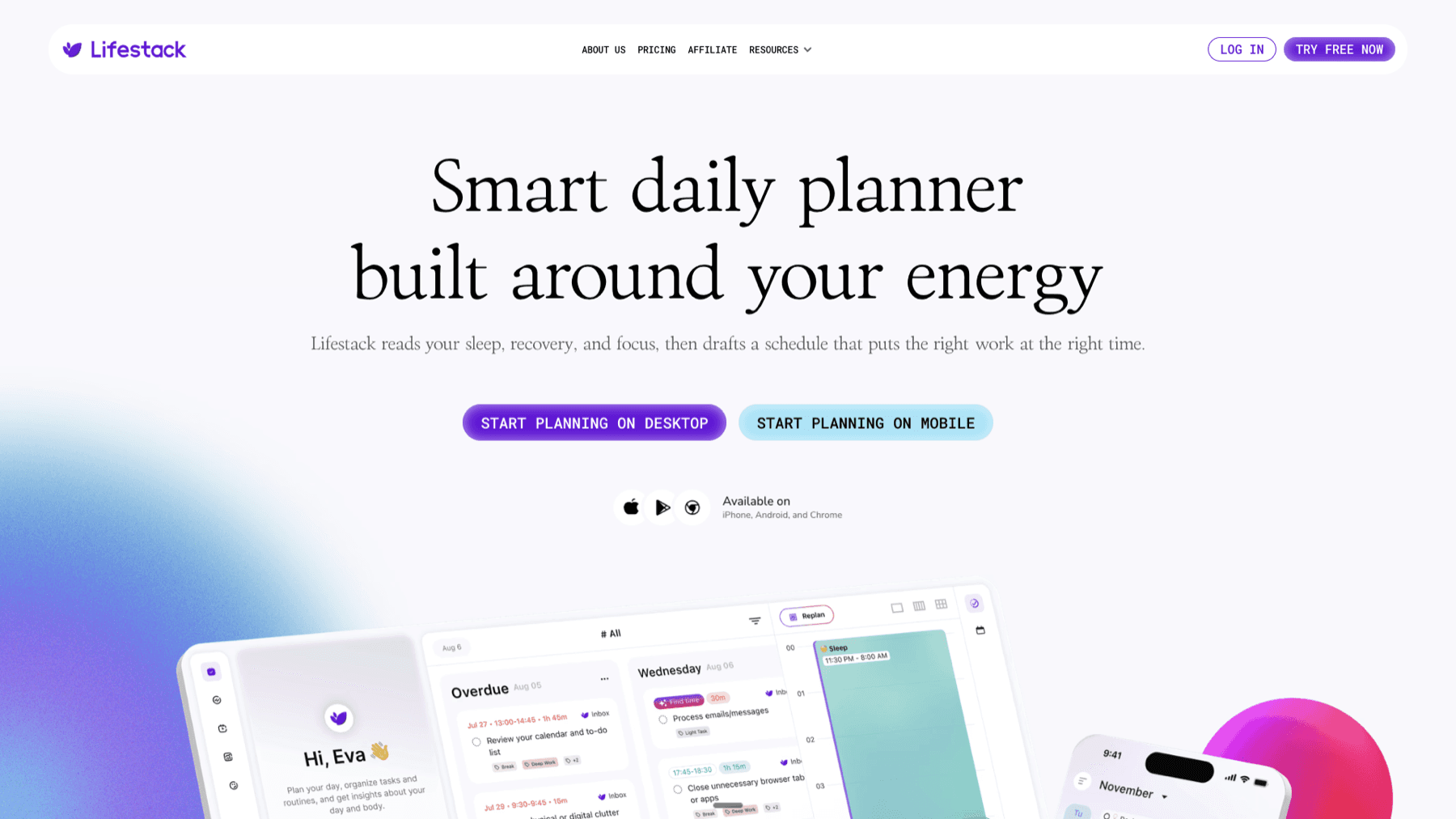
Most people reach for a meditation app because they're overwhelmed, burned out, or too wired to sleep. Lifestack takes a different approach: it attacks the source. Instead of teaching you to sit with stress, it helps you build a day where the stress doesn't accumulate in the first place.
The app connects to your sleep data from Oura, Apple Health, or Garmin, then uses that recovery information to schedule your cognitive work, meetings, and breaks around your actual energy peaks. You stop white-knuckling through low-energy afternoons. You stop scheduling your hardest work right after a bad night. The result is a day that feels manageable rather than one you need to meditate your way out of.
It's not a replacement for mindfulness practice. But if you've tried Calm and still feel constantly behind, a calmer schedule might matter more than a calmer morning routine. Read more about this approach in our energy-based scheduling guide.
Key Features
AI builds your daily schedule around sleep and energy data
Integrates with Oura Ring, Apple Health, Google Calendar, and task managers
Protects your peak hours for deep work automatically
Available on iOS, Android, and Chrome extension
What Works
Unique approach that addresses schedule-driven stress, not just symptoms
Energy-aware scheduling actually changes how your week feels
Clean interface that doesn't require daily habit maintenance
Limitations
Not a meditation or breathwork app, so you'll need something else for those
No free tier (annual plan includes a 7-day trial)
Most useful if you're already using a wearable or Apple Health
Pricing: $7/month or $50/year (7-day free trial on the annual plan). Lifetime access at $120.
Best for: People whose anxiety is rooted in schedule chaos rather than a lack of mindfulness practice
2. Headspace - Best for Structured Beginners
The most approachable way to build a daily meditation habit
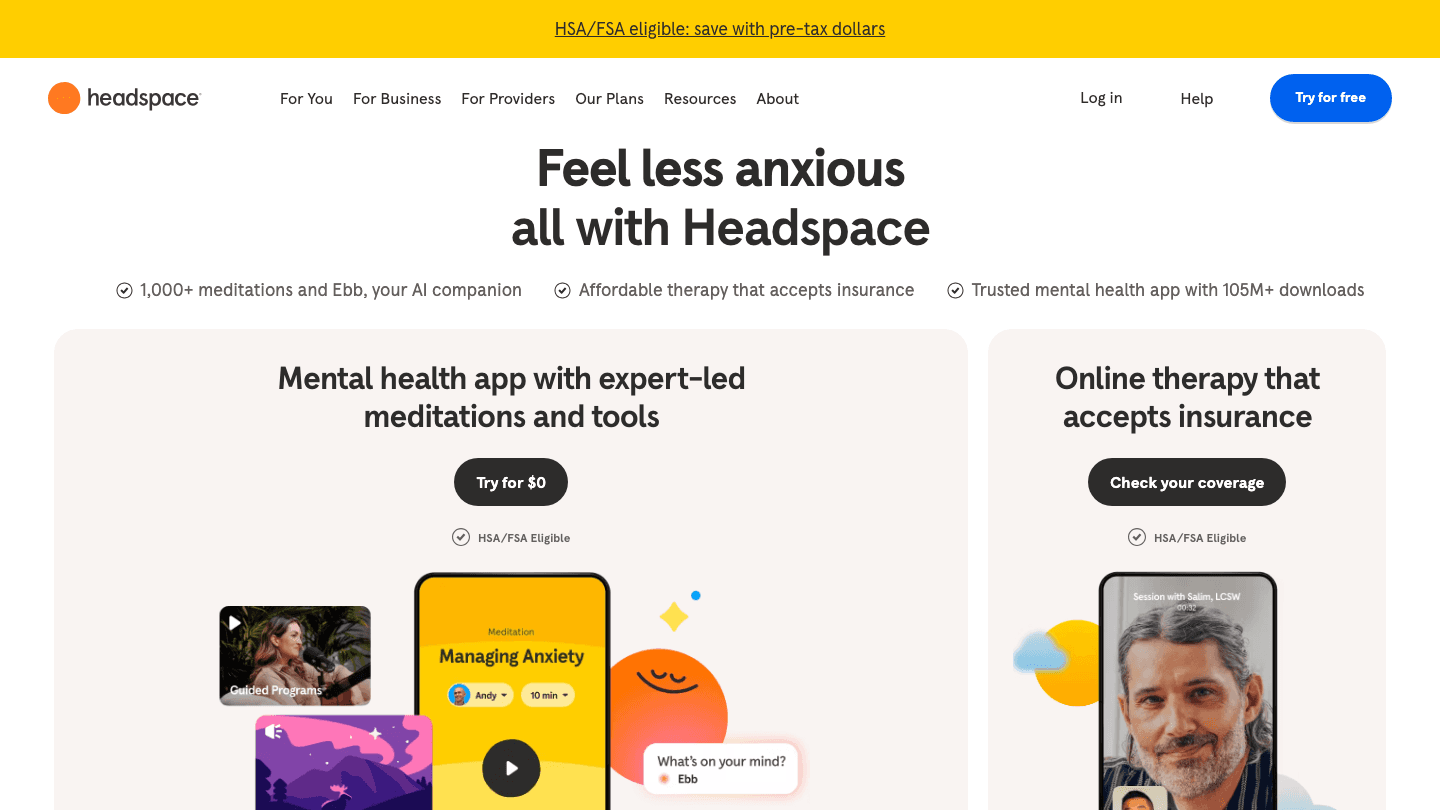
Headspace is the most common entry point for people leaving Calm. The app is built on progressive courses that teach meditation skills in order, rather than giving you a library of standalone sessions and leaving you to figure out what to do with them. If Calm's unstructured catalog felt overwhelming, Headspace's sequential approach may feel more natural.
The app added an AI companion called Ebb in 2025, which gives you a conversational interface for checking in and getting session recommendations. It also covers sleep, focus, and movement alongside traditional meditation. The content is grounded in evidence, though some teachers find the delivery a little corporate.
Key Features
Progressive meditation courses that build skills over weeks
Ebb, an AI companion for mood check-ins and session suggestions
Sleep, focus, and movement content in addition to meditation
Covers anxiety, stress, and performance goals specifically
What Works
Progressive structure is genuinely good for beginners
High production quality across sessions and design
Regular new content keeps the library from going stale
Limitations
More expensive than Calm on a monthly basis
The AI companion is surface-level compared to deeper tools
No energy awareness or scheduling integration
Pricing: $12.99/month or $69.99/year. Student plan at $9.99/year. Family plan: $19.99/month for up to six people. 14-day free trial available.
Best for: Beginners who want a structured, course-based path into meditation
3. Insight Timer - Best Free Option
350,000 guided sessions, most of them free

Insight Timer has a stronger free tier than almost any other wellness app. You get access to roughly 350,000 guided meditation tracks from thousands of independent teachers, plus a timer for unguided sessions and community features. There's no paywall blocking the majority of the content.
The depth of the library means you can explore different meditation techniques, from body scans to breathwork to Vipassana, without committing to a subscription. The quality varies across teachers since anyone can publish, but the top-rated sessions are consistently good. If variety matters more than curation, this is the app.
Key Features
350,000+ free guided sessions across traditions and styles
Teachers from Zen, Vipassana, yoga nidra, breathwork, and more
Customizable meditation timer for self-guided practice
Community and group features including live sessions
What Works
By far the best value, with most content free forever
Incredible variety of teachers, traditions, and session lengths
Good for people who want to explore before committing
Limitations
No curation or progressive structure, so finding great sessions takes effort
Quality varies widely since the platform is open to independent teachers
No energy awareness or scheduling features
Pricing: Free (core library). Plus subscription: $9.99/month or $59.99/year for offline access and extra features.
Best for: People who want a deep free library and don't mind exploring on their own
4. Happier - Best for Evidence-Based Depth
Formerly Ten Percent Happier, now rebuilt for broader access
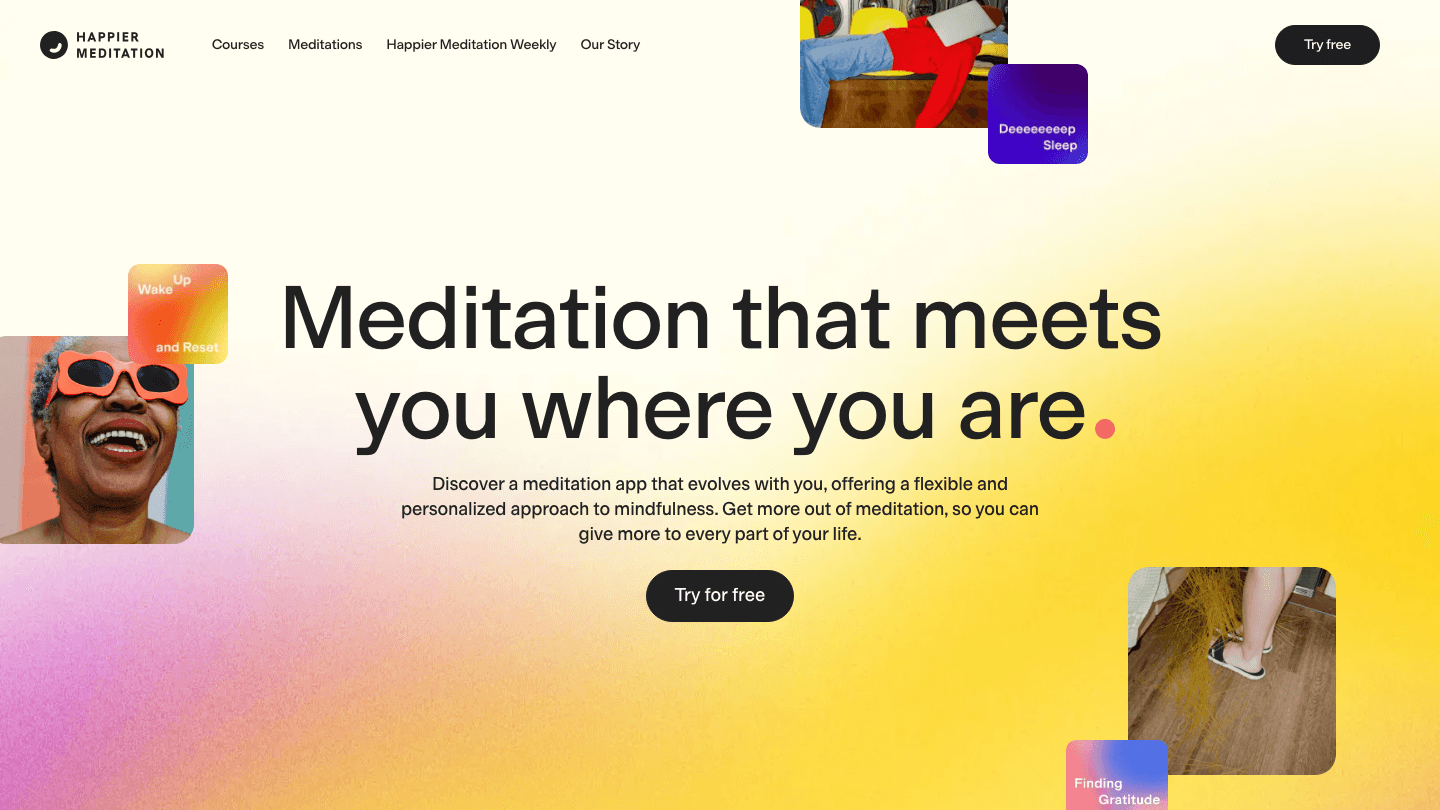
Happier (previously Ten Percent Happier) was built around a simple premise: meditation works, but most people need a skeptic's case for it before they'll start. The app features courses from prominent meditation teachers, researchers, and therapists, covering everything from basic breath awareness to complex psychological topics like perfectionism and self-compassion.
The teachers include Joseph Goldstein, Sharon Salzberg, and a rotating cast of psychologists and neuroscientists who ground the practice in evidence rather than spirituality. For people who find Calm too ambient or Headspace too corporate, Happier offers more substance. It's also one of the better apps if you're dealing with anxiety specifically. See our ADHD and stress guide for how meditation fits into a broader toolkit.
Key Features
Courses from Joseph Goldstein, Sharon Salzberg, and leading researchers
Dedicated anxiety, depression, and self-compassion tracks
Daily bite-sized practices alongside longer immersions
Limited free content available without a subscription
What Works
Teacher quality is genuinely high, with real domain expertise
Evidence-based framing makes it accessible to skeptics
Covers psychological depth that most apps avoid
Limitations
Annual-only pricing is a significant upfront commitment
No free tier worth using beyond a 7-day trial
The app is still mid-rebrand from Ten Percent Happier
Pricing: $99.99/year. 7-day free trial. No monthly option currently available.
Best for: People who want high-quality instruction from real meditation teachers and psychologists
5. Waking Up - Best for Philosophical Depth
Sam Harris's meditation app for people who want to understand the mind
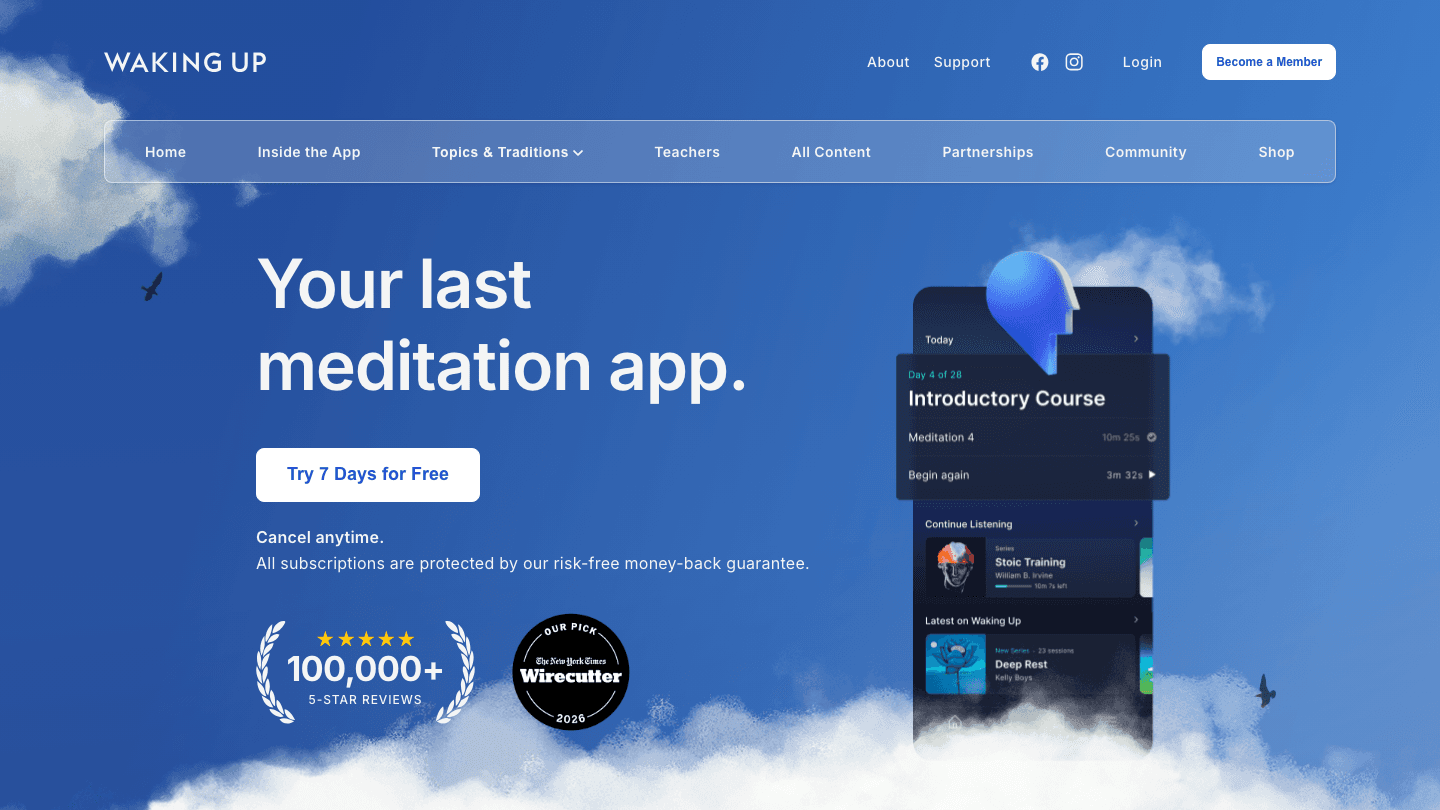
Waking Up is unlike any other app on this list. Sam Harris's approach to meditation is rooted in philosophy and neuroscience, and the app reflects that. Rather than teaching you to relax or sleep better, it's interested in the nature of consciousness itself: what attention actually is, why thoughts feel like "you," and what changes when you look directly at the mind.
This makes it sound abstract, but the daily practices are concrete. The introductory course is 28 days of short sessions that build a genuine understanding of mindfulness as a skill, not just a habit. The extended library includes conversations with philosophers, scientists, and teachers that go well beyond what you'd find in Calm or Headspace. It's also the only major app with a true financial assistance program: if you can't afford it, you can request free access, no questions asked.
For people dealing with anxiety who want to go deeper, combining Waking Up with structured breathing exercises creates a solid dual practice.
Key Features
28-day introductory course grounded in philosophy and neuroscience
Conversations with researchers, philosophers, and teachers
Free access program for anyone who can't afford the subscription
Theory of mind approach, not just stress management
What Works
Intellectually substantive in a way that other apps don't attempt
Free access for those with financial constraints, no questions asked
The introductory course is genuinely good as a standalone resource
Limitations
Most expensive option at $119.99/year
Philosophical framing won't appeal to everyone
Less practical for people who just want quick stress relief
Pricing: $14.99/month or $119.99/year. Free access available on request for those with financial constraints.
Best for: People who want to understand why meditation works, not just how to do it
6. Aura Health - Best for Mood-Adaptive Sessions
AI adjusts your session based on how you actually feel today
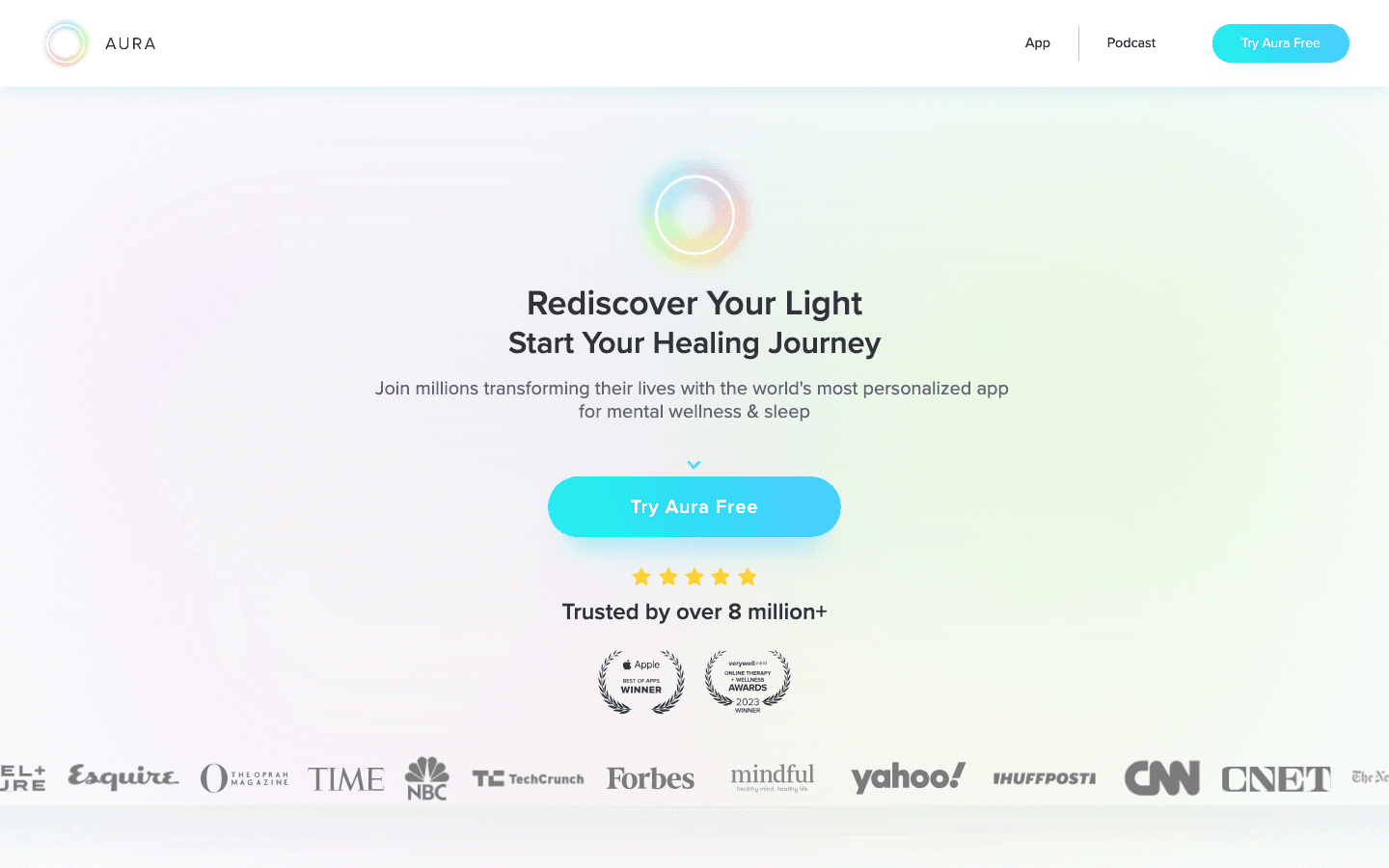
Aura takes personalization further than most. When you open the app, it asks how you're feeling before surfacing a session, and it uses that input alongside your history to suggest meditations, sleep content, CBT exercises, and life coaching sessions. Over time it learns what actually helps you, rather than serving the same playlist everyone else sees.
The content library is broad, covering meditation, mindfulness, hypnosis, and CBT-based exercises in two-to-three-minute formats designed to fit into real schedules. This makes it well-suited for people who find mindfulness at work more useful than extended morning sessions. The app also has a community layer and allows you to follow specific coaches.
Key Features
Mood check-in before every session to calibrate recommendations
Covers meditation, CBT exercises, sleep stories, and life coaching
Short 2-3 minute formats designed for use throughout the day
Follow specific coaches and build a personalized content feed
What Works
Mood-adaptive recommendations feel genuinely responsive over time
CBT content alongside meditation is a differentiated angle
Short formats work well for busy schedules
Limitations
More expensive per year than Headspace at $144/year for individuals
The coaching layer feels uneven depending on which coach you follow
No energy awareness or sleep integration
Pricing: $12/month (billed as $144/year). 14-day free trial. Promotional introductory pricing often available.
Best for: People who want sessions calibrated to how they actually feel each day
Which Calm Alternative Is Right for You?
Your stress comes from a chaotic schedule: Lifestack. It won't teach you to meditate, but it will build you a day you can actually get through without burning out
You're new to meditation and want guidance: Headspace. The progressive course structure removes decision fatigue and teaches real skills in sequence
You want to explore without spending money: Insight Timer. The free library is genuinely one of the best in the category
You want depth and expert instruction: Happier. Real teachers, real psychological frameworks, and a no-fluff approach
You want to understand what meditation actually is: Waking Up. The introductory course alone is worth the cost for the philosophically inclined
You want something that adapts to your mood: Aura. The check-in model means you're not getting the same recommendation every morning
If you're dealing with ADHD-related restlessness on top of general stress, our guide to calming activities for ADHD covers additional strategies that pair well with any of these apps.
FAQ
What is the best free alternative to Calm?
Insight Timer is the strongest free option. It gives you access to over 350,000 guided meditations at no cost, including sessions from independent teachers across almost every tradition. The Plus subscription adds offline access and a few extras, but the free tier is genuinely complete on its own.
Is Headspace better than Calm?
It depends on what you're looking for. Headspace is more structured, which suits beginners who want a clear learning path. Calm has a broader library and better sleep content. Our full Headspace alternatives guide walks through the comparison in detail, including when to choose each one.
Can a productivity app replace a meditation app for stress?
For some people, yes. If your anxiety comes primarily from schedule overload and the feeling of never catching up, addressing the schedule directly (as Lifestack does) can reduce baseline stress more than adding a meditation habit on top of an unchanged workload. The two approaches work well together, but the schedule is often the problem worth fixing first.
Is Waking Up worth the high price?
If you're intellectually curious about meditation and want to understand the practice at a deeper level, Waking Up offers content you won't find elsewhere. If you can't afford it, request the scholarship, they give it freely. If you just want a practical tool for sleep or quick stress relief, Headspace or Insight Timer will serve you better at a lower cost.
How much does Calm cost compared to its alternatives?
Calm runs $16.99/month or $69.99/year for individuals. Among the alternatives here, Insight Timer is free, Lifestack is $50/year, Headspace is $69.99/year, Happier is $99.99/year, and Waking Up is $119.99/year. See our full breakdown of what Calm costs if you're comparing before switching.
What should I look for in a Calm alternative?
Start with why you're looking. Calm's catalog is broad but unstructured. If structure is the problem, try Headspace. If cost is the issue, Insight Timer. If Calm isn't addressing the actual source of your stress, consider something different entirely, like building a schedule that works with your energy rather than against it. Our guide on improving mental clarity covers how scheduling and recovery fit together.
Calm is the most downloaded meditation app in the world. If you've tried it and found it wasn't the right fit, you're not alone. Some people want more structure. Others want something free. And some need to address the root cause of their stress, not just sit with it for ten minutes each morning. That's what the best Calm alternatives actually do.
The apps in this list cover a wide range of approaches. Some are meditation-first: guided sessions, breathing exercises, sleep stories. Others take a different angle entirely. Lifestack, for example, doesn't ask you to meditate at all. Instead, it reads your sleep and recovery data and builds a daily schedule around your actual energy levels, so you're not fighting your biology every afternoon.
We tested six alternatives based on content quality, personalization, pricing, and how well they address the underlying causes of stress. Before writing any pricing, we verified costs directly from each app's website and App Store listing.
If you're curious what Calm itself costs, our Calm pricing guide breaks it down.
Key Takeaways
Insight Timer is the best free option with 350,000+ guided sessions at no cost
Lifestack is the strongest pick for people whose stress is driven by schedule overwhelm, not lack of meditation
Waking Up and Happier are the deepest meditation apps if you want expert-level instruction
Quick Guide: Best Calm Alternatives
Lifestack - Best for reducing overwhelm before it starts
Headspace - Best for structured beginners
Insight Timer - Best free option
Happier - Best for evidence-based depth
Waking Up - Best for philosophical exploration
Aura Health - Best for mood-adaptive sessions
How We Evaluated These Apps
Approach to stress: Does the app treat symptoms or root causes?
Content quality: Guided sessions, teachers, and library depth
Personalization: Does it adapt to you over time?
Pricing fairness: Value relative to what you actually get
Mobile experience: iOS and Android quality and consistency
1. Lifestack - Best for Reducing Overwhelm at the Source
A smarter daily plan built around your energy, not your ambition
Most people reach for a meditation app because they're overwhelmed, burned out, or too wired to sleep. Lifestack takes a different approach: it attacks the source. Instead of teaching you to sit with stress, it helps you build a day where the stress doesn't accumulate in the first place.
The app connects to your sleep data from Oura, Apple Health, or Garmin, then uses that recovery information to schedule your cognitive work, meetings, and breaks around your actual energy peaks. You stop white-knuckling through low-energy afternoons. You stop scheduling your hardest work right after a bad night. The result is a day that feels manageable rather than one you need to meditate your way out of.
It's not a replacement for mindfulness practice. But if you've tried Calm and still feel constantly behind, a calmer schedule might matter more than a calmer morning routine. Read more about this approach in our energy-based scheduling guide.
Key Features
AI builds your daily schedule around sleep and energy data
Integrates with Oura Ring, Apple Health, Google Calendar, and task managers
Protects your peak hours for deep work automatically
Available on iOS, Android, and Chrome extension
What Works
Unique approach that addresses schedule-driven stress, not just symptoms
Energy-aware scheduling actually changes how your week feels
Clean interface that doesn't require daily habit maintenance
Limitations
Not a meditation or breathwork app, so you'll need something else for those
No free tier (annual plan includes a 7-day trial)
Most useful if you're already using a wearable or Apple Health
Pricing: $7/month or $50/year (7-day free trial on the annual plan). Lifetime access at $120.
Best for: People whose anxiety is rooted in schedule chaos rather than a lack of mindfulness practice
2. Headspace - Best for Structured Beginners
The most approachable way to build a daily meditation habit
Headspace is the most common entry point for people leaving Calm. The app is built on progressive courses that teach meditation skills in order, rather than giving you a library of standalone sessions and leaving you to figure out what to do with them. If Calm's unstructured catalog felt overwhelming, Headspace's sequential approach may feel more natural.
The app added an AI companion called Ebb in 2025, which gives you a conversational interface for checking in and getting session recommendations. It also covers sleep, focus, and movement alongside traditional meditation. The content is grounded in evidence, though some teachers find the delivery a little corporate.
Key Features
Progressive meditation courses that build skills over weeks
Ebb, an AI companion for mood check-ins and session suggestions
Sleep, focus, and movement content in addition to meditation
Covers anxiety, stress, and performance goals specifically
What Works
Progressive structure is genuinely good for beginners
High production quality across sessions and design
Regular new content keeps the library from going stale
Limitations
More expensive than Calm on a monthly basis
The AI companion is surface-level compared to deeper tools
No energy awareness or scheduling integration
Pricing: $12.99/month or $69.99/year. Student plan at $9.99/year. Family plan: $19.99/month for up to six people. 14-day free trial available.
Best for: Beginners who want a structured, course-based path into meditation
3. Insight Timer - Best Free Option
350,000 guided sessions, most of them free
Insight Timer has a stronger free tier than almost any other wellness app. You get access to roughly 350,000 guided meditation tracks from thousands of independent teachers, plus a timer for unguided sessions and community features. There's no paywall blocking the majority of the content.
The depth of the library means you can explore different meditation techniques, from body scans to breathwork to Vipassana, without committing to a subscription. The quality varies across teachers since anyone can publish, but the top-rated sessions are consistently good. If variety matters more than curation, this is the app.
Key Features
350,000+ free guided sessions across traditions and styles
Teachers from Zen, Vipassana, yoga nidra, breathwork, and more
Customizable meditation timer for self-guided practice
Community and group features including live sessions
What Works
By far the best value, with most content free forever
Incredible variety of teachers, traditions, and session lengths
Good for people who want to explore before committing
Limitations
No curation or progressive structure, so finding great sessions takes effort
Quality varies widely since the platform is open to independent teachers
No energy awareness or scheduling features
Pricing: Free (core library). Plus subscription: $9.99/month or $59.99/year for offline access and extra features.
Best for: People who want a deep free library and don't mind exploring on their own
4. Happier - Best for Evidence-Based Depth
Formerly Ten Percent Happier, now rebuilt for broader access
Happier (previously Ten Percent Happier) was built around a simple premise: meditation works, but most people need a skeptic's case for it before they'll start. The app features courses from prominent meditation teachers, researchers, and therapists, covering everything from basic breath awareness to complex psychological topics like perfectionism and self-compassion.
The teachers include Joseph Goldstein, Sharon Salzberg, and a rotating cast of psychologists and neuroscientists who ground the practice in evidence rather than spirituality. For people who find Calm too ambient or Headspace too corporate, Happier offers more substance. It's also one of the better apps if you're dealing with anxiety specifically. See our ADHD and stress guide for how meditation fits into a broader toolkit.
Key Features
Courses from Joseph Goldstein, Sharon Salzberg, and leading researchers
Dedicated anxiety, depression, and self-compassion tracks
Daily bite-sized practices alongside longer immersions
Limited free content available without a subscription
What Works
Teacher quality is genuinely high, with real domain expertise
Evidence-based framing makes it accessible to skeptics
Covers psychological depth that most apps avoid
Limitations
Annual-only pricing is a significant upfront commitment
No free tier worth using beyond a 7-day trial
The app is still mid-rebrand from Ten Percent Happier
Pricing: $99.99/year. 7-day free trial. No monthly option currently available.
Best for: People who want high-quality instruction from real meditation teachers and psychologists
5. Waking Up - Best for Philosophical Depth
Sam Harris's meditation app for people who want to understand the mind
Waking Up is unlike any other app on this list. Sam Harris's approach to meditation is rooted in philosophy and neuroscience, and the app reflects that. Rather than teaching you to relax or sleep better, it's interested in the nature of consciousness itself: what attention actually is, why thoughts feel like "you," and what changes when you look directly at the mind.
This makes it sound abstract, but the daily practices are concrete. The introductory course is 28 days of short sessions that build a genuine understanding of mindfulness as a skill, not just a habit. The extended library includes conversations with philosophers, scientists, and teachers that go well beyond what you'd find in Calm or Headspace. It's also the only major app with a true financial assistance program: if you can't afford it, you can request free access, no questions asked.
For people dealing with anxiety who want to go deeper, combining Waking Up with structured breathing exercises creates a solid dual practice.
Key Features
28-day introductory course grounded in philosophy and neuroscience
Conversations with researchers, philosophers, and teachers
Free access program for anyone who can't afford the subscription
Theory of mind approach, not just stress management
What Works
Intellectually substantive in a way that other apps don't attempt
Free access for those with financial constraints, no questions asked
The introductory course is genuinely good as a standalone resource
Limitations
Most expensive option at $119.99/year
Philosophical framing won't appeal to everyone
Less practical for people who just want quick stress relief
Pricing: $14.99/month or $119.99/year. Free access available on request for those with financial constraints.
Best for: People who want to understand why meditation works, not just how to do it
6. Aura Health - Best for Mood-Adaptive Sessions
AI adjusts your session based on how you actually feel today
Aura takes personalization further than most. When you open the app, it asks how you're feeling before surfacing a session, and it uses that input alongside your history to suggest meditations, sleep content, CBT exercises, and life coaching sessions. Over time it learns what actually helps you, rather than serving the same playlist everyone else sees.
The content library is broad, covering meditation, mindfulness, hypnosis, and CBT-based exercises in two-to-three-minute formats designed to fit into real schedules. This makes it well-suited for people who find mindfulness at work more useful than extended morning sessions. The app also has a community layer and allows you to follow specific coaches.
Key Features
Mood check-in before every session to calibrate recommendations
Covers meditation, CBT exercises, sleep stories, and life coaching
Short 2-3 minute formats designed for use throughout the day
Follow specific coaches and build a personalized content feed
What Works
Mood-adaptive recommendations feel genuinely responsive over time
CBT content alongside meditation is a differentiated angle
Short formats work well for busy schedules
Limitations
More expensive per year than Headspace at $144/year for individuals
The coaching layer feels uneven depending on which coach you follow
No energy awareness or sleep integration
Pricing: $12/month (billed as $144/year). 14-day free trial. Promotional introductory pricing often available.
Best for: People who want sessions calibrated to how they actually feel each day
Which Calm Alternative Is Right for You?
Your stress comes from a chaotic schedule: Lifestack. It won't teach you to meditate, but it will build you a day you can actually get through without burning out
You're new to meditation and want guidance: Headspace. The progressive course structure removes decision fatigue and teaches real skills in sequence
You want to explore without spending money: Insight Timer. The free library is genuinely one of the best in the category
You want depth and expert instruction: Happier. Real teachers, real psychological frameworks, and a no-fluff approach
You want to understand what meditation actually is: Waking Up. The introductory course alone is worth the cost for the philosophically inclined
You want something that adapts to your mood: Aura. The check-in model means you're not getting the same recommendation every morning
If you're dealing with ADHD-related restlessness on top of general stress, our guide to calming activities for ADHD covers additional strategies that pair well with any of these apps.
FAQ
What is the best free alternative to Calm?
Insight Timer is the strongest free option. It gives you access to over 350,000 guided meditations at no cost, including sessions from independent teachers across almost every tradition. The Plus subscription adds offline access and a few extras, but the free tier is genuinely complete on its own.
Is Headspace better than Calm?
It depends on what you're looking for. Headspace is more structured, which suits beginners who want a clear learning path. Calm has a broader library and better sleep content. Our full Headspace alternatives guide walks through the comparison in detail, including when to choose each one.
Can a productivity app replace a meditation app for stress?
For some people, yes. If your anxiety comes primarily from schedule overload and the feeling of never catching up, addressing the schedule directly (as Lifestack does) can reduce baseline stress more than adding a meditation habit on top of an unchanged workload. The two approaches work well together, but the schedule is often the problem worth fixing first.
Is Waking Up worth the high price?
If you're intellectually curious about meditation and want to understand the practice at a deeper level, Waking Up offers content you won't find elsewhere. If you can't afford it, request the scholarship, they give it freely. If you just want a practical tool for sleep or quick stress relief, Headspace or Insight Timer will serve you better at a lower cost.
How much does Calm cost compared to its alternatives?
Calm runs $16.99/month or $69.99/year for individuals. Among the alternatives here, Insight Timer is free, Lifestack is $50/year, Headspace is $69.99/year, Happier is $99.99/year, and Waking Up is $119.99/year. See our full breakdown of what Calm costs if you're comparing before switching.
What should I look for in a Calm alternative?
Start with why you're looking. Calm's catalog is broad but unstructured. If structure is the problem, try Headspace. If cost is the issue, Insight Timer. If Calm isn't addressing the actual source of your stress, consider something different entirely, like building a schedule that works with your energy rather than against it. Our guide on improving mental clarity covers how scheduling and recovery fit together.



FOLLOW ON
FOLLOW ON
FOLLOW ON


Copyright 2026 © Lifestack. All rights reserved
Copyright 2026 © Lifestack. All rights reserved

