
Tips
Examples of Meeting Minutes: 6 Templates That Work
Examples of Meeting Minutes: 6 Templates That Work

Most meeting minutes get written, sent once, and never opened again. That is the real problem. Good minutes are not a transcript of everything that was said. They are a short record of what was decided, who owns the next step, and when it is due.
This guide walks through clear examples of meeting minutes for different meeting types, from a formal board meeting to a quick standup. Each one is short enough to copy and adapt today.
You will also see what separates minutes that drive follow-through from ones that quietly rot in an inbox. The difference is almost always in how action items get captured and tracked after the meeting ends.
Let's start with what belongs in any good set of minutes, then move into the examples.
What Belongs in Meeting Minutes
Before the examples, here is the short list every set of minutes needs. Skip the play-by-play. Capture the facts and the commitments.
Meeting basics: title, date, time, and location or call link.
Attendees: who was present, who sent apologies, and whether quorum was met for formal meetings.
Agenda items: each topic discussed, kept to a one or two line summary.
Decisions: what was agreed, including a vote tally if there was one.
Action items: the task, the owner, and the deadline. An action without an owner does not happen.
Next meeting: the date of the follow-up, if known.
That structure carries every example below. The format shifts a little by meeting type, but the bones stay the same. If you want a deeper system for turning these notes into a real plan, our guide on how to build a project action plan picks up where minutes leave off.
Example 1: Formal Board Meeting Minutes
Formal minutes are a governance record, so they lean structured and complete. Attendance and votes matter because they may be reviewed later. Here is a sample for a small nonprofit board.
Meeting: Q3 Board Meeting, Riverside Community Trust
Date: July 14, 2026, 6:00 PM
Location: Main Office, Room 2B
Present: J. Okafor (Chair), M. Reyes, D. Singh, L. Chen
Apologies: P. Walsh
Quorum: Met (4 of 5)
1. Approval of prior minutes. The May minutes were approved without changes. Motion by M. Reyes, seconded by D. Singh. Passed 4-0.
2. Treasurer's report. D. Singh reported a closing balance of $42,180. The board accepted the report as presented.
3. Annual fundraiser budget. A budget of $8,000 was proposed for the fall gala. After discussion on venue costs, the motion passed 3-1, with L. Chen opposed.
Action items:
D. Singh to finalize the gala vendor contract by July 28.
M. Reyes to draft the donor outreach email by August 4.
Next meeting: October 13, 2026. Meeting adjourned at 7:25 PM.
Notice how every decision is tied to a motion and a tally. That is what makes formal minutes hold up. For a deeper look at sorting which items deserve a vote first, see our guide on prioritization methods that actually work.
Example 2: Informal Team Meeting Minutes
Most internal meetings do not need motions or quorum. They need a quick record so nobody asks "wait, what did we decide?" two days later. Keep these light.
Meeting: Marketing Weekly Sync
Date: June 22, 2026, 10:00 AM
Attendees: Priya, Marcus, Elena, Sam
Discussed:
Q3 campaign theme. The team agreed on "Plan Around Your Energy" as the lead angle.
Blog cadence. Moving from two posts a week to three, starting in July.
Webinar idea parked until after the product launch.
Action items:
Elena: draft the campaign brief by Thursday.
Marcus: line up two freelance writers for the new cadence by June 27.
Sam: pull last quarter's traffic numbers before the next sync.
Short, scannable, and every task has a name and a date. That is all an informal meeting needs. If your team struggles to actually finish these items, our piece on how to stay on task has practical fixes.
Example 3: Executive Meeting Minutes
Executive minutes trade detail for signal. Leaders want decisions, risks, and owners, not a long discussion summary. Write them so a busy reader can scan in thirty seconds.
Meeting: Leadership Monthly
Date: June 5, 2026
Attendees: CEO, COO, CFO, Head of Product
Key decisions:
Approved hiring two engineers in Q3.
Pausing the EU expansion until the next funding round closes.
Shifting the product roadmap to prioritize the mobile redesign.
Risks flagged: Cash runway tightens in Q4 if the round slips. CFO to model two scenarios.
Action items:
COO: open the two engineering roles by June 12.
CFO: deliver runway scenarios by June 18.
Decisions up top, risks called out, owners attached. Executives can act on this without reading a wall of text.
Example 4: Sprint Planning Meeting Minutes
Agile teams move fast, so sprint minutes focus on commitments and capacity. The goal is a shared record of what the team picked up and any blockers in the way.
Meeting: Sprint 24 Planning
Date: June 16, 2026
Attendees: Dev team, Product Owner, Scrum Master
Sprint goal: Ship the new onboarding flow to beta users.
Committed work:
Onboarding screens build (8 points).
Email verification fix (3 points).
Analytics events for the new flow (5 points).
Blockers: Design handoff for two screens is still pending. Product Owner to chase by end of day.
Action items:
Product Owner: confirm design handoff by June 17.
Scrum Master: book the mid-sprint check-in.
Capacity, commitments, and blockers in one view. That is the sprint record the team can stand behind. Tracking deadlines across a sprint is its own skill, covered in our guide on deadline management strategies.
Example 5: One-on-One Meeting Minutes
One-on-ones are personal, so the minutes stay private and short. You are mostly tracking commitments and follow-ups, not creating a public record. A few lines does the job.
Meeting: 1:1, Manager and Direct Report
Date: June 19, 2026
Talked about: Workload feels heavy this month. Wants more ownership of the analytics project. Career goal is to move toward a lead role within a year.
Follow-ups:
Manager: hand off the analytics project lead by next week.
Report: draft a 90-day growth plan before the next 1:1.
No formatting gymnastics needed. Capture the themes and the two or three things each person agreed to do.
Example 6: Standup Meeting Notes
A daily standup barely needs minutes, but a one-line log per person keeps remote teams aligned and gives you a paper trail for blockers. Keep it to bullets.
Meeting: Daily Standup
Date: June 23, 2026
Ana: Finished the export bug. Today: start the CSV import. No blockers.
Tom: Yesterday: API tests. Today: same. Blocked on staging access.
Riya: Wrapped the design review. Today: handoff specs to dev.
Action item: Tom to get staging access from DevOps this morning.
That is enough. The value is the blocker log, not a detailed summary. Standups should be measured in minutes, not the notes.
How to Turn Minutes Into Action That Sticks
Writing good minutes is half the work. The other half is making sure the action items actually get done. This is where most teams lose the thread. The notes get filed, the deadlines drift, and the next meeting reopens the same topics.
A few habits fix this. Send the minutes within 24 hours, while memory is fresh. Pull every action item out of the notes and into a real task list with a date and an owner. Then put those tasks somewhere you will actually see them, not buried in a doc you never reopen. Our guide on how to plan effectively covers the wider system around this.
The trap is treating an action item as a note instead of a scheduled commitment. A task without a slot on your calendar competes with everything else and usually loses.
Best Tool for Meeting Minutes Follow-Through: Lifestack
Lifestack is the piece most note-taking apps miss. Your minutes tell you what needs to happen. Lifestack decides when. It pulls your tasks and action items onto a daily plan and schedules them around your real energy, so the deadline you wrote at 4 PM lands in a slot where you can actually do it.
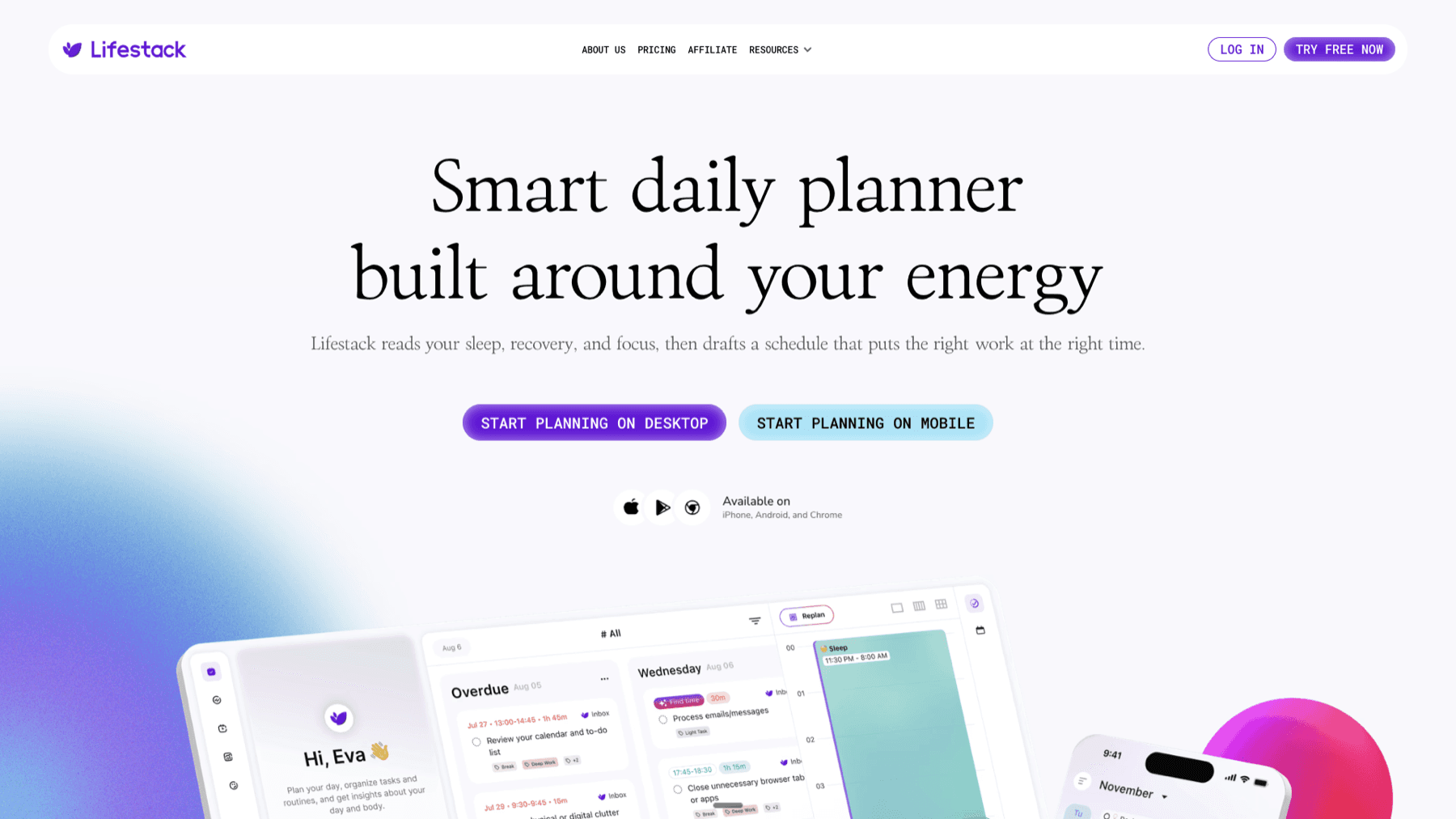
That energy-aware scheduling is the difference. A normal calendar drops a task into the next free gap. Lifestack reads your sleep, recovery, and focus patterns and places demanding follow-ups when you have the capacity for them. It is the same idea behind energy-based planning, applied to the action items your meetings generate.
Lifestack runs $7 per month, $50 per year with a 7-day free trial, or $120 as a one-time lifetime purchase. If your team keeps writing minutes that nobody acts on, this is the bridge from notes to done. You can read more in our introduction to Lifestack.
Frequently Asked Questions
What are examples of meeting minutes used for?
Examples of meeting minutes give you a reusable structure so you are not starting from a blank page each time. They show where to put attendees, decisions, and action items, which keeps your records consistent across formal board meetings, team syncs, and sprints.
What should you not include in meeting minutes?
Leave out word-for-word dialogue, personal opinions, side conversations, and anything off the record. Minutes record decisions and commitments, not a transcript. Keep emotional tone and informal banter out of the formal record.
How detailed should meeting minutes be?
Detail depends on the meeting type. Formal board minutes need motions and vote tallies for governance. Informal team and standup notes can be a few bullets. The test is whether someone who missed the meeting could see what was decided and what they owe.
Who is responsible for writing meeting minutes?
Traditionally a designated note-taker or secretary writes them. Many teams now rotate the role or use an AI notetaker to capture the record so everyone can stay present in the discussion. Either way, one person should own the final version.
How quickly should you send meeting minutes?
Aim for within 24 hours. The sooner you send them, the more accurate they are and the faster owners can start on their action items. A fast turnaround also signals that the meeting led to real commitments, not just talk.
How do you make sure action items from minutes get done?
Move each action item out of the notes and into a task system with an owner and a deadline, then schedule it on a calendar. A tool like energy-aware task management helps because it places the work when you actually have the capacity to finish it.
Most meeting minutes get written, sent once, and never opened again. That is the real problem. Good minutes are not a transcript of everything that was said. They are a short record of what was decided, who owns the next step, and when it is due.
This guide walks through clear examples of meeting minutes for different meeting types, from a formal board meeting to a quick standup. Each one is short enough to copy and adapt today.
You will also see what separates minutes that drive follow-through from ones that quietly rot in an inbox. The difference is almost always in how action items get captured and tracked after the meeting ends.
Let's start with what belongs in any good set of minutes, then move into the examples.
What Belongs in Meeting Minutes
Before the examples, here is the short list every set of minutes needs. Skip the play-by-play. Capture the facts and the commitments.
Meeting basics: title, date, time, and location or call link.
Attendees: who was present, who sent apologies, and whether quorum was met for formal meetings.
Agenda items: each topic discussed, kept to a one or two line summary.
Decisions: what was agreed, including a vote tally if there was one.
Action items: the task, the owner, and the deadline. An action without an owner does not happen.
Next meeting: the date of the follow-up, if known.
That structure carries every example below. The format shifts a little by meeting type, but the bones stay the same. If you want a deeper system for turning these notes into a real plan, our guide on how to build a project action plan picks up where minutes leave off.
Example 1: Formal Board Meeting Minutes
Formal minutes are a governance record, so they lean structured and complete. Attendance and votes matter because they may be reviewed later. Here is a sample for a small nonprofit board.
Meeting: Q3 Board Meeting, Riverside Community Trust
Date: July 14, 2026, 6:00 PM
Location: Main Office, Room 2B
Present: J. Okafor (Chair), M. Reyes, D. Singh, L. Chen
Apologies: P. Walsh
Quorum: Met (4 of 5)
1. Approval of prior minutes. The May minutes were approved without changes. Motion by M. Reyes, seconded by D. Singh. Passed 4-0.
2. Treasurer's report. D. Singh reported a closing balance of $42,180. The board accepted the report as presented.
3. Annual fundraiser budget. A budget of $8,000 was proposed for the fall gala. After discussion on venue costs, the motion passed 3-1, with L. Chen opposed.
Action items:
D. Singh to finalize the gala vendor contract by July 28.
M. Reyes to draft the donor outreach email by August 4.
Next meeting: October 13, 2026. Meeting adjourned at 7:25 PM.
Notice how every decision is tied to a motion and a tally. That is what makes formal minutes hold up. For a deeper look at sorting which items deserve a vote first, see our guide on prioritization methods that actually work.
Example 2: Informal Team Meeting Minutes
Most internal meetings do not need motions or quorum. They need a quick record so nobody asks "wait, what did we decide?" two days later. Keep these light.
Meeting: Marketing Weekly Sync
Date: June 22, 2026, 10:00 AM
Attendees: Priya, Marcus, Elena, Sam
Discussed:
Q3 campaign theme. The team agreed on "Plan Around Your Energy" as the lead angle.
Blog cadence. Moving from two posts a week to three, starting in July.
Webinar idea parked until after the product launch.
Action items:
Elena: draft the campaign brief by Thursday.
Marcus: line up two freelance writers for the new cadence by June 27.
Sam: pull last quarter's traffic numbers before the next sync.
Short, scannable, and every task has a name and a date. That is all an informal meeting needs. If your team struggles to actually finish these items, our piece on how to stay on task has practical fixes.
Example 3: Executive Meeting Minutes
Executive minutes trade detail for signal. Leaders want decisions, risks, and owners, not a long discussion summary. Write them so a busy reader can scan in thirty seconds.
Meeting: Leadership Monthly
Date: June 5, 2026
Attendees: CEO, COO, CFO, Head of Product
Key decisions:
Approved hiring two engineers in Q3.
Pausing the EU expansion until the next funding round closes.
Shifting the product roadmap to prioritize the mobile redesign.
Risks flagged: Cash runway tightens in Q4 if the round slips. CFO to model two scenarios.
Action items:
COO: open the two engineering roles by June 12.
CFO: deliver runway scenarios by June 18.
Decisions up top, risks called out, owners attached. Executives can act on this without reading a wall of text.
Example 4: Sprint Planning Meeting Minutes
Agile teams move fast, so sprint minutes focus on commitments and capacity. The goal is a shared record of what the team picked up and any blockers in the way.
Meeting: Sprint 24 Planning
Date: June 16, 2026
Attendees: Dev team, Product Owner, Scrum Master
Sprint goal: Ship the new onboarding flow to beta users.
Committed work:
Onboarding screens build (8 points).
Email verification fix (3 points).
Analytics events for the new flow (5 points).
Blockers: Design handoff for two screens is still pending. Product Owner to chase by end of day.
Action items:
Product Owner: confirm design handoff by June 17.
Scrum Master: book the mid-sprint check-in.
Capacity, commitments, and blockers in one view. That is the sprint record the team can stand behind. Tracking deadlines across a sprint is its own skill, covered in our guide on deadline management strategies.
Example 5: One-on-One Meeting Minutes
One-on-ones are personal, so the minutes stay private and short. You are mostly tracking commitments and follow-ups, not creating a public record. A few lines does the job.
Meeting: 1:1, Manager and Direct Report
Date: June 19, 2026
Talked about: Workload feels heavy this month. Wants more ownership of the analytics project. Career goal is to move toward a lead role within a year.
Follow-ups:
Manager: hand off the analytics project lead by next week.
Report: draft a 90-day growth plan before the next 1:1.
No formatting gymnastics needed. Capture the themes and the two or three things each person agreed to do.
Example 6: Standup Meeting Notes
A daily standup barely needs minutes, but a one-line log per person keeps remote teams aligned and gives you a paper trail for blockers. Keep it to bullets.
Meeting: Daily Standup
Date: June 23, 2026
Ana: Finished the export bug. Today: start the CSV import. No blockers.
Tom: Yesterday: API tests. Today: same. Blocked on staging access.
Riya: Wrapped the design review. Today: handoff specs to dev.
Action item: Tom to get staging access from DevOps this morning.
That is enough. The value is the blocker log, not a detailed summary. Standups should be measured in minutes, not the notes.
How to Turn Minutes Into Action That Sticks
Writing good minutes is half the work. The other half is making sure the action items actually get done. This is where most teams lose the thread. The notes get filed, the deadlines drift, and the next meeting reopens the same topics.
A few habits fix this. Send the minutes within 24 hours, while memory is fresh. Pull every action item out of the notes and into a real task list with a date and an owner. Then put those tasks somewhere you will actually see them, not buried in a doc you never reopen. Our guide on how to plan effectively covers the wider system around this.
The trap is treating an action item as a note instead of a scheduled commitment. A task without a slot on your calendar competes with everything else and usually loses.
Best Tool for Meeting Minutes Follow-Through: Lifestack
Lifestack is the piece most note-taking apps miss. Your minutes tell you what needs to happen. Lifestack decides when. It pulls your tasks and action items onto a daily plan and schedules them around your real energy, so the deadline you wrote at 4 PM lands in a slot where you can actually do it.
That energy-aware scheduling is the difference. A normal calendar drops a task into the next free gap. Lifestack reads your sleep, recovery, and focus patterns and places demanding follow-ups when you have the capacity for them. It is the same idea behind energy-based planning, applied to the action items your meetings generate.
Lifestack runs $7 per month, $50 per year with a 7-day free trial, or $120 as a one-time lifetime purchase. If your team keeps writing minutes that nobody acts on, this is the bridge from notes to done. You can read more in our introduction to Lifestack.
Frequently Asked Questions
What are examples of meeting minutes used for?
Examples of meeting minutes give you a reusable structure so you are not starting from a blank page each time. They show where to put attendees, decisions, and action items, which keeps your records consistent across formal board meetings, team syncs, and sprints.
What should you not include in meeting minutes?
Leave out word-for-word dialogue, personal opinions, side conversations, and anything off the record. Minutes record decisions and commitments, not a transcript. Keep emotional tone and informal banter out of the formal record.
How detailed should meeting minutes be?
Detail depends on the meeting type. Formal board minutes need motions and vote tallies for governance. Informal team and standup notes can be a few bullets. The test is whether someone who missed the meeting could see what was decided and what they owe.
Who is responsible for writing meeting minutes?
Traditionally a designated note-taker or secretary writes them. Many teams now rotate the role or use an AI notetaker to capture the record so everyone can stay present in the discussion. Either way, one person should own the final version.
How quickly should you send meeting minutes?
Aim for within 24 hours. The sooner you send them, the more accurate they are and the faster owners can start on their action items. A fast turnaround also signals that the meeting led to real commitments, not just talk.
How do you make sure action items from minutes get done?
Move each action item out of the notes and into a task system with an owner and a deadline, then schedule it on a calendar. A tool like energy-aware task management helps because it places the work when you actually have the capacity to finish it.



FOLLOW ON
FOLLOW ON
FOLLOW ON


Copyright 2026 © Lifestack. All rights reserved
Copyright 2026 © Lifestack. All rights reserved

