
App
Focusmate Reviews: Is It Worth It in 2026?
Focusmate Reviews: Is It Worth It in 2026?

Focusmate is a virtual coworking platform where you book 25-, 50-, or 75-minute sessions with another person, declare what you will work on, and then do it on camera together. No conversation required beyond a brief greeting and a closing check-in. The other person is not helping you with your work. Their presence is the entire point.
That sounds simple, and it is. But the reviews suggest that for a large number of people, particularly those with ADHD, anxiety, or chronic difficulty starting work, this simple setup produces results that more complex productivity tools do not. Since its launch, Focusmate has hosted tens of millions of sessions across more than 200 countries.
This review covers what Focusmate actually does, what users consistently praise and criticize, how the pricing compares, and who is most likely to find it genuinely useful.
Key Takeaways
Focusmate works through body doubling: social presence creates accountability that helps ADHD and anxious brains initiate and stay on task
The free plan (3 sessions per week) is enough for light use; the Plus plan ($8/month) unlocks unlimited sessions and suits daily users
It is not a task manager or planner, making it most effective when paired with a tool that handles what to work on during each session
How Focusmate Works
You create an account, pick a session time (sessions run every 30 minutes around the clock), and get matched with another Focusmate user. At the start of the session, you each say what you plan to accomplish. You then work silently on camera for the full duration. At the end, you briefly report on what you got done.
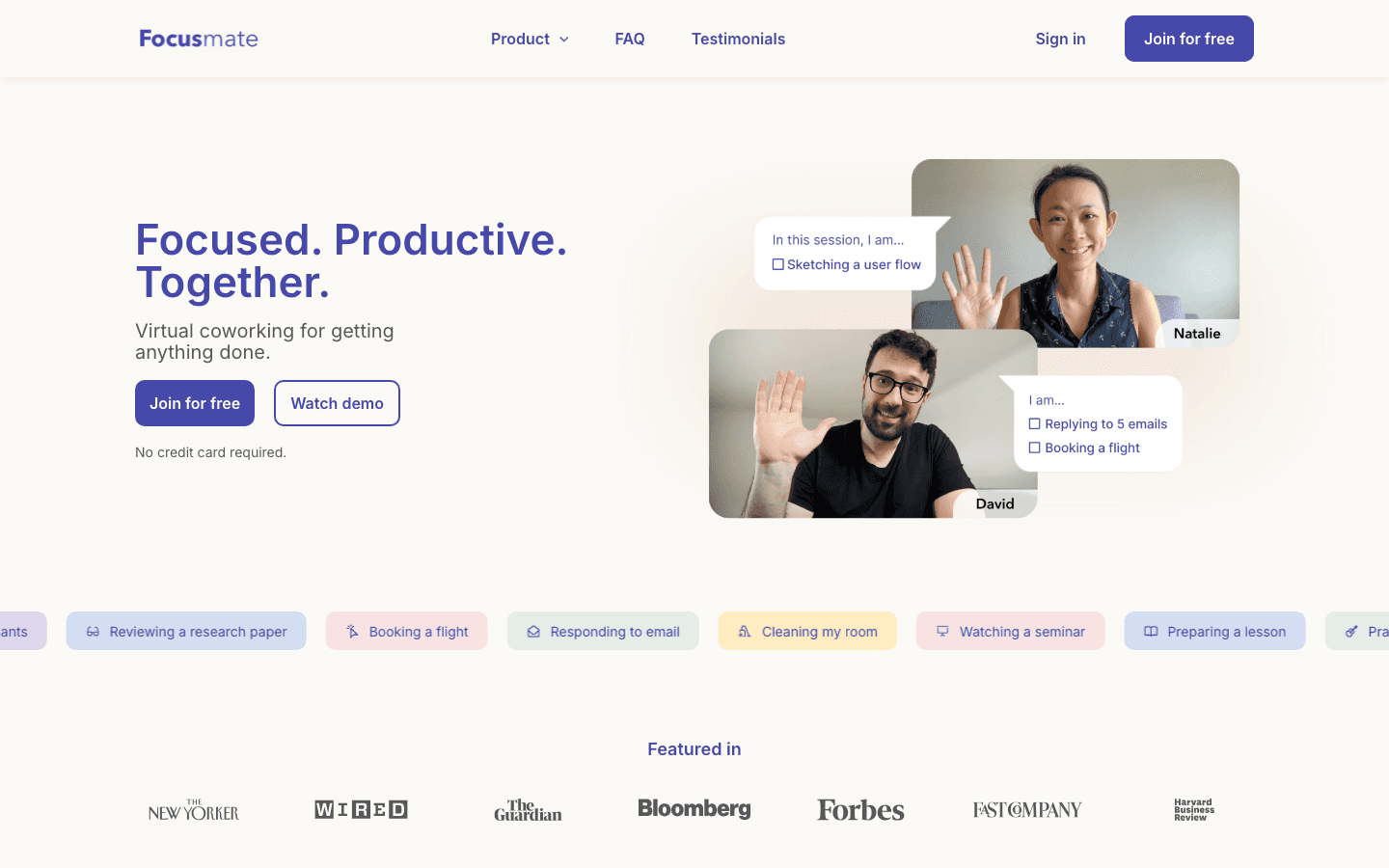
The peer-matching algorithm prioritizes people with similar schedules and preferences. You can filter by language and can build a list of preferred partners to book sessions with specific people repeatedly. Most users have video and audio on at the start and end of the session, with audio muted during the work block itself.
The mechanism at work is body doubling: the well-documented phenomenon where working alongside another person, even one who is doing something completely different, activates a different attentional mode in the brain. For ADHD brains in particular, social presence can substitute for the internal regulation that neurotypical brains generate more naturally.
What Users Like Most
The pattern across positive Focusmate reviews is consistent. Users who were previously unable to start or sustain work describe it as the difference between getting things done and not getting things done. Task initiation, which is one of the hardest aspects of ADHD and anxiety-related procrastination, appears to be the primary thing Focusmate solves.
A few specific things come up repeatedly:
The commitment to a specific task at the start of each session creates a clear, external contract that makes starting easier
The check-in at the end creates mild accountability that most users find motivating rather than stressful
Sessions are time-bounded, which prevents the all-or-nothing thinking that derails longer work blocks
The partners are warm and professional; most users report feeling supported rather than judged
For ADHD task initiation specifically, Focusmate's structured session format works well because it provides exactly what the ADHD brain needs to start: an external trigger, a defined scope, and another person watching.
What Users Criticize
No review should omit the friction points, and Focusmate has a few.
Scheduling can be challenging. You have to book sessions in advance, and if your schedule is unpredictable, finding available slots that align with your actual work windows requires effort. For spontaneous work needs at odd hours, availability can be thin depending on your time zone.
Partner quality varies. Most sessions are positive, but users occasionally get matched with partners who are disengaged, noisy, or who book and do not show. The preferred partner system helps, but it requires building that list over time.
It requires consistent use to deliver value. Focusmate is a habit, not a one-time fix. Users who try it a few times and do not integrate it into a regular schedule rarely see the results that daily users describe. The activation cost of booking and showing up is low, but it still requires forming a new routine.
Finally, Focusmate does not help you figure out what to work on. It solves the "starting" problem for a specific task you have already decided to do. If you are also struggling with knowing what your priorities are or when to schedule focus time, you need something additional. This is where a planner like Lifestack pairs naturally, more on that below.
Focusmate Pricing: Free vs Plus
Focusmate offers a free plan with three sessions per week, no credit card required. For most people testing the concept, three sessions is enough to evaluate whether body doubling works for them.
The Plus plan is $8/month billed annually ($12/month on monthly billing) and unlocks unlimited sessions. For daily users, three sessions per week typically runs out by Wednesday. If you want to use Focusmate as your primary work environment for multiple sessions per day, Plus is necessary.
For a detailed breakdown of what each tier includes, the Focusmate pricing guide has a full comparison. The short version: free is fine for evaluation and occasional use; Plus pays for itself if Focusmate becomes a core part of your work routine.
Who Should Use Focusmate?
Focusmate consistently earns its strongest reviews from people with ADHD, procrastination patterns driven by anxiety, remote workers who miss the ambient accountability of an office, and freelancers who work alone. In all of these cases, the common factor is difficulty starting or sustaining work without external structure.
For ADHD time management, Focusmate addresses one specific failure point: the gap between knowing what needs to be done and actually doing it. It is not a system for organizing your tasks. It is an activation mechanism for tasks you have already organized elsewhere.
It is less useful for people who have no trouble starting work independently, or who work in environments that already provide ambient accountability (open offices, team standups). For them, the overhead of scheduling and joining sessions may not be worth the benefit.
Pairing Focusmate with a Smart Planner
The most common gap in Focusmate reviews is what users do when they are not in a session: they are not sure what to work on next, they schedule sessions at the wrong time for their energy level, or they end a productive block without a clear path to the next one.
Lifestack fills that gap. It is an AI daily planner that schedules your tasks around your actual energy levels, so you know exactly which task to bring to each Focusmate session and when to book the session in the first place. It integrates with your calendar and learns your high-focus vs low-energy windows from wearable data.

The combination works like this: Lifestack handles the decision of what to do and when, Focusmate handles the activation. Together they address both halves of the productivity equation that ADHD brains find hardest. Lifestack starts at $7/month, with a $50/year annual plan and a 7-day free trial.
FAQ
Is Focusmate actually effective?
For many users, yes. Focusmate's mechanism, body doubling, has research support for improving focus and task initiation in ADHD and anxiety-related procrastination. The large volume of positive user reviews, particularly from ADHD communities, aligns with what the science predicts. Whether it works for you depends significantly on whether social presence activates your attention in this way, which varies by individual.
Is Focusmate free?
Yes, Focusmate has a free tier with three sessions per week and no credit card required. The Plus plan ($8/month annually) provides unlimited sessions for power users.
Is Focusmate safe?
Focusmate has community guidelines that users agree to, and its matching algorithm pairs users based on preferences and history. The platform has an active moderation system. Most users report positive experiences with partners, though as with any online platform, some encounters require using the reporting and blocking features.
Can Focusmate help with ADHD?
Focusmate is widely used and consistently reviewed positively in ADHD communities. It directly addresses task initiation, one of the most common ADHD pain points, through body doubling. It does not replace ADHD treatment, medication, or broader organizational systems, but as one tool in an ADHD management stack, it is among the highest-rated by users.
What is the difference between Focusmate free and Plus?
The free plan limits you to three sessions per week. The Plus plan at $8/month (annual) or $12/month (monthly) provides unlimited sessions. Both plans access the same core features. The main driver for upgrading is usage frequency: if you want daily sessions or multiple sessions per day, three per week runs out quickly.
Are there alternatives to Focusmate?
Yes. Flow Club is a similar virtual coworking platform with a different social structure. Some ADHD accountability apps offer one-on-one accountability partnerships with more of a coaching component. Body doubling with a friend over video call is a free alternative with less structure. For people who want both accountability sessions and full task scheduling in one stack, combining a virtual coworking option with an AI planner like Lifestack covers both dimensions.
Focusmate is a virtual coworking platform where you book 25-, 50-, or 75-minute sessions with another person, declare what you will work on, and then do it on camera together. No conversation required beyond a brief greeting and a closing check-in. The other person is not helping you with your work. Their presence is the entire point.
That sounds simple, and it is. But the reviews suggest that for a large number of people, particularly those with ADHD, anxiety, or chronic difficulty starting work, this simple setup produces results that more complex productivity tools do not. Since its launch, Focusmate has hosted tens of millions of sessions across more than 200 countries.
This review covers what Focusmate actually does, what users consistently praise and criticize, how the pricing compares, and who is most likely to find it genuinely useful.
Key Takeaways
Focusmate works through body doubling: social presence creates accountability that helps ADHD and anxious brains initiate and stay on task
The free plan (3 sessions per week) is enough for light use; the Plus plan ($8/month) unlocks unlimited sessions and suits daily users
It is not a task manager or planner, making it most effective when paired with a tool that handles what to work on during each session
How Focusmate Works
You create an account, pick a session time (sessions run every 30 minutes around the clock), and get matched with another Focusmate user. At the start of the session, you each say what you plan to accomplish. You then work silently on camera for the full duration. At the end, you briefly report on what you got done.
The peer-matching algorithm prioritizes people with similar schedules and preferences. You can filter by language and can build a list of preferred partners to book sessions with specific people repeatedly. Most users have video and audio on at the start and end of the session, with audio muted during the work block itself.
The mechanism at work is body doubling: the well-documented phenomenon where working alongside another person, even one who is doing something completely different, activates a different attentional mode in the brain. For ADHD brains in particular, social presence can substitute for the internal regulation that neurotypical brains generate more naturally.
What Users Like Most
The pattern across positive Focusmate reviews is consistent. Users who were previously unable to start or sustain work describe it as the difference between getting things done and not getting things done. Task initiation, which is one of the hardest aspects of ADHD and anxiety-related procrastination, appears to be the primary thing Focusmate solves.
A few specific things come up repeatedly:
The commitment to a specific task at the start of each session creates a clear, external contract that makes starting easier
The check-in at the end creates mild accountability that most users find motivating rather than stressful
Sessions are time-bounded, which prevents the all-or-nothing thinking that derails longer work blocks
The partners are warm and professional; most users report feeling supported rather than judged
For ADHD task initiation specifically, Focusmate's structured session format works well because it provides exactly what the ADHD brain needs to start: an external trigger, a defined scope, and another person watching.
What Users Criticize
No review should omit the friction points, and Focusmate has a few.
Scheduling can be challenging. You have to book sessions in advance, and if your schedule is unpredictable, finding available slots that align with your actual work windows requires effort. For spontaneous work needs at odd hours, availability can be thin depending on your time zone.
Partner quality varies. Most sessions are positive, but users occasionally get matched with partners who are disengaged, noisy, or who book and do not show. The preferred partner system helps, but it requires building that list over time.
It requires consistent use to deliver value. Focusmate is a habit, not a one-time fix. Users who try it a few times and do not integrate it into a regular schedule rarely see the results that daily users describe. The activation cost of booking and showing up is low, but it still requires forming a new routine.
Finally, Focusmate does not help you figure out what to work on. It solves the "starting" problem for a specific task you have already decided to do. If you are also struggling with knowing what your priorities are or when to schedule focus time, you need something additional. This is where a planner like Lifestack pairs naturally, more on that below.
Focusmate Pricing: Free vs Plus
Focusmate offers a free plan with three sessions per week, no credit card required. For most people testing the concept, three sessions is enough to evaluate whether body doubling works for them.
The Plus plan is $8/month billed annually ($12/month on monthly billing) and unlocks unlimited sessions. For daily users, three sessions per week typically runs out by Wednesday. If you want to use Focusmate as your primary work environment for multiple sessions per day, Plus is necessary.
For a detailed breakdown of what each tier includes, the Focusmate pricing guide has a full comparison. The short version: free is fine for evaluation and occasional use; Plus pays for itself if Focusmate becomes a core part of your work routine.
Who Should Use Focusmate?
Focusmate consistently earns its strongest reviews from people with ADHD, procrastination patterns driven by anxiety, remote workers who miss the ambient accountability of an office, and freelancers who work alone. In all of these cases, the common factor is difficulty starting or sustaining work without external structure.
For ADHD time management, Focusmate addresses one specific failure point: the gap between knowing what needs to be done and actually doing it. It is not a system for organizing your tasks. It is an activation mechanism for tasks you have already organized elsewhere.
It is less useful for people who have no trouble starting work independently, or who work in environments that already provide ambient accountability (open offices, team standups). For them, the overhead of scheduling and joining sessions may not be worth the benefit.
Pairing Focusmate with a Smart Planner
The most common gap in Focusmate reviews is what users do when they are not in a session: they are not sure what to work on next, they schedule sessions at the wrong time for their energy level, or they end a productive block without a clear path to the next one.
Lifestack fills that gap. It is an AI daily planner that schedules your tasks around your actual energy levels, so you know exactly which task to bring to each Focusmate session and when to book the session in the first place. It integrates with your calendar and learns your high-focus vs low-energy windows from wearable data.
The combination works like this: Lifestack handles the decision of what to do and when, Focusmate handles the activation. Together they address both halves of the productivity equation that ADHD brains find hardest. Lifestack starts at $7/month, with a $50/year annual plan and a 7-day free trial.
FAQ
Is Focusmate actually effective?
For many users, yes. Focusmate's mechanism, body doubling, has research support for improving focus and task initiation in ADHD and anxiety-related procrastination. The large volume of positive user reviews, particularly from ADHD communities, aligns with what the science predicts. Whether it works for you depends significantly on whether social presence activates your attention in this way, which varies by individual.
Is Focusmate free?
Yes, Focusmate has a free tier with three sessions per week and no credit card required. The Plus plan ($8/month annually) provides unlimited sessions for power users.
Is Focusmate safe?
Focusmate has community guidelines that users agree to, and its matching algorithm pairs users based on preferences and history. The platform has an active moderation system. Most users report positive experiences with partners, though as with any online platform, some encounters require using the reporting and blocking features.
Can Focusmate help with ADHD?
Focusmate is widely used and consistently reviewed positively in ADHD communities. It directly addresses task initiation, one of the most common ADHD pain points, through body doubling. It does not replace ADHD treatment, medication, or broader organizational systems, but as one tool in an ADHD management stack, it is among the highest-rated by users.
What is the difference between Focusmate free and Plus?
The free plan limits you to three sessions per week. The Plus plan at $8/month (annual) or $12/month (monthly) provides unlimited sessions. Both plans access the same core features. The main driver for upgrading is usage frequency: if you want daily sessions or multiple sessions per day, three per week runs out quickly.
Are there alternatives to Focusmate?
Yes. Flow Club is a similar virtual coworking platform with a different social structure. Some ADHD accountability apps offer one-on-one accountability partnerships with more of a coaching component. Body doubling with a friend over video call is a free alternative with less structure. For people who want both accountability sessions and full task scheduling in one stack, combining a virtual coworking option with an AI planner like Lifestack covers both dimensions.



FOLLOW ON
FOLLOW ON
FOLLOW ON


Copyright 2026 © Lifestack. All rights reserved
Copyright 2026 © Lifestack. All rights reserved

