
Tips
The Gifts of ADHD: 7 Strengths Worth Knowing
The Gifts of ADHD: 7 Strengths Worth Knowing

The conversation around ADHD tends to center on deficits: what is harder, what requires more effort, what the brain struggles with relative to neurotypical standards. That framing captures real challenges. It also leaves out half the picture. Many of the same neurological patterns that create difficulty in structured, conventional environments are the source of genuine strengths in other contexts.
Researchers, therapists, and adults with ADHD have documented a consistent set of traits that appear alongside the diagnosis. These are not consolation prizes. They are characteristics that, when channeled into the right work, environment, or relationship, produce outcomes that neurotypical patterns rarely replicate. This is sometimes called the upside of ADHD, and it is worth understanding on its own terms.
The seven strengths below are based on clinical research, first-person accounts, and the patterns that appear consistently in high-functioning ADHD adults across many fields.
Key Takeaways
The gifts of ADHD are not myths. Hyperfocus, creative thinking, high energy, resilience, and pattern recognition are traits that appear reliably in the research and in lived experience, even when they are hard to see through the lens of conventional productivity metrics.
These strengths are state-dependent and environment-dependent. An ADHD brain that is under-stimulated, sleep-deprived, or working in an environment that demands constant task-switching will not access them reliably. The same brain, in the right conditions, can outperform neurotypical peers significantly.
The most practical implication of understanding ADHD strengths is knowing how to create the conditions where they activate, and how to protect those conditions within the structure of a real day.
1. Hyperfocus
Hyperfocus is what happens when an ADHD brain locks onto something it finds genuinely compelling. In that state, time disappears, distractions fail to land, and output quality can be extraordinary. Hyperfocus is not just sustained attention. It is complete absorption, often for hours, producing work that would be difficult or impossible to replicate at normal levels of engagement.
The challenge is that hyperfocus is not fully voluntary. It activates in response to novelty, urgency, genuine interest, or competitive pressure. It does not activate reliably on demand for tasks that are important but boring. This is why ADHD task management requires building systems that work with this pattern rather than against it: creating interest and urgency where they would not otherwise exist, and scheduling high-interest work during windows when hyperfocus is most likely to engage.
People who have worked with hyperfocus deliberately often describe it as their greatest professional asset. Entrepreneurs, artists, scientists, and developers with ADHD frequently cite hyperfocus as what lets them go deeper on a problem than their peers. The limitation is not the state. It is the lack of reliable access to it on schedule.
2. Creative and Divergent Thinking
ADHD brains tend to make associations between ideas that are further apart than neurotypical thinking typically connects. This is partly structural: the default mode network, which generates spontaneous thought and creative association, is more active and less easily suppressed in ADHD. The same mechanism that produces mind-wandering in a meeting also produces the unexpected connection that solves a problem no one else noticed.
Research on creativity and ADHD has found consistently higher scores on divergent thinking tasks in people with ADHD compared to control groups. Divergent thinking is the ability to generate many possible solutions or interpretations from a single prompt. It is the cognitive engine behind creative work, innovation, and novel problem-solving.
This strength is most visible in fields that reward originality rather than precision: entrepreneurship, design, writing, comedy, research, strategy. In fields that reward consistency and procedural accuracy, the same pattern creates more friction than value. Environment match matters.
3. High Energy and Enthusiasm When Engaged
When an ADHD brain is interested and engaged, the energy output is exceptional. The same neurological system that produces listlessness and procrastination when under-stimulated generates intense drive when the conditions click. People with ADHD often describe the experience as zero to one hundred: complete flatness one moment, complete absorption and energy the next.
This makes ADHD particularly well-suited to work that comes in intensive sprints rather than steady, moderate output across a long period. Launch phases, creative projects, problem-solving sessions, and competitive scenarios all align well with the ADHD energy pattern. Long stretches of routine maintenance work are where the pattern creates the most friction.
The practical implication is that ADHD individuals often do their best work in short, intense bursts. Protecting those windows and removing barriers to entry (reducing ADHD inertia, providing clear starting points, building urgency cues) unlocks a level of performance that slower, steadier work structures rarely achieve.
4. Resilience and Adaptability
Growing up with ADHD in a system designed for neurotypical brains produces a specific kind of resilience. Most adults with ADHD have encountered repeated failure, criticism, and the experience of trying hard and still falling short by conventional metrics. The ones who reach adulthood with their self-concept intact have developed real adaptability: they have learned to find workarounds, to ask for help, to reframe failure, and to identify environments where they can actually succeed.
This is not a silver lining assigned retroactively to suffering. It is a genuine competency that comes from navigating a world that was not built for your brain. Adults with ADHD frequently demonstrate unusually high tolerance for uncertainty, quick recovery from setbacks, and comfort with improvisation. Those are not small traits in a world that changes fast.
Waiting mode and task avoidance are real ADHD challenges. So is the experience of systems that fail and needing to find a different path. The capacity for a different path, once built, is a durable asset.
5. Emotional Depth and Empathy
ADHD involves emotional dysregulation, which typically manifests as intense emotional responses that come quickly and are difficult to moderate. The same mechanism that makes frustration feel overwhelming can make joy, enthusiasm, and connection feel equally intense. Many people with ADHD describe experiencing emotions more fully than most people around them.
This often translates into genuine empathy. People with ADHD frequently report a strong ability to read emotional states in others and a deep investment in the wellbeing of people they care about. This can also be connected to the overlap between ADHD and autism, where emotional sensitivity and strong moral commitment appear alongside the formal diagnostic criteria.
In roles that require human connection, care, motivation of others, or sensitivity to group dynamics, emotional intensity is an asset rather than a liability. The challenge is developing the regulation skills to prevent the same intensity from becoming overwhelming in high-stakes or conflictual situations.
6. Entrepreneurial Drive and Risk Tolerance
ADHD is overrepresented among entrepreneurs. Studies have consistently found higher rates of ADHD diagnosis (and ADHD traits in those not formally diagnosed) among business founders compared to the general population. The likely reasons are several: higher tolerance for uncertainty, comfort with rapid iteration, the ability to sustain hyperfocus through early-stage problem-solving, and a drive toward autonomy that conventional employment structures frustrate.
Entrepreneurship is also a context that naturally accommodates ADHD patterns. The work is varied, the feedback loops are fast, there is no single manager imposing a rigid structure, and results matter more than process compliance. The same person who struggles in a corporate environment may thrive when building something where their energy and creativity define the pace.
The VAST framework (Variable Attention Stimulus Trait), developed by Edward Hallowell and John Ratey, frames ADHD traits as adaptations suited to exploration, rapid response, and opportunity-sensing. Those are precisely the traits that early-stage entrepreneurship rewards.
7. Spontaneity and Pattern Recognition
ADHD brains process the environment differently: they notice more, filter less, and respond to novel stimuli more strongly than neurotypical brains. This can make sustained attention in predictable settings difficult. It also makes ADHD individuals unusually good at noticing things that others miss, making rapid connections across seemingly unrelated domains, and identifying patterns in noisy or complex data.
Many people with ADHD describe an ability to walk into a room and immediately read the social dynamics, spot an anomaly in a system, or notice the detail that everyone else overlooked. This is not random. It reflects a perceptual system that has not fully habituated to its environment, which means it keeps registering what others have stopped seeing.
In fields that reward pattern recognition and rapid synthesis, including trading, design, emergency medicine, intelligence analysis, and comedy, ADHD traits appear repeatedly. These are not incidental. Visual thinking and rapid association are skills, not accidents.
Best Tool for Working With ADHD Strengths
The gifts of ADHD are not always accessible. They require the right conditions: genuine interest, adequate sleep, the right level of stimulation, and critically, tasks scheduled during the windows when the ADHD brain is actually capable of activating them. Forcing deep creative or analytical work during a low-energy or over-stimulated window produces little output. The same work during a genuine peak window can produce exceptional results.
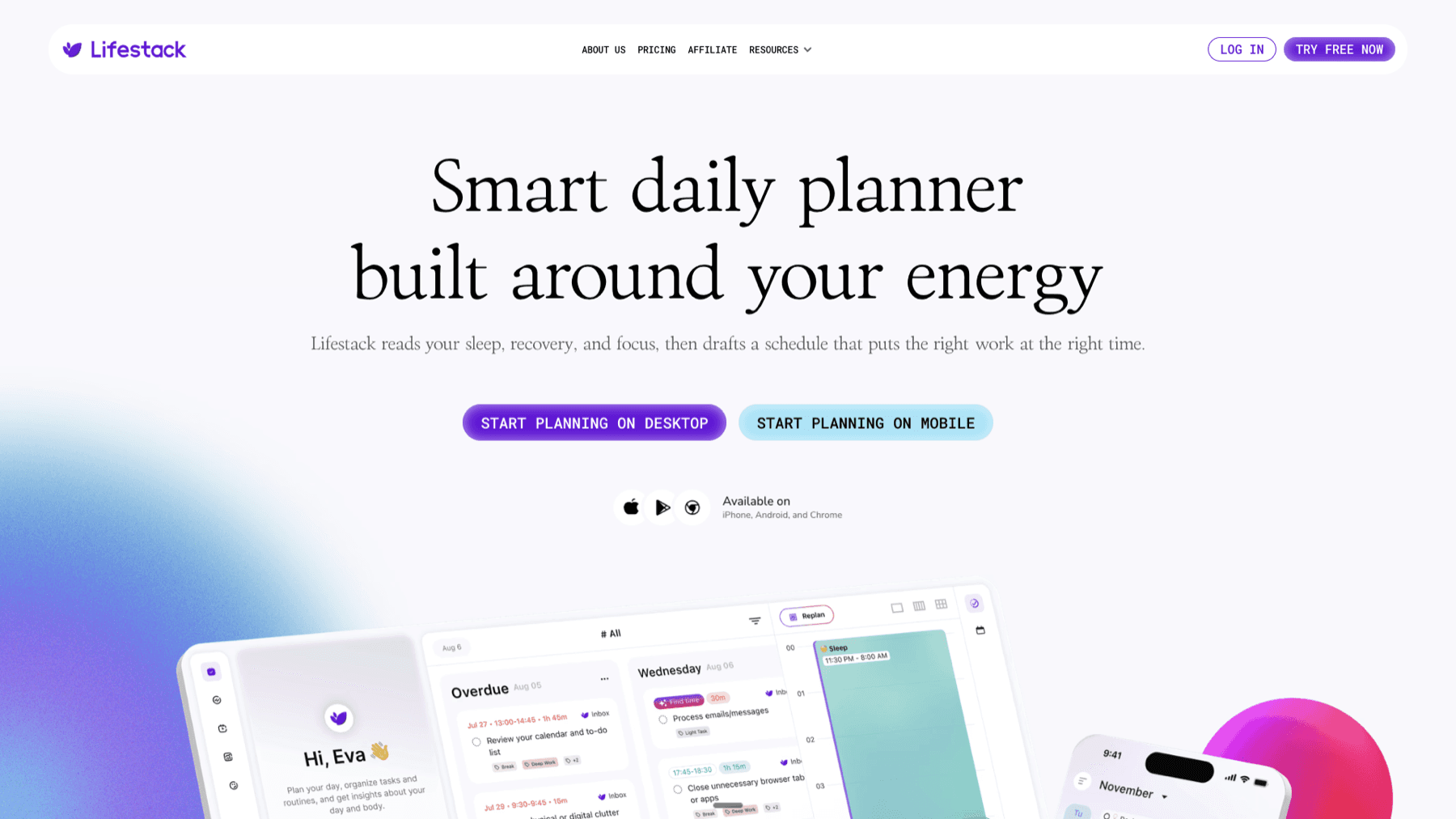
Lifestack reads your energy data from a wearable device (Apple Watch, Oura, Garmin, or WHOOP) and auto-schedules your tasks around your real cognitive peaks. For ADHD users, this removes one of the most executive-function-expensive decisions of the day: when to do what. The schedule is built for you, based on your actual biological state, so you can direct your energy to the work itself rather than to the meta-task of self-scheduling.
Lifestack is particularly effective for ADHD because it works with the brain's actual patterns rather than imposing a rigid time structure that ignores how variable ADHD energy states are. Read more about why energy-based planning outperforms generic time-blocking for variable-energy brains. Pricing: $7/month, $50/year (7-day free trial), or $120 as a one-time lifetime purchase.
Frequently Asked Questions
What are the gifts of ADHD?
The most consistently documented gifts of ADHD include hyperfocus (deep absorption in compelling work), divergent and creative thinking, high energy and enthusiasm when engaged, resilience and adaptability from navigating a neurotypical world, emotional depth and empathy, entrepreneurial drive and risk tolerance, and rapid pattern recognition and novel association.
Are the gifts of ADHD real or just compensation narratives?
They are real, though not universal. Research on divergent thinking, entrepreneurship rates, and creative output consistently finds higher representation of ADHD traits among individuals in fields that reward novelty and rapid association. Hyperfocus is documented clinically. Resilience and adaptability are logical consequences of navigating a world built for different neurology. These are not invented positives. They are real traits that show up in the right contexts.
Does everyone with ADHD have these gifts?
No. ADHD presents very differently across individuals. Some people experience significant strengths alongside significant challenges. Others are primarily affected by the impairments without clear compensatory gifts. The profile depends on many factors including severity, co-occurring conditions, environmental support, and the type of work and relationships the person is engaged in.
How can I access ADHD strengths more reliably?
The most important factors are environmental. ADHD strengths are most accessible when tasks are genuinely interesting, sleep is adequate, stimulation level is appropriate (not too low, not too high), and scheduling matches tasks to actual energy peaks. Creating conditions where hyperfocus can engage, reducing executive function drain through external structure, and deliberately choosing work environments that reward ADHD traits all make a significant difference.
Can ADHD be an advantage in some careers?
Yes, in specific domains. Entrepreneurship, emergency medicine, creative fields, performance, athletic coaching, design, comedy, and research have all been identified as fields where ADHD traits appear to provide advantage. The common thread is that these fields reward novelty, rapid response, pattern recognition, and intensive work bursts rather than sustained procedural attention. Match matters more than the diagnosis itself.
The conversation around ADHD tends to center on deficits: what is harder, what requires more effort, what the brain struggles with relative to neurotypical standards. That framing captures real challenges. It also leaves out half the picture. Many of the same neurological patterns that create difficulty in structured, conventional environments are the source of genuine strengths in other contexts.
Researchers, therapists, and adults with ADHD have documented a consistent set of traits that appear alongside the diagnosis. These are not consolation prizes. They are characteristics that, when channeled into the right work, environment, or relationship, produce outcomes that neurotypical patterns rarely replicate. This is sometimes called the upside of ADHD, and it is worth understanding on its own terms.
The seven strengths below are based on clinical research, first-person accounts, and the patterns that appear consistently in high-functioning ADHD adults across many fields.
Key Takeaways
The gifts of ADHD are not myths. Hyperfocus, creative thinking, high energy, resilience, and pattern recognition are traits that appear reliably in the research and in lived experience, even when they are hard to see through the lens of conventional productivity metrics.
These strengths are state-dependent and environment-dependent. An ADHD brain that is under-stimulated, sleep-deprived, or working in an environment that demands constant task-switching will not access them reliably. The same brain, in the right conditions, can outperform neurotypical peers significantly.
The most practical implication of understanding ADHD strengths is knowing how to create the conditions where they activate, and how to protect those conditions within the structure of a real day.
1. Hyperfocus
Hyperfocus is what happens when an ADHD brain locks onto something it finds genuinely compelling. In that state, time disappears, distractions fail to land, and output quality can be extraordinary. Hyperfocus is not just sustained attention. It is complete absorption, often for hours, producing work that would be difficult or impossible to replicate at normal levels of engagement.
The challenge is that hyperfocus is not fully voluntary. It activates in response to novelty, urgency, genuine interest, or competitive pressure. It does not activate reliably on demand for tasks that are important but boring. This is why ADHD task management requires building systems that work with this pattern rather than against it: creating interest and urgency where they would not otherwise exist, and scheduling high-interest work during windows when hyperfocus is most likely to engage.
People who have worked with hyperfocus deliberately often describe it as their greatest professional asset. Entrepreneurs, artists, scientists, and developers with ADHD frequently cite hyperfocus as what lets them go deeper on a problem than their peers. The limitation is not the state. It is the lack of reliable access to it on schedule.
2. Creative and Divergent Thinking
ADHD brains tend to make associations between ideas that are further apart than neurotypical thinking typically connects. This is partly structural: the default mode network, which generates spontaneous thought and creative association, is more active and less easily suppressed in ADHD. The same mechanism that produces mind-wandering in a meeting also produces the unexpected connection that solves a problem no one else noticed.
Research on creativity and ADHD has found consistently higher scores on divergent thinking tasks in people with ADHD compared to control groups. Divergent thinking is the ability to generate many possible solutions or interpretations from a single prompt. It is the cognitive engine behind creative work, innovation, and novel problem-solving.
This strength is most visible in fields that reward originality rather than precision: entrepreneurship, design, writing, comedy, research, strategy. In fields that reward consistency and procedural accuracy, the same pattern creates more friction than value. Environment match matters.
3. High Energy and Enthusiasm When Engaged
When an ADHD brain is interested and engaged, the energy output is exceptional. The same neurological system that produces listlessness and procrastination when under-stimulated generates intense drive when the conditions click. People with ADHD often describe the experience as zero to one hundred: complete flatness one moment, complete absorption and energy the next.
This makes ADHD particularly well-suited to work that comes in intensive sprints rather than steady, moderate output across a long period. Launch phases, creative projects, problem-solving sessions, and competitive scenarios all align well with the ADHD energy pattern. Long stretches of routine maintenance work are where the pattern creates the most friction.
The practical implication is that ADHD individuals often do their best work in short, intense bursts. Protecting those windows and removing barriers to entry (reducing ADHD inertia, providing clear starting points, building urgency cues) unlocks a level of performance that slower, steadier work structures rarely achieve.
4. Resilience and Adaptability
Growing up with ADHD in a system designed for neurotypical brains produces a specific kind of resilience. Most adults with ADHD have encountered repeated failure, criticism, and the experience of trying hard and still falling short by conventional metrics. The ones who reach adulthood with their self-concept intact have developed real adaptability: they have learned to find workarounds, to ask for help, to reframe failure, and to identify environments where they can actually succeed.
This is not a silver lining assigned retroactively to suffering. It is a genuine competency that comes from navigating a world that was not built for your brain. Adults with ADHD frequently demonstrate unusually high tolerance for uncertainty, quick recovery from setbacks, and comfort with improvisation. Those are not small traits in a world that changes fast.
Waiting mode and task avoidance are real ADHD challenges. So is the experience of systems that fail and needing to find a different path. The capacity for a different path, once built, is a durable asset.
5. Emotional Depth and Empathy
ADHD involves emotional dysregulation, which typically manifests as intense emotional responses that come quickly and are difficult to moderate. The same mechanism that makes frustration feel overwhelming can make joy, enthusiasm, and connection feel equally intense. Many people with ADHD describe experiencing emotions more fully than most people around them.
This often translates into genuine empathy. People with ADHD frequently report a strong ability to read emotional states in others and a deep investment in the wellbeing of people they care about. This can also be connected to the overlap between ADHD and autism, where emotional sensitivity and strong moral commitment appear alongside the formal diagnostic criteria.
In roles that require human connection, care, motivation of others, or sensitivity to group dynamics, emotional intensity is an asset rather than a liability. The challenge is developing the regulation skills to prevent the same intensity from becoming overwhelming in high-stakes or conflictual situations.
6. Entrepreneurial Drive and Risk Tolerance
ADHD is overrepresented among entrepreneurs. Studies have consistently found higher rates of ADHD diagnosis (and ADHD traits in those not formally diagnosed) among business founders compared to the general population. The likely reasons are several: higher tolerance for uncertainty, comfort with rapid iteration, the ability to sustain hyperfocus through early-stage problem-solving, and a drive toward autonomy that conventional employment structures frustrate.
Entrepreneurship is also a context that naturally accommodates ADHD patterns. The work is varied, the feedback loops are fast, there is no single manager imposing a rigid structure, and results matter more than process compliance. The same person who struggles in a corporate environment may thrive when building something where their energy and creativity define the pace.
The VAST framework (Variable Attention Stimulus Trait), developed by Edward Hallowell and John Ratey, frames ADHD traits as adaptations suited to exploration, rapid response, and opportunity-sensing. Those are precisely the traits that early-stage entrepreneurship rewards.
7. Spontaneity and Pattern Recognition
ADHD brains process the environment differently: they notice more, filter less, and respond to novel stimuli more strongly than neurotypical brains. This can make sustained attention in predictable settings difficult. It also makes ADHD individuals unusually good at noticing things that others miss, making rapid connections across seemingly unrelated domains, and identifying patterns in noisy or complex data.
Many people with ADHD describe an ability to walk into a room and immediately read the social dynamics, spot an anomaly in a system, or notice the detail that everyone else overlooked. This is not random. It reflects a perceptual system that has not fully habituated to its environment, which means it keeps registering what others have stopped seeing.
In fields that reward pattern recognition and rapid synthesis, including trading, design, emergency medicine, intelligence analysis, and comedy, ADHD traits appear repeatedly. These are not incidental. Visual thinking and rapid association are skills, not accidents.
Best Tool for Working With ADHD Strengths
The gifts of ADHD are not always accessible. They require the right conditions: genuine interest, adequate sleep, the right level of stimulation, and critically, tasks scheduled during the windows when the ADHD brain is actually capable of activating them. Forcing deep creative or analytical work during a low-energy or over-stimulated window produces little output. The same work during a genuine peak window can produce exceptional results.
Lifestack reads your energy data from a wearable device (Apple Watch, Oura, Garmin, or WHOOP) and auto-schedules your tasks around your real cognitive peaks. For ADHD users, this removes one of the most executive-function-expensive decisions of the day: when to do what. The schedule is built for you, based on your actual biological state, so you can direct your energy to the work itself rather than to the meta-task of self-scheduling.
Lifestack is particularly effective for ADHD because it works with the brain's actual patterns rather than imposing a rigid time structure that ignores how variable ADHD energy states are. Read more about why energy-based planning outperforms generic time-blocking for variable-energy brains. Pricing: $7/month, $50/year (7-day free trial), or $120 as a one-time lifetime purchase.
Frequently Asked Questions
What are the gifts of ADHD?
The most consistently documented gifts of ADHD include hyperfocus (deep absorption in compelling work), divergent and creative thinking, high energy and enthusiasm when engaged, resilience and adaptability from navigating a neurotypical world, emotional depth and empathy, entrepreneurial drive and risk tolerance, and rapid pattern recognition and novel association.
Are the gifts of ADHD real or just compensation narratives?
They are real, though not universal. Research on divergent thinking, entrepreneurship rates, and creative output consistently finds higher representation of ADHD traits among individuals in fields that reward novelty and rapid association. Hyperfocus is documented clinically. Resilience and adaptability are logical consequences of navigating a world built for different neurology. These are not invented positives. They are real traits that show up in the right contexts.
Does everyone with ADHD have these gifts?
No. ADHD presents very differently across individuals. Some people experience significant strengths alongside significant challenges. Others are primarily affected by the impairments without clear compensatory gifts. The profile depends on many factors including severity, co-occurring conditions, environmental support, and the type of work and relationships the person is engaged in.
How can I access ADHD strengths more reliably?
The most important factors are environmental. ADHD strengths are most accessible when tasks are genuinely interesting, sleep is adequate, stimulation level is appropriate (not too low, not too high), and scheduling matches tasks to actual energy peaks. Creating conditions where hyperfocus can engage, reducing executive function drain through external structure, and deliberately choosing work environments that reward ADHD traits all make a significant difference.
Can ADHD be an advantage in some careers?
Yes, in specific domains. Entrepreneurship, emergency medicine, creative fields, performance, athletic coaching, design, comedy, and research have all been identified as fields where ADHD traits appear to provide advantage. The common thread is that these fields reward novelty, rapid response, pattern recognition, and intensive work bursts rather than sustained procedural attention. Match matters more than the diagnosis itself.



FOLLOW ON
FOLLOW ON
FOLLOW ON


Copyright 2026 © Lifestack. All rights reserved
Copyright 2026 © Lifestack. All rights reserved

